
How Do Air Conditioners Work in 2026? The Science Behind Staying Cool
Imagine returning home on a hot summer afternoon. Outside, the pavement radiates heat, the air feels heavy, and sunlight has warmed every room. You press a button on the air-conditioner remote. A quiet machine starts humming, cool air begins circulating, and the room gradually becomes comfortable.
It might seem as though the machine creates coldness from nothing. However, an air conditioner does something more interesting: it removes heat from one place and transfers it somewhere else.
This principle explains how everything from small bedroom units to large central cooling systems works. A circulating substance called refrigerant absorbs indoor heat, carries it through a sealed circuit and releases it outdoors. A compressor, two heat exchangers, an expansion device and fans make this process possible.
Modern air conditioning involves much more than temperature control. In 2026, variable-speed compressors, electronic sensors, improved refrigerants and smart controls are helping systems deliver comfortable indoor environments while managing electricity consumption.
Key Takeaways
- Air conditioners transfer heat rather than manufacture coldness.
- The refrigeration cycle involves evaporation, compression, condensation and expansion.
- The evaporator absorbs indoor heat, while the condenser releases it outdoors.
- Refrigerant transports thermal energy through a sealed circuit.
- Air conditioners can remove moisture through condensation.
- Inverter technology adjusts compressor speed to changing cooling demand.
- Correct sizing improves comfort and efficiency.
- Clean filters and coils support proper airflow and heat transfer.
- Refrigerant selection affects environmental impact.
- Ventilation and filtration remain important for indoor air quality.


1. What Does an Air Conditioner Actually Do?
An air conditioner removes thermal energy from indoor spaces. When a room becomes cooler, it is because heat has been transferred away from its air, furniture, walls and other surfaces.
Think of a room as a container filled with unwanted heat. The air conditioner acts like a transportation system, collecting that energy and releasing it outside.
Electricity powers the compressor, fans and electronic controls that make this transfer possible. Without an outdoor heat-rejection process, the room could not remain cool indefinitely.
2. The Science of Heat Transfer
Heat naturally moves from warmer objects toward cooler surroundings. This is why hot tea gradually cools and an ice cube melts in a warm drink.
Air conditioners use mechanical energy to move heat from indoors to outdoors. Three mechanisms explain heat transfer: conduction, convection and radiation.
Conduction transfers energy through direct contact, convection involves moving fluids such as air, and radiation transfers energy through electromagnetic waves. Inside an air conditioner, conduction and convection are especially important as indoor air passes over cold metal coils.
3. What Is Refrigerant?
Refrigerant is the working fluid that transports heat through an air-conditioning system. It is selected because its pressure and temperature characteristics allow it to evaporate and condense under controlled conditions.
Imagine a delivery vehicle collecting packages in one neighbourhood and transporting them elsewhere. Refrigerant performs a similar job, except its cargo is thermal energy.
Common refrigerants include R-410A and R-32, although newer equipment increasingly uses alternatives with lower global warming potential. The correct refrigerant depends on equipment design, safety requirements and applicable regulations.
Refrigerant normally circulates inside sealed pipes and is not consumed during ordinary operation. Repeated refrigerant loss usually indicates a leak or another fault.
4. Understanding the Four Main Stages
The vapour-compression refrigeration cycle has four main stages: evaporation, compression, condensation and expansion.
First, refrigerant absorbs indoor heat while evaporating. Second, the compressor raises its pressure and temperature. Third, it releases heat outdoors and condenses into liquid. Finally, an expansion device reduces its pressure before it returns to the evaporator.
This continuous cycle resembles a delivery route. The refrigerant collects heat, transports it, releases it and returns to collect more.
5. The Evaporator: Where Indoor Heat Is Collected
The evaporator is the heat exchanger responsible for absorbing energy from indoor air. In a wall-mounted split system, it is located inside the indoor unit.
A fan draws room air through a filter and across the evaporator coil. The refrigerant inside absorbs heat and evaporates, allowing the air to leave the unit at a lower temperature.
The coil consists of metal tubing and thin fins that increase its surface area. This design improves heat transfer.
Dust accumulation can restrict airflow and reduce performance. This is why keeping the filter clean is important.
6. The Compressor: The Heart of the System
After absorbing heat, refrigerant leaves the evaporator as a relatively low-pressure vapour and enters the compressor.
The compressor raises its pressure and temperature, preparing it to release heat in the outdoor condenser.
A bicycle pump provides a simple analogy: compressing air inside the pump makes it warmer. An air-conditioning compressor performs a specialised version of this process using refrigerant.
Compressors consume electricity and strongly influence cooling capacity, noise and efficiency. Unusual sounds, repeated electrical trips or poor cooling may indicate a mechanical problem requiring professional inspection.
7. The Condenser: Releasing Heat Outdoors
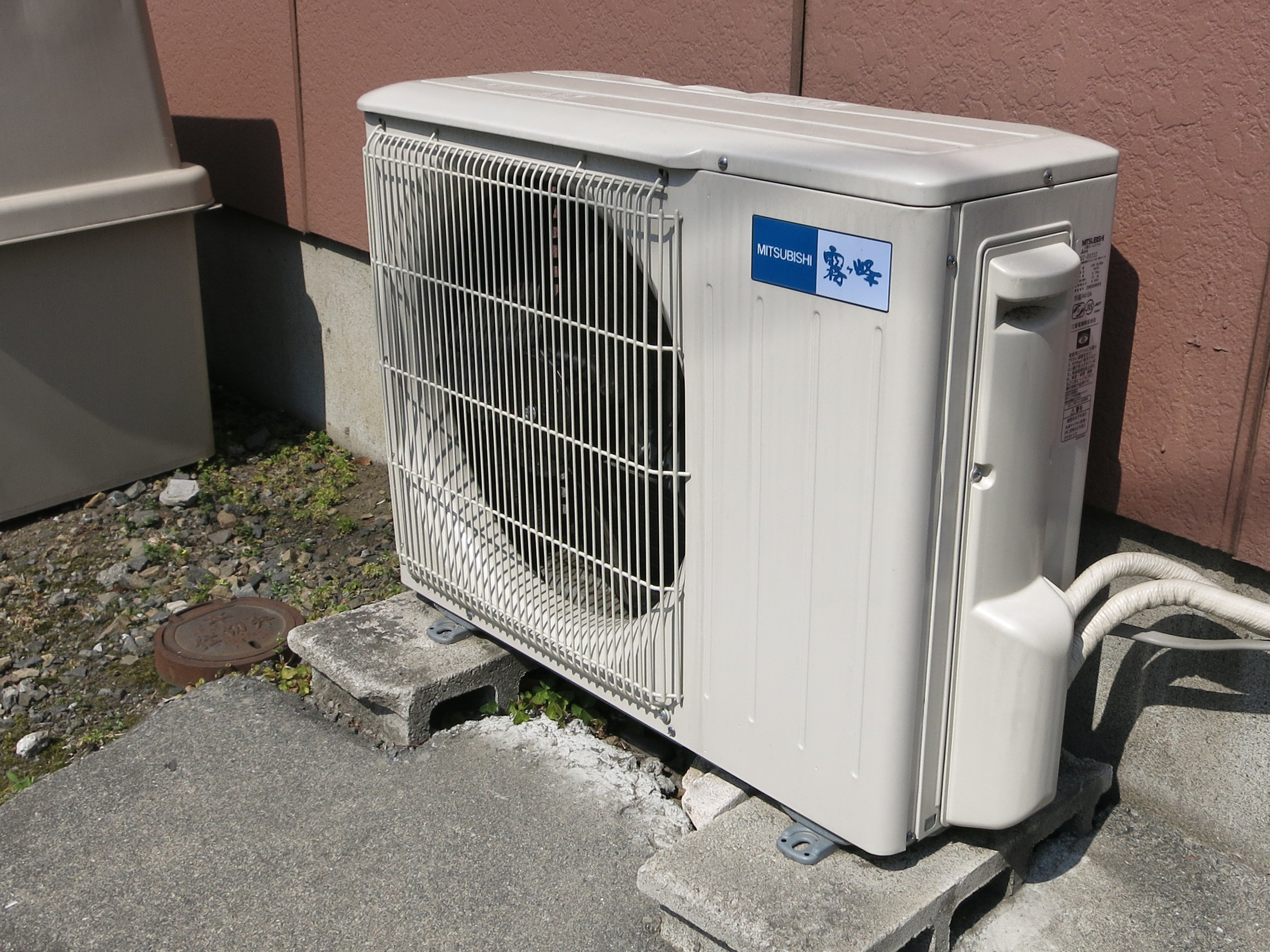
The condenser is the heat exchanger that releases collected indoor heat into the outdoor environment. In a split system, it is located inside the outdoor unit.
Outdoor air passes across its metal coils. Heat travels from the hot refrigerant into the surrounding air, causing the refrigerant to condense into liquid.
This explains why an outdoor unit blows warm or hot air. It is releasing heat removed from indoors, together with energy associated with operating the equipment.
Leaves, dirt and blocked airflow can reduce heat rejection, forcing the system to work harder.

8. The Expansion Valve: Preparing Refrigerant for Another Cycle
Before returning to the evaporator, refrigerant passes through an expansion device. Depending on the equipment, this may be a thermostatic or electronic expansion valve.
The device regulates refrigerant flow and reduces its pressure. This lowers its saturation temperature, allowing it to absorb heat from indoor air during the next cycle.
Proper refrigerant metering is essential. Incorrect flow can reduce cooling performance and affect the system's efficiency.
9. Why Refrigerant Changes Between Liquid and Gas
Substances can exist as solids, liquids or gases depending on their temperature and pressure. Water provides a familiar example: when it evaporates, it absorbs energy from its surroundings.
Refrigerants are selected because they undergo useful phase changes at temperatures and pressures suitable for air conditioning.
During evaporation, refrigerant absorbs substantial heat. During condensation, it releases that energy. These changes allow a relatively small quantity of circulating fluid to transport considerable thermal energy.
10. Why Air Conditioners Remove Humidity
Comfort depends on humidity as well as temperature. Humid air can feel uncomfortable even when the thermometer shows a moderate temperature.
When indoor air passes over an evaporator coil colder than its dew point, water vapour condenses into droplets. The droplets collect in a drain pan and leave through a drainage pipe.
This resembles water forming on the outside of a cold glass on a humid afternoon.
Humidity removal depends on coil temperature, airflow, operating time and equipment sizing. An oversized unit may cool a room quickly but stop before removing sufficient moisture.
11. Why Water Drips From an Air Conditioner
Water dripping from a correctly functioning condensate drain is normally a result of dehumidification.
Moisture collected from indoor air flows into a drainage tray and then through a pipe, usually toward an outdoor discharge point or suitable drainage system.
However, a blocked drain, damaged tray or incorrect installation can cause water to leak indoors. Persistent leakage should be inspected to prevent damage to walls, ceilings and electrical components.
12. How the Thermostat Controls Cooling
The thermostat measures indoor temperature and compares it with the target selected by the user.
When the room becomes warmer than the target, it sends a cooling demand to the air conditioner. When the desired temperature is reached, the system reduces or stops cooling.
Conventional systems often switch their compressors on and off. Variable-speed systems can adjust their output more gradually.
Modern controls may also consider humidity, occupancy, schedules and additional sensor measurements. The thermostat coordinates cooling; it does not produce coldness itself.
13. Split Systems, Window Units and Portable Air Conditioners
Air conditioners come in different configurations, but most use the same basic refrigeration principle.
Split-system air conditioners
These systems separate the indoor air-handling unit from the outdoor compressor and condenser. Refrigerant pipes connect both sections.
Window air conditioners
A window unit combines the main cooling components in one housing, with one section facing indoors and the other outdoors.
Portable air conditioners
Portable models sit inside the room and usually release hot exhaust air through a flexible hose. Single-hose and dual-hose designs have different performance characteristics.
Central air conditioning
Central systems cool air in an indoor unit and distribute it through ducts to multiple rooms or an entire building.
The appropriate design depends on building layout, climate, budget and cooling requirements.
14. What Is Inverter Technology?
Traditional air conditioners commonly use compressors that operate at a relatively fixed speed. They switch on when cooling is required and stop when the target is reached.
Inverter technology allows compressor speed to vary with cooling demand. Instead of always operating at full capacity, the equipment can maintain a more suitable output.
Think of driving through changing traffic. Adjusting speed smoothly is generally more efficient than constantly accelerating and braking.
Variable-speed operation can improve temperature stability, reduce cycling and save electricity under suitable conditions. Actual savings depend on equipment quality, installation and climate.
15. How Air Conditioners Use Electricity
Electricity powers the compressor, fans and electronic controls. The compressor usually accounts for a substantial share of the system's energy consumption.
Electricity does not directly become cold air. Instead, it operates a machine that transfers thermal energy from indoors to outdoors.
This explains why an air conditioner can move more heat than the electrical energy it consumes. Its performance is commonly described using the coefficient of performance, or COP.
A cooling system with a COP of 4 transfers four units of heat for each unit of electrical energy supplied under the specified test conditions.
16. Understanding BTUs, SEER2 and Energy Ratings
Air-conditioning specifications describe different aspects of equipment performance.
BTU per hour
Cooling capacity is commonly measured in British thermal units per hour. It indicates how much heat a unit can remove over time.
SEER2
Seasonal Energy Efficiency Ratio 2 measures seasonal cooling efficiency under a defined testing procedure. Higher values generally indicate greater efficiency.
EER2
Energy Efficiency Ratio 2 measures cooling efficiency under specified operating conditions.
COP
The coefficient of performance compares useful cooling output with electrical energy input.
When comparing products, check the appropriate rating for the equipment category and market. Actual performance also depends on operating conditions.
17. Why Correct Sizing Matters
Buying the largest air conditioner available is not necessarily the best decision.
An undersized unit may run continuously without adequately cooling a space. An oversized unit may cool the air quickly but switch off before removing enough humidity.
Correct sizing considers floor area, ceiling height, insulation, windows, sunlight, building orientation, occupancy and local climate.
Professional load calculations, such as the residential Manual J method used in the United States, provide a more reliable estimate than floor area alone.
18. Filters, Airflow and Indoor Air Quality
Filters catch airborne particles before they accumulate on internal components. Depending on their design, they can capture dust, lint and other particles.
A clogged filter restricts airflow, reduces heat transfer and can contribute to evaporator icing. Filters should be inspected and cleaned or replaced according to manufacturer instructions.
Air conditioning and ventilation are not the same thing. Many residential split systems mainly recirculate indoor air instead of continuously bringing fresh outdoor air inside.
Good indoor air quality therefore also requires appropriate ventilation, source control and suitable filtration.
19. Refrigerants, Climate Change and Environmental Responsibility
Some refrigerants have high global warming potential. If released into the atmosphere, they can contribute to climate change. Older ozone-depleting substances have also damaged the protective stratospheric ozone layer.
International agreements and national regulations encourage the transition toward less harmful refrigerants. The Kigali Amendment to the Montreal Protocol addresses the phasedown of hydrofluorocarbons.
Alternatives include R-32 and other lower-global-warming-potential refrigerants. Some alternatives have special flammability or handling requirements, making correct equipment design and installation essential.
In the United States, EPA regulations under the American Innovation and Manufacturing Act address HFC phasedown and refrigerant management.
Leak prevention, responsible servicing, refrigerant recovery and proper disposal help reduce environmental impact.
20. The Future of Air Conditioning in 2026 and Beyond
Air conditioning technology continues to develop as buildings face changing temperatures and increasing cooling requirements.
Smarter temperature control
Connected thermostats can adjust schedules, provide energy information and allow remote control. Some systems also use occupancy and environmental sensors.
More efficient compressors
Variable-speed motors, improved compressors and electronic expansion controls help equipment respond more accurately to cooling demand.
Lower-impact refrigerants
Manufacturers are developing systems using refrigerants with lower environmental impact while addressing safety and performance requirements.
Heat pumps and reversible operation
Many air conditioners can also operate as heat pumps. Reversing the refrigeration cycle allows them to transfer heat indoors during cold weather.
Better building design
Insulation, external shading, reflective roofs and efficient windows reduce the heat entering buildings and therefore reduce cooling demand.
The future of cooling will depend on the relationship between equipment, buildings, refrigerants, electricity systems and environmental responsibility.
Practical Guide: Getting the Best Performance From an Air Conditioner
1. Choose the Correct Capacity
Consider room dimensions, ceiling height, insulation, windows and sunlight. Manufacturer sizing guidance is useful, but complex installations benefit from professional cooling-load calculations.
2. Keep Filters Clean
Inspect filters regularly, especially during heavy use. Clean reusable filters or replace disposable ones according to the manufacturer's instructions.
3. Maintain the Outdoor Unit
Remove leaves and debris around the condenser. Keep sufficient clearance for airflow and follow the manufacturer's cleaning recommendations.
4. Use Sensible Temperature Settings
Choose a comfortable setting without unnecessary cooling. The U.S. Department of Energy commonly recommends approximately 78°F (26°C) when people are at home and comfortable with that temperature.
5. Reduce Heat Entering the Building
Close blinds during strong sunlight, improve insulation and seal unwanted air leaks. These measures reduce cooling demand.
6. Pay Attention to Unusual Symptoms
Weak airflow, persistent leakage, unusual noises, repeated shutdowns and ice on the indoor coil may indicate a fault. Arrange professional inspection when necessary.
7. Schedule Professional Maintenance
A qualified technician can inspect coils, electrical connections, refrigerant performance, drainage and fans. Refrigerant handling should follow applicable safety requirements and regulations.
Known vs. Uncertain: What Science Tells Us
What Is Well Established?
- Vapour-compression air conditioners transfer heat using circulating refrigerant.
- Evaporation absorbs heat, while condensation releases it.
- Compressors increase refrigerant pressure and require electricity.
- Cold evaporator coils can remove moisture from indoor air.
- Equipment sizing, airflow and maintenance influence performance.
- Refrigerant emissions can have environmental consequences.
- Variable-speed technology can improve efficiency under suitable conditions.
What Depends on Conditions?
- Inverter energy savings depend on climate, equipment and operating habits.
- Ideal indoor temperatures vary with humidity, activity and personal preference.
- Refrigerant suitability depends on safety, design and environmental requirements.
- Cooling capacity cannot always be determined from floor area alone.
- Actual efficiency may differ from laboratory ratings.
What Is Still Developing?
Research continues into alternative refrigerants, improved heat exchangers, thermal energy storage, smart-grid integration and more efficient cooling technologies. The challenge is to provide reliable comfort while reducing energy consumption and environmental impact.
Frequently Asked Questions
1. How does an air conditioner work in simple terms?
It removes heat from indoor air and releases it outdoors using a circulating refrigerant.
2. Does an air conditioner create cold air?
Not exactly. It cools indoor air by transferring its heat to refrigerant and moving that energy outside.
3. Why does an air conditioner need an outdoor unit?
The outdoor section releases heat collected indoors. It generally contains the compressor, condenser coil and fan in a split system.
4. What is the purpose of refrigerant?
Refrigerant transports heat through the system, changing between liquid and vapour as pressure and temperature change.
5. Why does the outdoor unit blow hot air?
It releases heat removed from inside the building, together with energy associated with operating the equipment.
6. Why does my air conditioner produce water?
Moisture condenses on the cold evaporator coil and normally leaves through a condensate drain.
7. Does an air conditioner reduce humidity?
Yes. Water vapour condenses on a sufficiently cold evaporator coil and is removed from indoor air.
8. What happens if an air conditioner loses refrigerant?
Cooling performance may decline. A technician should locate and repair the leak rather than simply adding refrigerant.
9. What is the difference between an evaporator and a condenser?
The evaporator absorbs indoor heat, while the condenser releases heat outdoors during cooling operation.
10. What does an air-conditioning compressor do?
It increases refrigerant pressure, allowing the refrigerant to release heat in the condenser.
11. What is inverter air conditioning?
It uses variable-speed compressor control to adjust cooling output instead of relying entirely on repeated full-speed operation and shutdown.
12. Is inverter air conditioning more energy efficient?
It can be, especially when cooling demand changes. Actual efficiency depends on installation, climate and equipment quality.
13. What does BTU mean in air conditioning?
BTU means British thermal unit. BTU per hour is a common measurement of cooling capacity.
14. What does SEER2 measure?
SEER2 measures seasonal cooling efficiency under defined testing conditions. Higher ratings generally indicate better efficiency.
15. Why is my air conditioner running but not cooling?
Possible causes include dirty filters, restricted airflow, blocked coils, refrigerant leaks or mechanical faults. Professional diagnosis may be necessary.
16. How often should I clean my air-conditioner filter?
Inspect it regularly and follow the manufacturer's schedule. Dust, pets and operating hours affect cleaning frequency.
17. Can an air conditioner work when it is extremely hot outside?
Most systems operate within specified outdoor temperature limits, although cooling capacity and efficiency may decline in extreme heat.
18. Can an air conditioner heat a room?
Some systems can. Reversible heat pumps transfer outdoor heat indoors during heating operation.
19. Does an air conditioner bring fresh air into a room?
Many residential split systems mainly recirculate indoor air. Separate ventilation may be needed to provide fresh outdoor air.
20. What is the most important factor in choosing an air conditioner?
Choose a properly sized, efficient system suited to the building and climate. Installation quality and maintenance also matter.
Conclusion: The Science Behind Everyday Comfort
An air conditioner may look like an ordinary household appliance, but its operation combines thermodynamics, fluid mechanics, heat transfer and electrical engineering.
Its central task is straightforward: collect unwanted heat indoors, transport it through a refrigerant circuit and release it outdoors. The compressor provides the mechanical work, while the evaporator, condenser and expansion device maintain the repeating cycle.
This explains familiar observations. Warm air leaving the outdoor unit is heat being rejected. Water leaving the drainage pipe is moisture removed from indoor air. Dirty filters restrict airflow, while incorrectly sized equipment can struggle with humidity control.
In 2026, improvements in inverter compressors, electronic controls, heat exchangers and refrigerants are helping make cooling more efficient and environmentally responsible. Nevertheless, even advanced equipment depends on correct sizing, professional installation and regular maintenance.
As buildings become increasingly dependent on mechanical cooling, understanding how air conditioners work is a practical step toward making better decisions about comfort, electricity consumption and environmental responsibility.
Sources and Further Reading
- U.S. Department of Energy — Air Conditioning. Cooling fundamentals and energy guidance.
- U.S. Department of Energy — Home Cooling Systems. Residential cooling technologies.
- U.S. Department of Energy — Residential Central Air Conditioners. Efficiency and purchasing guidance.
- U.S. Department of Energy — Room Air Conditioners. Equipment selection and efficiency.
- ENERGY STAR — Room Air Conditioners. Sizing, efficiency and operating advice.
- ENERGY STAR — Air Conditioning. Energy-efficient cooling information.
- ENERGY STAR — Room AC Product Criteria. Technical efficiency requirements.
- ASHRAE — Technical FAQs. Building environmental and HVAC engineering information.
- ASHRAE — Standards and Guidelines. Thermal comfort and HVAC standards.
- U.S. Environmental Protection Agency — HFC Phasedown FAQs. Refrigerant transition and regulations.
- U.S. Environmental Protection Agency — Safe Disposal Requirements. Refrigerant recovery and disposal.
- U.S. Environmental Protection Agency — Refrigerant Venting. Environmental protection requirements.
- Bonneville Power Administration — HVAC Technology Guide. Vapour-compression cycle explanation.
- Carrier — Residential Air Conditioners. Equipment and technology.
- Daikin — Air Conditioning and Refrigeration Technology. Cooling equipment and HVAC technology.
The conversation
Post a Comment