
At 8:15 on a Monday morning, an intersection can look like a small experiment in controlled chaos. Cars arrive from four directions. A bus stops near the crossing. A cyclist waits behind a white line, while pedestrians gather on the pavement. Somewhere in the distance, an ambulance approaches.
Then something remarkable happens.
One direction receives a green light. Cars begin moving. A few seconds later, the light changes to yellow, then red. Another direction receives permission to move. Pedestrians get their turn. The ambulance approaches, and the entire sequence may change to give it a safer passage.
Nobody at the intersection is giving instructions with a microphone. There is no traffic police officer manually directing every vehicle. Yet dozens of road users are being organized through a system that appears to consist of only three colored lights.
So how does it actually work?
A modern traffic light is much more than an electrically operated lamp. It is the visible part of a transportation control system involving sensors, computers, communication networks, mathematical models, safety rules and, increasingly, artificial intelligence.
Some intersections follow carefully programmed schedules. Others detect approaching vehicles and adjust their green periods. More advanced systems communicate with neighboring intersections, monitor traffic conditions and change their timing to respond to congestion.
In 2026, traffic signals are also becoming part of a broader connected transportation network. They can interact with public transport, emergency vehicles, pedestrian detection systems and connected vehicles.
Understanding these systems reveals something interesting: a traffic light does not simply tell drivers when to stop and start. It manages competing movements, distributes limited road space and attempts to make an entire intersection work safely.
This guide explores the hidden technology behind traffic lights, from the basic controller inside a roadside cabinet to the intelligent systems helping cities manage increasingly complicated roads.
Key Takeaways
- Traffic lights operate through electronic controllers that manage different movements using programmed safety rules.
- Red, yellow and green represent different stages of permission and warning, not simply three interchangeable colors.
- Some intersections use fixed schedules, while others detect vehicles and adjust green time automatically.
- Inductive loops, cameras, radar and other sensors help traffic controllers understand road conditions.
- Yellow lights provide a transition period that allows drivers to make safe stopping or clearing decisions.
- Pedestrian signals are integrated into intersection timing to protect people crossing the road.
- Coordinated signals use timing relationships called cycle length, split and offset to improve traffic flow.
- Emergency vehicles can request traffic signal preemption, allowing the normal sequence to change.
- Artificial intelligence and connected technologies can help analyze traffic, but they do not eliminate the need for engineering and safety rules.
- A well-designed traffic signal must balance mobility, safety, accessibility and the needs of different road users.
1. What Is a Traffic Light, Really?
A traffic light is an electrical signaling device that controls the movement of vehicles, pedestrians and sometimes bicycles at road intersections.
Its purpose is to prevent conflicting movements from happening simultaneously.
Imagine a busy intersection as a small room with four doors. If everyone tries to enter and leave through every door at once, people collide. The solution is to organize access, allowing one group to move while the others wait.
Traffic lights perform a similar job on roads.
They divide traffic into groups called movements or phases. A phase provides permission for a particular movement, such as vehicles traveling northbound or pedestrians crossing an east-west road.
The signal head that drivers see is only the display. Behind it is a controller that decides which indication should appear and when.
A typical installation may contain:
- Signal heads facing approaching traffic.
- Pedestrian signal displays.
- Vehicle and pedestrian detectors.
- A traffic signal controller.
- Electrical power and backup equipment.
- Communication connections to other signals or a traffic management center.
- A roadside cabinet containing control electronics.
These components work together to make the intersection behave like an organized system rather than a collection of independent traffic lights.
The distinction matters because replacing a bulb does not necessarily repair a traffic signal problem. The underlying issue might involve a detector, controller setting, electrical connection or communication failure.
2. Why Are Traffic Lights Red, Yellow and Green?
The three familiar colors provide a simple visual language that can be understood quickly, even when drivers are moving at considerable speed.
Red means stop. It indicates that the movement facing the signal must stop before entering the intersection, subject to applicable local traffic laws.
Yellow means caution and transition. It warns that the green indication is ending and that a red indication will follow. Drivers must respond according to the rules governing the location and their ability to stop safely.
Green means permission to proceed. It does not mean that the road is guaranteed to be clear. Drivers must still check for pedestrians, vehicles and other hazards.
The system works because the meanings are consistent within the applicable traffic-control standards.
In the United States, the Federal Highway Administration publishes the Manual on Uniform Traffic Control Devices, commonly called the MUTCD. It establishes national standards and guidance for traffic-control devices on roads open to public travel.
The current federal publication in November 2026 is the 11th Edition with Revision 1, dated December 2025.
The colors therefore represent standardized instructions, not suggestions invented separately by individual intersections.
3. What Happens Inside a Traffic Light?
The visible signal head contains the lights, but the decision-making equipment is usually located in a metal cabinet near the intersection.
This cabinet is effectively the intersection's control room.
Inside, engineers may find:
- A traffic signal controller.
- Electrical power supplies.
- Signal output equipment.
- Detector interface electronics.
- Communication equipment.
- Protective devices and monitoring components.
The controller is a specialized computer designed for traffic operations.
It receives information from detectors, processes programmed timing rules and sends commands to the signal displays.
Think of it as a conductor leading an orchestra. The orchestra has several groups of instruments, but they must not all play competing melodies at the same moment. The conductor organizes their turns.
Similarly, the controller coordinates vehicles, pedestrians and turning movements.
Unlike a general-purpose computer, a traffic controller must follow strict operational rules. It cannot simply decide that two conflicting directions should receive green simultaneously because doing so appears faster.
Its programming must maintain safe transitions and compatible signal indications.
The controller also monitors equipment and may enter a predefined failure mode if certain faults occur. The exact response depends on the equipment, configuration and applicable requirements.
4. How Does a Traffic Light Know When to Change?
There are several ways to decide when a traffic signal should change.
The simplest is a programmed schedule.
A controller can be configured to display green for one direction for a specified period, followed by yellow and red clearance, before allowing another movement.
For example, an imaginary intersection might use:
| Stage | Example duration |
|---|---|
| Main road green | 40 seconds |
| Main road yellow | 4 seconds |
| Clearance interval | 2 seconds |
| Side road green | 20 seconds |
| Side road yellow | 4 seconds |
| Clearance interval | 2 seconds |
These numbers are illustrative, not universal engineering recommendations.
Actual timings depend on traffic demand, vehicle speeds, intersection geometry, pedestrian requirements and local standards.
A different intersection may use a completely different schedule.
The controller can also use multiple timing plans. A morning plan might provide more time to the road carrying commuters into a business district. An evening plan could favor the opposite direction.
This is similar to changing the schedule of a railway system according to passenger demand.
The important point is that a traffic signal does not necessarily operate with one permanent sequence throughout the day.
5. What Is the Difference Between Fixed-Time and Sensor-Based Traffic Lights?
Not every traffic light reacts to approaching vehicles.
Two important categories are fixed-time and actuated traffic control.
Fixed-time traffic signals
A fixed-time signal follows a programmed schedule.
It might give the main road 45 seconds of green and the side road 20 seconds, regardless of whether the side road contains one vehicle or twenty.
This arrangement can work well when traffic patterns are predictable.
For example, an intersection in a busy urban center may have relatively consistent traffic volumes during a particular period.
Fixed-time operation is also useful when signals need to coordinate with neighboring intersections.
Its disadvantage is that it may waste time when demand changes unexpectedly.
Imagine waiting at a red light on an empty side street while the main road continues receiving green time. If the schedule cannot respond to actual demand, the intersection may be using its available capacity inefficiently.
Actuated traffic signals
An actuated signal uses detectors to identify demand.
When a vehicle arrives on a side road, the detector can send a request to the controller.
The controller then considers whether and when the movement can receive green time.
Some systems can extend an existing green when vehicles continue arriving. Others can skip a phase when nobody requests it.
This makes the intersection more responsive.
However, sensor-based does not mean completely unrestricted. The controller must still respect minimum green times, maximum green times, clearance intervals and pedestrian requirements.
The distinction is similar to the difference between a bus that follows a timetable regardless of passengers and a service that adjusts certain departures according to demand.
6. How Do Traffic Sensors Detect Cars?
Traffic sensors are among the most interesting parts of modern traffic control.
They allow a controller to receive information about vehicles without requiring a person to watch every lane.
Several detection technologies are used.
Inductive loop detectors
One traditional method involves wires embedded in the road surface.
These wires form an electrical loop that creates a magnetic field. When a vehicle containing conductive metal passes over the loop, the electrical characteristics change.
The detection electronics recognize this change and report the vehicle's presence.
Imagine placing a metal object near a carefully designed electromagnetic sensor. The sensor notices that its electrical environment has changed.
That is the basic principle behind an inductive loop detector.
These detectors are commonly installed near stop lines or farther upstream, depending on their purpose.
Video detection
Some intersections use cameras connected to image-processing equipment.
Software examines the camera feed to identify vehicles, queues and movement within designated detection zones.
A camera can monitor several lanes without requiring separate loops in every lane.
However, video detection can be affected by lighting, shadows, weather, camera positioning and visual obstruction.
Radar and microwave detection
Radar-based systems transmit electromagnetic signals and analyze returning signals to detect objects and estimate movement.
They can monitor vehicles without embedding detection wires into the pavement.
Other technologies
Depending on the application, agencies may also use magnetometers, infrared equipment, ultrasonic sensors and other detection systems.
The Federal Highway Administration describes these different detector technologies in its traffic detector research.

7. Why Does a Traffic Light Sometimes Stay Red Even When No Cars Are Coming?
This is one of the most common questions drivers ask.
You approach an empty intersection, stop at a red light and wait. No vehicles appear from the other direction. Yet your signal does not change.
There are several possible explanations.
First, the intersection may operate on a fixed schedule. The controller is not necessarily checking whether the opposite road contains vehicles.
Second, the controller may be waiting for a minimum green or clearance requirement to be satisfied.
Third, a vehicle detector may have failed or may not be registering your vehicle.
Fourth, the signal may be part of a coordinated timing system. Changing its sequence immediately could disrupt traffic progression at neighboring intersections.
Pedestrian requests can also affect the timing sequence.
Another possibility is that the signal is operating under a special plan for a nearby railway crossing, emergency route or other transportation facility.
The important lesson is that an apparently empty road does not always mean the controller has permission to change immediately.
Traffic signals must consider more than the number of cars visible from one driver's position.
8. How Does a Traffic Light Decide How Long Green Should Last?
Green time is one of the most important variables in intersection design.
Give a movement too little green and vehicles may remain queued after the light changes.
Give it too much green and other road users may experience unnecessary delays.
Engineers consider several factors when developing signal timing:
- Vehicle arrival rates.
- Number of available lanes.
- Turning movements.
- Road speed.
- Intersection width.
- Queue length.
- Pedestrian crossing requirements.
- Traffic patterns throughout the day.
In an actuated system, a vehicle detector may register additional demand and allow green to continue for a limited period.
A controller can use a passage-time setting, which determines how much time may pass between detected vehicles before a phase is allowed to end.
If vehicles keep arriving within the permitted gap, green may continue.
If the arrivals stop, the controller can terminate the phase after its minimum requirements have been met.
This is useful because traffic does not arrive in perfectly predictable groups.
A road may receive several vehicles in quick succession, followed by a short period with no traffic.
An intelligent timing strategy attempts to use that variation rather than treating every second as equally valuable.
9. What Is a Traffic Signal Phase?
A phase is a part of the signal sequence that serves one or more compatible traffic movements.
For example, a basic four-way intersection might have:
- Northbound and southbound through movements.
- Eastbound and westbound through movements.
- A protected left-turn movement.
- A pedestrian crossing movement.
The controller organizes these movements so that incompatible traffic streams do not receive conflicting permission.
Consider two vehicles approaching from opposite directions. Both may be allowed to travel straight through the intersection at the same time.
However, a vehicle turning across the path of another vehicle requires a different arrangement.
This is why traffic engineers distinguish between protected and permissive turning movements.
A protected turn receives a dedicated indication allowing the movement without conflicting opposing traffic.
A permissive turn allows the driver to turn only when it is safe under the applicable traffic rules.
The sequence of phases is therefore not simply a matter of changing colors. It is a carefully designed arrangement of compatible movements.
10. Why Does the Yellow Light Exist?
The yellow light is one of the most important safety elements in the entire system.
Its purpose is to warn approaching drivers that their green indication is ending.
Without a yellow transition, drivers might face an abrupt change from permission to stop.
Imagine driving at 45 miles per hour toward an intersection. If the light suddenly changes from green to red, you may not have enough distance to stop comfortably.
The yellow interval gives drivers information about the approaching change.
Its duration is not supposed to be chosen randomly.
Engineers consider factors such as:
- Approach speed.
- Driver perception and reaction time.
- Vehicle deceleration.
- Road gradient.
- Intersection geometry.
The FHWA explains that an appropriately timed yellow interval can reduce red-light running and improve intersection safety. It also warns that intervals that are too short or excessively long can create different problems.
What happens after yellow?
Some intersections also use a red clearance interval.
During this short interval, the previous movement has received red, while the next conflicting movement has not yet received green.
This creates additional time for vehicles already inside the intersection to clear it.
The distinction is important: yellow is a warning that the green is ending, while red clearance provides a transition before conflicting traffic is released.
The current MUTCD includes engineering provisions for yellow change and red clearance intervals.
11. How Do Pedestrian Crossing Signals Work?
Pedestrian signals are connected to the same traffic-control system that manages vehicle movements.
At many intersections, a pedestrian can press a button to request permission to cross.
That button does not necessarily turn the signal green immediately.
Instead, it sends a request to the controller.
The controller records the request and serves the pedestrian crossing during an appropriate part of the signal sequence.
The pedestrian indication may include:
- A steady WALK symbol or instruction.
- A flashing DON'T WALK indication.
- A steady DON'T WALK indication.
These stages communicate when pedestrians may begin crossing, when they should finish crossing and when they must wait.
Why is there a flashing hand?
The flashing DON'T WALK indication generally means that pedestrians should not begin a new crossing, while people already in the crosswalk should complete their crossing within the available clearance time.
The steady DON'T WALK indication tells pedestrians to wait.
Exact display conventions and legal requirements vary by jurisdiction.
How is crossing time calculated?
Pedestrian timing takes into account the crossing distance and the expected walking speed used by the applicable engineering standards.
A wide road generally needs more crossing time than a narrow road.
An intersection near a school, hospital or area with many older pedestrians may require particular attention to pedestrian needs.
Some locations also have accessible pedestrian signals that provide audible or vibrotactile information for people who cannot rely on visual indications alone.
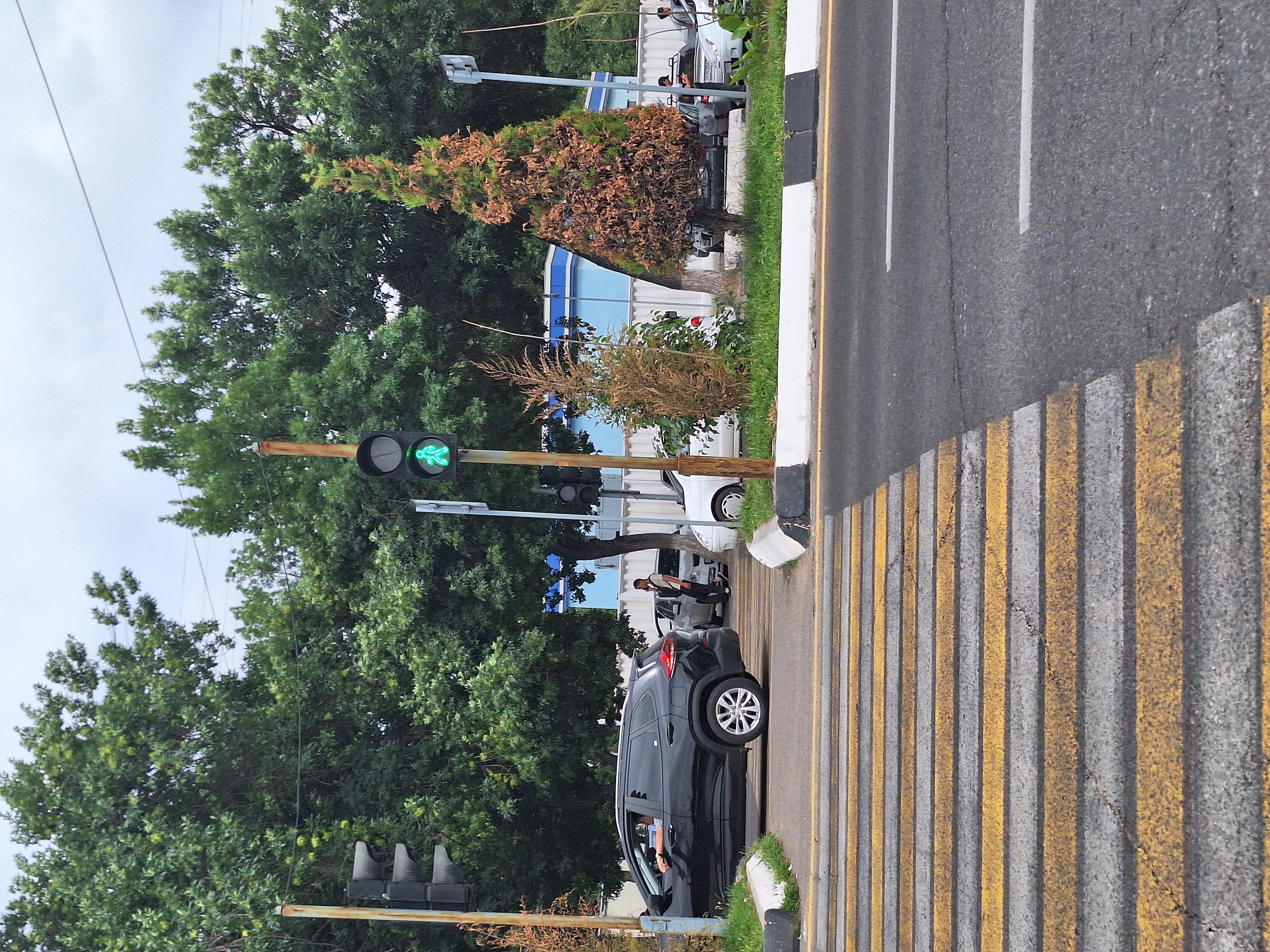
12. What Does the Pedestrian Countdown Actually Measure?
A pedestrian countdown display shows the remaining time available during the pedestrian clearance period.
For example, a display might count down from 15 seconds to zero.
It helps pedestrians understand how much time remains before the crossing period ends.
However, it should not be interpreted as a guarantee that every pedestrian can safely begin crossing at any moment.
The distinction between starting a crossing and completing one matters.
A pedestrian who begins crossing during the permitted WALK period may need additional time to reach the opposite pavement.
The clearance interval is designed to accommodate this movement according to the crossing's timing requirements.
Countdown displays provide useful information, but they do not replace the need to pay attention to traffic conditions.
13. How Do Traffic Lights Coordinate With Each Other?
Have you ever driven along a road and noticed that several traffic lights turn green one after another?
This is often called coordinated signal operation or, more informally, a green wave.
The objective is to help vehicles travel through several intersections with fewer unnecessary stops.
To achieve this, engineers use three important timing concepts.
Cycle length
The cycle length is the time required to complete a full sequence of signal indications.
Imagine an intersection whose complete programmed sequence takes 90 seconds.
That is its cycle length under that timing plan.
Split
A split describes the amount of cycle time allocated to a particular phase or movement, including its associated clearance time in common timing conventions.
For example, a main road might receive a larger share of the cycle than a lightly used side street.
Offset
An offset is the timing relationship between coordinated intersections.
Suppose two traffic lights are 400 metres apart.
If the first releases a group of vehicles, engineers can adjust the second signal's timing so that the group approaches when the downstream signal is green.
This is similar to synchronizing two railway stations so that trains arrive at suitable times.
The three concepts work together to coordinate traffic along a corridor.
The FHWA's Traffic Signal Timing Manual explains these relationships and how timing plans are developed.
14. Can Traffic Lights Detect Ambulances and Fire Trucks?
Yes. Many traffic signal systems can support emergency vehicle preemption.
This technology allows an authorized emergency vehicle to request a change in normal traffic signal operation.
The purpose is to reduce delays and help emergency vehicles pass through intersections more safely.
Different systems use different methods of communication or detection.
Examples include:
- Optical emitters and roadside detectors.
- Radio communication.
- Vehicle-mounted transmitters.
- Other approved detection and communication technologies.
When a valid request is received, the controller may change its normal sequence to provide a suitable green indication for the emergency vehicle.
However, the signal does not necessarily switch instantly.
The controller must manage conflicting movements, provide necessary clearance and avoid releasing traffic into the emergency vehicle's path.
After the emergency vehicle passes, the intersection can return to normal operation.
This is particularly important because emergency vehicles often travel at speeds and under conditions that make ordinary intersection timing inadequate.
The FHWA's intersection guidance describes several approaches to emergency vehicle detection and preemption.
15. How Do Traffic Lights Give Buses Priority?
Public transport creates a different challenge.
A bus may carry dozens of people, while a nearby car carries only one or two.
If a bus is delayed at every intersection, the entire public transportation route can become less reliable.
Some cities therefore use transit signal priority.
Unlike emergency preemption, transit priority generally works within the normal signal operation.
It may:
- Extend an existing green phase.
- Reduce unnecessary waiting before a bus arrives.
- Adjust the sequence when conditions permit.
- Give selected public transport vehicles a timing advantage.
The bus may communicate with the signal system through radio, vehicle location technology or other detection methods.
The system evaluates the request and decides whether the adjustment is appropriate.
Importantly, priority does not mean that a bus can ignore safety requirements or receive unlimited green time.
The controller still has to consider pedestrians, other vehicles and conflicting movements.
Transit signal priority can be especially useful on routes where several intersections create repeated delays.
16. What Happens When Traffic Lights Become Intelligent?
Traditional traffic signals often depend on schedules developed from traffic studies.
More advanced systems use real-time data to adjust their operation.
This is commonly called adaptive traffic signal control.
An adaptive system gathers information about traffic conditions, evaluates possible timing strategies and adjusts signal settings in response.
Imagine a supermarket that normally assigns four checkout counters to customers. During a sudden rush, it opens additional counters. When demand decreases, it adjusts again.
Adaptive traffic control follows a comparable idea, except the resources being distributed are green-light time and access to the intersection.
The system may consider:
- Traffic volume.
- Queue lengths.
- Vehicle arrival patterns.
- Congestion in neighboring areas.
- Changes in travel demand.
- Available green time.
The FHWA describes adaptive signal control as a process involving real-time traffic detection, algorithmic evaluation and repeated timing adjustments.
Does adaptive control always work better?
Not necessarily.
An adaptive system is only as useful as the data, algorithms and infrastructure supporting it.
If detectors fail, communication becomes unreliable or the system is poorly configured, performance may suffer.
A well-maintained conventional signal can sometimes perform as well as or better than an adaptive system under particular conditions.
Technology is not automatically an improvement simply because it is newer.
17. Can Artificial Intelligence Control Traffic Lights in 2026?
Artificial intelligence is increasingly relevant to traffic management, but it is important to distinguish between real applications and exaggerated claims.
AI can analyze large volumes of traffic information and identify patterns that may be difficult to recognize through simple fixed schedules.
For example, machine-learning systems can help estimate traffic demand, predict queue development or evaluate alternative signal timing strategies.
Computer vision can also help classify vehicles and estimate the number of vehicles waiting in different lanes.
Some research and pilot projects investigate reinforcement learning, where algorithms evaluate different signal decisions using feedback from simulated or real traffic conditions.
However, this does not mean every traffic light in 2026 is controlled by an AI model.
Many intersections still use conventional controllers and carefully engineered timing plans.
Even where AI supports decision-making, the system must operate within safety requirements and approved traffic-control logic.
A useful way to understand the relationship is to compare AI with a weather forecasting system.
A forecast can help a city prepare for rain, but it does not eliminate the need for drainage infrastructure, safety rules or human oversight.
Similarly, AI can help predict and manage traffic, but it does not replace the physical and engineering requirements of an intersection.
18. What Is a Smart Traffic Light Network?
A smart traffic light network connects individual intersections into a broader traffic management system.
Instead of treating each intersection as an isolated location, the network considers how vehicles move through an entire district or city.
For example, imagine a football stadium releasing thousands of spectators after a match.
Traffic demand may suddenly increase on several surrounding roads.
A networked signal system can use information from multiple intersections to understand where congestion is developing.
Traffic engineers or automated systems may then adjust timing plans to improve traffic movement across the affected area.
These systems can also support:
- Traffic monitoring.
- Incident detection.
- Performance measurement.
- Coordinated signal timing.
- Maintenance alerts.
- Transportation planning.
Some cities use centralized traffic management centers where operators can observe conditions and monitor equipment.
Other systems distribute much of the decision-making among individual intersection controllers.
The goal is to make traffic management more responsive and less dependent on outdated assumptions about road demand.
19. What Happens When a Traffic Light Loses Power or Stops Working?
Traffic signals depend on electrical power and electronic equipment, so failures are possible.
Common problems include:
- Power outages.
- Damaged electrical connections.
- Failed lamps or LED modules.
- Detector malfunctions.
- Controller faults.
- Communication interruptions.
- Physical damage caused by collisions or severe weather.
Some installations have backup power systems that allow signals to continue operating during certain outages.
However, backup equipment is not universal, and its operating time depends on the installation.
If a signal fails, the applicable local traffic laws determine how drivers must respond.
In many US jurisdictions, an intersection with completely dark traffic signals is treated as an all-way stop. Drivers should follow the local rules and approach cautiously.
A flashing red indication generally requires drivers to stop before proceeding when safe. A flashing yellow indication generally warns drivers to proceed cautiously.
The exact rules should always be checked against the relevant jurisdiction's traffic laws.
Maintenance is therefore a crucial part of traffic management. A sophisticated signal system is not useful if its detectors, electrical connections or control equipment are unreliable.
20. What Will Traffic Lights Look Like in the Future?
The future of traffic signals is likely to involve greater connectivity, better detection and more detailed information about how people use roads.
One important development is vehicle-to-infrastructure communication.
Connected vehicles may be able to receive information about traffic signal status and timing.
One example is SPaT, short for Signal Phase and Timing.
SPaT messages can communicate information about the current signal indication and the expected timing of signal phases.
This information may help connected vehicles anticipate upcoming signal changes and support safer, more efficient driving.
Another development involves improved traffic detection.
Instead of relying only on individual vehicle sensors, future systems may combine information from cameras, radar, connected vehicles, pedestrian equipment and transportation networks.
This could provide a more complete picture of intersection activity.
Cities may also use better data to prioritize buses, protect pedestrian movements and identify recurring congestion problems.
However, the future will not necessarily involve replacing every traffic light with an autonomous AI-controlled system.
Physical signal displays will remain important because drivers, cyclists and pedestrians need clear, visible instructions.
Technology may become more sophisticated behind the scenes while the familiar red, yellow and green lights remain recognizable.
The most successful future traffic systems will probably be those that combine useful technology with reliable engineering, clear communication and strong safety principles.
Practical Guide: How to Understand Traffic Lights as a Road User
Understanding the technology behind traffic signals can make everyday journeys safer.
Here are ten practical habits worth developing.
- Approach intersections carefully. Reduce speed when approaching a signal, especially when visibility is limited.
- Understand yellow correctly. Treat yellow as a warning that the green indication is ending. Do not accelerate simply to beat the red light.
- Stop behind the stop line. Keep your vehicle outside the pedestrian crossing and designated intersection area.
- Check before moving on green. A green indication does not guarantee that the intersection is clear. Look for pedestrians, cyclists and vehicles still completing their movements.
- Respect pedestrian signals. Do not begin crossing when the indication tells you to wait.
- Watch for turning vehicles. Drivers turning across a pedestrian crossing may have limited visibility or may fail to notice someone crossing.
- Never block an intersection. Enter only when there is sufficient space to clear it, even if the signal is green.
- Give emergency vehicles room. Listen and watch for emergency vehicles, and follow the appropriate local rules without creating additional hazards.
- Treat malfunctioning signals cautiously. If the signal is dark or displaying an unusual indication, follow the applicable local traffic rules.
- Avoid distractions. Put away your phone and focus on changing signals, road users and surrounding conditions.
The central principle is simple: traffic signals organize movement, but drivers remain responsible for paying attention.
Known vs. Uncertain: What Do We Actually Know About Modern Traffic Lights?
Traffic signal technology is well established, but its effectiveness depends on the location, equipment and operating conditions.
It is useful to distinguish proven engineering principles from developments that are still evolving.
What is well established?
- Electronic controllers manage traffic signal indications through programmed logic.
- Vehicle detectors can register traffic demand and support actuated signal operation.
- Inductive loops, video and radar are established detection technologies.
- Yellow change intervals provide a transition warning before red.
- Red clearance intervals can provide additional time before conflicting traffic receives permission to move.
- Coordinated timing uses cycle length, split and offset.
- Emergency vehicle preemption is an established traffic-control application.
- Adaptive signal systems can modify timing in response to detected traffic conditions.
These principles are documented in FHWA manuals and transportation engineering guidance.
What remains uncertain or context-dependent?
How much time adaptive systems save: Benefits depend on the quality of the existing timing plan, traffic patterns, detector reliability and the way performance is measured.
Whether AI will become standard everywhere: AI has useful applications, but cost, infrastructure, maintenance, regulation and safety considerations will influence adoption.
How quickly connected vehicles will become widespread: Vehicle-to-infrastructure communication requires compatible vehicles, roadside equipment and supporting communication networks.
Whether every intersection will become fully automated: Different roads have different needs. A quiet rural intersection may not benefit from the same technology as a busy urban corridor.
How traffic systems will balance competing priorities: More green time for buses, pedestrians or one traffic direction can affect other road users. Engineers must decide how to balance these needs.
The important distinction is that traffic signals are already computerized in many places, but a computerized traffic signal is not necessarily an adaptive or AI-controlled traffic signal.
Frequently Asked Questions (FAQ)
1. How do traffic lights work in simple terms?
Traffic lights use an electronic controller to organize vehicles and pedestrians into different movements, giving each group permission to move at an appropriate time.
2. Are traffic lights controlled by computers?
Yes. Modern traffic signals generally use specialized electronic controllers that manage their timing, indications and connected detection equipment.
3. Do traffic lights use cameras to detect cars?
Some do. Video detection systems analyze camera images to identify vehicles, queues and movement, although many intersections use other technologies.
4. How do traffic lights detect cars underground?
Inductive loop detectors use wires embedded in the road to create an electromagnetic field and detect changes caused by vehicles passing over them.
5. Why do some traffic lights change automatically when a car arrives?
Those intersections may use vehicle detectors that register demand and send a request to the controller for a green phase.
6. Why does a traffic light sometimes stay red when the road is empty?
It may follow a fixed schedule, be maintaining required timing intervals, responding to pedestrian demand or coordinating with nearby intersections.
7. How long does a traffic light stay green?
There is no universal duration because green time depends on traffic demand, road design, pedestrian requirements and the intersection's programmed timing plan.
8. Why does the traffic light turn yellow before red?
Yellow warns drivers that the green indication is ending and gives them information needed to make a safe stopping or intersection-clearing decision.
9. What is the difference between yellow and red clearance?
Yellow warns that green is ending, while red clearance provides an additional transition interval before conflicting traffic movements receive green.
10. How do pedestrian crossing buttons work?
They send a request to the traffic signal controller, which can include the pedestrian movement in an appropriate part of the signal sequence.
11. What does the flashing pedestrian hand mean?
It generally means pedestrians should not begin crossing, while those already crossing should complete their crossing within the available clearance time.
12. Can traffic lights recognize ambulances?
Some systems can detect authorized emergency vehicle requests through optical, radio or other communication technologies and provide signal preemption.
13. Can traffic lights communicate with buses?
Yes. Transit signal priority systems can communicate with buses and adjust certain signal timings to reduce public transport delays.
14. What is a green wave in traffic management?
A green wave is a coordinated timing strategy designed to allow vehicles traveling along a road to encounter successive green signals with fewer stops.
15. Are traffic lights controlled by artificial intelligence?
Some experimental and operational systems use AI-related techniques, but many traffic signals continue to rely on conventional controllers and engineering-based timing plans.
16. Do traffic lights communicate with each other?
In coordinated networks, traffic signal controllers can exchange information or follow common timing plans to improve traffic flow across multiple intersections.
17. What happens if traffic lights lose electricity?
The signal may stop operating, unless backup power is available, and drivers must follow the traffic laws governing failed or dark signals in their jurisdiction.
18. Are LED traffic lights better than older lights?
LED signal modules generally use less electricity and have longer service lives than traditional incandescent signal lamps, although actual savings depend on the equipment and installation.
19. Will connected cars change how traffic lights work?
Connected vehicles may receive signal phase and timing information, helping them anticipate upcoming signal changes and supporting future transportation applications.
20. Will traffic lights disappear in the future?
Physical traffic signals are likely to remain important because they provide visible instructions to all road users, even as the technology controlling them becomes more advanced.
Conclusion: Three Lights, an Entire Transportation Network
A traffic light looks like a remarkably simple invention. Three colors, a metal pole and a few electrical connections appear to be all that is needed to control a busy intersection.
But behind that familiar display is a much more complicated system.
Controllers manage movements. Sensors detect vehicles. Timing plans distribute available green time. Pedestrian systems protect crossing movements. Emergency preemption supports urgent journeys, while coordinated and adaptive systems help cities respond to changing traffic conditions.
In 2026, traffic signals are increasingly connected to the wider world of intelligent transportation. Cameras, radar, communication networks, data analytics and AI-assisted systems are expanding what traffic management can accomplish.
Yet the central challenge remains the same as it was when the first electric traffic signals appeared: how can many different road users share limited space without creating unnecessary danger or delay?
The answer is not simply to make lights change faster.
It is to understand traffic as a constantly changing system and manage it with reliable engineering, good information and sensible priorities.
The next time you stop at a red light, remember that the small signal above the road may be coordinating an entire network of vehicles, pedestrians, sensors and computers.
Three colored lights are only the beginning of the story.
Sources and Further Reading
- Federal Highway Administration – Manual on Uniform Traffic Control Devices, 11th Edition with Revision 1 (2025)
- FHWA – MUTCD 11th Edition, Complete PDF
- FHWA – Traffic Signal Timing Manual, Chapter 4: Traffic Signal Systems
- FHWA – Traffic Signal Timing Manual, Chapter 5: Basic Timing Parameters
- FHWA – Traffic Signal Timing Manual, Chapter 6: Coordinated Operations
- FHWA – Traffic Signal Timing Manual, Chapter 9: Adaptive Traffic Signal Control
- FHWA – Yellow Change Intervals and Road Safety
- FHWA – Automated Traffic Signal Performance Measures
- FHWA – Signalized Intersections Informational Guide
- FHWA – Traffic Detector Handbook: Modern Vehicle Sensors
- FHWA – Traffic Detector Handbook: In-Roadway Sensor Design
- FHWA – Traffic Signal Timing Manual, Chapter 2: Timing Strategies
- FHWA – Traffic Signal Timing Manual, Chapter 7: Coordinated Operations
- FHWA – Signal Timing on a Shoestring: Signal Timing Toolbox
- FHWA – Traffic Signal Program Handbook
The conversation
Post a Comment