
Quantum Computing in 2026: How Machines That Think in Qubits Are About to Change Everything
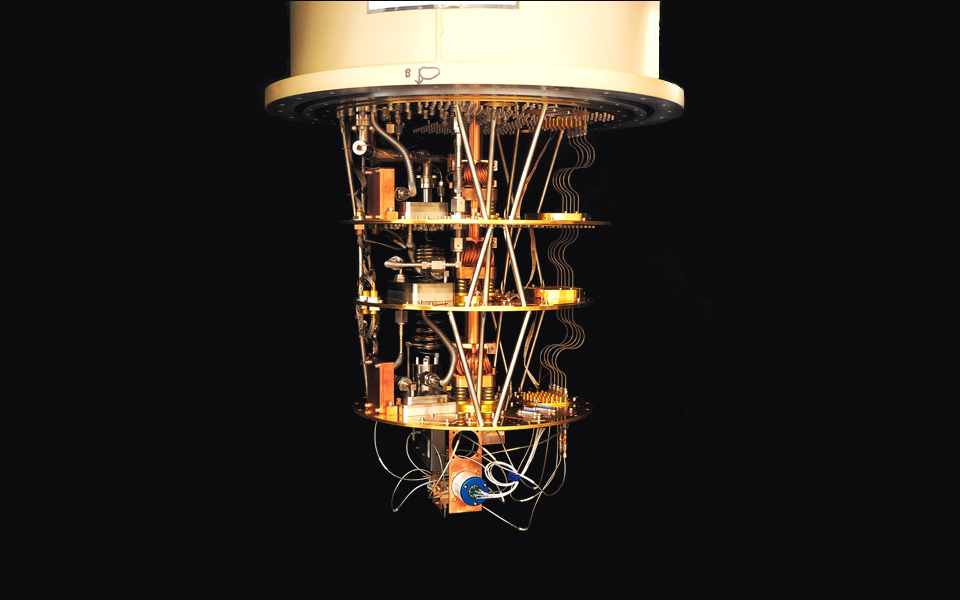
Imagine entering a laboratory where an unusual machine hangs beneath a complicated arrangement of metal plates, cables and electronic equipment. Its central processor is smaller than a smartphone, yet the equipment surrounding it can occupy an entire room. The processor must be protected from vibration, carefully controlled by microwave signals and, in some designs, cooled to temperatures colder than outer space.
This is not a machine designed to run your favourite video game, edit photographs or replace the laptop on your desk. It is something fundamentally different: a quantum computer.
Inside this machine, information follows rules that are unfamiliar to everyday experience. Instead of relying exclusively on the familiar zeros and ones used by conventional computers, quantum computers use quantum bits, commonly called qubits. These units of information can be prepared in combinations of states, connected through entanglement and manipulated using carefully designed quantum operations.
The possibilities are fascinating. Scientists hope quantum computers will eventually help discover better medicines, develop advanced materials, improve certain chemical processes and solve specialised mathematical problems that would overwhelm even powerful conventional computers.
But there is an important distinction between what quantum computers might accomplish and what they can actually accomplish today.
In 2026, quantum computing is advancing rapidly. Researchers are demonstrating more sophisticated error-correction techniques, improving processor architectures and exploring practical applications. Some experiments have crossed important computational milestones. Yet reliable, large-scale, fault-tolerant quantum computing remains a major engineering challenge.
The technology is neither an imaginary invention nor a magical replacement for ordinary computers. It is a developing scientific tool whose eventual influence could be substantial.
This guide explores how quantum computing works, what has changed by 2026, where the most promising applications lie, why encryption experts are paying attention and what ordinary people, businesses and governments should understand before the next major breakthroughs arrive.
Key Takeaways
- Quantum computers use qubits rather than ordinary binary bits, allowing them to exploit quantum mechanical effects.
- Superposition and entanglement are essential to quantum computing, but neither means a computer simply tries every possible answer simultaneously.
- Quantum computers are specialised machines, not universal replacements for laptops, smartphones or supercomputers.
- Hardware progress in 2026 includes improved superconducting processors, trapped-ion systems, neutral atoms and photonic approaches.
- Error correction is one of the most important breakthroughs because physical qubits are vulnerable to noise and interference.
- IBM and the University of Chicago reported a significant demonstration involving 70 logical qubits in July 2026.
- Potential applications include molecular simulation, drug research, advanced materials, selected optimisation problems and scientific discovery.
- Quantum computers could threaten some existing public-key encryption systems in the future, making post-quantum cryptography important today.
- Quantum computing will not automatically make artificial intelligence smarter, solve every mathematical problem or replace conventional computing.
- The most realistic future is a combination of classical computers, quantum processors and specialised scientific software.
1. What Exactly Is Quantum Computing?
To understand quantum computing, it helps to start with something familiar: the computer you are using right now.
Every ordinary digital computer, whether it is a smartphone, desktop PC, gaming console or enormous data-centre server, processes information using bits.
A bit has one of two possible values:
- 0
- 1
These two values form the foundation of modern digital technology. Everything from photographs and music to banking transactions and artificial intelligence models can ultimately be represented through combinations of zeros and ones.
A conventional computer processes these bits using electronic circuits. Billions of tiny transistors switch between electrical states to perform calculations and follow instructions.
Quantum computers work differently.
Instead of ordinary bits, they use quantum bits, or qubits. A qubit is a physical quantum system that can be controlled to represent information using quantum states.
Depending on the technology, a qubit might be represented by:
- The energy states of a superconducting electrical circuit.
- The internal energy levels of a trapped ion.
- The spin state of an electron.
- The state of a neutral atom.
- Certain properties of individual photons of light.
The important difference is that a qubit can exist in a quantum superposition of its two computational basis states.
This gives quantum computers access to computational techniques that ordinary binary machines cannot reproduce efficiently for certain problems.
Why scientists developed quantum computers
The idea emerged partly from a problem in physics.
Nature operates according to quantum mechanics. At the atomic and subatomic levels, particles do not behave like tiny versions of everyday objects. Their behaviour involves probabilities, interference and other quantum effects.
Scientists studying atoms, molecules and materials frequently need to simulate systems governed by these rules.
However, conventional computers can struggle to represent complicated quantum systems accurately. As the number of interacting particles increases, the mathematical description can become extraordinarily expensive to calculate.
A quantum computer could potentially represent and manipulate certain quantum systems more naturally.
This is one reason physicists became interested in using quantum mechanics itself as a computational resource.
The concept developed through contributions from researchers including Richard Feynman and David Deutsch, among others.
The ambition was not simply to build a faster calculator. It was to develop a different kind of computing machine for problems where quantum behaviour could offer a fundamental advantage.
2. Understanding Qubits Without Complicated Physics
A qubit is the basic information unit of a quantum computer.
Imagine a conventional light switch. It is either switched on or switched off. You can represent its condition as 1 or 0.
A qubit is more complicated.
Before measurement, it can be prepared in a superposition of the states represented by 0 and 1.
Mathematically, its state can be written as:
|ψ⟩ = α|0⟩ + β|1⟩
Here, alpha and beta describe probability amplitudes. Their squared magnitudes determine the probabilities of measuring 0 or 1, and they must satisfy a normalisation condition.
This is not simply a statement that the qubit secretly contains two ordinary values.
It means the qubit has a genuinely quantum state, including information about the relative phase between its possible outcomes.
That phase matters because quantum operations can cause probability amplitudes to reinforce or cancel one another.
Superposition: more than one possibility
Superposition is probably the most frequently discussed feature of quantum computing.
Imagine a spinning coin.
While the coin is spinning, it is not yet showing a definite heads-or-tails result in the ordinary way that it does after landing.
This provides a loose visual analogy for a qubit in superposition.
However, the analogy has limitations. A spinning coin is a classical object whose position and motion can, in principle, be described using ordinary physics. A quantum superposition is a mathematical state governed by quantum mechanics.
When a qubit is measured in its computational basis, the result is either 0 or 1.
The probability of obtaining each result depends on the amplitudes of its state.
For example, a qubit prepared in an equal superposition has a 50% probability of producing 0 and a 50% probability of producing 1 when measured in that basis.
The interesting part is that quantum algorithms can manipulate these states before measurement.
They use interference to increase the likelihood of useful outcomes and decrease the likelihood of unwanted ones.
This is where much of the computational power of quantum algorithms comes from.
Entanglement: when qubits become connected
Another important concept is quantum entanglement.
Imagine two people receiving matching boxes containing objects that have correlated properties. When one person opens a box and discovers a particular result, the result of the other box is strongly connected to it.
Entanglement goes beyond ordinary matching objects.
Two or more quantum systems can share a combined state that cannot be described as independent states for each system.
Measurements on entangled particles can show correlations that cannot be explained by certain classical models based on local hidden variables.
Entanglement is an important resource for many quantum algorithms, quantum communication protocols and quantum error-correction systems.
It allows quantum processors to create relationships between qubits that have no direct equivalent in ordinary classical information processing.
Why superposition and entanglement matter together
Superposition provides a range of possible quantum states. Entanglement allows different qubits to become correlated in ways that can support complex computations.
Together with interference and carefully designed quantum gates, these properties allow quantum algorithms to perform certain calculations in distinctive ways.
But there is an important misunderstanding to avoid.
A quantum computer does not simply calculate every possible answer and allow the user to read all of them at the end.
Measurement produces a classical result. The algorithm must be designed so that useful results become sufficiently likely.
That is why developing effective quantum algorithms is as important as building better hardware.
3. How Quantum Computers Differ From Ordinary Computers
The difference between quantum and classical computing is not merely a matter of processor speed.
They use different physical principles and have different strengths.
| Feature | Classical computer | Quantum computer |
|---|---|---|
| Basic information unit | Bit | Qubit |
| Information states | 0 or 1 | Quantum superpositions of basis states |
| Main operations | Logic gates | Quantum gates |
| Information behaviour | Classical logic | Quantum mechanics |
| Error handling | Mature correction techniques | Specialised quantum error correction |
| Typical environment | Room-temperature electronics | Depends on hardware; some require extreme cooling |
| Best applications | General-purpose computing | Selected specialised computational problems |
| Technology maturity | Highly mature | Developing |
Does a quantum computer replace a supercomputer?
No.
A modern supercomputer can perform enormous numbers of conventional calculations, process large datasets, simulate weather systems, train scientific models and run complex engineering applications.
Quantum computers have a narrower potential advantage.
They may be particularly useful for selected problems involving quantum simulation, certain mathematical structures and specialised optimisation or sampling tasks.
For many everyday activities, classical computers are already faster, cheaper and more reliable.
A quantum computer would not be the obvious choice for opening a website, rendering a normal photograph, editing a video or running an ordinary database.
The two technologies are better understood as complementary tools.
Why a hybrid system makes sense
Consider a pharmaceutical research laboratory.
A classical supercomputer might organise experimental data, prepare a molecular model and analyse possible results.
A quantum processor could eventually perform a specialised calculation involving molecular interactions.
The resulting information would then return to classical software for interpretation.
This combination is often called quantum-centric computing or hybrid quantum-classical computing.
Rather than replacing existing infrastructure, quantum systems are being developed to work alongside it.
This approach is likely to remain important as the technology matures.
4. What Does a Quantum Computer Actually Look Like?
Quantum computers do not necessarily look like conventional desktop computers.
Some systems resemble large scientific instruments, with complex wiring, refrigeration equipment, laser systems and specialised control electronics.
The processor itself can be surprisingly small.
Superconducting quantum computers
One major approach uses superconducting circuits.
These circuits are manufactured using techniques related to semiconductor fabrication. They contain special electrical components called Josephson junctions, which allow engineers to create controllable quantum states.
The circuits must operate at extremely low temperatures, often just a small fraction of a degree above absolute zero.
Why so cold?
Heat creates unwanted disturbances. These disturbances can destroy the delicate quantum states that calculations depend on.
A dilution refrigerator provides the necessary environment.
The processor is placed deep inside the cooling system, while electronic equipment outside controls the qubits using microwave signals.
Companies such as IBM and Google have invested heavily in this approach.
Trapped-ion quantum computers
Another approach uses electrically charged atoms called ions.
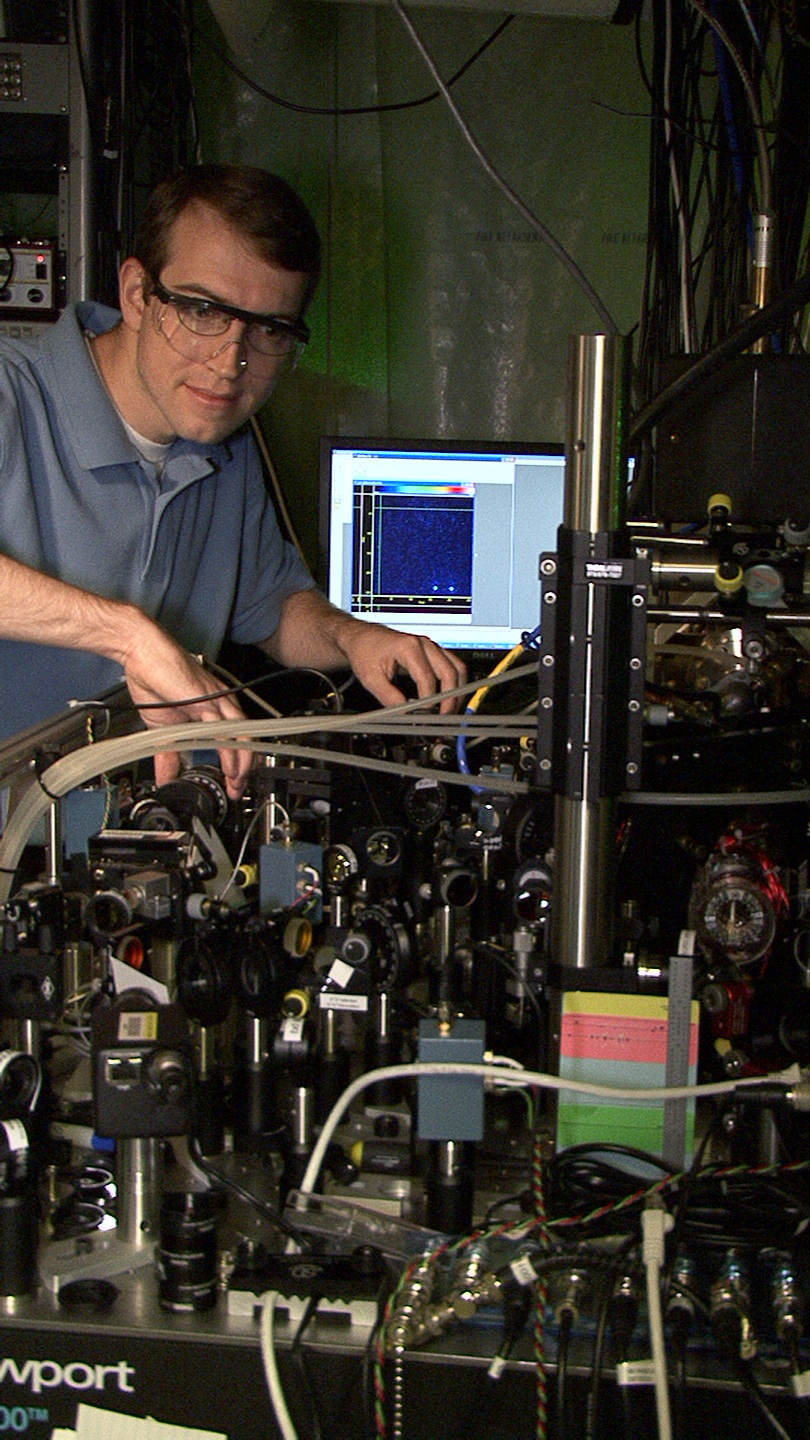
The ions are suspended using electromagnetic fields inside a vacuum chamber.
Laser systems manipulate their internal quantum states and help perform operations between them.
Trapped-ion systems can offer high-quality operations and relatively long coherence times.
Their challenges include scaling the architecture, controlling many ions and performing operations quickly enough for demanding calculations.
Neutral-atom quantum computers
Neutral-atom systems use individual atoms held in carefully arranged positions by laser beams.
Researchers can manipulate these atoms and create interactions that support quantum computation.
One advantage is the potential to arrange large numbers of atoms in flexible configurations.
The challenge is turning these systems into reliable processors that can repeatedly perform complex, error-corrected computations.
Photonic quantum computers
Photonic systems use individual particles of light to represent and process quantum information.
Photons are attractive because they can travel through optical systems and may be useful for quantum networking.
However, creating reliable interactions between photons and building scalable photonic quantum processors present substantial engineering challenges.
Silicon spin qubits and other approaches
Researchers are also investigating silicon-based qubits and other technologies.
Some approaches seek to use semiconductor manufacturing methods that already support the conventional electronics industry.
The long-term objective is to create quantum processors that can be manufactured consistently, controlled precisely and connected into larger systems.
No single architecture has yet eliminated all the major technical difficulties.
This diversity is important because the eventual quantum-computing industry may use several different hardware technologies for different purposes.
5. Where Quantum Computing Stands in 2026
The year 2026 is important because quantum computing is moving beyond demonstrations focused only on increasing physical qubit counts.
Researchers are increasingly concentrating on the quality of computation, the reliability of logical qubits and the ability to verify results.
A processor containing hundreds of physical qubits is not automatically more useful than a smaller processor with better-controlled operations.
The quality of the qubits, their connections, their coherence times and the accuracy of their gates all matter.
Physical qubits versus logical qubits
This distinction is essential.
A physical qubit is an actual quantum information unit implemented in hardware.
A logical qubit is a more reliable unit of quantum information constructed using multiple physical qubits and an error-correction procedure.
The purpose is to protect information from errors that affect individual physical components.
Think about protecting an important document.
Instead of keeping one fragile copy, you might maintain several carefully organised copies and use a method to identify inconsistencies.
Quantum error correction is much more mathematically sophisticated, but the general idea is similar: encode information in a larger system so that certain errors can be detected and corrected without destroying the information itself.
Consequently, a machine with thousands of physical qubits might have far fewer usable logical qubits.
The number of physical qubits needed for each logical qubit depends on the error rates, the correction code, the architecture and the reliability required by the computation.
There is no single conversion ratio that applies to every machine.
IBM's 2026 hardware progress
IBM's quantum hardware programme illustrates how the industry is approaching this challenge.
Its publicly described processor families include Heron processors with 133 or 156 programmable qubits and Nighthawk processors with 120 programmable qubits.
These specifications are not directly comparable with every competing architecture because different technologies have different connectivity, error rates and operating characteristics.
IBM is also working on modular quantum systems.
The objective is to connect multiple processors while maintaining the highly controlled environment necessary for superconducting qubits.
In August 2026, IBM announced that it had successfully connected and cooled two modular cryogenic systems.
The work is part of its longer-term plan to build larger interconnected quantum computers.
IBM's announced Starling system is planned for 2029, with a target of 200 logical qubits and the ability to execute 100 million quantum gates.
These are development targets, not capabilities that should be treated as already commercially available.
Google's quantum research
Google Quantum AI has also helped advance quantum computing through its work on superconducting processors and quantum error correction.
Its Willow processor became particularly prominent for research demonstrating improvements in error correction as the size of a surface-code system increased.
The significance was not simply the number of physical qubits. It was evidence that increasing the resources devoted to error correction could reduce the logical error rate under the conditions tested.
This is a crucial requirement for building more reliable quantum computers.
A major 2026 milestone: 70 logical qubits
One particularly notable development came in July 2026.
IBM and researchers from the University of Chicago announced a quantum computation using 70 logical qubits.
The experiment involved a specially constructed encoded circuit and a method designed to improve confidence in the accuracy of the results.
According to the published announcement, the team performed:
- 70 logical qubits.
- 2,415 logical two-qubit operations.
- 468 logical T gates.
- Effective logical error rates approximately ten times lower than the underlying physical error rates.
The reported computation took approximately 15 minutes.
The researchers argued that the problem was beyond the practical reach of leading classical simulation approaches.
This was an important milestone because quantum advantage experiments have faced a difficult question: how can researchers confidently verify a result when reproducing the computation classically is itself extremely expensive?
The new method addressed part of that verification challenge.
However, this result should not be confused with a general-purpose commercial quantum computer capable of outperforming conventional computers across everyday workloads.
It was a specific research demonstration, and its practical importance must be assessed in the context of the problem being solved.
Source: IBM and the University of Chicago, July 30, 2026.
6. Why Quantum Error Correction Could Change Everything
If there is one engineering problem that defines the future of quantum computing, it is error correction.
Quantum states are extremely delicate.
They can be disturbed by:
- Temperature fluctuations.
- Electromagnetic interference.
- Imperfect control signals.
- Interactions with the surrounding environment.
- Unwanted interactions between neighbouring qubits.
- Imperfections in measurement.
These problems can introduce errors into calculations.
A classical computer can use established error-detection and correction techniques to recover from many common forms of hardware failure.
Quantum error correction is more difficult because unknown quantum states cannot simply be copied and stored in multiple independent locations.
This limitation is related to the no-cloning theorem, a fundamental result in quantum physics.
Instead, quantum information is encoded across multiple physical qubits.
How quantum error correction works
A quantum error-correction code distributes information across a larger quantum system.
Additional measurements, called syndrome measurements, reveal information about certain errors without directly measuring and destroying the encoded logical information.
A classical decoder analyses these measurements and determines what correction should be applied.
This process must happen repeatedly while the quantum computation continues.
A successful system must therefore coordinate several technologies:
- Reliable physical qubits.
- Accurate quantum gates.
- Repeated error-detection measurements.
- Fast classical decoding.
- Reliable correction operations.
- A scalable architecture.
Every component matters.
A quantum processor may demonstrate an excellent error rate for a short experiment but still struggle with a much longer calculation.
The real objective is to make logical operations reliable enough that larger computations become increasingly practical.
What does fault tolerance mean?
Fault-tolerant quantum computing means building a system that can continue performing computations reliably despite individual hardware errors.
The objective is not to eliminate every error. That would be unrealistic.
Instead, the system must detect and manage errors so effectively that the overall computation remains dependable.
A fault-tolerant machine would represent a major change in the field.
It could support longer algorithms, more complex simulations and applications that require large numbers of reliable operations.
This is why logical-qubit performance is increasingly important in 2026.
Recent progress
In September 2026, Microsoft researchers published further work on scalable logical qubits.
The research emphasised that a useful logical qubit must meet several requirements simultaneously:
- Reliability over long computations.
- The ability to perform universal quantum operations.
- Low-latency decoding and feedback.
- The possibility of scaling to hundreds or thousands of logical qubits.
This is a useful way to understand the industry's direction.
The goal is no longer simply to announce a larger number of qubits. It is to demonstrate that those qubits can perform increasingly reliable and useful work.
Source: Microsoft Quantum — Scalable Logical Qubits, September 2026.
7. The Real-World Applications: Where Could Quantum Computing Help?
Quantum computing is attracting investment because of its possible applications in science and industry.
However, it is important to separate three different categories:
- Applications that are scientifically promising.
- Applications currently being investigated through experiments and hybrid methods.
- Applications that remain speculative because the necessary hardware does not yet exist.
The most convincing long-term opportunities are often found in problems involving complex quantum systems.
7.1 Medicine and drug discovery
Developing a medicine is an extraordinarily complicated process.
Scientists must understand how molecules interact, how chemical structures behave and how a potential treatment affects biological systems.
A drug molecule may contain many interacting electrons and atoms.
Conventional computers can model molecular behaviour, but accurately representing certain quantum interactions becomes difficult as the system grows.
Quantum computers could eventually help scientists simulate particular molecular properties more naturally.
Imagine a research team investigating a molecule that might bind to a protein associated with a disease.
A quantum processor could potentially help calculate aspects of the molecule's electronic structure or chemical interactions.
Researchers could then use those results to guide laboratory experiments.
This might help with:
- Investigating molecular structures.
- Understanding chemical reactions.
- Studying molecular bonding.
- Exploring potential drug candidates.
- Developing better computational models for biological chemistry.
But quantum computers will not automatically discover medicines.
Drug development also requires laboratory experiments, biological testing, safety evaluation, clinical trials and regulatory approval.
Even a highly accurate molecular simulation cannot replace those steps.
What is known: Quantum simulation is a scientifically well-motivated application of quantum computing.
What remains uncertain: When large, fault-tolerant machines will deliver a consistent and economically meaningful advantage in pharmaceutical research.
7.2 Advanced materials
Materials science is another promising area.
Modern industries depend on materials with specialised properties.
Examples include:
- Better batteries.
- More efficient solar cells.
- Stronger lightweight materials.
- Advanced superconductors.
- Improved catalysts.
- Materials that can operate under extreme conditions.
The properties of many materials depend on complicated interactions between electrons and atoms.
These interactions are quantum mechanical.
A sufficiently powerful quantum computer could help model certain material properties and explore structures that are difficult to simulate accurately using conventional approaches.
For example, researchers could investigate materials that might store energy more efficiently or support improved electrical systems.
Better catalysts could also help reduce the energy required for industrial chemical processes.
However, finding a promising theoretical material does not mean it can immediately be manufactured economically.
Manufacturing, stability, cost and real-world performance remain separate challenges.
7.3 Finance and investment
Financial institutions are exploring quantum computing for selected mathematical and optimisation problems.
Modern finance involves enormous numbers of variables.
A financial organisation might need to balance investment returns, risk exposure, transaction costs and regulatory requirements.
Quantum algorithms have been investigated for:
- Portfolio optimisation.
- Risk modelling.
- Derivative pricing.
- Monte Carlo-related calculations.
- Financial scenario analysis.
Consider a portfolio containing dozens or hundreds of possible assets.
The organisation wants to select a combination that meets certain constraints while balancing expected returns and risk.
This can become a difficult optimisation problem.
Quantum computing might eventually help with certain specialised formulations.
But there is no reason to assume that every financial calculation will become faster simply because it is transferred to a quantum processor.
Classical algorithms are highly developed, and many financial optimisation tasks are already handled efficiently using conventional methods.
The real question is whether a quantum approach can provide a measurable advantage after accounting for hardware errors, data preparation and operating costs.
7.4 Climate science and energy
Climate research relies on large-scale simulations involving the atmosphere, oceans, land, energy systems and human activity.
Quantum computing is not expected to replace conventional climate models.
However, it could potentially contribute to some specialised problems associated with energy and chemistry.
Possible research directions include:
- Designing improved battery materials.
- Understanding chemical processes involved in carbon capture.
- Developing better catalysts for industrial production.
- Studying materials for more efficient energy conversion.
- Exploring complex reactions relevant to clean fuels.
For example, carbon capture technologies often depend on materials that selectively interact with particular molecules.
Improving our understanding of these interactions could help scientists develop more effective materials.
Quantum simulation may eventually become one tool in that research process.
But a quantum processor will not independently predict tomorrow's weather or solve global warming.
Climate change is a physical, economic and political challenge requiring many different technologies and policies.
7.5 Logistics and supply chains
Businesses regularly face optimisation challenges.
A delivery company may need to determine the most efficient routes for hundreds of vehicles.
A manufacturer may need to schedule machines, manage inventory and coordinate deliveries.
An airline must organise aircraft, crews, maintenance and passenger requirements.
These problems can involve many variables and constraints.
Quantum optimisation algorithms are being studied as potential tools for certain complex problems.
One famous example is the travelling salesperson problem, which asks how to visit a collection of locations while minimising the total distance travelled.
As the number of locations increases, the number of possible routes grows rapidly.
Quantum algorithms may help explore some optimisation structures differently.
However, classical optimisation techniques are extremely sophisticated.
A quantum algorithm must demonstrate a practical advantage over the best relevant classical alternatives, not merely over a deliberately weak comparison.
7.6 Artificial intelligence and machine learning
The relationship between quantum computing and artificial intelligence is attracting considerable attention.
The two fields could eventually support each other.
Quantum machine learning investigates whether quantum processors can accelerate or improve particular machine-learning tasks.
Possible research directions include:
- Quantum-enhanced feature representations.
- Specialised sampling methods.
- Hybrid neural-network architectures.
- Certain linear-algebra-related calculations.
- Machine learning for quantum hardware control.
A future scientific workflow might use AI to identify a promising molecular structure, a quantum computer to calculate selected properties and conventional computing to analyse the result.
That is an interesting possibility.
However, quantum computing does not automatically make AI models more intelligent.
Training large language models currently depends on extensive classical computing infrastructure, especially GPUs and specialised accelerators.
Quantum processors have not demonstrated a general replacement for these systems.
Any claim that quantum computers will soon make all AI training thousands of times faster should be treated cautiously.
7.7 Scientific research and fundamental physics
Beyond commercial applications, quantum computers could become valuable scientific instruments.
Researchers are interested in using them to investigate quantum systems that are difficult to reproduce using conventional simulation.
Potential research areas include:
- Quantum magnetism.
- Superconductivity.
- Molecular interactions.
- Complex chemical reactions.
- Many-body physics.
- Fundamental questions about quantum information.
This application is particularly interesting because quantum computers are not just tools for industry.
They could help scientists investigate the physical rules governing the universe.
8. Quantum Computing and Cryptography: A Major Security Challenge
Perhaps the most urgent reason governments are paying attention to quantum computing is cybersecurity.
Today, the internet relies on cryptographic systems to protect communications, financial transactions, digital identities and confidential information.
Some widely used public-key cryptographic methods depend on mathematical problems that are difficult for conventional computers to solve.
Two important examples involve:
- Factoring large integers.
- Solving discrete logarithm problems.
These mathematical problems support cryptographic systems such as RSA and elliptic-curve cryptography.
A sufficiently powerful, fault-tolerant quantum computer could use Shor's algorithm to solve the mathematical problems underlying these systems much more efficiently than known classical methods.
That could have serious consequences.
Could quantum computers break passwords?
Not in the simple way many headlines suggest.
Quantum computers do not automatically reveal every password or unlock every encrypted file.
Different cryptographic systems have different vulnerabilities.
For example, Shor's algorithm threatens important public-key cryptographic methods, while Grover's algorithm offers a quadratic speedup for certain unstructured search problems.
That does not mean all encryption becomes useless.
Symmetric encryption and cryptographic hash functions require different security assessments and may be protected through appropriate parameter choices.
The main concern is that sufficiently capable quantum computers could undermine some of the mathematical foundations used by existing public-key systems.
The harvest now, decrypt later threat
There is another problem that exists before powerful quantum computers become available.
Imagine an attacker collecting encrypted communications today.
The attacker cannot currently decrypt them, but stores them for years.
If a sufficiently powerful quantum computer becomes available in the future, some of that previously collected information might become vulnerable.
This is known as the harvest-now, decrypt-later threat.
It is particularly concerning for information that must remain confidential for a long time, including:
- Government communications.
- Medical records.
- Intellectual property.
- Business secrets.
- Sensitive diplomatic information.
- Long-term financial information.
This is why organisations should not wait until a powerful quantum computer arrives before thinking about security.
Post-quantum cryptography
The solution being developed is called post-quantum cryptography, often abbreviated as PQC.
These are cryptographic algorithms designed to resist attacks from both conventional computers and sufficiently powerful quantum computers.
In August 2024, the US National Institute of Standards and Technology finalised its first three post-quantum cryptography standards:
- FIPS 203: Module-Lattice-Based Key-Encapsulation Mechanism, also known as ML-KEM.
- FIPS 204: Module-Lattice-Based Digital Signature Algorithm, also known as ML-DSA.
- FIPS 205: Stateless Hash-Based Digital Signature Algorithm, also known as SLH-DSA.
These standards are an important step towards a more quantum-resistant digital infrastructure.
They do not require ordinary organisations to purchase quantum computers.
Instead, they provide cryptographic methods that conventional computing systems can implement.
What should businesses do now?
Businesses should begin by understanding where their cryptography is used.
A sensible preparation programme includes:
- Creating an inventory of encryption systems.
- Identifying applications that rely on vulnerable public-key algorithms.
- Understanding how suppliers plan to support post-quantum standards.
- Prioritising sensitive information with long confidentiality requirements.
- Testing new cryptographic implementations.
- Planning a gradual migration.
- Monitoring updates from recognised cybersecurity authorities.
This process can take years, particularly for large organisations with older infrastructure.
The US Government Accountability Office published a report in October 2026 highlighting the need for government agencies to prepare for the transition.
The report also stressed that today's quantum computers cannot yet break the cryptography under discussion.
That distinction matters.
The risk is a future technological possibility, not evidence that existing internet encryption has already been defeated.
Useful resources:
- NIST: What Is Post-Quantum Cryptography?
- NIST: Post-Quantum Cryptography Standards
- US Government Accountability Office: Quantum Computing and Cybersecurity
9. What Quantum Computers Will NOT Do
The excitement surrounding quantum computing has produced some unrealistic expectations.
Understanding its limitations is just as important as understanding its potential.
They will not make every calculation faster
Quantum computers are not universally faster.
They offer potential advantages for specific mathematical structures and computational problems.
A normal computer remains the better tool for countless everyday tasks.
For example, opening a browser, editing a document or calculating a household budget does not require quantum mechanics.
They will not replace smartphones and laptops
There is no practical reason to expect smartphones to contain powerful quantum processors for ordinary everyday computing.
Quantum hardware requires specialised environments and control systems.
Even if quantum processors become much more scalable, they will probably remain specialised components within larger computing systems.
They will not automatically solve every scientific problem
A quantum computer cannot simply be given a scientific question and expected to produce a breakthrough.
Researchers still need mathematical models, appropriate algorithms, high-quality input data and reliable methods for checking results.
Scientific discoveries also require experimentation.
A theoretical prediction is not the same as a confirmed laboratory result.
They will not automatically make AI conscious
Quantum computing and artificial intelligence are separate fields.
There is no established scientific evidence that using qubits makes an AI system conscious, self-aware or capable of human-like understanding.
A quantum processor may eventually help with selected machine-learning calculations, but that is not equivalent to creating a conscious machine.
They will not immediately destroy all cybersecurity
Quantum computers threaten particular cryptographic methods under specific conditions.
They do not instantly defeat every form of encryption, every password system or every cybersecurity technology.
Post-quantum cryptography is already being developed and standardised to address the risks.
The important challenge is making the transition in time.
10. The Main Technical Challenges Still Facing the Industry
Despite important progress, several problems remain.
Qubit stability
Quantum information can be lost through interactions with the environment.
Researchers measure this behaviour using quantities such as coherence time.
A longer coherence time can be helpful, but it does not independently determine whether a processor is useful.
Gate accuracy, connectivity, measurement quality and operating speed also matter.
Scaling the hardware
Building a processor with more qubits is not simply a matter of making a larger chip.
Engineers must provide control signals, wiring, cooling, calibration and reliable connections between components.
As the number of qubits increases, the surrounding infrastructure becomes more complicated.
For superconducting systems, cryogenic engineering is especially important.
Quantum error correction overhead
Logical qubits require physical resources.
The exact overhead depends on the error-correction method and the quality of the underlying hardware.
A useful quantum computer may require a very large number of physical qubits to create a much smaller number of high-quality logical qubits.
This is one reason physical qubit counts alone can be misleading.
Software and algorithms
Hardware improvements are only part of the challenge.
Developers need better algorithms that can exploit the strengths of quantum processors.
They also need tools for:
- Programming quantum circuits.
- Optimising operations.
- Managing noise.
- Correcting errors.
- Connecting quantum and classical processors.
- Verifying computational results.
Software ecosystems such as IBM's Qiskit and Microsoft's Quantum Development Kit help researchers and developers experiment with quantum applications.
Cost and accessibility
Operating a quantum research facility is expensive.
The infrastructure may require advanced manufacturing, specialised refrigeration, lasers, vacuum systems and highly trained engineers.
Cloud-based access helps researchers and companies experiment without building their own quantum laboratories.
However, access to a quantum processor does not automatically mean that a useful business application exists.
The economic case must still be demonstrated.
11. Quantum Computing Around the World: Who Is Leading?
Quantum computing has become an international research and industrial priority.
Different countries are investing in hardware, software, scientific research, workforce development and national security.
United States
The United States has a substantial ecosystem involving technology companies, universities, national laboratories and specialised startups.
IBM, Google, Microsoft, Quantinuum and several other organisations are developing different parts of the quantum technology stack.
Federal research programmes also support quantum science and engineering.
China
China has invested heavily in quantum information science, including quantum computing, communications and sensing.
Its research programmes cover multiple hardware approaches.
International comparisons are difficult because different organisations report different benchmarks and not all technical details are publicly available.
Europe
European research programmes support quantum technology through universities, national initiatives and companies.
Countries including Germany, France, the Netherlands and Denmark have active quantum research communities.
European efforts also focus on building a stronger industrial supply chain and developing quantum communication infrastructure.
Japan
Japan has invested in quantum technology through academic institutions, government initiatives and companies.
Research includes superconducting quantum processors, quantum software and applications in materials science and industry.
Canada
Canada has developed a notable quantum technology ecosystem, with research in areas such as quantum algorithms, photonics and quantum hardware.
Companies and universities contribute to the international development of the field.
What about Africa and Morocco?
Quantum computing is also an opportunity for countries that are not currently major hardware manufacturers.
For Morocco, the most practical starting points may include:
- University research collaborations.
- Quantum physics and mathematics education.
- Quantum programming and software development.
- Cybersecurity and post-quantum cryptography.
- Scientific partnerships with international laboratories.
- Training in semiconductor and advanced electronics engineering.
A country does not need to manufacture a world-leading quantum processor to participate in the industry.
It can contribute through software, mathematical research, engineering, cybersecurity and specialised applications.
For students and developers, learning the foundations of quantum information could become a valuable way to enter an emerging technological field.
12. How Ordinary People Can Prepare for the Quantum Era
Quantum computing may sound like a subject reserved for physicists and research laboratories.
However, people with different educational and professional backgrounds can begin learning about it today.
The most important step is to understand the basic concepts without becoming overwhelmed by advanced mathematics.
Learn the fundamentals
Start with:
- Basic linear algebra.
- Complex numbers.
- Probability.
- Classical computing.
- Introductory quantum mechanics.
- Quantum gates and circuits.
You do not need a doctorate in physics to understand the basic principles.
A good understanding of mathematics and programming provides a useful foundation.
Experiment with quantum programming
Several organisations provide educational tools and cloud-accessible quantum computing environments.
Some useful resources include:
These resources allow learners to explore quantum circuits, algorithms and simulations.
A beginner could start by creating a circuit with a single qubit, applying a Hadamard gate and measuring the result.
The experiment would demonstrate how a qubit can be prepared in a superposition and how measurement produces classical outcomes.
Choose a useful specialisation
The quantum industry requires more than physicists.
Possible career directions include:
- Quantum software engineering.
- Quantum algorithm development.
- Applied mathematics.
- Quantum hardware engineering.
- Semiconductor manufacturing.
- Cryogenic engineering.
- Quantum cybersecurity.
- Scientific computing.
- Research and education.
Someone with a software background might concentrate on quantum programming.
An electronics engineer might investigate control systems and processor design.
A cybersecurity professional could specialise in post-quantum cryptography.
There is no single career path into the industry.
Businesses should investigate applications carefully
Companies should avoid buying into quantum technology simply because it is fashionable.
A more sensible approach is to identify a genuine business problem first.
Then ask whether the problem has a mathematical structure that might benefit from quantum computing.
A company should compare:
- Existing classical solutions.
- Quantum algorithms.
- Hardware availability.
- Operating costs.
- Data preparation requirements.
- Accuracy.
- Reproducibility.
- Potential business value.
A successful quantum pilot should produce measurable results rather than just an impressive demonstration.
13. What Could Happen Between 2027 and 2030?
The next several years could determine whether quantum computing becomes a commercially useful technology or remains primarily a specialised research field.
Several developments deserve particular attention.
More reliable logical qubits
The most important milestone will be the ability to create logical qubits that remain reliable through increasingly long computations.
Researchers will need to demonstrate that error correction works consistently, rather than only in isolated experiments.
The number of logical qubits, their error rates and the complexity of the operations they can perform will all matter.
Larger interconnected processors
A single quantum chip may eventually become insufficient for the most demanding applications.
Companies are therefore exploring modular architectures in which several processors communicate through specialised connections.
IBM's modular cryogenic work is an example of this direction.
Connecting multiple processors creates new engineering challenges, but it could provide a route towards much larger systems.
Better quantum software
The software environment will also need to mature.
Developers will require better tools for circuit compilation, error correction, simulation and hybrid computing.
More efficient algorithms could make existing hardware more useful without requiring enormous increases in physical qubit counts.
Commercial applications with measurable advantages
The industry will need to move beyond impressive laboratory demonstrations.
The next important question is whether quantum computers can repeatedly solve useful problems more effectively than competitive classical methods.
This could involve chemistry, materials science, energy research or specialised optimisation.
A commercially meaningful advantage must include the full cost of running the computation, preparing the data and validating the answer.
Post-quantum cybersecurity migration
The transition to quantum-resistant cryptography will continue.
Governments, banks, technology companies and other organisations will need to update systems that rely on vulnerable cryptographic methods.
This work is important even if large-scale quantum computers take longer than expected to arrive.
14. The Economic Impact: Is Quantum Computing a New Industrial Revolution?
Quantum computing could create economic opportunities across several industries.
But estimating its eventual financial impact is difficult.
The technology is still developing, and many of its most valuable applications have not yet been demonstrated at commercial scale.
Potential economic opportunities include:
Healthcare: Better molecular simulations could support pharmaceutical research and the development of new treatments.
Energy: Improved materials and chemical simulations could contribute to more efficient batteries, catalysts and energy technologies.
Manufacturing: Quantum simulation could help researchers investigate advanced materials and industrial processes.
Finance: Specialised optimisation and modelling applications could become useful in selected financial workflows.
Cybersecurity: The development of quantum-resistant cryptography will create demand for new security products, consultancy and infrastructure.
Education: Universities and training organisations may expand programmes in quantum information science, software and engineering.
There will also be indirect economic benefits.
For example, improvements in cryogenic equipment, semiconductor manufacturing, precision electronics and scientific instrumentation could support other industries.
However, investment should be approached carefully.
A company developing a promising quantum processor is not necessarily a profitable company.
A scientific breakthrough does not automatically become a successful commercial product.
Investors and businesses should distinguish between research progress, technical feasibility, commercial adoption and sustainable revenue.
These are separate stages.
15. The Environmental Question: Are Quantum Computers Energy Efficient?
Quantum computers are sometimes described as exceptionally powerful machines, which raises an important question: how much energy do they consume?
The answer depends on the hardware architecture.
Superconducting quantum computers require extremely cold operating environments.
Dilution refrigerators, vacuum systems, microwave electronics and associated infrastructure all consume energy.
The processor itself is not the only component that matters.
Trapped-ion systems have different requirements, including laser systems, vacuum equipment and electronic controls.
Photonic systems also have their own optical and electronic infrastructure.
Therefore, it is too early to make a general claim that quantum computers are environmentally friendly or environmentally harmful compared with conventional computing.
A meaningful comparison should consider the entire computing task.
For example:
- How much electricity is consumed by the quantum hardware?
- How much energy is required by the cooling system?
- How much classical computing is needed?
- How long does the calculation take?
- How many repeated experiments are necessary?
- Does the quantum method provide a better result than a conventional alternative?
If a quantum computer eventually performs a specialised scientific calculation using significantly fewer total resources, that could have environmental benefits.
But those benefits must be measured.
Quantum technology should be evaluated using real performance and energy data rather than assumptions based on its unusual physics.
16. Quantum Computing Risks Beyond Encryption
Cybersecurity is not the only issue that deserves attention.
As quantum computing develops, governments and organisations will face broader questions involving technological competition, economic access and responsible research.
Concentration of technological power
Developing large quantum computers requires advanced facilities, specialised knowledge and substantial investment.
This could concentrate important capabilities among a relatively small number of companies and governments.
Access to quantum computing resources may therefore become an economic and strategic issue.
Research security
Quantum technology involves sensitive areas such as advanced materials, cryogenic systems, precision electronics and scientific software.
These capabilities can have applications in commercial research and national security.
International cooperation is important, but research organisations must also protect intellectual property and sensitive infrastructure.
Misleading commercial claims
A growing industry attracts ambitious marketing.
Some organisations may describe a demonstration as a breakthrough in practical computing without explaining its limitations.
Customers should ask whether a claimed advantage has been independently evaluated and whether it applies to a realistic business problem.
Unequal access
If powerful quantum systems become commercially valuable, access may initially be concentrated among wealthy organisations and research institutions.
Education, international collaboration and cloud-based access could help make the technology more widely available.
The long-term goal should be to ensure that scientific progress benefits more than a small group of technology leaders.
17. How to Recognise Genuine Quantum Breakthroughs
Quantum computing announcements can be difficult to evaluate.
A headline might announce a processor with thousands of qubits, but that number alone does not establish its usefulness.
A more meaningful assessment considers several measurements.
| Measurement | Why it matters |
|---|---|
| Physical qubit count | Shows the size of the hardware system. |
| Logical qubit count | Indicates how much information is protected through error correction. |
| Gate fidelity | Measures how accurately quantum operations are performed. |
| Coherence time | Indicates how long quantum information can remain usable. |
| Connectivity | Determines how qubits can interact. |
| Circuit depth | Shows how many operations can be performed in sequence. |
| Logical error rate | Measures the reliability of encoded quantum information. |
| Execution time | Indicates how quickly a computation can be completed. |
| Verification | Helps establish whether the result can be trusted. |
| Classical comparison | Tests whether a quantum approach offers a meaningful advantage. |
Five questions to ask when reading quantum news
Before believing a headline, ask:
- Is the result an experiment, a commercial product or a future development target?
- Are the reported qubits physical or logical?
- Has error correction been demonstrated during computation?
- Can the result be independently verified?
- Does the system outperform competitive classical methods on a useful problem?
These questions can help separate meaningful scientific progress from exaggerated marketing.
The most valuable quantum announcements will increasingly provide detailed technical evidence rather than relying exclusively on large qubit numbers.
18. What to Watch Next: A Practical Quantum Computing Checklist
The following developments will help readers understand whether the industry is approaching a genuinely useful era.
- Logical-qubit scaling: Are researchers increasing the number of reliable logical qubits?
- Error-correction performance: Are logical errors becoming less frequent as systems grow?
- Longer computations: Can processors perform increasingly complex circuits without losing reliability?
- Hardware connectivity: Can multiple processors communicate effectively?
- Real scientific applications: Are quantum systems producing useful results in chemistry and materials research?
- Independent verification: Can researchers demonstrate that their results are trustworthy?
- Commercial economics: Can quantum computing deliver benefits that justify its cost?
- Post-quantum security: Are organisations migrating to quantum-resistant cryptographic standards?
- Developer accessibility: Are programming tools becoming easier to use?
- International participation: Are more universities and countries developing the skills needed to participate?
The strongest evidence of progress will come from several of these areas improving together.
A machine with more qubits but poor reliability is not necessarily a better quantum computer.
Likewise, a processor with excellent individual operations may still struggle to scale into a practical system.
The challenge is building an entire computing platform in which hardware, software, error correction and applications work together.
Conclusion: The Future of Computing May Be More Than Binary
Quantum computing is one of the most fascinating technological developments of our time.
It challenges the familiar idea that all computing must be based on ordinary zeros and ones.
By using superposition, entanglement and interference, quantum processors can perform certain calculations in ways that classical machines cannot reproduce efficiently.
The possibilities are significant.
Scientists could eventually simulate complicated molecules, investigate new materials, improve selected chemical processes and explore mathematical problems that are difficult for conventional systems.
The technology may also reshape cybersecurity, creating an urgent need to prepare for a future in which some existing encryption methods become vulnerable.
In 2026, the field has made important progress.
The development of logical qubits, increasingly sophisticated error-correction methods and interconnected processor architectures demonstrates that quantum computing is moving beyond its earliest experimental stage.
The July 2026 demonstration involving 70 logical qubits by IBM and the University of Chicago is an example of this progress.
Nevertheless, important obstacles remain.
Large-scale fault tolerance, reliable operations, manufacturing, software development and commercial usefulness are still major challenges.
The next stage will not be determined simply by which company announces the largest processor.
It will be determined by which researchers and engineers can build systems that solve meaningful problems accurately, repeatedly and economically.
Perhaps the most important thing to understand is that the future is unlikely to be a competition between quantum and classical computers.
Instead, the two may become partners.
Classical computers will continue handling everyday computing, while quantum processors may become specialised scientific tools integrated into larger computing systems.
The revolution, if it arrives, may not involve a quantum computer sitting on every desk.
It may happen quietly inside laboratories, pharmaceutical research facilities, advanced manufacturing plants and secure computing infrastructure.
And the most important breakthroughs may be discovered not when quantum machines become impressive demonstrations, but when they begin helping humanity solve problems that were previously beyond our reach.
Frequently Asked Questions (FAQ)
1. What is quantum computing in simple words?
Quantum computing is a type of computing that uses the principles of quantum mechanics to process information. Instead of ordinary bits, it uses quantum bits called qubits. These can be manipulated through superposition, entanglement and quantum gates to perform certain specialised calculations.
2. What is a qubit?
A qubit is the basic unit of quantum information. Unlike a conventional bit, which has a definite value of either 0 or 1, a qubit can be prepared in a superposition of its two computational basis states. Measuring it produces a classical result.
3. What is the difference between superposition and entanglement?
Superposition describes a quantum state that combines multiple possible measurement outcomes. Entanglement describes a relationship between quantum systems in which their combined state cannot be described as independent states. Both are important resources in quantum computing.
4. Are quantum computers faster than normal computers?
Not for every task. Quantum computers may offer substantial advantages for particular mathematical and scientific problems. However, conventional computers remain better for most everyday applications, general-purpose software and many existing commercial workloads.
5. How many qubits does a quantum computer need to be useful?
There is no universal number. The requirements depend on the application, the hardware quality and the algorithm. A relatively small number of high-quality logical qubits may be more useful for some tasks than a much larger number of noisy physical qubits.
6. Can quantum computers break Bitcoin and other cryptocurrencies?
A sufficiently powerful, fault-tolerant quantum computer could threaten some public-key cryptographic methods used in cryptocurrency systems. However, today's quantum computers cannot perform the necessary attacks at a practical scale. The exact risks depend on the cryptographic algorithms and system design. Cryptocurrency networks may need to adopt quantum-resistant security methods in the future.
7. Can quantum computers break ordinary internet encryption?
They could threaten certain widely used public-key cryptographic systems if sufficiently powerful machines become available. They do not automatically break all encryption. Post-quantum cryptography provides alternative algorithms designed to resist quantum attacks.
8. Will quantum computers replace GPUs?
Not generally. GPUs are highly effective for graphics, machine learning and parallel numerical calculations. Quantum processors are specialised devices intended for particular classes of problems. In the foreseeable future, they are more likely to work alongside GPUs and conventional CPUs.
9. Can quantum computers help discover new medicines?
Potentially, yes. Quantum computers could eventually simulate certain molecular and chemical interactions more effectively than classical approaches. This could support drug research and molecular discovery. However, laboratory testing, clinical trials and regulatory approval will still be necessary.
10. Can quantum computing help fight climate change?
It could contribute indirectly through research into advanced batteries, catalysts, carbon-capture materials and clean-energy technologies. These applications remain under investigation, and quantum computing should be considered one potential research tool rather than a complete solution to climate change.
11. Why do quantum computers need extremely cold temperatures?
Some superconducting quantum processors need temperatures close to absolute zero to maintain their quantum states. Excess heat can create noise and disturb the delicate operations required for computation. Other quantum technologies use different environments, including vacuum chambers and laser systems.
12. What is a logical qubit?
A logical qubit is an encoded quantum information unit constructed from multiple physical qubits using quantum error correction. Its purpose is to protect quantum information against errors and make longer, more reliable computations possible.
13. What is quantum error correction?
Quantum error correction is a collection of techniques that detect and correct certain errors affecting quantum information. It distributes information across multiple physical qubits and uses additional measurements to identify errors without directly measuring and destroying the encoded information.
14. Can ordinary people use quantum computers in 2026?
Yes. Several technology organisations provide cloud-based access to quantum processors, simulators and educational development tools. Beginners can explore quantum circuits and algorithms using platforms such as IBM Quantum, Qiskit, Microsoft Quantum and Amazon Braket.
15. Is quantum computing a good career choice?
It could be a promising specialisation for people interested in mathematics, physics, software engineering, electronics or cybersecurity. However, it is still a developing industry. Strong foundations in programming, mathematics and scientific problem-solving are valuable starting points.
16. Will quantum computing make artificial intelligence more powerful?
It might help with certain specialised machine-learning calculations in the future. However, a general advantage for AI training and inference has not been established. Quantum computing is not automatically a replacement for the GPUs and classical systems currently used to develop AI models.
17. When will quantum computers become commercially useful?
There is no universally accepted date. Some specialised quantum applications may demonstrate practical value before large-scale fault-tolerant systems become available. More demanding applications will require substantial improvements in logical qubits, error correction and hardware scalability.
18. What is post-quantum cryptography?
Post-quantum cryptography refers to cryptographic algorithms designed to resist attacks from both conventional and sufficiently powerful quantum computers. NIST finalised its first three major post-quantum cryptography standards in 2024, helping organisations prepare for future security challenges.
19. Which companies are developing quantum computers?
Important organisations include IBM, Google, Microsoft, Quantinuum, IonQ, Rigetti, D-Wave, Atom Computing and several other specialised companies. They are investigating different hardware technologies, software platforms and approaches to quantum computing.
20. Is quantum computing already changing the world in 2026?
It is already influencing scientific research, cybersecurity planning, technology investment and university education. However, its broad commercial impact remains uncertain. The most transformative applications will depend on further improvements in reliable hardware, logical qubits and error correction.
Sources and Further Reading
The following organisations and research resources provide useful technical information, scientific context and updates on quantum computing.
- National Institute of Standards and Technology (NIST) — Quantum Computing Explained. Read the resource.
- IBM Quantum — Hardware, processors and quantum computing roadmap. Visit IBM Quantum Hardware.
- IBM Research and University of Chicago — Trusted Quantum Computation on Logical Circuits, July 2026. Read the announcement.
- Google Quantum AI — Quantum computing research. Visit Google Quantum AI.
- Microsoft Quantum — Scalable Logical Qubits, September 2026. Read the research update.
- Microsoft Quantum — Quantum development resources. Visit Microsoft Quantum.
- NIST — What Is Post-Quantum Cryptography? Read the explanation.
- NIST Computer Security Resource Center — Post-Quantum Cryptography Standards. Explore the standards.
- US Government Accountability Office — Quantum Computing: Federal Actions Needed to Prepare for Emerging Cyber Threat, October 2026. Read the report.
- IBM Quantum — Quantum computing research and technical developments. Explore IBM Quantum Research.
- National Institute of Standards and Technology — Boulder Cryogenic Quantum Testbed photograph and research context. View the NIST resource.
- National Institute of Standards and Technology — Quantum Processor photograph and trapped-ion research. View the NIST resource.
The conversation
Post a Comment