
Space Debris in 2026: The Growing Traffic Jam Above Our Heads
Imagine driving along a busy motorway at night. Cars are moving in both directions, trucks are changing lanes, and every vehicle is travelling at more than a hundred kilometres per hour. Now imagine that some of those vehicles have no drivers, no lights and no brakes, that others have broken apart and left pieces of metal scattered across every lane, and that nobody can sweep the road clean. That is, in essence, what is happening above our heads.
Earth's orbit, once considered an almost limitless highway for scientific exploration, has become an increasingly crowded place. Thousands of dead satellites, spent rocket stages and millions of fragments are circling the planet at extraordinary speeds. They threaten working satellites, the International Space Station and the future of spaceflight itself. This is the story of how that traffic jam formed, why even a tiny fragment can be dangerous, what the Kessler syndrome really means, and what scientists and companies are doing about it.
The problem is becoming more complicated as commercial satellite networks expand and launch costs fall. The European Space Agency's 2026 Space Environment Report describes a worrying trend: more than 300 launches a year in recent years, thousands of new satellites, and a debris population that keeps growing even when no new collisions occur. In 2026, the question is no longer simply how humanity can put more satellites into space. It is how humanity can keep using space safely.
1. What Exactly Is Space Debris?
Space debris, sometimes called orbital debris or space junk, refers to human-made objects in orbit that no longer serve a useful purpose. It includes much more than abandoned satellites. A rocket that has delivered its payload may leave behind an empty upper stage. A satellite can stop working and remain in orbit for years. A collision can turn two objects into thousands of fragments. Even a fleck of paint, a bolt or a piece of insulation can become debris.
Think of a busy construction site after everyone has gone home. The machines are no longer operating, but the scaffolding, tools and offcuts are still there. In orbit, however, the rubbish does not simply remain where it was left. It continues travelling around Earth at several kilometres per second, and it can remain there for decades or even centuries, depending on its altitude.
The different types of orbital debris
Scientists generally distinguish between several categories. Defunct satellites are spacecraft that have completed their missions, suffered technical failures or lost communication. Spent rocket stages separate during launches; some are designed to re-enter the atmosphere, but others remain in orbit, and large rocket bodies are particularly concerning because they can eventually fragment into many small pieces. Collision fragments are created when two objects meet at orbital speed, producing a cloud of debris. Explosion fragments come from old spacecraft that retain residual energy: batteries can fail, pressure systems can rupture, and a single event can turn one large object into hundreds or thousands of smaller objects. Finally, there are tiny particles — small metal fragments, insulation material and paint flakes — that are too small to track reliably, yet can still damage a spacecraft.
Why the distinction matters
A functioning satellite is not automatically a danger simply because it occupies space. Operators can steer it, communicate with it and plan its disposal. A dead satellite is different. It may be impossible to communicate with, and it may not have the equipment needed for a safe disposal. The orbital environment therefore contains two very different populations: spacecraft that can participate in avoiding collisions, and objects that cannot. That difference is central to understanding the challenge.
2. How Much Space Junk Is There in 2026?
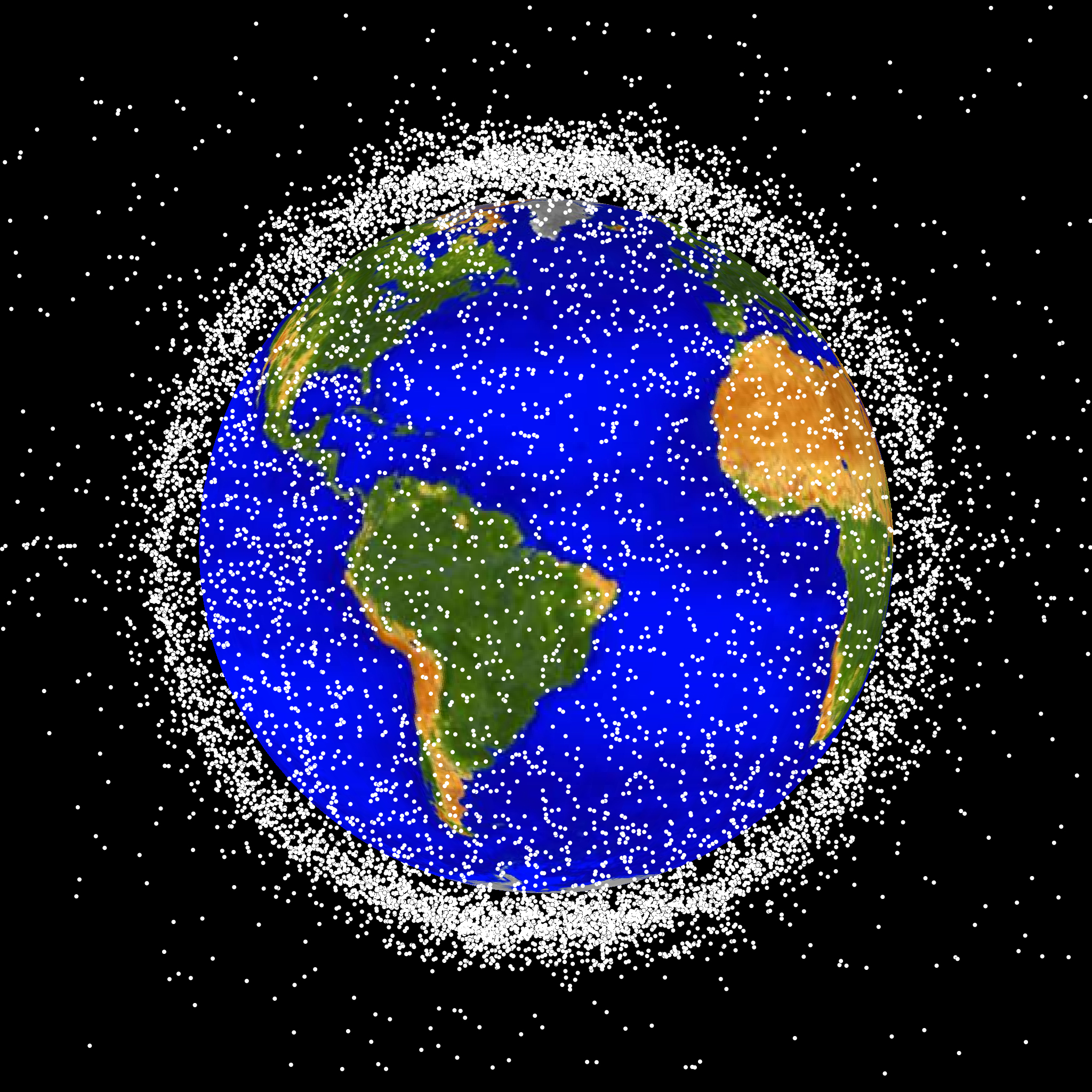
The scale of the problem is difficult to imagine because most debris cannot be seen from Earth with the naked eye. The European Space Agency maintains statistics using observations, tracking networks and mathematical modelling. According to its Space Debris User Portal, updated on 2 November 2026, the estimated orbital population includes about 47,280 regularly tracked objects, about 68,450 objects larger than 10 centimetres according to statistical modelling, about 1.5 million debris objects between 1 and 10 centimetres, and about 230 million debris objects between 1 millimetre and 1 centimetre. The modelled total includes both operational payloads and debris where appropriate, and the figures should be read as estimates, not as an exact census.
These figures reveal an important distinction between what scientists can track and what they estimate. A large object may be detected by radar or optical instruments and entered into a catalogue. Smaller objects are often too faint or too small to catalogue individually, so researchers estimate their numbers from models and from samples, such as returned spacecraft surfaces that show impact craters. Imagine counting vehicles on a motorway using cameras that can only identify buses and trucks. You might know how many large vehicles there are, but you would have to estimate the number of cars and motorcycles. That is broadly the difficulty facing orbital debris researchers.
Why are there so many objects?
Human spaceflight began in 1957 with the launch of Sputnik 1. Over the following decades, governments launched communication satellites, weather spacecraft, navigation systems and scientific missions. Each generation of launches added more hardware to the orbital environment. Some spacecraft completed their missions and were safely removed. Others remained in orbit. The situation became more complicated when satellites and rocket stages fragmented. Two particularly important historical events demonstrate the danger. In 2007, China intentionally destroyed its Fengyun-1C weather satellite during an anti-satellite test, creating thousands of fragments. In 2009, the active American Iridium 33 communications satellite collided with the inactive Russian Cosmos 2251 satellite, creating another large debris cloud. Both events generated substantial amounts of orbital debris, and NASA identifies these events as major contributors to the growth of the catalogued debris population. The lesson is straightforward: space debris is not generated only by accidental failures. Human decisions matter too.
The problem is not evenly distributed
It is tempting to imagine a uniform cloud of rubbish surrounding Earth. Reality is more complicated. Debris is concentrated in particular orbital regions, especially in low Earth orbit, or LEO, which extends to approximately 2,000 kilometres above Earth's surface and contains many important satellites. NASA identifies particularly significant debris concentrations at certain altitudes within this region, including around 800 to 1,000 kilometres. A relatively quiet orbital region can coexist with a much more crowded one. This is why discussions about orbital congestion must consider altitude, inclination, orbital lifetime and the type of mission, not just the total number of objects.
3. Why Even a Tiny Piece of Debris Can Be Dangerous
On Earth, a small piece of metal travelling slowly may cause little damage. In orbit, the same object can become a serious threat. The reason is speed. Objects in low Earth orbit typically travel at approximately 7 to 8 kilometres per second. When two objects meet head-on, their relative speed can be far higher. NASA describes an average orbital debris impact speed of approximately 10 kilometres per second, with some encounters much faster. To understand the difference, consider a car travelling at 100 kilometres per hour. Now imagine a small metal fragment travelling thousands of times faster. At such speeds, the energy released during impact can be enormous, even if the fragment weighs only a few grams.
The difference between size and destructive power
A common misunderstanding is that only large pieces of debris matter. In reality, small objects can be extremely dangerous. A fragment measuring one centimetre across might be too small to detect and track reliably in many cases, yet it carries enough energy to disable a satellite. NASA's orbital debris research identifies millimetre- to centimetre-sized debris as a significant threat to spacecraft. The damage depends on several factors: the object's mass, its velocity relative to the spacecraft, its shape and material, the location of the impact, and the protection surrounding the affected component. A small fragment hitting a solar panel may reduce electricity generation. A fragment striking a fuel tank, a sensor or a pressurised vessel could cause far more serious damage.
Why spacecraft need protective shielding
Engineers cannot simply build satellites with extremely thick metal walls. Every additional kilogram increases launch costs and affects spacecraft design. Instead, engineers develop specialised protective structures. One example is the Whipple shield, which generally consists of a thin outer bumper separated from an internal protective wall. When a tiny projectile strikes the outer layer, it breaks apart and spreads into a cloud of smaller, slower particles that the inner wall can absorb. The idea is similar to using multiple layers of protection rather than expecting one thick wall to stop everything. However, shielding has limitations. It cannot protect every component against every possible impact, and large fragments may overwhelm protective structures entirely.
The International Space Station faces the same problem
The International Space Station is an especially important example because it carries astronauts. Its operators continuously monitor potential conjunctions, which are predicted close approaches between the station and another object. When the calculated collision risk becomes sufficiently high, the station can perform a debris avoidance manoeuvre, changing its trajectory slightly to avoid a predicted encounter. The manoeuvre may be small, but it requires planning, fuel and coordination. The ISS also uses protective shielding in selected areas to reduce the risk from smaller particles. This demonstrates an important reality: space debris is not a distant theoretical problem. It is already shaping how astronauts live and work in orbit, every day.
4. What Is the Kessler Syndrome?
Perhaps the most worrying concept in orbital debris research is the Kessler syndrome. It takes its name from NASA scientist Donald J. Kessler, who described the possibility of a cascading collision process in 1978. The basic idea is surprisingly simple. Imagine a crowded room filled with glass objects. One object falls and breaks. Its fragments strike nearby objects, causing additional breakages. Those fragments cause further breakages, and eventually the original accident becomes a chain reaction. The Kessler syndrome describes a similar possibility in orbit: collisions create debris, debris causes more collisions, and those collisions create still more debris.
How the chain reaction works
Consider a hypothetical sequence. Stage 1: a collision occurs, and two large objects collide in orbit, both breaking apart and producing numerous fragments. Stage 2: the debris cloud spreads, and the fragments continue travelling around Earth along their own trajectories, becoming additional hazards for functioning satellites and other debris. Stage 3: more collisions become possible, as some fragments encounter other large objects and those collisions generate still more fragments. Stage 4: the population becomes increasingly self-generating, because in sufficiently congested orbital regions, collisions may produce new debris faster than natural processes remove old debris. The result is a potentially self-sustaining cycle that could continue even if humanity stopped launching satellites altogether.
Does the Kessler syndrome mean Earth will become surrounded by an impenetrable wall?
No. This is an important distinction. The Kessler syndrome does not mean every object in orbit will suddenly collide or that space will become completely unusable. It describes a potential long-term process in which certain orbital regions become increasingly hazardous and expensive to use. Different altitudes have different debris populations and natural removal rates. In lower orbits, atmospheric drag gradually slows objects and eventually causes many of them to re-enter the atmosphere. At higher altitudes, debris can remain in orbit for much longer. The consequences therefore depend on where debris accumulates and how quickly it is removed.
Has the Kessler syndrome already started?
The answer requires care. Scientists have observed collisions, fragmentation events and an increasing debris population. The ESA's 2026 report warns that collision-driven debris growth is becoming a serious long-term concern. However, this does not establish that a complete, unstoppable cascade has already begun throughout low Earth orbit. It is more accurate to say that the conditions that could lead to cascading collisions are a growing concern, and that the risk increases the longer large, uncontrolled objects remain in crowded orbits. The distinction matters because the Kessler syndrome is a scenario with different possible outcomes, not a single event with a fixed date. What happens next depends on decisions made now about launching, disposing of and removing spacecraft.
5. Why the Satellite Boom Is Making the Problem More Complicated
Space is experiencing a commercial transformation. A satellite launch that once required an enormous government programme can now be purchased through a commercial provider. Smaller satellites have also become more affordable and capable. This has created opportunities for businesses, universities and governments. Satellite constellations can provide internet access, monitor forests, track ships, improve weather forecasting and support disaster response. But the benefits come with a new challenge: traffic.
The rise of satellite constellations
A constellation is a group of satellites working together as one coordinated system. Instead of depending on one spacecraft, operators deploy many satellites across carefully planned orbits. This approach can improve coverage, reduce communication delays and provide redundancy if one satellite fails. However, thousands of satellites require careful orbital management. The ESA's 2026 report records more than 4,000 new payloads entering orbit during 2025, following more than 3,500 in 2024, and the total number of active satellites is now well above 10,000. Each new satellite is another vehicle on an already busy road, and each one will eventually need to be removed or replaced.
More satellites mean more coordination
Imagine an airport. A small airport can manage a limited number of aircraft using a relatively simple traffic system. An international airport requires radar, communication networks, flight plans, air traffic controllers and strict rules. The same principle applies to orbital traffic. As satellite numbers increase, operators need better information about the planned position of each spacecraft, its predicted future trajectory, potential encounters with other satellites, its ability to manoeuvre, its remaining fuel and operational lifetime, and its disposal plan after the mission. The challenge is that orbital traffic management is not yet as unified as the air traffic control system. Different countries and companies operate different spacecraft and use different data systems. Better international coordination is therefore essential, and it is becoming more urgent every year.
The danger of abandoned satellites
An operational satellite can often manoeuvre away from a potential collision. A dead satellite generally cannot. This creates an unusual problem: the more spacecraft that become inactive without being removed, the more uncontrolled hazards accumulate in orbit. It is similar to allowing thousands of abandoned vehicles to remain on busy roads. Even if every new driver follows the rules, the old vehicles continue creating hazards. That is why disposal planning, not just launch planning, has become a central part of responsible spaceflight.
6. How Scientists Track Space Debris
Cleaning up space begins with knowing what is there. But tracking debris is a difficult scientific and engineering challenge. Scientists use several technologies to observe objects in orbit, and each one has strengths and limitations.
Ground-based radar
Radar systems transmit radio signals towards objects and analyse the reflected signals. By measuring how the signal returns, researchers can estimate an object's distance, movement and orbit. Radar is particularly useful for detecting objects that do not reflect sunlight or are too faint for optical telescopes, and it can operate day and night, in many weather conditions.
Optical telescopes
Telescopes observe sunlight reflected by satellites and debris. They are particularly useful for tracking objects in higher orbital regions, including geostationary orbit. However, their effectiveness depends on weather, lighting conditions, object brightness and observing geometry. A small, dark object may be very hard to see, even with a powerful telescope.
Space-based sensors
Satellites equipped with specialised instruments can observe objects from orbit. Space-based observation offers different viewing angles and may help detect objects that are difficult to observe from the ground. It also avoids some of the limitations imposed by Earth's atmosphere and weather.
Artificial intelligence and prediction
The growing number of orbital objects creates an enormous data-processing challenge. Artificial intelligence and advanced mathematical models can help researchers identify patterns in observations, estimate future trajectories, compare predicted positions, detect possible conjunctions, improve object classification and prioritise potentially dangerous encounters. However, AI cannot magically eliminate uncertainty. An orbital prediction depends on the accuracy of measurements and the quality of the mathematical model. A tiny error in an object's estimated position or velocity can become important when predicting its path days or weeks ahead. Human expertise remains essential when interpreting warnings and deciding whether a spacecraft should manoeuvre.
Why scientists cannot track everything
The smallest fragments are difficult to detect consistently. A radar system that can identify a large rocket stage may not be able to catalogue every millimetre-sized particle. This means spacecraft operators must combine direct observations with statistical models. It is similar to weather forecasting. Meteorologists cannot measure every molecule in the atmosphere, but they can use observations and models to make useful predictions. Orbital debris researchers work with a comparable mixture of measurement and modelling, and they are honest about the uncertainty that remains.
7. What Happens When a Satellite Reaches the End of Its Life?
One of the most effective ways to reduce future debris is to plan for a satellite's retirement before it is even launched. This is called end-of-life disposal. A satellite should not simply stop working and remain in an important orbital region indefinitely. Its designers and operators need to consider what will happen when its mission ends, and they need to build that plan into the spacecraft from the start.
Controlled re-entry
Some satellites can use their remaining propulsion to lower their orbits. As they descend into denser atmospheric layers, atmospheric drag increases. Eventually, the spacecraft re-enters the atmosphere. Most spacecraft materials burn up or break apart during this process, although some components may survive to reach the ground, which is why operators plan re-entries carefully and, where possible, aim for uninhabited ocean areas.
Moving into a graveyard orbit
Some satellites operate in geostationary orbit, approximately 35,786 kilometres above Earth's equator. At the end of their missions, operators may move them into a higher disposal orbit, often called a graveyard orbit. This helps reduce interference with operational spacecraft. However, it is not the same as completely removing the object from space, and the graveyard orbit itself must be managed so that it does not become a new source of congestion.
Passivation
Another important measure is passivation. Passivation means removing or reducing stored energy that could cause a spacecraft or rocket stage to explode later. For example, operators may vent remaining propellant and discharge batteries. Think of switching off a machine and releasing stored pressure before leaving it unattended. The goal is to reduce the possibility that an abandoned object becomes a source of additional debris years after its mission ends.
The move from 25 years to five years
A significant development in debris mitigation is the move towards shorter disposal timelines in low Earth orbit. The ESA's 2026 report describes the transition from a traditional 25-year disposal target to a five-year target for many missions. This is a meaningful improvement. However, a disposal target is not a universal guarantee that every satellite will leave orbit within that time. Requirements, national regulations, mission types and applicable standards differ, and a satellite that cannot manoeuvre after failure may not be able to follow its planned disposal strategy. Prevention must therefore begin during design, not just at the end of a mission.
8. Can We Actually Clean Up Space?
Preventing new debris is essential. But what about the millions of objects already in orbit? This is where active debris removal becomes important. Active debris removal involves sending a spacecraft to approach, capture and remove another object from orbit. It is considerably more difficult than it sounds. A dead satellite is not waiting in a fixed position. It is travelling at orbital speed, rotating, and possibly tumbling unpredictably. A removal spacecraft must approach it safely, match its motion and capture it without causing additional debris.
Robotic arms
One proposed solution uses robotic arms. The removal spacecraft approaches an abandoned satellite and captures it using mechanical arms. The captured object can then be guided towards atmospheric re-entry. This is one of the technologies being developed for ESA's ClearSpace-1 mission, and it is also being studied for satellite servicing, where a spacecraft might repair or refuel another satellite instead of removing it.
Nets
Another proposed approach involves deploying a net around a target. The net captures the object and allows the removal spacecraft to control its movement. This concept is particularly interesting for objects that are difficult to grab using conventional mechanical arms, because a net can conform to an irregular shape. The RemoveDEBRIS mission demonstrated net capture in orbit in 2018, showing that the basic idea can work in space.
Harpoons
Harpoons have also been studied as a possible capture mechanism. A spacecraft could attach a tether to a target and use it to control or deorbit the object. However, this approach requires extremely careful engineering because the target may be fragile, rotating or covered in materials that do not hold a harpoon reliably. A failed capture attempt could itself create debris, so any such system must be tested thoroughly.
Tethers and propulsion systems
Long tethers and propulsion-based systems may help change the orbit of captured or specially equipped objects. Some concepts use electrodynamic tethers to interact with Earth's magnetic field and generate a force that lowers an orbit. Other systems use propulsion to lower an object's orbit more directly. Each method has different advantages and limitations, and the most suitable technology depends on the target's size, shape, orbit and physical condition. There is no single tool that can clean up every kind of debris.
9. ClearSpace-1: Europe's Plan to Remove an Abandoned Satellite
One of the most closely watched active debris removal programmes is ClearSpace-1. The mission is being developed with the European Space Agency and an industrial team led by OHB, working with ClearSpace, a Swiss company founded to clean up space. Its target is ESA's PROBA-1 satellite. Launched in 2001, PROBA-1 weighs approximately 95 kilograms. The satellite was not designed with a modern docking or removal interface, which makes it an interesting engineering challenge: the removal spacecraft must capture a satellite that was never built to be captured.
The removal spacecraft is planned to approach the target and capture it using four robotic arms. The two objects would then be guided together towards atmospheric re-entry, where they would burn up. As of November 2026, ESA lists the planned launch for 2029. This is a future mission, not a completed debris-removal operation, and that distinction is important. Capturing an unprepared satellite is much more difficult than removing a spacecraft that has been designed for servicing or disposal. ClearSpace-1 is therefore intended to demonstrate technologies that could support a future commercial debris-removal service. If successful, it could help establish a practical model for removing some of the most concerning abandoned objects in orbit.
Why not remove every piece of debris?
Because it would be technically and economically unrealistic. A removal spacecraft cannot chase hundreds of millions of tiny particles individually. A more practical approach is to prioritise large objects that could generate enormous quantities of new debris if they collide or explode. Removing a single large abandoned rocket stage might prevent a future fragmentation event that would create thousands of trackable fragments and countless smaller ones. This is similar to removing a dangerous abandoned vehicle from a busy motorway rather than attempting to collect every piece of litter on the roadside. Prevention and targeted removal work together.

10. The Commercial Business of Cleaning Up Space
Space debris is not only an environmental issue. It is also becoming a business opportunity. Companies are developing technologies for satellite inspection, servicing, refuelling, life extension and active debris removal. The concept is sometimes described as in-space servicing, assembly and manufacturing, or ISAM. Instead of treating satellites as disposable machines, companies could eventually repair or upgrade them in orbit, extending their useful lives and reducing the need for replacement launches.
Satellite servicing
A servicing spacecraft could approach a satellite and perform maintenance. Depending on its design, it might replace components, inspect damage or provide additional fuel. This could extend the useful life of expensive spacecraft, and it could also help operators understand why a satellite failed. Northrop Grumman's Mission Extension Vehicle has already demonstrated docking with satellites in geostationary orbit to extend their lives, showing that servicing is no longer purely theoretical.
Refuelling
Fuel is one of the factors that limits how long many satellites can operate. If spacecraft could be refuelled in orbit, they might remain useful for longer. However, refuelling requires compatible connections, reliable robotic operations and carefully designed interfaces. Many existing satellites were not built for this purpose, so refuelling is most promising for future spacecraft that are designed from the start to be serviced.
Inspection and monitoring
A servicing spacecraft could also inspect a satellite without capturing it. This may help operators identify damage, investigate unexpected behaviour or determine whether a spacecraft is safe to approach. Companies such as Astroscale are developing inspection missions, including missions to approach and photograph defunct satellites and rocket stages, gathering information that will be essential for future removal attempts.
The challenge of making removal profitable
There is an obvious economic difficulty. A satellite operator may be willing to pay for a service that extends the life of a functioning spacecraft. But who pays to remove an abandoned object? The company responsible for the debris may no longer exist. The object may belong to a government or to a company in another country. There are also legal questions involving ownership, consent and responsibility. A satellite cannot simply be treated as abandoned property that anyone is free to capture. International cooperation and clear legal agreements will be essential before debris removal can become a routine commercial service.
11. The Role of Governments and International Rules
Space is used by countries around the world. No single government controls the entire orbital environment. That makes international cooperation particularly important. The Outer Space Treaty of 1967 established fundamental principles governing activities in space, including that states are responsible for their national space activities and that space should be used for the benefit of all. Other international frameworks address registration, liability and space debris mitigation. However, international guidelines are not always equivalent to enforceable domestic regulations, and that gap is one of the central problems in orbital sustainability.
Why stronger rules are needed
Consider what would happen if every country developed its own completely different road safety system. Vehicles would face different standards, drivers would struggle to coordinate, and enforcement would be inconsistent. Orbital traffic faces a similar challenge. A more sustainable system requires common expectations about satellite registration and identification, sharing orbital information, collision avoidance, end-of-life disposal, prevention of accidental explosions, responsible launch and deployment practices, and liability for debris-generating events. Without common rules, responsible operators can be undercut by operators that take shortcuts.
ESA's Zero Debris initiative
The European Space Agency has established a Zero Debris approach aimed at significantly limiting the creation of new debris from ESA missions, and it has supported the Zero Debris Charter, which encourages organisations across the space sector to commit to debris mitigation. The programme includes improvements in spacecraft design, disposal procedures, prevention of fragmentation and better tracking. The important idea is that sustainability must become part of the entire mission lifecycle. A satellite should be designed with its retirement in mind, not as an afterthought.
Why voluntary commitments may not be enough
Companies may support sustainability in principle but face financial pressure to launch quickly and cheaply. If responsible disposal is expensive and competitors are not required to follow the same standards, there is a temptation to cut corners. This is why transparent standards, meaningful enforcement and international cooperation matter. A sustainable orbital environment is a shared resource. Its protection should not depend entirely on whether individual companies consider it commercially attractive in the short term.
12. The Hidden Risk: Space Debris Can Also Affect Life on Earth
The most obvious concern is what happens in orbit. But debris can also return to Earth. Objects in low Earth orbit gradually lose altitude because of atmospheric drag. Eventually, they re-enter the atmosphere. Many small objects burn up during re-entry. Larger objects can break apart, and some components may survive the journey to the ground.
How dangerous is falling space debris?
The probability of a person being harmed by an individual uncontrolled re-entry is generally low. However, the total number of objects returning to Earth is increasing. The ESA's 2026 report introduced a specific metric for estimating the casualty risk associated with re-entries, and it notes that the overall probability remains low compared with many everyday risks, while the long-term trend deserves attention. This is a useful example of how scientific risk assessment works. A low probability does not mean zero risk, and a growing number of events can change the overall risk even when each individual event remains unlikely.
Designing satellites to burn up more completely
Engineers are investigating design-for-demise approaches. These involve designing spacecraft so that their components are more likely to burn up during atmospheric re-entry. The goal is to reduce the amount of surviving material that reaches the ground. This requires careful material selection and testing. A component that seems harmless in orbit may behave differently during the intense heating of re-entry, and a material that is strong in space may be precisely the material that survives to the ground.
What about atmospheric pollution?
Another emerging research question concerns the chemical effects of spacecraft re-entry. As the number of satellites increases, more material may enter the upper atmosphere, including metals such as aluminium. Scientists are investigating the possible environmental consequences, including effects on the ozone layer and on the upper atmosphere. At present, the scale and long-term implications require further study. It would be premature to claim that satellite re-entries are already causing a particular level of global harm. However, monitoring these effects is an important part of responsible space development, and it is an area where more measurement is needed.
13. Will Space Debris Stop Humanity From Exploring Space?
It is understandable to wonder whether Earth's orbital environment could eventually become too dangerous to use. The answer is not a simple yes or no. Space is enormous, and the debris problem is concentrated in particular regions. There are still many possible orbital paths and opportunities for scientific missions. However, increasing congestion could make some missions more expensive and complicated, and it could force operators to spend more time and money on collision avoidance instead of on science.
The effect on scientific research
Earth-observation satellites provide data about climate, forests, oceans, agriculture and natural disasters. Weather satellites help forecast storms. Scientific spacecraft measure radiation, study the atmosphere and support astronomy. If orbital risks increase, operators may need to spend more resources on collision avoidance, shielding and insurance. That could reduce the money available for scientific research, and it could delay missions that depend on particular orbits.
The effect on commercial communications
Satellite internet services are particularly dependent on reliable constellations. A significant collision or widespread debris problem could disrupt individual satellites and require operators to launch replacements, reconfigure their networks or accept reduced service. This could increase operating costs and, ultimately, the cost of the services that depend on those satellites.
The effect on human exploration
Space stations and future crewed missions must consider the debris environment. A serious increase in orbital hazards could require more protective measures, additional monitoring and more frequent avoidance manoeuvres. However, this does not mean that journeys to the Moon or Mars are automatically impossible. The orbital environment around Earth must be managed carefully, but different destinations and trajectories present different challenges, and the debris problem is concentrated around Earth, not throughout the Solar System.
A problem that can still be managed
The situation is serious, but there are reasons for cautious optimism. Scientists understand the physics of orbital collisions. Governments and companies are improving tracking systems. Spacecraft disposal practices are becoming more ambitious. New technologies are being developed to inspect, service and remove objects. The biggest challenge is making these measures widespread enough to match the growth in space activity, and doing so quickly enough to prevent the most crowded orbits from becoming much harder to use.
14. What Could the Future of Space Look Like?
There are two broad possibilities. One future involves continuing to launch spacecraft without sufficiently improving disposal and debris prevention, while the number of satellites keeps growing. Another involves building an orbital environment where sustainability is treated as a basic requirement of spaceflight, like safety checks before a launch.
Scenario A: Business as usual
If the number of satellites continues growing while old debris remains in orbit, certain regions may become more hazardous. Collision avoidance may become more frequent. Insurance and operating costs could rise. Some missions may need to avoid particular orbital bands. The ESA's 2026 projections highlight the possibility of significantly worsening long-term conditions if mitigation does not improve, with collision-driven debris growth becoming a larger share of the problem over time.
Scenario B: Responsible space development
In a more sustainable future, satellites are designed to dispose of themselves safely, operators share accurate orbital information, rocket stages are prevented from becoming long-term hazards, large abandoned objects are removed where practical, spacecraft are designed for servicing and reuse, international rules become more consistent, and artificial intelligence improves traffic prediction. This would not eliminate every fragment. But it could reduce the rate at which new debris is generated and prevent some of the most dangerous collisions from happening in the first place.
The possibility of a circular space economy
An especially interesting long-term possibility is a circular economy in space. Instead of launching new hardware every time a satellite fails, companies might eventually repair, refuel or upgrade satellites in orbit. Materials and components could be reused in future orbital manufacturing systems. This would require major technological advances, but the concept is already influencing research and mission design. The broader lesson is that the future of spaceflight may depend as much on maintaining existing infrastructure as on building new rockets.
15. What We Know, What Remains Uncertain, and What Comes Next
The debate about orbital debris contains established scientific findings, reasonable projections and open questions. Keeping those categories separate is essential, because confusing a projection with a fact, or an uncertainty with a reason to do nothing, makes the problem harder to solve.
What is known
Several facts are well established. First, Earth orbit contains a large and growing population of human-made objects. Second, many objects are too small to be tracked individually. Third, collisions at orbital speeds can produce serious damage. Fourth, fragmentation events can generate additional debris. Fifth, the expansion of commercial satellite constellations is increasing the demands placed on orbital traffic management. Finally, responsible disposal and active debris removal are important parts of a long-term solution.
What remains uncertain
Several important questions remain open. How quickly will the debris population grow? The answer depends on launch rates, collision frequency, spacecraft reliability and disposal compliance. Will certain orbital regions experience runaway collision growth? Models can explore possible scenarios, but the outcome depends on many variables and is not a fixed prediction. How economically practical will debris removal become? Removing large objects is technically challenging and expensive, and the business models needed to make it routine are not yet proven. What will be the atmospheric effects of increasing re-entries? Scientists need more measurements to understand the long-term consequences. How quickly will international rules improve? Technical progress may move faster than diplomatic agreements and national regulations.
What should happen next?
The next decade will be important. Space agencies, governments, satellite manufacturers and commercial operators need to move beyond treating sustainability as an optional extra. It should become a fundamental part of mission design. Tracking systems must become more accurate. Operators should share information more effectively. Disposal strategies should be reliable. And active debris removal must move from demonstration projects towards practical, repeatable services. The goal is not to stop humanity from exploring space. It is to ensure that the infrastructure enabling that exploration remains usable, so that future generations can still reach orbit, study Earth and explore the Solar System.
Key Takeaways
- Space debris includes dead satellites, abandoned rocket stages and fragments created by collisions and explosions.
- ESA's November 2026 statistics estimate approximately 68,450 objects larger than 10 centimetres, 1.5 million objects between 1 and 10 centimetres, and 230 million objects between 1 millimetre and 1 centimetre.
- Objects in low Earth orbit travel at approximately 7-8 kilometres per second, and relative impact speeds average about 10 kilometres per second.
- Even small fragments can damage spacecraft because of their extraordinary relative impact speeds.
- The Kessler syndrome describes a potential chain reaction in which collisions generate debris that causes further collisions.
- The problem is concentrated in particular orbital regions, especially low Earth orbit, rather than being evenly distributed around Earth.
- Large satellite constellations are increasing the need for better space traffic management.
- Radar, optical telescopes, space-based sensors and mathematical models help scientists monitor orbital objects.
- End-of-life disposal, passivation and responsible spacecraft design can reduce future debris.
- Active debris removal technologies include robotic arms, nets, harpoons, tethers and propulsion systems.
- ESA's ClearSpace-1 mission is planned to remove the 95-kilogram PROBA-1 satellite, with launch currently planned for 2029.
- Space debris can also return to Earth, making re-entry safety and design-for-demise important research topics.
- International cooperation and consistent regulations will be essential for long-term orbital sustainability.
- The problem is serious, but preventing new debris and removing selected dangerous objects can help preserve space for future generations.
Frequently Asked Questions
1. What is space debris?
Space debris is human-made material in orbit that no longer serves a useful purpose. It includes dead satellites, spent rocket stages, fragments from collisions and explosions, and tiny particles such as paint flakes and metal shards.
2. How much space debris is there in 2026?
ESA's statistics updated on 2 November 2026 estimate approximately 68,450 objects larger than 10 centimetres, 1.5 million objects between 1 and 10 centimetres, and 230 million objects between 1 millimetre and 1 centimetre. About 47,280 objects are regularly tracked.
3. What is the Kessler syndrome?
The Kessler syndrome is a theoretical scenario in which collisions between objects in orbit generate debris, and that debris causes further collisions, creating a self-sustaining chain reaction in crowded orbital regions.
4. Who discovered the Kessler syndrome?
NASA scientist Donald J. Kessler described the concept in 1978. His work examined how increasing congestion in low Earth orbit could lead to collisions producing debris faster than natural processes remove it.
5. Can a tiny piece of space debris destroy a satellite?
Yes. A small fragment can cause serious damage because orbital objects travel at several kilometres per second. A one-centimetre fragment can disable a satellite, and even millimetre-sized particles can damage solar panels and sensors.
6. How fast does space debris travel?
Objects in low Earth orbit typically travel at approximately 7-8 kilometres per second. Relative collision speeds average about 10 kilometres per second, and head-on encounters can be much faster.
7. Where is space debris most concentrated?
Much of Earth's orbital debris is found in low Earth orbit, within approximately 2,000 kilometres of the surface, with particularly significant concentrations at altitudes around 800 to 1,000 kilometres.
8. Does the International Space Station avoid space debris?
Yes. The ISS is monitored for potential collisions. When a sufficiently concerning encounter is predicted, the station performs a debris avoidance manoeuvre, changing its orbit slightly. It also has protective shielding in selected areas.
9. Can space debris fall to Earth?
Yes. Objects in orbit can gradually lose altitude because of atmospheric drag and eventually re-enter the atmosphere. Most small objects burn up, but some components of larger objects can survive to the ground, which is why re-entry risk is studied carefully.
10. How do scientists track space debris?
Scientists use ground-based radar, optical telescopes, space-based sensors and mathematical models, increasingly assisted by artificial intelligence, to detect objects, estimate their orbits and predict possible close approaches.
11. Can artificial intelligence help solve the space debris problem?
AI can assist with analysing tracking data, identifying objects, predicting conjunctions and improving traffic management. It cannot eliminate uncertainty, and human expertise remains essential for decisions about manoeuvres.
12. What is active debris removal?
Active debris removal means sending a spacecraft to capture or otherwise interact with an abandoned object and guide it towards atmospheric re-entry or a disposal orbit, using robotic arms, nets, harpoons, tethers or propulsion.
13. What is ESA's ClearSpace-1 mission?
ClearSpace-1 is a planned European debris-removal demonstration targeting ESA's 95-kilogram PROBA-1 satellite, using four robotic arms. As of November 2026, ESA lists its planned launch for 2029.
14. Will space debris make space exploration impossible?
Not necessarily. Space debris creates increasing risks and costs in particular orbital regions, but space is vast, and many missions remain possible. The risk depends on whether mitigation, disposal and removal improve as fast as satellite numbers grow.
15. What is the best way to prevent space debris?
The most effective strategy combines prevention and cleanup. Satellites should be designed for safe disposal, passivated at the end of their missions, removed from crowded orbits within a few years, and, where practical, large abandoned objects should be removed by dedicated missions, supported by clear international rules.
Sources and Further Reading
The following sources provide scientific background, official statistics and technical information used in this article.
- European Space Agency — Space Environment Report 2026. https://www.esa.int/Space_Safety/Space_Debris/ESA_Space_Environment_Report_2026
- European Space Agency — Space Debris User Portal / Space Environment Statistics. https://sdup.esoc.esa.int/
- European Space Agency — ClearSpace-1. https://www.esa.int/Space_Safety/ClearSpace-1
- European Space Agency — Active Debris Removal. https://www.esa.int/Space_Safety/Space_Debris/Active_debris_removal
- NASA — Orbital Debris Program Office. https://orbitaldebris.jsc.nasa.gov/
- NASA — Orbital Debris Frequently Asked Questions. https://orbitaldebris.jsc.nasa.gov/faq/
- NASA Office of Inspector General — NASA's Efforts to Mitigate the Risks Posed by Orbital Debris. https://oig.nasa.gov/reports-and-publications/
- Organisation for Economic Co-operation and Development — The Space Economy at a Glance 2026. https://www.oecd.org/en/publications/space-economy.html
- European Space Agency — Zero Debris Initiative. https://www.esa.int/Space_Safety/Space_Debris/Zero_Debris
Photo Credits and Image Licensing
Photo 1 — Earth's orbital debris environment. Direct image: https://orbitaldebris.jsc.nasa.gov/photo-gallery/_images/highresolution/LEO-2019-2048.jpg Credit: NASA Orbital Debris Program Office. Type: Computer-generated scientific visualisation, based on tracked orbital objects as of 1 January 2019. NASA's gallery states that its images are generally available for public use unless otherwise noted.
Photo 2 — Orbital debris observed from the International Space Station. Direct image: https://upload.wikimedia.org/wikipedia/commons/f/fd/A_piece_of_unidentified_space_debris_is_pictured_from_the_International_Space_Station_%28iss074e0540224%29.jpg Credit: NASA / Chris Williams. Date: 27 April 2026. Source: NASA Johnson Space Center, ISS photograph ISS074E0540224, via Wikimedia Commons. Check the Wikimedia Commons file's licensing and attribution information before commercial reuse.
Editorial note: The numerical statistics in this article are dated to the November 2026 ESA portal update and to the ESA 2026 Space Environment Report. Figures are estimates and may be revised as tracking and modelling improve. No AI-generated images were used in this article.
The conversation
Post a Comment