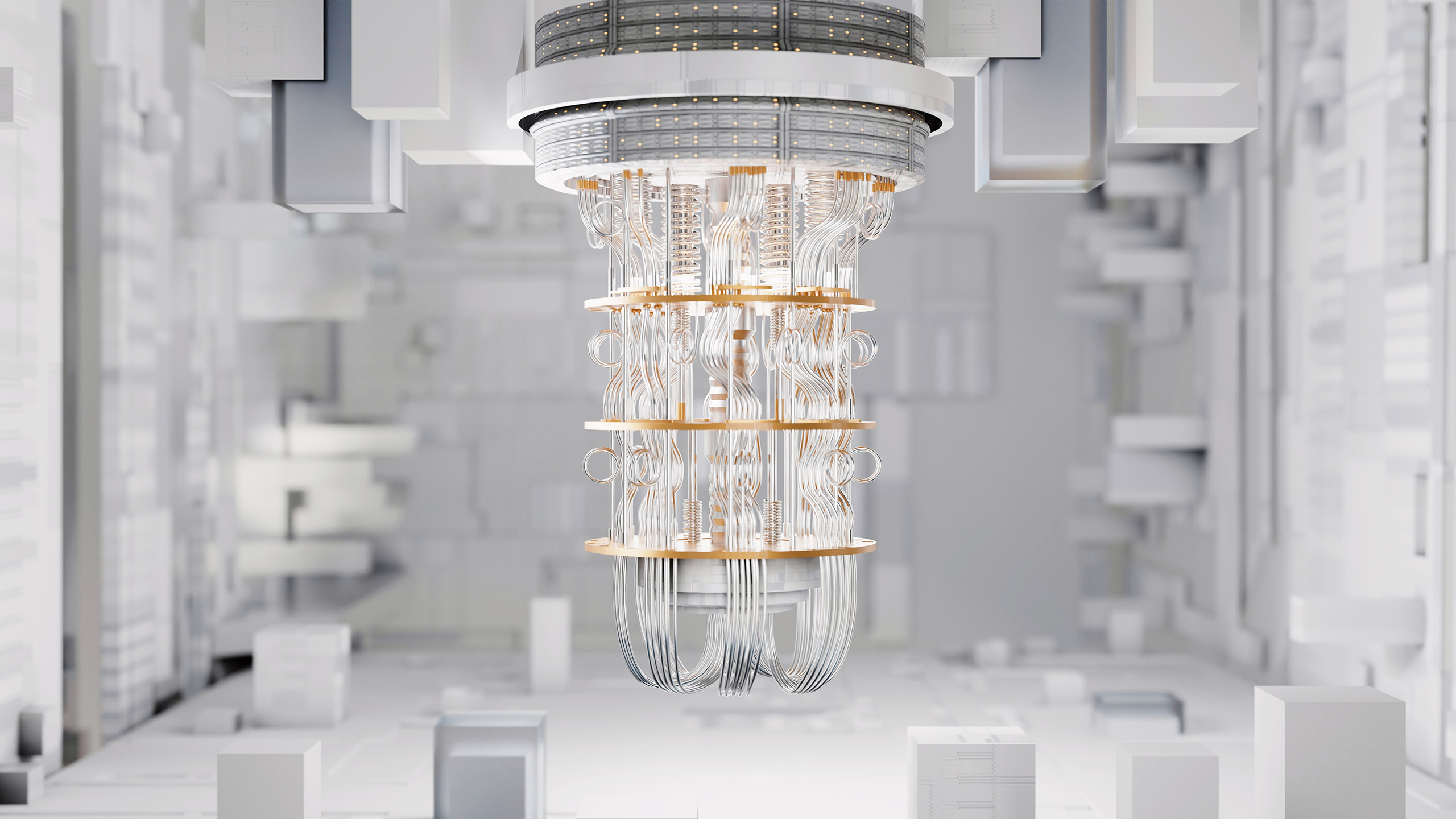
Quantum computers are supposed to change everything — design life-saving drugs, crack unbreakable codes, model the climate down to the molecule. But anyone who has followed the field knows the dirty secret: today's quantum machines make mistakes. Constantly.
On October 15, Google's Quantum AI team reported progress on one of the field's most stubborn problems. In a study published in the journal Science, researchers showed that their Willow quantum processor can now "grow" a fragile but essential ingredient called magic states with roughly 40 times fewer errors than before — hitting a record fidelity of 99.99 percent. It is the first time magic state cultivation has run on real hardware.
It is not a working quantum supercomputer. It is not the end of encryption. But it is a meaningful brick laid on the long road toward machines that actually work — and the way the team got there is almost as interesting as the result.
The bottleneck nobody talks about
To understand why this matters, you need a quick tour of how a quantum computer calculates.
A regular computer builds everything from a handful of simple logic gates — AND, OR, NOT. A quantum computer has its own gate set, called Clifford gates. The catch, as Google researcher Emma Rosenfeld — the study's lead author — explains, is that Clifford gates alone can be faked by an ordinary computer. The real power of a quantum machine is unlocked by one extra operation: a non-Clifford gate, most often called the T gate.
That gate is produced by consuming a magic state — a qubit prepared in an extremely precise blend of 0 and 1. Every time the machine performs its most valuable operations, it burns through magic states and needs fresh ones.
And here is the bottleneck: making those states precisely enough is brutally expensive. The standard recipe, called distillation, refines many imperfect states into fewer accurate ones. Some estimates suggest that as much as 95 percent of a future quantum computer's capacity could be devoured just manufacturing magic states — leaving almost nothing for actual computation.
That is the problem Google just dented.
How you "grow" a quantum state
In 2024, three Google researchers — Craig Gidney, Noah Shutty and Cody Jones — proposed an alternative called cultivation. The gardening metaphor is deliberate, and it is the clearest way to understand it.
Instead of distilling many states into one, you start with a single rough magic state encoded in just a few qubits. The trick is to interrogate it without destroying it. Normally, measuring a quantum state collapses it into a 0 or a 1. Cultivation asks a different question: not "are you 0 or 1?" but "are you the right magic state — yes or no?"
States that pass are spread across more qubits for stronger protection. States that fail are discarded. The state starts small, gets checked, and grows — like a seedling transplanted into richer soil only after surviving the first frost.
On paper, the idea promised the same purity as distillation with far less waste. The question was whether it would survive contact with a real, noisy quantum chip.
What happened inside Willow
The team tested cultivation on Willow, Google's 105-qubit superconducting processor. The experiment used 54 of those qubits.
Without cultivation, about four attempts in a thousand produced a faulty state. With cultivation, errors fell by roughly a factor of forty. The team produced the critical T-states at a logical fidelity of 99.99 percent — a record for this kind of experiment.
There is an asterisk, and the team puts it in the open: cultivation works by rejection. Only about 8 percent of attempts survived the checks — 92 percent were thrown away. "The Google experiment shows that cultivation works in practice," said Kenneth Brown, director of the Duke Quantum Center, who was not involved in the study — while noting that the high rejection rate is the price of that quality.
Getting this far required serious engineering: low-frequency electrical noise — drifting lab equipment, temperature changes, stray magnetic fields — made the team's usual benchmarks unreliable, so they added extra controls and devised a new way to measure their own results.
To squeeze out the last drops of performance, the team used reinforcement learning — the same family of techniques behind game-playing AI — as a final calibration step, training the chip's controls for about four hours before collecting data. It improved both the error rate and the fraction of attempts kept by roughly a factor of ten.
The measurement that almost broke physics
Here is where the story gets genuinely strange.
At one point, the team's results appeared inconsistent with the laws of physics. The culprit was their quality-checking method, called logical state tomography, which estimates a quantum state by combining measurements taken in different ways.
The problem: because faulty attempts are discarded, different measurements can retain different subsets of attempts. Combining them can produce an estimate of a state that cannot physically exist — or inflate the fidelity without any obviously impossible result. The team traced the behavior to low-frequency phase noise from slow changes in qubit frequencies, residual magnetic fields and microwave interference.
Their fix was a new technique called kickback tomography, which produces a self-consistent assessment by design — measuring a lower bound on fidelity, so the real quality is at least this good and the measurement cannot fool itself. Simulations confirmed it behaves correctly at the device's actual noise levels.
This is the kind of unglamorous, meticulous work that separates real progress from press releases: a team that discovered their own yardstick might be lying to them, and built a better one.
From lab trick to real machine
A magic state is only useful inside a larger computation, so the team also demonstrated "grafting": transferring a cultivated state from one error-correction scheme (a color code) into a larger, more established one (a surface code) meant for broader use.
Then they stress-tested storage: with extended error-correction cycles after grafting, the observed error rate came in about seven times higher than simulations predicted. The likely culprit is "leakage" — qubits slipping outside the two states used to encode information — and the experimental circuits lacked dedicated leakage-removal operations.
This is the honest part of the story. Cultivation is a breakthrough in accuracy, but not yet in efficiency. The technology works on real hardware, but it still has to be shown at a much larger scale before it is practical — and Google says so itself.
What this changes — and what it doesn't
The most sensible question readers ask about any quantum milestone: does this bring us closer to a quantum computer breaking encryption?
Here is the measured answer. Right now, the team stands at roughly one error in 10,000 attempts. To simulate molecules — the nearer-term scientific prize, useful for chemistry and drug discovery — researchers estimate we would need magic states that fail only once in a million to once in a hundred million tries. To break RSA-2048 encryption, the standard protecting websites, banking and electronic ID cards, would require states that fail just once in ten billion tries.
Independent analyses put the gap into perspective: a cryptographically relevant machine would need on the order of 1,200 to 1,450 stable logical qubits, and scaling from today's architectures by roughly a hundred thousand times. This week's result, impressive as it is, does not recalculate that timeline. As analysts noted, it is a breakthrough in accuracy, not yet in efficiency — 8 percent yield means the factory rejects nearly everything it makes.
The realistic near-term target is not breaking codes; it is useful science — molecule simulation, materials design, complex optimization — applications where a quantum computer must be better than anything else we have, not perfect. "We're more galvanized than ever to get to these near-term scientific applications," Rosenfeld said.
That is the real story of this week: not a finish line, but a bottleneck beginning to crack — one of many that stand between today's noisy prototypes and tomorrow's useful machines.
The bottom line
Google's magic state cultivation is the kind of advance that does not make headlines for long but moves the field forward for years. A 2024 theory survived contact with real hardware. Errors fell fortyfold. Fidelity hit 99.99 percent. The measurement tools got sharper. And the path from preparing a delicate quantum state to actually using it in a computation got a little bit clearer.
Practical, fault-tolerant quantum computers are still years away, and plenty of hard problems remain — yield, storage, scale. But every one of those problems is now easier to see, measure and attack. Sometimes the most important breakthroughs are the ones that make the next breakthrough possible.
What do you think — will quantum computers deliver on their promises in this decade, or is the hype still ahead of the hardware? Let us know in the comments.
Frequently asked questions
What are magic states in quantum computing?
Magic states are specially prepared quantum states consumed to perform a quantum computer's most powerful operations — non-Clifford gates like the T gate. Without them, everything else a quantum computer does can be simulated by an ordinary machine. They are single-use, so a running computer must keep producing replacements.
What is Google's Willow chip?
Willow is Google's superconducting quantum processor with 105 physical qubits arranged in a square lattice. It debuted in late 2024 as a major step in quantum error correction, and the October 2026 magic-state experiment used 54 of its qubits.
What is magic state cultivation?
Cultivation is a technique proposed in 2024 by Google researchers Craig Gidney, Noah Shutty and Cody Jones as an alternative to the standard "distillation" method. A rough magic state is encoded in a few qubits, checked for errors, and flawed attempts are discarded. Survivors are spread across more qubits for stronger protection — hence the gardening name: the state starts small, gets checked, and grows.
Does this breakthrough threaten Bitcoin or encryption?
Not directly. Current results reach about one error in 10,000 attempts, while breaking modern encryption would require states failing just once in 10 billion tries — plus thousands of stable logical qubits, roughly a hundred-thousand-fold scale-up from today's hardware. Cryptocurrencies and encrypted communications are safe for now. The advance is in accuracy, not in breaking codes.
When will quantum computers become genuinely useful?
The nearer-term target is scientific applications like simulating molecules for chemistry and drug discovery, which need far less perfection than code-breaking. Google says it is more focused than ever on those near-term applications, while acknowledging that larger-scale demonstrations are still needed.
Why did Google discard 92 percent of attempts?
Cultivation achieves its record fidelity through strict quality control: states that fail error checks are thrown away, and only about 8 percent survived in the experiment. That high rejection rate is the trade-off for purity — and improving yield, along with storage and scale, is one of the next challenges the field must solve.
Sources
- Scientific American — Google's quantum Willow chip may be able to grow 'magic states'
- The Quantum Insider — Google Demonstrates Method to Cut Errors in Quantum Computing's 'Magic States'
- Neowin — Google's Willow processor cuts quantum errors 40x with magic states
The conversation
Post a Comment