Print on Demand 2026: Launch a Profitable POD Business
- Print on demand means selling custom products with zero inventory — a partner prints and ships each order.
- Personalized pet products lead 2026 Etsy trends; home decor and hobby merch show strong demand too.
- Printify wins on base cost, Printful on quality consistency.
- A $25 t-shirt nets roughly $8–$9 after costs and fees; realistic results build over 12–18 months.
Print on demand (POD) is one of the simplest online businesses a beginner can start. You upload a design, connect to a print provider, and every order is printed and shipped for you. You never buy inventory or pack boxes — which is why the startup cost can be close to zero.
In 2026 the model is more mature than ever. DTF printing has improved quality, catalogs extend well beyond t-shirts, and social commerce lets you sell where buyers already scroll. But maturity also means more competition — success comes down to the right niche, honest pricing, and consistent marketing.
Why Print on Demand Works in 2026
The fundamentals are steady, but several 2026 trends favor sellers. Home decor is the fastest-growing POD category at a 24.5% CAGR, while apparel still holds the largest revenue share at 39.5%, according to Teeinblue's 2026 roundup — so both wall art and classic t-shirts remain viable with specific designs.
Around 7 in 10 shoppers already purchase directly through social media, per DHL's 2025 e-commerce data cited by Teeinblue — so TikTok Shop and Instagram Shopping let a POD store sell without a website. Meanwhile, Etsy buyers reward personalization: an Insight Agent analysis of 2026 Etsy data found 73% of Etsy POD buyers customize their orders.
The 5 Best Print-on-Demand Niches in 2026
The biggest lesson from 2026 trend data: generic designs are saturated, but "stacked" niches — a specific audience crossed with a specific aesthetic — still have room. The strongest signals:
- Personalized pet products. The standout of 2026: Insight Agent reports 67% year-over-year growth on Etsy, and Customily notes the AI pet portrait market was valued around $1.5 billion in 2024, projected to exceed $4.5 billion by 2033. Breed-specific designs outperform generic pet graphics.
- Home decor and aesthetic room prints. Gallery wall sets of 6–20 coordinated prints dominate Etsy sales, per Accio's 2026 analysis, with aesthetic room decor showing roughly 54% growth.
- Niche hobby merchandise. Mahjong shows this: Etsy's 2026 trend report puts mahjong products up 178% with Gen Z, yet "mahjong shirt" has a tiny fraction of the listings of generic categories (Teeinblue).
- Mental health and identity apparel. Anxiety-specific, ADHD-specific, and neurodivergent-pride designs are underserved compared to generic positivity quotes (Podradar).
- Occupation and life-event gifts. Nurse gifts, teacher appreciation, pet memorials, and new-parent milestones — evergreen gift niches with strong Q4 surges.
Avoid generic "hustle" quotes, basic flag designs, and mass-produced AI art — Teeinblue identifies generic AI-generated designs as the most saturated segment of 2026. If you're also exploring other inventory-free models, these niches pair naturally with profitable digital products you can sell online, which share the same zero-inventory economics.

Printify vs Printful: Which Platform to Choose in 2026
The two giants remain Printify and Printful. Printify is a network of 90+ independent print providers; Printful prints in its own facilities with one quality standard.
| Criteria | Printify | Printful |
|---|---|---|
| Fulfillment model | Network of 90+ independent providers | In-house across owned facilities |
| Base cost (standard tee) | ~$8–$9.50 (Bella+Canvas 3001) | ~$11–$12 (Bella+Canvas 3001) |
| Paid plan | Premium $39/mo ($24.99/mo billed yearly) — up to 20% off base prices | Growth $24.99/mo — up to 33% off select products; free once sales pass $12K/year |
| Catalog | 1,000+ products | 400+ products |
| Quality consistency | High ceiling, varies by provider | Uniform across all facilities |
| US t-shirt shipping | $3.99–$5.49 first item (provider-dependent) | Flat $3.99 first / $1.90 each additional |
| Best for | Margin-focused sellers willing to vet providers | Brand builders prioritizing consistency |
Printify wins on raw base cost — a $25 tee nets roughly $9.61 profit per shirt on Printify versus $8.81 on Printful after base cost and shipping, per Printify's January 2026 figures cited by Home Hustle Hub. But Laptop and Coffee flags a hidden cost beginners miss: on Printify, if one order's items come from two different providers, you can be charged shipping twice.
Also note the 2026 pricing changes: Printify raised Premium from $29 to $39/month in February 2026, while Printful's Growth plan became free once your store passes $12,000 in annual sales (Side Hustle).
How to Launch: The 5-Step Playbook
Step 1 — Pick one niche and go deep. Build 20–30 designs around a single niche — breed-specific pet designs, or humor for one profession — before expanding. Depth beats breadth.
Step 2 — Create designs without being an artist. Canva handles typography layouts and simple graphics for free; AI image generators can produce illustrated styles (check each platform's commercial-use terms). Export at 300 DPI with a transparent background, and order one sample before listing — quality varies between Printify providers.
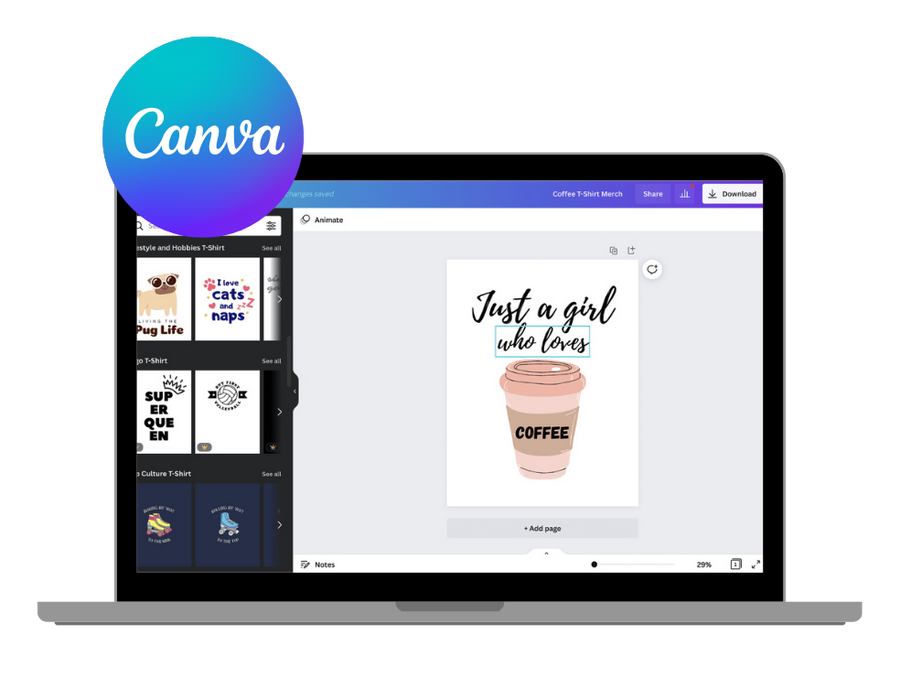
Step 3 — Connect a print provider. Open a free account on Printify or Printful, choose the provider and blank (Bella+Canvas 3001 is the standard tee), upload your design, and set your margin.
Step 4 — List where buyers already shop. Etsy is the best testing ground: its listing counts reveal the competition before you commit, and its gift-buying audience matches POD products. Connect your provider directly to Etsy, Shopify, or WooCommerce so orders route automatically — but dominate one channel first.
Step 5 — Price with real math. Profit = retail price − base cost − shipping − platform fees. A $25 t-shirt on Printify (~$9.50 base, ~$4 shipping) leaves roughly $11 before marketplace fees; Etsy's combined fees take another ~10%, so net is closer to $9. On Printful's higher base, net is roughly $8. Run this math before setting any price — and once you're live, drive traffic to your POD store with consistent content.
Marketing That Actually Moves the Needle
Most beginners fail at marketing, not at design. The two channels worth your time are Etsy SEO and organic short-form video.
Etsy SEO. Use the exact phrases buyers type ("personalized golden retriever mom shirt"), fill all 13 Etsy tag slots, and study top sellers' keyword patterns without copying their text.
Organic short-form video. TikTok and Reels reward process content: record the design being created or unbox your own sample. Post daily for 90 days before judging results — and as search changes, it also helps to get found in AI-powered search beyond marketplaces.
Realistic Earnings and Mistakes to Avoid
Set honest expectations. Matrix Designs puts realistic results at $500–$2,000 per month within 12–18 months, with a catalog of 1,000+ designs in proven niches. First sales often take weeks or months.
The most common mistakes: saturated generic niches; pricing without including shipping and fees; skipping samples; spreading across five platforms before dominating one; and quitting at 30 listings when compounding starts at 300.
Frequently Asked Questions
How much money do I need to start print on demand in 2026?
You can start for nearly $0. Both platforms offer free plans with no monthly fee, and Canva's free tier covers basic designs. Optional costs: Etsy listing and transaction fees, $10–$20 per sample order, and paid plans once volume justifies them.
Is Printify or Printful better for beginners?
Printify is better if your priority is maximum margin and you're willing to vet providers. Printful suits premium stores that value consistent quality and simpler operations.
Can I use AI-generated designs for print on demand?
Yes, with caution. Check the AI tool's commercial-use terms, and avoid copyrighted characters, celebrity likenesses, or trademarked phrases. Generic AI art is the most saturated segment of 2026, so use AI as a starting point you refine into a specific niche.
How long does it take to get the first sale?
Expect weeks to months. Sellers who publish dozens to hundreds of listings in a proven niche with proper SEO see first sales much faster than those who upload ten designs and wait.
Do I need a website to sell print on demand?
No. Etsy, TikTok Shop, and marketplace integrations let you sell without a website. A Shopify store makes sense later, once you have proven designs and want higher margins and brand control.
What are the best-selling print on demand products in 2026?
Apparel still holds the largest revenue share, but home decor (wall art, gallery sets, throw pillows) is the fastest-growing category. Personalized pet products lead niche demand with 67% year-over-year growth reported for 2026.
The Bottom Line
Print on demand in 2026 is a real business with real margins — not a lottery ticket. Pick a specific niche with proven demand, price with the full cost math, choose Printify for margin or Printful for consistency, and market on Etsy search plus organic video.
Disclaimer: this article is for informational purposes only. Platform fees, base costs, and plan prices change over time — verify current terms before listing products. Earnings figures reflect third-party reports, not a guarantee of results.
The conversation
Post a Comment