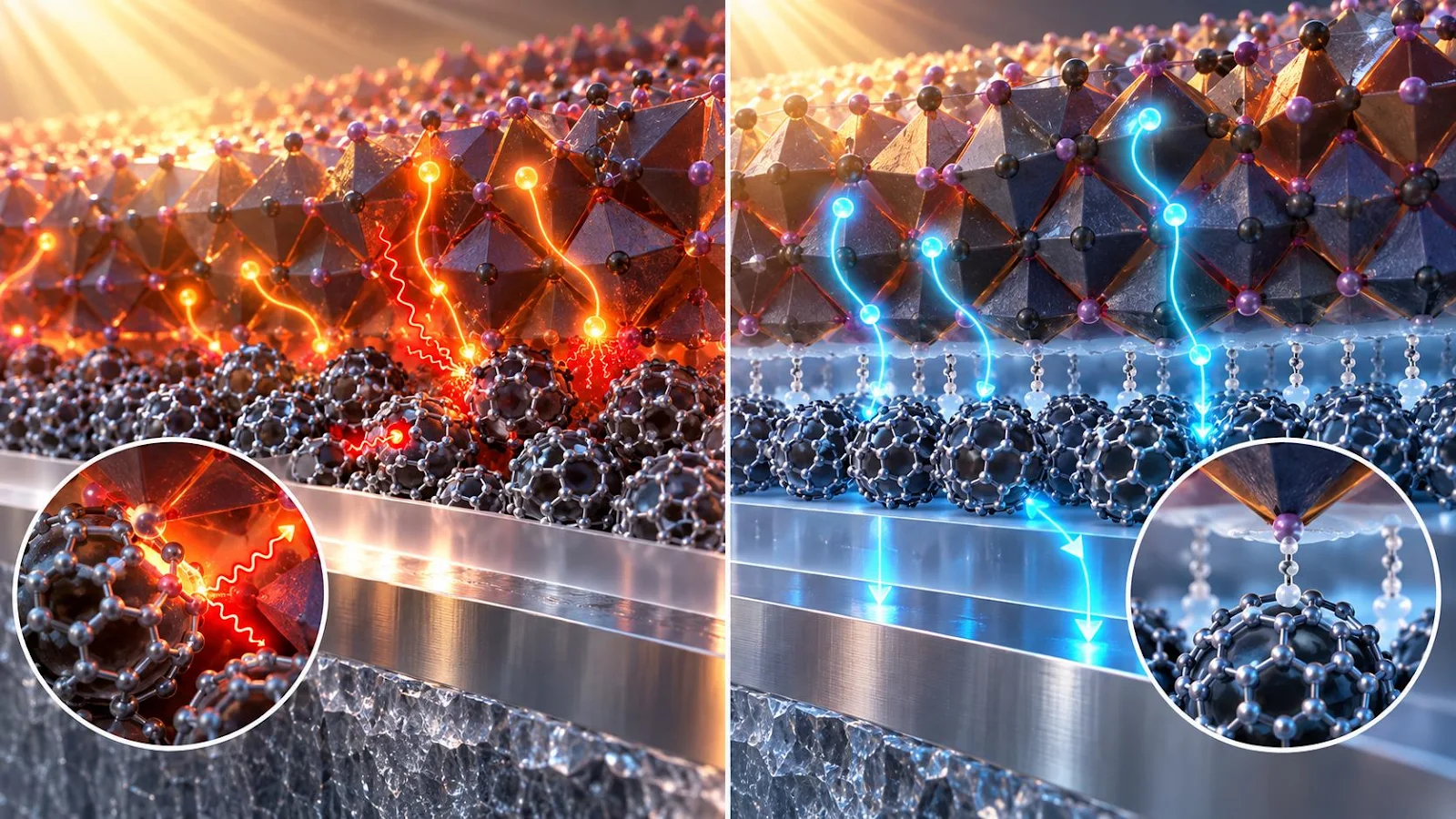
Updated October 27, 2026. An October 2026 Nature Photonics study identifies a mechanism for non-radiative recombination at C60 contacts and explores molecular decoupling. This guide explains what the finding means, what it does not mean, how interfacial charge recombination fits into the broader field of semiconductor physics, and what evidence would justify stronger claims. It is written for curious readers who want more than a headline, with concrete examples, realistic limitations and a link to the originating source. The underlying challenge is straightforward to describe but difficult to solve: charge carriers can disappear as heat rather than collected current.
The development and why it matters
The reported starting point is specific: An October 2026 Nature Photonics study identifies a mechanism for non-radiative recombination at C60 contacts and explores molecular decoupling. That is the factual anchor for this discussion. It matters because charge carriers can disappear as heat rather than collected current. It does not, by itself, establish a product launch, universal performance gain, or proven long-term durability. Readers should keep those separate. In semiconductor physics, progress is often incremental: a new instrument, a clearer mechanism, or a better comparison can change the questions that laboratories are able to ask next.
Finally, there is a system-level question. Improvements to C60 electron-selective layer may require different sensors, computing resources, fabrication steps or operating procedures elsewhere. Those additions have costs and sometimes introduce their own faults. A device physicist deciding whether to adopt the idea would weigh the whole workflow, including training, calibration, power use, safety, spare parts and downtime. Thinking in systems turns an abstract research announcement into a concrete question about performance in the world.
One way to understand the significance is to compare two time horizons. On a short horizon, the question is whether the experimental signal is real and repeatable. On a medium horizon, the question is whether teams can assemble the supporting instruments, software, materials and procedures. On a long horizon, the question is whether the whole arrangement survives everyday use. For C60 electron-selective layer, these horizons can diverge. An impressive demonstration today may still need years of validation, while an unglamorous measurement improvement may make an entire research program more productive.
How the underlying technology works
The process at the center of this story is interfacial charge recombination. Think of C60 electron-selective layer as one part in a larger chain: an input is observed, physical interactions change its state, an instrument or model estimates that change, and a decision follows. If any link is poorly characterized, the final answer is less reliable. The important challenge is that charge carriers can disappear as heat rather than collected current. A useful technical report therefore explains both what was controlled during the experiment and what remained outside the researchers’ control.
One way to understand the significance is to compare two time horizons. On a short horizon, the question is whether the experimental signal is real and repeatable. On a medium horizon, the question is whether teams can assemble the supporting instruments, software, materials and procedures. On a long horizon, the question is whether the whole arrangement survives everyday use. For C60 electron-selective layer, these horizons can diverge. An impressive demonstration today may still need years of validation, while an unglamorous measurement improvement may make an entire research program more productive.
It also helps to separate evidence from inference. A measured response tells scientists something about interfacial charge recombination under the stated conditions. An inferred mechanism explains why the response might occur. A forecast imagines what the mechanism could enable. Confusing these levels is how exciting research becomes an exaggerated promise. When charge carriers can disappear as heat rather than collected current, a small change in assumptions can affect the outcome. A careful reader should look for the assumptions in the methods rather than treating an attractive illustration as if it were an engineering specification.
Key idea: Interfacial charge recombination is a mechanism, not a guarantee that a commercial system already exists. Independent reproduction matters.
An everyday analogy and worked example
Imagine a device physicist comparing two versions of C60 electron-selective layer. Version A appears better on a headline metric, but version B gives consistent results across many runs. Which is actually better depends on the decision. If the aim is discovery, the unusual result in A may teach more. If the aim is continuous operation, B may be preferable. This illustrative comparison is not a claim that the source study tested those two versions; it shows why a single score cannot settle an engineering choice.
It also helps to separate evidence from inference. A measured response tells scientists something about interfacial charge recombination under the stated conditions. An inferred mechanism explains why the response might occur. A forecast imagines what the mechanism could enable. Confusing these levels is how exciting research becomes an exaggerated promise. When charge carriers can disappear as heat rather than collected current, a small change in assumptions can affect the outcome. A careful reader should look for the assumptions in the methods rather than treating an attractive illustration as if it were an engineering specification.
Finally, there is a system-level question. Improvements to C60 electron-selective layer may require different sensors, computing resources, fabrication steps or operating procedures elsewhere. Those additions have costs and sometimes introduce their own faults. A device physicist deciding whether to adopt the idea would weigh the whole workflow, including training, calibration, power use, safety, spare parts and downtime. Thinking in systems turns an abstract research announcement into a concrete question about performance in the world.
What researchers can measure
Researchers generally need a baseline, a measurement protocol and meaningful error bars. In this case, one might track the behavior of C60 electron-selective layer while changing only a few variables at a time. Repeated trials can reveal drift, sensitivity and interactions among factors. A test set collected in the same lab may be easier than truly independent data. That difference is especially consequential when interfacial charge recombination is involved, because a system may learn the experiment's quirks instead of the intended physics.
Finally, there is a system-level question. Improvements to C60 electron-selective layer may require different sensors, computing resources, fabrication steps or operating procedures elsewhere. Those additions have costs and sometimes introduce their own faults. A device physicist deciding whether to adopt the idea would weigh the whole workflow, including training, calibration, power use, safety, spare parts and downtime. Thinking in systems turns an abstract research announcement into a concrete question about performance in the world.
One way to understand the significance is to compare two time horizons. On a short horizon, the question is whether the experimental signal is real and repeatable. On a medium horizon, the question is whether teams can assemble the supporting instruments, software, materials and procedures. On a long horizon, the question is whether the whole arrangement survives everyday use. For C60 electron-selective layer, these horizons can diverge. An impressive demonstration today may still need years of validation, while an unglamorous measurement improvement may make an entire research program more productive.
Where the first practical benefits may appear
A plausible early application is a better decision for a device physicist. Rather than immediately replacing an established tool, the new technique could help prioritize experiments, shorten analysis time or flag an unusual operating state. It is worth asking whether the improvement remains after adding calibration, maintenance, data collection and human review. The answer will depend on how the technology handles charge carriers can disappear as heat rather than collected current outside the carefully arranged original setting.
One way to understand the significance is to compare two time horizons. On a short horizon, the question is whether the experimental signal is real and repeatable. On a medium horizon, the question is whether teams can assemble the supporting instruments, software, materials and procedures. On a long horizon, the question is whether the whole arrangement survives everyday use. For C60 electron-selective layer, these horizons can diverge. An impressive demonstration today may still need years of validation, while an unglamorous measurement improvement may make an entire research program more productive.
It also helps to separate evidence from inference. A measured response tells scientists something about interfacial charge recombination under the stated conditions. An inferred mechanism explains why the response might occur. A forecast imagines what the mechanism could enable. Confusing these levels is how exciting research becomes an exaggerated promise. When charge carriers can disappear as heat rather than collected current, a small change in assumptions can affect the outcome. A careful reader should look for the assumptions in the methods rather than treating an attractive illustration as if it were an engineering specification.
Illustrative scenario: A device physicist first tests the approach on historical or controlled data, then compares it with established practice before contemplating deployment. This example is an explanation, not an unreported result from the cited research.

What could go wrong
The limitations should not be hidden: interface durability, materials compatibility and commercial yield. Failure modes may include noisy measurements, unrecognized changes in the environment, mismatched training data, manufacturing variation or unexpected interactions among components. A trustworthy development process looks for these weaknesses early. Where safety matters, the novel system should be accompanied by independent monitoring and a way to fall back to a validated conventional method.
It also helps to separate evidence from inference. A measured response tells scientists something about interfacial charge recombination under the stated conditions. An inferred mechanism explains why the response might occur. A forecast imagines what the mechanism could enable. Confusing these levels is how exciting research becomes an exaggerated promise. When charge carriers can disappear as heat rather than collected current, a small change in assumptions can affect the outcome. A careful reader should look for the assumptions in the methods rather than treating an attractive illustration as if it were an engineering specification.
Finally, there is a system-level question. Improvements to C60 electron-selective layer may require different sensors, computing resources, fabrication steps or operating procedures elsewhere. Those additions have costs and sometimes introduce their own faults. A device physicist deciding whether to adopt the idea would weigh the whole workflow, including training, calibration, power use, safety, spare parts and downtime. Thinking in systems turns an abstract research announcement into a concrete question about performance in the world.
How to judge new headlines about this topic
A strong news article distinguishes the original observation, the authors' interpretation and the journalist's forecast. For why c60 interfaces matter in next-generation solar cells, identify which numbers were measured and which were predicted. Then look for a comparison group, experimental conditions, sample size, reproducibility and limitations. A peer-reviewed publication is more informative than an unattributed social post, but publication does not eliminate uncertainty. The primary source should remain the starting point for a serious assessment.
Finally, there is a system-level question. Improvements to C60 electron-selective layer may require different sensors, computing resources, fabrication steps or operating procedures elsewhere. Those additions have costs and sometimes introduce their own faults. A device physicist deciding whether to adopt the idea would weigh the whole workflow, including training, calibration, power use, safety, spare parts and downtime. Thinking in systems turns an abstract research announcement into a concrete question about performance in the world.
One way to understand the significance is to compare two time horizons. On a short horizon, the question is whether the experimental signal is real and repeatable. On a medium horizon, the question is whether teams can assemble the supporting instruments, software, materials and procedures. On a long horizon, the question is whether the whole arrangement survives everyday use. For C60 electron-selective layer, these horizons can diverge. An impressive demonstration today may still need years of validation, while an unglamorous measurement improvement may make an entire research program more productive.
The next research questions
The most important next experiment would push beyond the easiest conditions. For C60 electron-selective layer, that could mean longer test duration, more varied inputs, independent replication or operation beside conventional equipment. Researchers will also have to assess interface durability, materials compatibility and commercial yield. Those steps are less glamorous than an announcement but ultimately decide whether interfacial charge recombination becomes a dependable scientific tool.
One way to understand the significance is to compare two time horizons. On a short horizon, the question is whether the experimental signal is real and repeatable. On a medium horizon, the question is whether teams can assemble the supporting instruments, software, materials and procedures. On a long horizon, the question is whether the whole arrangement survives everyday use. For C60 electron-selective layer, these horizons can diverge. An impressive demonstration today may still need years of validation, while an unglamorous measurement improvement may make an entire research program more productive.
It also helps to separate evidence from inference. A measured response tells scientists something about interfacial charge recombination under the stated conditions. An inferred mechanism explains why the response might occur. A forecast imagines what the mechanism could enable. Confusing these levels is how exciting research becomes an exaggerated promise. When charge carriers can disappear as heat rather than collected current, a small change in assumptions can affect the outcome. A careful reader should look for the assumptions in the methods rather than treating an attractive illustration as if it were an engineering specification.
A practical checklist for readers
For a reader evaluating future claims, start with the question being solved, not the branding. Find the original study or institutional release, note the date, identify the relevant benchmark, and look for explicit boundaries. Ask whether the result has been reproduced by another team. Finally, compare the proposed benefit with its cost and the consequences of error. That method makes technical news easier to understand without demanding specialist training.
It also helps to separate evidence from inference. A measured response tells scientists something about interfacial charge recombination under the stated conditions. An inferred mechanism explains why the response might occur. A forecast imagines what the mechanism could enable. Confusing these levels is how exciting research becomes an exaggerated promise. When charge carriers can disappear as heat rather than collected current, a small change in assumptions can affect the outcome. A careful reader should look for the assumptions in the methods rather than treating an attractive illustration as if it were an engineering specification.
Finally, there is a system-level question. Improvements to C60 electron-selective layer may require different sensors, computing resources, fabrication steps or operating procedures elsewhere. Those additions have costs and sometimes introduce their own faults. A device physicist deciding whether to adopt the idea would weigh the whole workflow, including training, calibration, power use, safety, spare parts and downtime. Thinking in systems turns an abstract research announcement into a concrete question about performance in the world.
Frequently asked questions
What is the main news about why c60 interfaces matter in next-generation solar cells?
An October 2026 Nature Photonics study identifies a mechanism for non-radiative recombination at C60 contacts and explores molecular decoupling.
Does the result mean the technology is ready to buy?
No. The reported work concerns semiconductor physics. Additional proof is needed on interface durability, materials compatibility and commercial yield before making market-readiness claims.
What is the core technical challenge?
The central obstacle is that charge carriers can disappear as heat rather than collected current. The relevant technical process is interfacial charge recombination.
What should I look for in the next study?
Look for independent replication, openly described tests, clear comparison with earlier methods, and direct evidence about interface durability, materials compatibility and commercial yield.
Can ordinary readers trust popular summaries?
They can be useful introductions, but always check the date and the primary source. Watch for language that turns a possibility into a demonstrated product.
Sources and further reading
Primary institutional or research source. Source descriptions refer to developments reported by the linked institution or journal. The worked examples, checklists and broader interpretations in this article are explanatory synthesis rather than claims made by the research team.
Editorial note: This is a science explainer, not professional engineering, medical or investment advice. Dates and source links are retained for readers who want to verify developments.
The conversation
Post a Comment