THE JORNAL | Science & Environment | November 3, 2026
Introduction: The World's Hidden Living Infrastructure
Imagine walking through a forest on a quiet morning. Sunlight filters through the branches, leaves rustle overhead, and the ground feels solid beneath your feet. Everything appears familiar. Yet just a few inches below the surface, an extraordinary biological system is operating almost entirely out of sight.
Billions of microscopic fungal threads weave through the soil. They enter into partnerships with plant roots, collect nutrients from places roots cannot easily reach, and help move carbon through ecosystems. Together, these threads form a living infrastructure that supports much of the plant life covering our planet.
Scientists have understood the importance of these partnerships for decades. What remained largely unknown was their full planetary scale.
That mystery is beginning to change.
In June 2026, researchers published a major study in the journal Science that produced the first global estimates of the density, total length, and biomass of arbuscular mycorrhizal fungal networks. Combining soil measurements, machine learning, and sophisticated microscopic imaging, they calculated that Earth's topsoils contain approximately 110 quadrillion kilometers of living fungal threads.
That is an almost unimaginable distance.
The researchers also estimated that these networks contain approximately 300 million metric tons of living fungal biomass, several times the biomass of all humans combined. These organisms are not simply passengers in Earth's ecosystems. They help determine how plants grow, how nutrients circulate, and how carbon enters the soil.
But the discovery raises an uncomfortable question. If this underground infrastructure is so important, why has humanity devoted so little attention to protecting it?
The answer reveals a remarkable gap in how we understand nature. For generations, conservation has concentrated on the life we can see: forests, wildlife, rivers, and landscapes. Now scientists are discovering that some of the planet's most important ecological systems may be hidden underneath them.
Understanding this underground world could transform agriculture, biodiversity conservation, ecological restoration, and the way we think about climate change.
1. What Exactly Is an Underground Fungal Network?
To understand the discovery, we first need to look beyond the familiar mushroom.
Most people recognize fungi through mushrooms appearing after rainfall, mold growing on bread, or yeast used in baking. These are only a few visible examples of an extraordinarily diverse kingdom of life.
Many fungi grow primarily as microscopic filaments called hyphae. A single hypha may be thinner than a human hair, yet it can extend through soil pores, around mineral particles, and into spaces inaccessible to most plant roots.
Collections of these filaments form structures known as mycelium. Depending on the species and environment, fungal networks can spread through soil, decaying wood, leaf litter, and living plant tissues.
Some fungi obtain nutrients by decomposing dead organic matter. Others cause plant diseases. A particularly important group forms mutually beneficial relationships with living plants.
These are called mycorrhizal fungi.
The word mycorrhiza comes from Greek roots meaning fungus and root. The name describes the partnership: fungi associate closely with plant roots, exchanging resources that each partner can obtain more effectively than the other.
Plants use sunlight to manufacture sugars through photosynthesis. They can transfer some of their carbon-rich compounds to fungal partners. In return, fungal networks help acquire nutrients such as phosphorus and nitrogen from surrounding soil.
It is a biological trading relationship developed over hundreds of millions of years.
The 2026 global mapping study focused specifically on arbuscular mycorrhizal fungi, often abbreviated AM fungi. These fungi associate with approximately 70 percent of plant species and are particularly important across grasslands, croplands, and many other terrestrial ecosystems.
Their hyphae function as microscopic pathways for resource transport. Although the individual threads are tiny, their combined global extent is enormous.
This distinction matters: the new estimate describes AM fungal networks in topsoil, not every fungal species or every fungal structure throughout the Earth.

Photo 1 — Mushrooms emerging through fallen autumn leaves illustrate the visible side of fungal diversity. Not all mushroom-forming fungi are mycorrhizal, and this photograph does not depict the microscopic AM networks measured in the study. Photograph: Olexandr Ostrovyi, Wikimedia Commons, CC BY 4.0.
2. The Discovery That Changed the Scale of the Story
One of the most striking findings of the 2026 research was not that these networks exist, but how much living material they represent.
The team assembled information from 322 studies involving more than 16,000 soil cores collected across nine major biome types. These measurements provided evidence of how fungal thread density varies under different environmental conditions.
Researchers then combined the field observations with machine-learning models designed to predict fungal density across landscapes where direct measurements were unavailable.
The modeling indicated that the combined length of living AM fungal hyphae in global topsoils is approximately 1.10 x 10^17 kilometers, with substantial uncertainty around the estimate.
In ordinary language, that is approximately 110 quadrillion kilometers.
Using automated imaging of more than 300,000 fungal hyphae, researchers estimated the relationship between fungal thread length and biomass. The resulting global estimate was approximately 300 million metric tons, with a reported standard deviation of around 60 million metric tons.
The numbers are remarkable, but they are not a literal count of every fungal filament on Earth. They are scientifically informed estimates based on measurements, laboratory calibration, and modeling.
The distinction is essential because underground ecosystems remain difficult to observe directly.
Another unexpected aspect of the findings concerns geography. Grasslands accounted for an estimated 40 percent of the world's AM fungal infrastructure, highlighting the importance of ecosystems that often receive less public attention than tropical forests.
The research also identified substantial variation among regions. Some soils contain much denser networks than others, reflecting differences in vegetation, soil properties, moisture, and climate.
The scientific achievement was therefore more than producing a spectacular global number. It created a geographical picture of a living system that had previously been largely invisible at planetary scale.
3. How Scientists Can Map Something They Cannot See
Mapping a mountain is relatively straightforward compared with mapping living organisms buried in soil. Satellites can reveal the contours of land, the extent of vegetation, and patterns in temperature. They cannot directly count microscopic fungal threads twisting around individual grains of sand. Scientists must therefore combine several different kinds of evidence.
The first step is physical sampling. Researchers collect carefully documented soil cores from fields, forests, grasslands, and other habitats. They extract and measure fungal material, record environmental conditions, and compare the samples. The process sounds simple, but field measurements are influenced by season, depth, soil texture, and the methods used to separate fungal threads from roots and organic debris.
Next comes statistical prediction. Machine-learning algorithms search for relationships between observed fungal density and environmental characteristics. Once trained and tested, these models estimate the likely density in places that have never been sampled. The result resembles a weather map: a spatially detailed prediction supported by observations, not a direct photograph of every location.
The biomass estimate required an additional innovation. Length alone does not tell researchers how much an organism weighs. Thin and thick hyphae can have very different masses, even when they span identical distances. Researchers grew fungal species in controlled laboratory conditions, then used robotic imaging to measure hundreds of thousands of filaments. Those measurements helped connect predicted network length to living biomass.
This approach is powerful precisely because it also reveals its limitations. A global map can guide further exploration, but its details are less certain where observations are sparse. The ideal next step is to visit predicted hotspots, collect independent samples, and test whether the actual networks match the models. The map is a starting point for discovery, not the final word.
4. The Underground Exchange: What Plants Give and What Fungi Return
Consider a young plant growing in soil that contains phosphorus but offers little of it in an easily accessible form. The plant can extend its roots, yet acquiring enough phosphorus may remain difficult. A mycorrhizal partner can help by sending extremely fine hyphae into surrounding soil, increasing the volume explored beyond the immediate root surface.
The fungus does not manufacture carbohydrates through photosynthesis. It depends on the plant for carbon compounds that supply energy and raw material. In exchange, the fungus can transport mineral nutrients toward the root. Specialized interfaces between fungal and plant cells make this trade possible without simply merging the two organisms.
In arbuscular mycorrhizal associations, branching structures called arbuscules form inside the plant's root cortical cells. Their elaborate surfaces create sites for nutrient exchange. They are temporary biological structures, formed and remodeled as the relationship continues.
This partnership is not a fixed charity arrangement. Its costs and benefits change with circumstances. A plant growing in nutrient-rich soil may gain less from fungal assistance than a plant in nutrient-poor soil. Some fungal partners deliver nutrients more effectively than others, and plants can differ in how they allocate carbon among partners.
Research published in Nature in 2025 used robotic time-lapse imaging to examine how fungal networks build and move resources. It demonstrated that these living networks can display sophisticated transport behavior. Such findings encourage scientists to study the partnership as a changing economic system of resource acquisition and exchange rather than as a static set of root extensions.
Still, describing fungi as businesspeople or pipelines is only an analogy. They do not negotiate consciously, and their networks have no central command. Their remarkable organization emerges from living growth, transport processes, local environmental feedback, and long evolutionary histories.
5. Why Carbon Makes This Discovery Globally Important
The connection between soil fungi and the climate begins with a familiar process: photosynthesis. Plants absorb carbon dioxide from the air and use sunlight to convert it into organic molecules. Some of that carbon becomes leaves, wood, seeds, and roots. Some enters soil through root exudates, fallen plant material, and interactions with microorganisms.
Mycorrhizal fungi are part of this movement. Plants deliver carbon-rich molecules to their fungal partners, and the fungi use them to maintain and extend their networks. Fungal tissues and compounds can eventually contribute to soil organic matter, where carbon may persist for varying periods.
Researchers have estimated that several billion metric tons of carbon dioxide equivalent move annually through these plant-fungal relationships into the soil system. That flow is substantial, but it must not be confused with permanent atmospheric carbon removal. Carbon entering a soil ecosystem may later return to the atmosphere as organisms respire or organic material decomposes.
For carbon accounting, the crucial question is not simply how much carbon passes through the network. It is how much remains stored, for how long, and under what environmental conditions. Temperature, moisture, mineral associations, land use, and microbial activity all influence the answer.
The global mapping work helps scientists understand where living fungal infrastructure is concentrated. It does not establish that every kilometer of hyphae provides an equal climate benefit. Nor does it imply that adding fungal inoculants to any landscape will reliably deliver large carbon savings.
Its importance is more fundamental. Climate models often simplify processes occurring underground because they are difficult to measure. Better information about fungal abundance and distribution provides a foundation for testing those assumptions. It also reminds policymakers that protecting soil processes can matter as much as preserving visible vegetation.
6. The Surprising Role of Grasslands
When people imagine Earth's most important biological landscapes, tropical rainforests usually appear first. Their towering canopies and extraordinary animal diversity make them natural symbols of conservation. But the fungal mapping study draws attention to a very different landscape: grasslands.
Grasslands support plants whose extensive root systems may invest a large share of their biological activity below ground. Their soils can contain complex communities of fungi, bacteria, insects, and other organisms. In many regions, mycorrhizal fungi help grasses obtain nutrients and maintain productive growth through changing seasons.
The 2026 analysis estimated that grasslands contain around 40 percent of global arbuscular mycorrhizal fungal infrastructure. That is a compelling reason to look beyond tree cover when assessing ecosystem importance. A landscape with few large trees may still support an enormous living network beneath its surface.
This matters because grasslands face pressures that are easy to overlook. Conversion to cropland, construction, poorly managed grazing, and changes in fire regimes can alter vegetation and soils. Some disturbances affect fungal abundance or composition, although outcomes vary widely by location, management, and intensity.
The lesson is not that all grazing is damaging or that grasslands must be left untouched. Many grassland ecosystems have long histories of interaction with grazing animals and human communities. Effective protection requires understanding local ecology, land rights, and sustainable livelihoods.
A map of underground fungi can help identify promising places for field surveys and restoration monitoring. It can also broaden public appreciation of landscapes that may look ordinary from a distance but contain intricate biological systems beneath every step.
7. A Conservation Blind Spot Hidden in Plain Sight
The new infrastructure map is part of a larger shift in fungal conservation. In July 2025, a Nature study used approximately 25,000 geolocated soil samples and more than 2.8 billion fungal DNA sequences to predict where different kinds of mycorrhizal fungi are especially rich or rare. Its disturbing conclusion was that less than 10 percent of predicted mycorrhizal richness hotspots overlap protected areas.
This result does not mean that more than 90 percent of all fungi are immediately threatened. A hotspot is an area predicted to contain unusually high diversity; it is not a complete count of every individual organism. Protected-area boundaries also do not automatically measure how effective protection is on the ground.
Nevertheless, the mismatch is important. Nature reserves are often planned using visible indicators, including forests, large mammals, and flowering plants. Those priorities are valuable, but they may fail to capture the distribution of organisms living below the surface.
A second 2025 study found that global plant and mycorrhizal fungal diversity patterns are only weakly correlated at the planetary scale. Protecting places with diverse plants does not therefore guarantee that the world's most diverse fungal communities are equally represented.
In May 2026, another study extended the discussion to estimated ranges of individual mycorrhizal fungal species. The researchers found systematic shortcomings in fungal coverage compared with terrestrial mammals and highlighted the particularly poor representation of arbuscular mycorrhizal fungi.
Taken together, these findings suggest that conservation planning needs a third dimension. A protected forest is not merely its trees and animals. It is also the living soil, its chemistry, and the multitude of organisms that regulate life underground.
8. Why DNA Is Transforming the Search
How can scientists identify fungi that are too small to recognize by sight? An increasingly important answer is environmental DNA, often shortened to eDNA. Rather than relying on visible mushrooms, researchers extract genetic material from soil and analyze sequences that can reveal which groups of fungi were present in a sample.
The process begins with collecting soil under controlled conditions. Laboratory techniques break open cells and isolate DNA. Researchers amplify or sequence selected genetic regions, then compare the results with reference databases to assign identities or distinguish groups of organisms.
In a single sample, this can reveal a community far richer than a casual observer would ever suspect. It can also expose organisms that do not routinely form conspicuous fruiting bodies. When samples come with reliable coordinates, their genetic profiles contribute to maps of biodiversity.
Yet DNA is not the same thing as a living organism counted under a microscope. A sequence may persist after an organism has died. Different genetic markers detect different groups with unequal efficiency. Database gaps, laboratory contamination, and uncertainty about species boundaries can complicate interpretation.
These problems are especially significant for some arbuscular mycorrhizal fungi, whose unusual genetic organization makes defining and identifying species challenging. Researchers must be careful not to turn clusters of similar sequences automatically into confident counts of formally described species.
The most informative investigations combine approaches: DNA to describe community composition, microscopy to inspect structures, field ecology to assess habitat, and experimental measurements to evaluate functions. Together, they can reveal not just which organisms might be present, but what they are doing and how their relationships respond to environmental change.
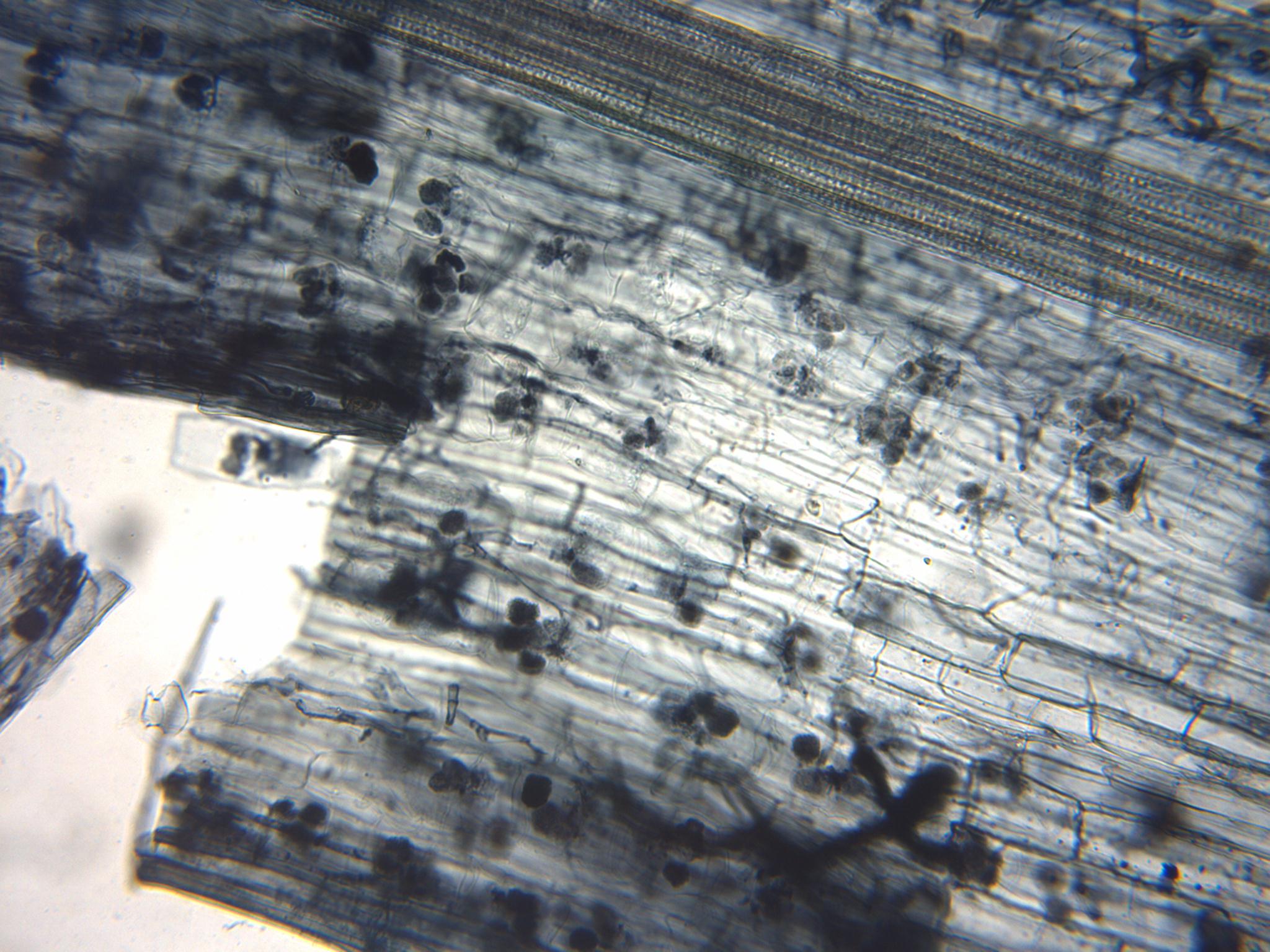
Photo 2 — A real microscope photograph of arbuscular mycorrhizal structures within flax root cells. Photograph: Msturmel, University of Manitoba. Public domain. Source: Wikimedia Commons.
9. What Farmers Can Learn From the Hidden Network
For agriculture, fungal networks are neither a newly invented technology nor a universal miracle fertilizer. They are existing ecological partners whose influence depends on crops, soil conditions, and farming practices. Understanding them better may help farmers make decisions about long-term soil health.
A functioning mycorrhizal association can improve a plant's access to particular nutrients, especially phosphorus under suitable conditions. Fungal partners may also influence soil structure and the interactions among roots, water, and microorganisms. These benefits are not automatic; certain crops respond strongly, while others respond less or do not form the same associations.
Management choices can influence fungal communities. Crop rotations, living roots, soil disturbance, organic matter inputs, and fertilizer application can alter the environments in which fungi survive. Their effects differ across farming systems, and simple slogans rarely capture the trade-offs.
Commercial mycorrhizal inoculants illustrate why caution matters. Adding fungal propagules may benefit certain crops in some soils, particularly where appropriate partners are absent or depleted. But the results can be inconsistent. Existing native fungi, unsuitable inoculant species, or nutrient-rich conditions can limit the added value.
A sound strategy starts with knowing what the soil already contains. Testing, well-designed local trials, and consultation with agronomists are more reliable than assuming that a packaged fungal product will transform every field.
The global maps could eventually help scientists identify regions where fungal density is unusually low, where local communities require closer study, or where land management might support recovery. But field-scale decisions still require local measurements. A global prediction cannot tell a farmer precisely which action will work on a particular hectare.
10. A Lesson for Cities and Ecological Restoration
Underground fungal ecology matters even in places that appear far removed from wilderness. Urban parks, roadside trees, community gardens, and restored wetlands all depend on functioning soil. Cities frequently replace natural ground with compacted surfaces, construction fill, and fragmented planting areas, creating difficult conditions for roots and soil organisms.
When a city plants trees, attention often centers on the visible sapling: its species, size, and watering schedule. But the environment around the roots can determine whether that tree thrives. Soil volume, aeration, moisture, contamination, and suitable microbial communities all influence the outcome.
A deeper understanding of mycorrhizal relationships can encourage urban planners to treat soil as living habitat rather than an inert material used to hold plants upright. That may mean protecting existing soil where possible, avoiding unnecessary compaction, and monitoring restoration outcomes over several years.
Similar principles apply to damaged landscapes. After mining, severe erosion, or intensive construction, simply planting vegetation may not recreate the biological interactions present before disturbance. Recovering healthy soil communities can be a gradual process requiring appropriate plants, suitable substrate, and time.
However, restoration should not become a matter of importing mysterious fungi from elsewhere. Introducing organisms without ecological assessment may be ineffective or create unwanted effects. Local conditions and native biological communities matter.
The larger promise is a more complete definition of success. Instead of measuring restoration only by how green an area looks after one growing season, scientists can examine whether roots, fungal communities, soil structure, and nutrient cycling are recovering together.
11. The Danger of Turning the Wood Wide Web Into a Fairy Tale
Fungal networks have inspired one of modern ecology's most memorable metaphors: the wood wide web. The phrase suggests a hidden communication system connecting plants through underground fungal partners. It captures public imagination, but it can also produce misleading conclusions if used too loosely.
Some mycorrhizal fungi can connect multiple plant roots. Studies have investigated transfers of carbon, nutrients, and chemical signals through shared fungal associations. Yet demonstrating a connection does not automatically establish that a whole forest operates like a benevolent internet.
Scientists continue to debate how common particular transfers are in natural environments, how much they matter to plant growth, and whether observed effects require a direct fungal link rather than another pathway through soil. Claims that mature trees routinely send resources to younger trees as deliberate acts of care go beyond what can always be established from the evidence.
The 2026 global map should not be interpreted as proof that every fungal filament belongs to one connected global network. It describes the combined extent and estimated mass of many organisms and networks in soils. These are not all physically joined together, and the map cannot reveal which individual plants share fungal partners.
This does not make the real science less extraordinary. In fact, the actual questions are more interesting than the simplified story. Under what conditions does a fungus link multiple plants? What controls the direction of resource movement? How do soil disturbance and drought change network structure? Which relationships help ecosystems recover after stress?
Good science earns its wonder by leaving room for uncertainty. The underground world is fascinating without imagining that it behaves exactly like human society.
12. The Questions Researchers Must Answer Next
The first global maps are milestones, not finished inventories. Large gaps remain in field sampling, particularly in remote and underrepresented environments. Differences in soil methods, seasonal conditions, and laboratory techniques can also affect comparisons among regions. Independent validation is therefore an essential next phase.
Researchers need repeated measurements through time. A single soil sample captures conditions at one moment, while fungal networks grow, shrink, die, and reorganize. Long-term observations could reveal how drought, extreme heat, flooding, and vegetation change affect their abundance and the services they provide.
Another priority is function. A soil packed with hyphae is not necessarily performing every useful process at maximum efficiency. The identity of the fungi, the plants they associate with, and the availability of resources all matter. Future studies must connect measurements of density and diversity with actual nutrient transport, carbon persistence, and plant performance.
New technologies may help. Automated microscopy can track microscopic growth at scales that previously demanded impractical amounts of human labor. Better DNA sequencing and reference libraries can improve identification. Sensors and experiments can measure environmental responses. Machine learning can combine those datasets while highlighting the locations where predictions remain uncertain.
Conservation researchers face a further challenge: turning global evidence into responsible decisions. They will need to work with land managers, Indigenous peoples, farmers, local communities, and governments to determine which underground habitats need protection and which practices genuinely maintain fungal biodiversity.
The most consequential advance may be institutional rather than technological. If environmental assessments begin routinely considering soil fungal communities, the invisible world will become part of ordinary planning instead of an afterthought.
13. What This Means for Ordinary People
Few people will ever measure a fungal hypha, but nearly everyone depends on plants growing in soils shaped by fungi and other microorganisms. Food production, urban shade, natural vegetation, and many ecological processes rely on the health of environments that cannot be judged from the surface alone.
The new research offers a different way to observe familiar places. A meadow is not an empty space awaiting trees. A patch of healthy soil is not merely dirt. A garden is more than the plants visible above its beds. Each contains relationships unfolding on scales that human eyes cannot easily follow.
Readers interested in the science can start by following peer-reviewed research, university reports, and open biodiversity maps rather than relying on dramatic claims about intelligent fungi. Those resources explain both what is known and what remains uncertain. Public participation in locally organized soil and biodiversity projects may also help build awareness, provided sampling is conducted responsibly.
Schools can use the discovery to teach an unusually powerful lesson about evidence. Students might compare visible vegetation with published soil biodiversity maps, examine safe prepared microscope slides, or investigate how soil organisms contribute to nutrient cycles. The goal need not be to reproduce a laboratory study. It can simply be to show that scientific instruments change what counts as visible nature.
For households, the practical message is modest but meaningful: treat healthy soil as a living system. Avoid unnecessary damage to established root zones, follow locally appropriate gardening practices, and resist miracle-product claims that promise immediate ecological transformation.
Most importantly, the discovery offers a reason to care about landscapes that do not attract the attention of wildlife documentaries. Invisible biodiversity is still biodiversity. Its value does not depend on whether it can be photographed with an ordinary camera.
Conclusion: A Planet With More Life Than We Imagined
For centuries, the Earth's living landscapes have been described primarily from above. We mapped forests by their canopies, grasslands by their vegetation, and farms by the crops they produced. Beneath those surfaces, an immense biological infrastructure continued operating without appearing on most maps.
The 2026 research changes that picture. By combining field measurements, machine learning, and high-resolution imaging, scientists have estimated an extraordinary global abundance of living mycorrhizal fungal threads. Related studies have shown that centers of underground diversity often fall outside the areas humanity has chosen to protect.
The findings do not mean that science has suddenly understood everything underground. Researchers still need to verify regional predictions, identify more species, measure real-world ecological functions, and understand how networks respond to a changing climate. Vast length alone cannot answer all those questions.
But a map changes what society can notice. Once a hidden system has a measurable scale and an estimated distribution, scientists can ask sharper questions about its vulnerability. Policymakers can begin examining where existing conservation strategies fall short. Farmers and restoration specialists can design better local studies. The public can discover that even ordinary soil contains remarkable complexity.
The next time you walk through a field or forest, the visible landscape may seem exactly the same. Yet your understanding of it can be fundamentally different. Underfoot is an intricate living world, quietly helping plants obtain nutrients and shaping the movement of carbon through the planet.
Earth's invisible forest was always there. We are finally learning how to map it — and why protecting it deserves a place in the future of conservation.
Sources
- Stewart et al. (2026), Science. Global density and biomass of arbuscular mycorrhizal fungal networks.
- University of Sheffield (June 12, 2026). First global map reveals underground fungi networks.
- Nature (July 23, 2025). Global hotspots of mycorrhizal fungal richness are poorly protected.
- Conservation Letters (May 19, 2026). High-Resolution Range Mapping of Mycorrhizal Fungal Species Reveals Systematic Biases in Their Protection.
- Nature (February 26, 2025). A travelling-wave strategy for plant-fungal trade.
- Nature Communications (July 31, 2025). Global divergence in plant and mycorrhizal fungal diversity hotspots.
The conversation
Post a Comment