The Interstellar Comet 3I/ATLAS: What NASA's James Webb Telescope Is Discovering About a World From Another Star
Science & Space | 7 November 2026
A Visitor From Somewhere Beyond Our Solar System
Imagine finding a bottle washed onto a beach after drifting across an ocean for millions of years. You have no idea which country it came from, who placed it in the water, or how long it travelled. Yet the material inside might reveal something about the distant place where it began its journey.
Astronomers are experiencing something similar with an extraordinary visitor from beyond our solar system.
Its name is 3I/ATLAS, and it is not an ordinary comet.
It entered our astronomical neighbourhood after travelling through interstellar space, carrying material that formed around another star. Unlike familiar comets, which have spent billions of years orbiting our Sun or residing in the distant outskirts of our solar system, 3I/ATLAS originated somewhere beyond this planetary family.
It is the third confirmed interstellar object discovered passing through our solar system, following 1I/'Oumuamua in 2017 and 2I/Borisov in 2019.
But the most interesting part of its story is not simply where it came from. It is what the comet can tell us about the chemistry of another planetary system.
During 2025, NASA's James Webb Space Telescope examined the object using its sophisticated infrared instruments. Those observations revealed unusual chemical signatures, including remarkable isotope ratios involving carbon and hydrogen.
In October 2026, further research added another important piece to the picture: an unusually high deuterium-to-hydrogen ratio in methane detected in the comet's coma.
This finding is particularly interesting because methane preserves information about the chemical environment in which the comet's material formed or was processed.
The results offer a rare opportunity to investigate the materials from which planets form around other stars.
However, there is an important distinction between what scientists have measured and what they are trying to reconstruct.
We can identify certain molecules, measure their chemical signatures and study the comet's movement. We cannot yet identify its original star with certainty or reconstruct every stage of its history.
The story of 3I/ATLAS is therefore not a finished mystery. It is an investigation in progress.
Key Takeaways
- A rare visitor: 3I/ATLAS is the third confirmed interstellar object observed passing through our solar system.
- An extraordinary chemical record: JWST observations have revealed unusual isotope ratios involving hydrogen and carbon.
- Methane matters: Research published in October 2026 reported an exceptionally high deuterium-to-hydrogen ratio in methane.
- An unusual chemical environment: The measured isotope ratios are consistent with formation in a very cold, low-metallicity environment.
- An ancient possible origin: Some chemical evidence is consistent with formation in a very early planetary system, potentially 10-12 billion years ago.
- No known threat: NASA reports that the comet poses no danger to Earth.
- Important uncertainty: Scientists have not established its exact birthplace, original star or complete formation history.
1. What Exactly Is 3I/ATLAS?
To understand why this discovery matters, it helps to begin with the difference between an ordinary comet and an interstellar comet.
Most comets familiar to astronomers belong to our solar system.
They are icy bodies left over from the formation of the Sun and planets approximately 4.6 billion years ago. Some travel around the Sun in relatively short orbits. Others spend most of their existence in extremely distant regions before occasionally approaching the inner solar system.
Their paths are gravitationally connected to our Sun.
An interstellar object is different.
It travels through space between star systems rather than remaining permanently attached to the Sun's gravitational family.
The distinction is similar to the difference between a boat travelling around a lake and a ship arriving from an entirely different ocean.
3I/ATLAS belongs to the second category.
Understanding Its Unusual Name
The name itself provides useful information.
- 3: It is the third confirmed interstellar object.
- I: This stands for interstellar.
- ATLAS: This refers to the survey system that first detected it.
The discovery was reported on 1 July 2025 by the NASA-funded Asteroid Terrestrial-impact Last Alert System telescope in Rio Hurtado, Chile.
Astronomers subsequently identified earlier observations in archived telescope data, extending the observation record back to June 2025.
Its trajectory provided the crucial evidence that it originated outside the solar system.
Unlike a typical comet moving around the Sun on a closed orbital path, 3I/ATLAS follows a hyperbolic trajectory. Its path is not a permanently closed orbit around our star.
This is the scientific foundation for classifying it as interstellar.
Why Three Interstellar Visitors Matter
Before 2017, astronomers had no confirmed observation of an object arriving from another planetary system and passing near our own.
Then came 1I/'Oumuamua.
In 2019, 2I/Borisov provided another opportunity to examine material from beyond the solar system.
Now 3I/ATLAS gives researchers a third example.
Three objects are not enough to establish a complete picture of interstellar visitors. However, each provides a different scientific opportunity.
The comparison is particularly valuable because astronomers can investigate whether these visitors share similar chemical characteristics or represent very different planetary environments.
If their compositions vary substantially, that may suggest that planetary systems produce a wider range of icy bodies than previously understood.
2. Why the James Webb Space Telescope Is So Important

The James Webb Space Telescope is not simply a more powerful version of a conventional telescope.
It was designed to observe the universe primarily in infrared wavelengths, allowing scientists to investigate objects and phenomena that can be difficult to study using visible light.
This capability makes it particularly useful for studying comets.
The Problem With Observing a Comet
A comet is not necessarily a bright, clearly defined object.
Its solid nucleus can be relatively small, while the surrounding cloud of gas and dust may extend across a much larger region.
When sunlight warms the comet, frozen materials begin to release gas. This process is called sublimation.
The gas escapes from the surface and carries dust and sometimes tiny ice particles into the surrounding environment.
The resulting cloud is called the coma.
As the comet continues moving, radiation and the solar wind can contribute to the development of its tails.
Imagine opening a bottle of perfume in a room.
The bottle itself is small, but its scent spreads into the surrounding air. Detecting the perfume does not necessarily mean you can see the original container clearly.
Comets create a somewhat comparable observational challenge: scientists often learn about the nucleus by examining the material released into its surrounding coma.
Why Infrared Observations Help
Different molecules interact with light at particular wavelengths.
Water, carbon dioxide, carbon monoxide, methane and other compounds have identifiable spectral characteristics.
By measuring these features, astronomers can determine which substances are present and estimate their relative abundances.
This is called spectroscopy.
It is a little like identifying ingredients in an unfamiliar drink by analysing its chemical composition rather than relying on its colour or smell.
JWST carries instruments capable of performing extremely sensitive infrared observations.
One particularly important instrument is NIRSpec, the Near-Infrared Spectrograph.
It allows researchers to study the chemical fingerprints of objects such as 3I/ATLAS.
NASA's research programme used Webb to investigate the comet during its journey through the solar system, including observations in August 2025 and December 2025.
The result is a collection of measurements that goes beyond simply photographing an unusual comet.
It provides clues about the physical and chemical environment in which the object formed.
3. The Discovery That Made 3I/ATLAS Especially Interesting
The first major scientific question was straightforward:
Is this object made from the same kinds of materials as comets in our solar system?
The answer became increasingly interesting as researchers examined its chemistry.
Although 3I/ATLAS contains familiar substances, the proportions and chemical signatures do not simply reproduce what astronomers expect from every familiar comet.
Its composition provides evidence of a different formation environment.
This matters because comets preserve ancient material.
Unlike planets, which have experienced extensive geological changes, heating and internal processing, small icy bodies can retain chemical information from their early history.
A comet is therefore something like a time capsule.
Its contents may preserve traces of the environment in which its building materials first assembled.
For an interstellar comet, that time capsule comes from outside our solar system.
Scientists can use it to compare the conditions around another star with those that existed around our own young Sun.
That is an unusually valuable opportunity.
4. The First Major Clue: Unusual Water and Heavy Hydrogen
One of the important findings from Webb's earlier observations concerned deuterium.
Deuterium is a heavier form of hydrogen.
Ordinary hydrogen contains one proton in its nucleus. Deuterium contains one proton and one neutron.
The difference may sound small, but the relative abundance of these forms of hydrogen can provide important information about the temperature and chemical history of an astronomical environment.
What Is Heavy Water?
When deuterium replaces ordinary hydrogen in a water molecule, the result is known as heavy water.
Its chemical formula is D2O when both hydrogen positions contain deuterium.
Naturally occurring water also contains small proportions of molecules with one deuterium atom, known as HDO.
The abundance of these heavier forms can help astronomers investigate the conditions under which water formed.
Think of it as a chemical fingerprint.
Two objects might both contain water, but the relative amounts of ordinary hydrogen and deuterium can reveal differences in their histories.
What Webb Found
NASA reported in June 2026 that its Webb observations revealed unusually high levels of deuterium-related signatures in 3I/ATLAS.
The research described isotope ratios that differed substantially from those found in the solar-system comets used for comparison.
The measurements suggested that the comet's original material may have formed in a very cold environment.
NASA researchers also discussed the possibility that the object formed much earlier than our solar system.
The estimated formation period could extend as far back as 10-12 billion years ago.
This is an extraordinary possibility.
Our solar system is approximately 4.6 billion years old.
If the estimate is correct, the material preserved in 3I/ATLAS could be significantly older than the Sun itself.
However, the age of the material must not be confused with a direct measurement of the comet's exact age.
Scientists infer formation conditions and possible timing from chemical evidence. They have not watched the object form, and its exact birthplace remains unknown.
5. October 2026: A New Clue Hidden Inside Methane
The investigation became even more interesting in October 2026.
A research paper published in Nature Astronomy on 23 October presented near-infrared observations of 3I/ATLAS made with the James Webb Space Telescope.
The study focused on methane and its deuterium-to-hydrogen ratio.
Methane is a simple molecule containing one carbon atom and four hydrogen atoms.
Its chemical formula is CH4.
It is familiar on Earth as a component of natural gas, but methane is also important in planetary science.
It has been detected in a variety of environments, including the atmospheres of planets and the icy materials associated with distant astronomical objects.
In a comet, methane can provide clues about the chemical environment in which its building materials formed.
Why Researchers Examined Methane
The important question was not simply whether methane existed.
Astronomers wanted to understand the isotope composition of that methane.
In particular, they examined methane molecules in which deuterium replaces ordinary hydrogen.
One such molecule is CH3D.
The presence of deuterium changes the molecule's mass and produces identifiable spectral characteristics.
By measuring these characteristics, researchers can investigate the relative abundance of ordinary and deuterium-containing methane.
An Unusually High Measurement
The October study reported a methane deuterium-to-hydrogen ratio of:
3.18 +/- 0.30%
Approximately 13 +/- 2 times higher than the methane value measured in comet 67P/Churyumov-Gerasimenko.
The comparison is particularly interesting because comet 67P, studied by the European Space Agency's Rosetta mission, is the only other comet for which CH3D had been detected in the comparison described by the researchers.
The study therefore offers an unusual opportunity to compare methane chemistry in a visitor from another planetary system with methane chemistry in a comet from our own.
What Does This Actually Tell Us?
The isotope ratio provides information about the conditions in which the methane formed or was chemically processed.
Deuterium enrichment can be associated with particular low-temperature chemical processes.
In other words, the chemical fingerprint may preserve information about the cold environment in which the comet's material developed.
Imagine comparing two pieces of wood.
One comes from a tree that grew in a tropical rainforest. The other comes from a tree that grew in a much colder region.
They are both wood, but their composition and growth patterns may preserve clues about their different environments.
Methane isotope ratios provide a much more sophisticated version of this kind of comparison.
What the Result Does Not Prove
It does not identify the comet's original star.
It does not establish that the comet contains life.
It does not demonstrate that the comet came from a particular known planetary system.
It also does not mean that all interstellar comets must have similar methane chemistry.
The result is one important measurement from one unusual object.
Its greatest value lies in helping scientists test how chemical conditions differ between planetary systems.
6. Why the Comet's Chemical Composition Matters
The methane discovery is only one part of the scientific investigation.
Researchers are also interested in the relative abundance of carbon-containing molecules, water and other volatile substances.
These compounds behave differently depending on the temperatures and chemical conditions surrounding a young star.
Some substances freeze readily, while others remain gaseous until temperatures fall further.
That difference affects where materials accumulate in a developing planetary system.
The Role of Carbon Dioxide and Carbon Monoxide
Carbon dioxide and carbon monoxide are important volatile compounds in cometary science.
They can be released when icy material is warmed, and their relative abundance can help researchers investigate the conditions in which cometary material formed.
JWST's NIRSpec instrument mapped the molecular signatures of water, carbon dioxide and carbon monoxide in 3I/ATLAS.
These maps are particularly useful because they reveal more than the simple presence of a chemical substance.
They show how different emissions are distributed around the comet.
Researchers can use this information to examine the behaviour of the coma and the relationship between different volatile compounds.
The observations also provide a basis for comparing 3I/ATLAS with comets formed in our own solar system.
Why Chemical Proportions Matter
Finding carbon dioxide in a comet is not unusual by itself.
Finding methane is not unusual either.
The scientific importance comes from studying the proportions of these substances and their isotope characteristics together.
Imagine comparing two recipes.
Both contain flour, water and salt, but their proportions are different. Those differences may reveal that the recipes were developed under different conditions or for different purposes.
In astronomy, the chemical proportions are not recipes in the human sense, but they can provide a similar kind of historical evidence.
They help scientists reconstruct the conditions in which material developed.
7. Could 3I/ATLAS Be Older Than Our Solar System?
One of the most fascinating questions surrounding 3I/ATLAS concerns its possible age.
NASA's June 2026 research discussed the possibility that the comet could have formed 10-12 billion years ago.
That estimate would make it a potential survivor from a very early period in the history of the Milky Way.
To understand why this matters, consider the timeline.
The universe is approximately 13.8 billion years old.
Our solar system formed around 4.6 billion years ago.
A body formed 10-12 billion years ago would have originated long before the Sun and its planets existed.
It may preserve chemical information from a period when the galaxy contained a different mixture of elements.
How Can Scientists Estimate Such an Age?
Astronomers examine the relative abundance of different isotopes.
For example, carbon exists in several isotopic forms.
Carbon-12 is the most common form. Carbon-13 is heavier because it contains an additional neutron.
The abundance of carbon-13 in the galaxy has changed over cosmic history.
Generations of stars produce and distribute elements through stellar evolution and other processes.
Consequently, the relative proportions of certain isotopes can provide clues about the environment in which an astronomical object formed.
NASA's June report discussed the comparatively unusual carbon isotope characteristics of 3I/ATLAS.
That finding, considered alongside its deuterium-related signatures, supports the possibility of an ancient origin.
Why the Age Remains an Estimate
There is an important limitation.
The isotope measurements do not function like a clock attached to the comet.
They are chemical evidence that scientists interpret using models of galactic evolution and planetary formation.
Different environments can produce different chemical signatures.
The object may also have experienced changes during its journey through interstellar space and during its passage through the solar system.
Therefore, 10-12 billion years should be understood as a scientific estimate discussed by researchers, not a directly measured birth date.
The distinction matters.
A responsible explanation should communicate the extraordinary possibility without presenting it as an established fact.
8. Where Did the Comet Come From?
This is perhaps the greatest unanswered question.
Scientists know that 3I/ATLAS originated outside our solar system.
However, identifying the exact planetary system from which it came is much more difficult.
The Milky Way contains hundreds of billions of stars.
An interstellar object may travel for millions or billions of years before passing near another star.
During that journey, gravitational interactions can change its trajectory.
The comet's current path is therefore not necessarily a simple pointer leading directly back to its original star.
A Journey Without a Known Address
Imagine finding a message in a bottle on a coastline.
You might determine the type of paper, ink and container.
You might even estimate how long the bottle has been exposed to the ocean.
But identifying the exact beach from which it was launched would require additional evidence.
The same difficulty applies to interstellar objects.
Chemical measurements can help reconstruct the environment in which 3I/ATLAS formed.
They do not automatically reveal the identity of its parent star.
The Possibility of an Ancient Planetary System
The chemical evidence suggests that the comet may have originated in a cold environment around a young star.
Researchers have discussed a formation period potentially extending back 10-12 billion years.
If that interpretation is correct, the object could have originated in a planetary system formed during an earlier period of galactic history.
But scientists have not established the original system.
They also cannot yet determine whether the comet was ejected through a close encounter with a planet, interactions with another star, or some other gravitational process.
These remain questions for further investigation.
9. How Did 3I/ATLAS Escape Its Original Planetary System?
A comet does not normally leave its planetary system simply because it wants to.
Gravity controls the motion of planets, asteroids and comets.
For an object to become interstellar, its trajectory must eventually allow it to escape the gravitational influence of its original star.
There are several possible mechanisms.
Gravitational Encounters With Giant Planets
In our solar system, large planets can significantly alter the paths of smaller objects.
A comet passing relatively close to a giant planet may gain enough orbital energy to move onto a trajectory that eventually takes it out of the solar system.
Jupiter, because of its enormous mass, is particularly important in this type of interaction.
Other planetary systems may have similar gravitational mechanisms.
Interactions With Other Stars
A young planetary system can be dynamically complicated.
Nearby stars may pass relatively close to one another, especially in environments where many stars form together.
Their gravitational fields can disturb the orbits of distant icy bodies.
Some objects may eventually be ejected into interstellar space.
What Happened to 3I/ATLAS?
The exact mechanism remains uncertain.
Its present interstellar trajectory establishes that it is not gravitationally bound to our Sun in the ordinary cometary sense.
It does not tell researchers precisely how it escaped its original system.
This is another reason why the object is so scientifically valuable.
It allows astronomers to investigate not only the chemistry of another planetary system but also the processes that distribute material between stars.
10. What Happened When It Approached the Sun?
Comets are particularly interesting because their activity changes as they move closer to a star.
A comet that has spent most of its existence in deep space may contain frozen substances that have remained relatively undisturbed.
As it approaches the Sun, solar radiation warms its surface.
Some materials begin to sublimate.
Gas and dust are released into the surrounding space.
The coma develops, and the comet may become more observable.
The Closest Solar Approach
NASA reports that 3I/ATLAS reached its closest point to the Sun around 30 October 2025.
It passed approximately 1.4 astronomical units from the Sun.
An astronomical unit is the average distance between Earth and the Sun.
This placed the comet just inside the orbital distance of Mars.
After passing the Sun, the object continued outward.
Astronomers were able to obtain additional observations as it moved away.
Why This Period Mattered for Webb
The comet's changing activity provided an opportunity to study material released during its journey.
Different frozen compounds can behave differently when heated.
Some substances become active at lower temperatures than others.
By observing the comet at different stages, astronomers can examine how its coma changes and investigate the relationships between its composition and its activity.
This is important because the material released from the nucleus is not necessarily a perfect representation of everything inside it.
A comet's outer layers may be affected by solar heating, while deeper regions may preserve different material.
The observations must therefore be interpreted carefully.
11. Is 3I/ATLAS Dangerous to Earth?
Whenever a new object from space attracts attention, one question often appears immediately:
Could it hit Earth?
In this case, NASA's answer is reassuring.
3I/ATLAS poses no threat to Earth.
NASA reports that its closest approach to our planet was approximately 1.8 astronomical units, or around 270 million kilometres.
That is an enormous distance.
It is also important to understand that the comet's interstellar origin does not automatically make it dangerous.
An object can come from another planetary system and still pass through our solar system at a very safe distance.
The fact that something is unusual does not mean it represents a threat.
Why Scientists Monitor Interstellar Objects
Astronomers study such objects for scientific reasons.
Their trajectories, compositions and physical properties provide opportunities to understand the movement of material through the galaxy.
Monitoring also helps researchers improve their ability to identify and classify unusual objects.
For 3I/ATLAS, the available evidence supports scientific curiosity rather than alarm.
12. Could 3I/ATLAS Contain the Ingredients for Life?
This question requires particularly careful treatment.
Comets contain materials that are relevant to prebiotic chemistry.
Prebiotic chemistry refers to chemical processes that can occur before the emergence of life.
These processes involve molecules and reactions that may contribute to the development of more complex organic chemistry.
Water, carbon-containing compounds and other molecules are important subjects of research in this field.
3I/ATLAS is therefore an interesting object for scientists studying the chemical conditions that exist in other planetary systems.
Organic Molecules Are Not Evidence of Organisms
The word organic can be misleading.
In chemistry, organic compounds are generally carbon-containing molecules.
They do not have to originate from living organisms.
Methane, for example, can exist through non-biological chemical processes.
The presence of carbon-containing material in a comet does not demonstrate that life existed on the comet or in its original planetary system.
Why the Findings Still Matter
Scientists are interested in whether the chemical ingredients associated with prebiotic chemistry are common throughout the galaxy.
Our solar system provides one example of a planetary environment where life emerged.
An interstellar comet provides an opportunity to study material formed elsewhere.
If similar chemical building blocks occur in different planetary systems, that may help researchers understand how widespread the ingredients for prebiotic chemistry could be.
However, the chemical conditions required for life are much more complex than the presence of water, methane or organic molecules.
The October methane research adds valuable information about the chemical history of the comet, not evidence of extraterrestrial biology.
13. What Makes This Discovery Different From Previous Interstellar Visitors?
The three confirmed interstellar objects have offered different scientific opportunities.
| Object | Discovery year | Why it matters |
|---|---|---|
| 1I/'Oumuamua | 2017 | First confirmed interstellar object; its unusual appearance and behaviour raised new questions. |
| 2I/Borisov | 2019 | First confirmed interstellar comet with a clearly observed cometary coma. |
| 3I/ATLAS | 2025 | Provides extensive opportunities for chemical analysis using modern space observatories. |
The comparison is important because each object expands the available evidence.
'Oumuamua: The First Visitor
The discovery of 1I/'Oumuamua changed the way astronomers thought about small bodies moving between stars.
Its unusual trajectory and physical characteristics generated considerable discussion.
However, it passed through the solar system quickly, limiting the opportunities for detailed investigation.
Borisov: A More Familiar Comet From Elsewhere
2I/Borisov provided a clearer cometary appearance.
Its coma and chemical characteristics allowed astronomers to study it as an active comet rather than simply an unusual moving object.
3I/ATLAS: A New Level of Chemical Investigation
The third visitor benefits from a combination of modern observational capabilities.
JWST, Hubble and other space-based and ground-based facilities have contributed observations.
Researchers can therefore examine different aspects of the comet's behaviour and composition.
Its methane isotope measurements make it especially interesting.
It does not mean that 3I/ATLAS is necessarily the most unusual interstellar object in every respect.
It means that astronomers have obtained a particularly valuable opportunity to investigate its chemistry.
14. What We Know and What We Still Do Not Know
The distinction between established measurements and scientific interpretation is essential.
The following comparison summarises the scientific position as of 7 November 2026.
| Scientific question | Current understanding |
|---|---|
| Is it interstellar? | Confirmed. |
| Was it discovered in 2025? | Yes, reported on 1 July. |
| Does it contain water-related material? | Yes, observations support water-related emissions and ice in the comet's environment. |
| Has methane been studied? | Yes, JWST observations have measured its isotope characteristics. |
| Is its methane deuterium-rich? | Yes, unusually high enrichment was reported. |
| Could it be extremely ancient? | Possibly; estimates suggest 10-12 billion years. |
| Is its original star known? | No. |
| Is its exact formation mechanism known? | No. |
| Does it contain life? | No evidence. |
| Is it dangerous to Earth? | No. |
What Is Known With Confidence?
The object originated outside the solar system.
Its orbit establishes its interstellar classification.
It contains material that can be studied through infrared spectroscopy.
JWST has measured unusual chemical signatures, including methane-related isotope ratios.
Researchers have also studied its water, carbon dioxide and carbon monoxide emissions.
What Remains Uncertain?
Its original star has not been identified.
Its precise formation environment has not been reconstructed.
Its estimated age depends on the interpretation of chemical evidence.
The exact mechanism responsible for its ejection from its original planetary system is unknown.
The complete physical structure of its nucleus also remains difficult to determine.
This is not a weakness of the research.
It is how scientific investigation works.
Measurements provide evidence. Models help interpret that evidence. Further observations test whether those interpretations are correct.
15. Why Scientists Need More Than One Telescope
The James Webb Space Telescope is exceptionally powerful, but it does not answer every astronomical question by itself.
Different observatories have different strengths.
James Webb: Chemical Fingerprints
Webb's infrared instruments are particularly valuable for studying molecular signatures.
It can identify compounds and investigate their relative abundances.
For 3I/ATLAS, this has provided information about water-related material, carbon compounds and methane.
Hubble: Structure and Activity
The Hubble Space Telescope can provide valuable observations of the comet's surrounding dust and activity.
NASA reports that Hubble captured 3I/ATLAS on 21 July 2025, when it was approximately 277 million miles from Earth.
The image revealed a teardrop-shaped cocoon of dust surrounding the comet's nucleus.
Ground-Based Observatories: Continued Monitoring
Observatories on Earth can contribute additional measurements.
They can monitor the comet's movement and investigate its changing brightness and chemical emissions.
Different instruments provide different pieces of the puzzle.
Combining those measurements gives researchers a more complete picture than relying on a single observation.
This is similar to investigating an unfamiliar building.
One person examines the architecture, another studies its materials, and another maps its location.
Each specialist provides information that becomes more meaningful when combined.
16. The Bigger Scientific Question: Are Other Planetary Systems Built From Similar Materials?
The most important implication of 3I/ATLAS may extend beyond the comet itself.
Astronomers have spent decades discovering planets around other stars.
Thousands of exoplanets have now been identified.
However, studying planets directly does not always reveal the full chemical history of their planetary systems.
Small icy objects provide a different perspective.
They preserve material from the environments in which planets form.
By examining the chemistry of interstellar objects, researchers may learn whether the building blocks of planetary systems are broadly similar across the galaxy.
A Common Starting Point?
The recent findings provide an opportunity to compare the chemical characteristics of 3I/ATLAS with those of familiar solar-system comets.
That is interesting because it helps scientists investigate whether some chemical processes involved in forming icy grains are shared across different stellar environments.
It does not mean that every planetary system develops in the same way.
The distribution of planets, the availability of water, the amount of radiation and the temperatures in a protoplanetary disk can vary significantly.
Nevertheless, the findings provide evidence that some basic chemical ingredients may be widespread.
Why This Matters for Planet Formation
Planets do not form from nothing.
They develop through the accumulation of material within disks of gas and dust surrounding young stars.
Tiny grains collide and stick together.
Over time, these materials can contribute to larger aggregates, planetesimals and eventually planetary bodies.
If researchers can understand the composition of an interstellar comet, they gain another piece of information about how this process may work elsewhere.
The chemical properties of 3I/ATLAS are particularly relevant because they may preserve clues about the early stages of this process.
17. Could More Interstellar Objects Be Discovered?
Astronomers expect to find more interstellar objects.
The discovery of three confirmed visitors has demonstrated that such objects can pass through our solar system.
However, detecting them is challenging.
They may be faint, fast-moving and visible for only a limited period.
Their trajectories can also make them difficult to observe from particular locations on Earth.
Why Improved Surveys Matter
Modern astronomical surveys repeatedly scan large portions of the sky.
They search for moving objects, changes in brightness and unusual trajectories.
The more frequently the sky is observed, the greater the opportunity to discover objects that would otherwise pass unnoticed.
Future survey capabilities should improve the chances of detecting additional interstellar visitors.
Why Early Detection Is Important
An interstellar object may be observable for a relatively short period.
If scientists identify it early, they have more time to coordinate observations.
They can use different telescopes to examine its movement, brightness, composition and physical characteristics.
The case of 3I/ATLAS demonstrates the importance of having powerful observatories ready to study unusual visitors.
It also shows why international scientific cooperation matters.
18. What Should We Expect Next From the Research?
The story of 3I/ATLAS is not over simply because it has passed its closest point to the Sun.
Astronomers can continue analysing the observations already collected.
They can also compare its chemical properties with those of other comets and interstellar objects.
Several research questions remain particularly important.
Better Understanding of Its Nucleus
The nucleus is the solid central body of the comet.
Its exact size, structure and internal composition remain difficult to establish because the coma can obscure the central object.
Further analysis of the observations may improve estimates of its physical properties.
More Accurate Chemical Comparisons
Researchers can compare the isotope ratios in 3I/ATLAS with those found in solar-system comets.
The methane measurements are especially valuable because the available comparison sample is limited.
Future detections of deuterated molecules in other comets may help establish whether the enrichment seen in 3I/ATLAS is unusual or part of a wider pattern.
Better Models of Icy Material Formation
The chemical characteristics of the comet provide an opportunity to test models of how dust and ice combine in planetary-forming environments.
Researchers may discover that the materials found in distant planetary systems are more varied than previously expected.
Improved Estimates of Its Origin
As the chemical evidence grows, researchers may be able to narrow down the range of possible formation environments.
However, identifying a particular original star may remain extremely difficult.
It is important not to assume that every new measurement will resolve every unanswered question.
Sometimes a discovery creates more questions than it answers.
That is often what makes good science exciting.
19. Why 3I/ATLAS Is More Than an Astronomical Curiosity
It is tempting to think of an interstellar comet as simply an unusual object travelling through space.
But its scientific value is much greater.
It offers an opportunity to study matter that formed beyond the solar system without having to send a spacecraft to another star.
That is an extraordinary advantage.
Even though the comet is moving through our neighbourhood, the material it carries may preserve evidence from a planetary system that existed billions of years ago.
Its chemistry gives researchers access to conditions that cannot be recreated simply by looking at the planets around our Sun.
It also challenges an important assumption.
For many years, the solar system was the main example available for understanding how planets and their building materials form.
Now, astronomers have another kind of evidence.
Interstellar objects allow researchers to compare material from different planetary systems.
They are small, but their scientific importance can be enormous.
The discovery of unusual methane chemistry in 3I/ATLAS demonstrates just how much information a single visitor can carry.
20. How to Read the Images of 3I/ATLAS
One of the difficulties in communicating modern astronomy is that scientific images are not always photographs in the ordinary sense.
Some images are direct observations. Others are processed representations of measurements collected at wavelengths that human eyes cannot see.
This distinction is important when looking at the JWST observations.
Understanding the JWST Chemical Maps
NASA published an image showing three different maps of the comet's chemical emissions.
The three panels represent different chemical components:
- H2O: Water.
- CO2: Carbon dioxide.
- CO: Carbon monoxide.
The different colours help distinguish the measured emissions.
They should not be interpreted as the comet literally glowing blue, orange and red in space.
Instead, the image translates scientific measurements into a visual representation that makes the spatial distribution of different substances easier to compare.
This is a useful example of how modern astronomy works.
A telescope collects information that cannot necessarily be seen with the human eye. Scientists then process that information to make the underlying physical properties understandable.
What the Hubble Photograph Shows
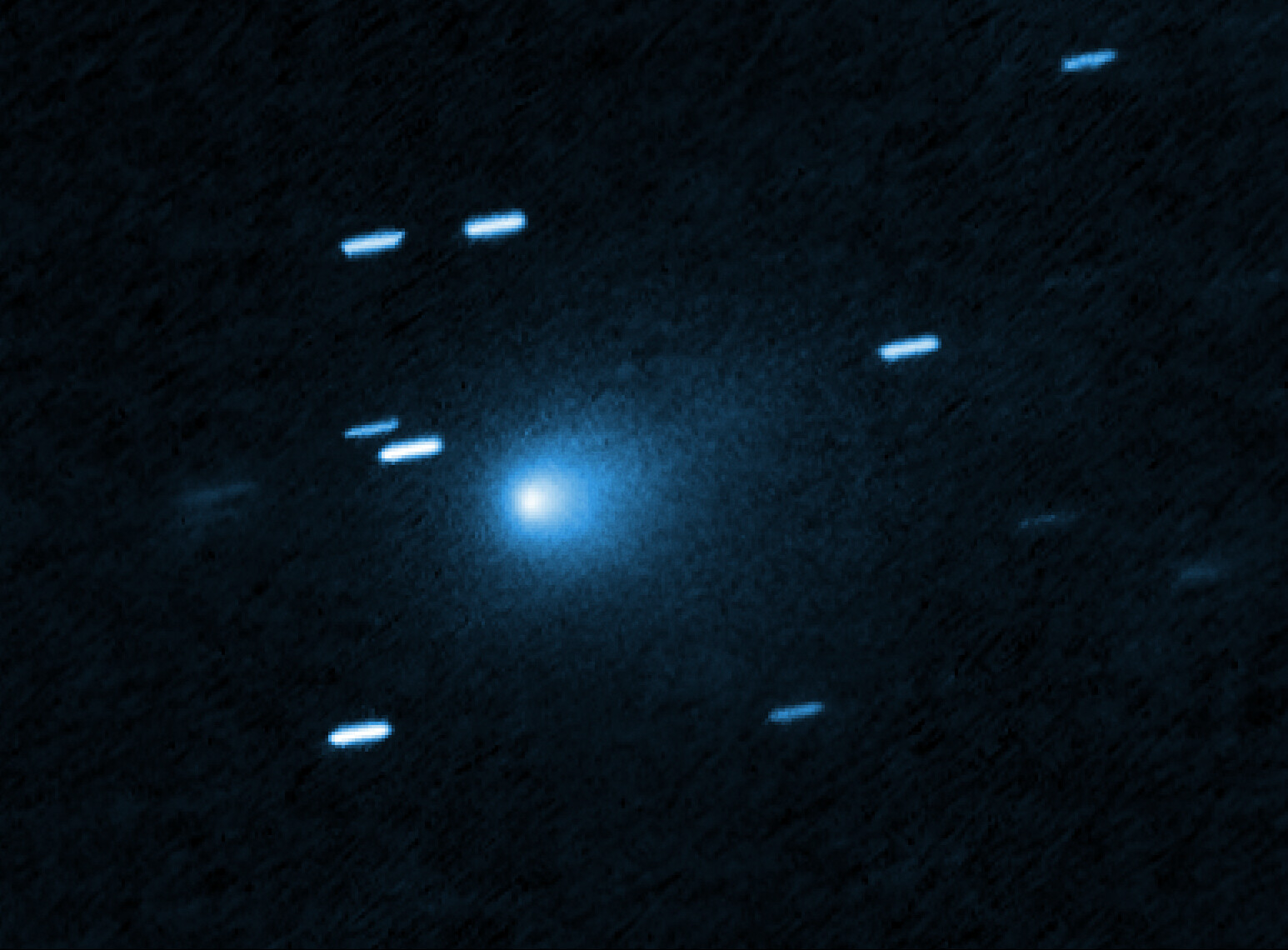
Hubble's observation reveals the comet's surrounding dust cloud.
The bright central region is associated with the comet, while the surrounding structure shows the dust released into space.
The background stars appear as streaks because Hubble tracked the moving comet during the exposure.
The image was captured using Hubble's Wide Field Camera 3 and its F350LP filter.
It shows visible wavelengths of light, unlike the infrared measurements collected by Webb.
Together, these images illustrate two different ways of studying the same visitor: observing its physical appearance and mapping its chemical environment.
21. The Limitations of Studying an Object That Is Already Moving Away
There is one major challenge facing astronomers.
3I/ATLAS is not going to remain close to Earth or the Sun indefinitely.
It is travelling through the solar system on an interstellar trajectory.
This means that the opportunity for detailed observations is limited.
Unlike a planet that can be observed repeatedly over many years, an interstellar visitor passes through our neighbourhood and continues into the wider galaxy.
Distance Changes Everything
As an object moves farther away, its apparent brightness generally decreases.
The amount of light collected by a telescope becomes smaller, making observations more difficult.
Even the most sophisticated space telescope has physical limitations.
Researchers must therefore make the best possible use of the observations obtained while the comet is accessible.
Why Archived Data Becomes Important
Astronomy does not depend exclusively on new observations.
Researchers regularly revisit previously collected measurements.
A new scientific model can sometimes reveal information that was not obvious when the original data was first analysed.
This is especially valuable for objects like 3I/ATLAS.
Different teams can examine the same observations with different scientific questions.
One group might investigate methane.
Another might study water-related emissions.
A third might analyse the distribution of dust.
The combination of these investigations can gradually produce a more complete picture of the comet.
The Importance of Independent Verification
Scientific findings become stronger when independent researchers can test the results.
They can examine the methods, compare the data and evaluate whether alternative explanations are possible.
This is particularly important when studying an object with unusual chemical characteristics.
A surprising result is not automatically a revolutionary discovery.
It becomes more convincing when different measurements and independent analyses support the same interpretation.
22. What 3I/ATLAS Teaches Us About the History of the Milky Way
The most exciting aspect of this research may be the connection between a small comet and the wider history of our galaxy.
The Milky Way is not a static collection of stars.
It has evolved over billions of years.
Stars form, develop and eventually release material into their surroundings. That material can become part of new stars, planets and smaller astronomical bodies.
The chemical composition of a planetary system therefore reflects its formation environment and the history of the surrounding galaxy.
A Record of an Earlier Cosmic Environment
If 3I/ATLAS really formed 10-12 billion years ago, its chemistry may preserve evidence from a very early stage of galactic development.
That would make it especially valuable.
The Sun formed much later, after several generations of stars had already contributed elements to the Milky Way.
Comparing the chemical characteristics of an ancient interstellar comet with those of younger solar-system comets may therefore help researchers understand how planetary building materials changed over time.
The Importance of Isotope Ratios
An isotope is a form of an element with a different number of neutrons.
The chemical behaviour of different isotopes is broadly similar, but their masses differ.
These small differences can influence chemical reactions and the way molecules form under different conditions.
The relative abundance of isotopes can therefore preserve information about temperature, chemical processing and the environment in which material developed.
This is why researchers are so interested in deuterium and carbon isotopes.
They are not simply looking for unusual substances.
They are looking for historical evidence encoded in the proportions of those substances.
A Small Object With a Large Scientific Purpose
A comet is physically tiny compared with a star or galaxy.
Yet it can preserve material that offers information about an entire planetary environment.
That is the remarkable value of 3I/ATLAS.
It allows astronomers to investigate the history of another stellar system through a visitor that has travelled into our own.
23. The Real Significance of the JWST Discoveries
The scientific importance of 3I/ATLAS should not be measured by how strange its appearance might seem.
Its importance lies in what researchers can learn from its composition.
The October 2026 research adds a particularly interesting result to the existing observations.
The high deuterium abundance measured in methane provides another chemical clue about the comet's formation environment.
Together with the earlier JWST observations, these findings suggest that 3I/ATLAS preserves a complex record of another planetary system.
There are several reasons why this matters.
First, it demonstrates that interstellar objects can provide detailed chemical information about environments beyond our solar system.
Second, it gives researchers an opportunity to compare the chemistry of different planetary systems.
Third, it helps scientists investigate the early stages of planet formation, including the behaviour of microscopic grains of ice and dust.
Finally, it provides a way to explore the possible diversity of planetary systems across the Milky Way.
The discoveries do not answer every question.
But they provide something extremely valuable: evidence that can be tested, compared and used to improve our understanding of the universe.
Frequently Asked Questions About 3I/ATLAS and the James Webb Space Telescope
1. What Is Comet 3I/ATLAS?
3I/ATLAS is an interstellar comet that originated outside our solar system. It was first reported on 1 July 2025 by the ATLAS survey telescope in Chile. It is the third confirmed interstellar object observed passing through our solar system, following 1I/'Oumuamua and 2I/Borisov.
2. Why Is 3I/ATLAS Called an Interstellar Comet?
Its orbital trajectory is hyperbolic rather than a permanently closed orbit around the Sun. Astronomers traced its path and determined that it originated beyond our solar system. The letter I in its name stands for interstellar.
3. What Did the James Webb Space Telescope Discover About 3I/ATLAS?
JWST observations revealed unusual chemical signatures, including distinctive isotope ratios involving hydrogen and carbon. More recent research has reported an unusually high deuterium-to-hydrogen ratio in methane. Webb also mapped the comet's water, carbon dioxide and carbon monoxide emissions.
4. What Is the Most Important Discovery From October 2026?
A study published in Nature Astronomy on 23 October 2026 reported a methane deuterium-to-hydrogen ratio of 3.18 +/- 0.30%. This was reported as approximately 13 +/- 2 times the methane value measured in comet 67P/Churyumov-Gerasimenko.
5. Is 3I/ATLAS Older Than the Sun?
Possibly. NASA discussed an estimated formation period of approximately 10-12 billion years ago, based on the comet's chemical signatures. This is a scientific interpretation, not a directly measured birth date. If correct, the material could be much older than our 4.6-billion-year-old solar system.
6. Where Did 3I/ATLAS Originate?
Scientists know that it originated outside our solar system, but its exact original star and planetary system have not been identified. Its chemical composition provides clues about the environment in which it formed.
7. Does 3I/ATLAS Contain Water?
JWST observations support the presence of water-related material and emissions in the comet's coma. Researchers have also studied its water-related chemical signatures and isotope composition.
8. Why Is the Comet's Chemical Composition Important?
The chemical composition can reveal information about the temperatures, radiation and physical conditions in which the comet's material formed. Comparing its molecules and isotope ratios with those of solar-system comets helps scientists understand differences between planetary systems.
9. Is 3I/ATLAS Dangerous to Earth?
No. NASA reports that the comet poses no threat to Earth. Its closest approach to our planet was approximately 270 million kilometres.
10. Could 3I/ATLAS Contain Extraterrestrial Life?
There is no evidence that it contains life. Its chemical composition is scientifically interesting because it contains substances relevant to prebiotic chemistry, but finding organic molecules or methane does not demonstrate the existence of organisms.
11. What Is the Difference Between 3I/ATLAS and 2I/Borisov?
Both are interstellar comets, but they were discovered at different times and offer different observational opportunities. 3I/ATLAS has provided particularly valuable JWST infrared observations, including detailed measurements of its chemical and isotopic composition.
12. Can the James Webb Space Telescope Photograph the Comet's Nucleus?
JWST can observe the comet and study the material surrounding its nucleus, but its observations do not necessarily provide a clear photograph of the solid nucleus itself. The coma can make the central object difficult to distinguish.
13. Why Is Deuterium Important in Astronomy?
Deuterium is a heavier isotope of hydrogen. Its relative abundance in molecules such as water and methane can provide clues about the temperatures and chemical conditions in which astronomical material formed.
14. Will Scientists Discover More Interstellar Objects?
Astronomers expect additional discoveries as sky surveys and telescope technology improve. Detecting these objects early is important because their passage through our solar system provides a limited opportunity for detailed observations.
15. What Is the Biggest Unanswered Question About 3I/ATLAS?
Its exact origin remains unknown. Scientists have developed ideas about its possible age and formation environment, but they have not identified its original star or reconstructed its complete journey through interstellar space.
Sources and Further Reading
The following sources provide the scientific background, original research and observational information used in this article.
- NASA Science - Comet 3I/ATLAS: Overview, Discovery and Observations
- NASA - Webb Finds Clues to Ancient, Distant Origin of Comet 3I/ATLAS (22 June 2026)
- Nature Astronomy - An Enriched Methane D/H Ratio in the Interstellar Object 3I/ATLAS (23 October 2026)
- NASA - Interstellar Comet 3I/ATLAS (NIRSpec IFU): Webb Chemical Maps
https://science.nasa.gov/asset/webb/interstellar-comet-3i-atlas-nirspec-ifu/
- ESA/Hubble - 3I/ATLAS: Hubble Image (7 August 2025)
- NASA - As NASA Missions Study Interstellar Comet, Hubble Makes Size Estimate (7 August 2025)
- NASA - James Webb Space Telescope
- European Space Agency - Rosetta Mission
https://www.esa.int/Science_Exploration/Space_Science/Rosetta
- NASA - Hubble Space Telescope
Conclusion: A Message From Another Planetary System
3I/ATLAS is a small visitor travelling through an enormous galaxy.
It will not remain close to our Sun. Its passage through our solar system is temporary, and eventually it will continue its journey into interstellar space.
Yet the information it carries may remain scientifically valuable for decades.
Through the James Webb Space Telescope, astronomers have examined its chemical composition and found evidence that challenges simple comparisons with familiar solar-system comets.
Its unusual methane isotope ratio and possible ancient formation history provide clues about the environment in which it developed.
Perhaps the most remarkable aspect is that these clues come from an object that formed around another star.
For the first time in human history, astronomers are building a growing collection of detailed chemical observations of visitors from other planetary systems.
We still do not know the exact star from which 3I/ATLAS originated. We cannot reconstruct every stage of its journey, and we should not confuse unusual chemistry with evidence of extraterrestrial life.
But we can study its materials, test scientific explanations and compare its composition with objects closer to home.
That is the real achievement.
The comet is not simply passing through our solar system.
It is bringing a small piece of another planetary system's history into our neighbourhood.
And thanks to the James Webb Space Telescope, we are beginning to read it.
Editorial note: This article reflects the scientific information available on 7 November 2026. Formation ages and interpretations of the comet's original environment are estimates, not confirmed facts. Scientific conclusions may change as further observations and independent analyses become available.
The conversation
Post a Comment