NASA’s 378-Day Mars Experiment Is Over: What a Year on a Simulated Red Planet Revealed About Living on Mars
The mission ended October 31, 2026. Four volunteers spent 378 days isolated inside a simulated Martian habitat, testing the routines, technologies, and human limits that could shape future missions to the Red Planet.
There is a particular kind of silence that comes with being far away from everyone you know.
Imagine waking up in the morning, opening your eyes, and realizing that the nearest person outside your small world is not in another city, another country, or even another continent. They are millions of kilometres away. You cannot simply step outside for fresh air, visit a supermarket, call an emergency service, or decide to spend the weekend somewhere different.
Every meal, every repair, every disagreement, and every unexpected problem becomes part of a much larger challenge: keeping four people healthy, productive, and mentally prepared to continue living together.
This is not a description of life on Mars. Not yet.
It is, however, a remarkably important experiment in preparing humanity for that possibility.
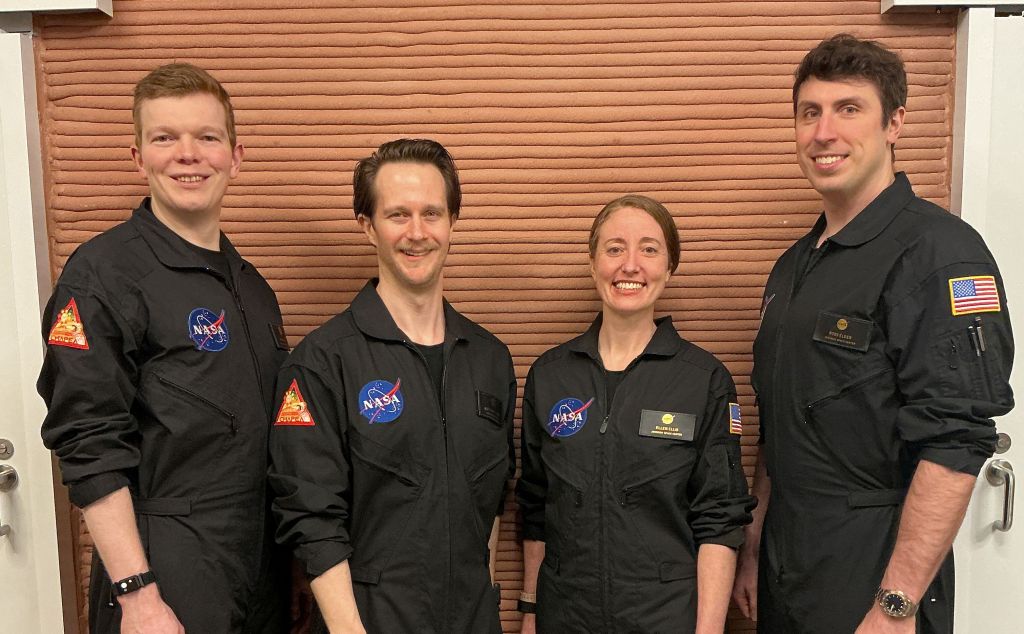
On October 31, 2026, four volunteers emerged from NASA's Crew Health and Performance Exploration Analog (CHAPEA) habitat at Johnson Space Center in Houston, Texas. They had spent 378 days living and working inside an isolated environment designed to imitate important aspects of a future human mission to Mars.
Their departure marked the completion of CHAPEA Mission 2, a year-long experiment examining one of the biggest questions in human space exploration: Can people successfully live, work, cooperate, and maintain their health in an environment where ordinary life is no longer possible?
NASA confirmed the crew's return on November 2, 2026. The mission was a ground-based simulation, not an actual journey to Mars, but its findings can help scientists prepare for the extraordinary practical and psychological demands of future planetary exploration.
1. What Exactly Happened on October 31, 2026?
The October 31 milestone was the conclusion of CHAPEA Mission 2, NASA's second year-long Mars analog mission.
The four participants were:
- Ross Elder – Mission commander.
- Ellen Ellis – Medical officer.
- Matthew Montgomery – Science officer.
- James Spicer – Flight engineer.
They entered the habitat on October 19, 2025, and remained inside until October 31, 2026. NASA's completion announcement confirmed that they had spent 378 days in isolation.
Their home was a 1,700-square-foot (approximately 158-square-metre) three-dimensional-printed structure at NASA's Johnson Space Center in Houston. The facility is known as Mars Dune Alpha.
It was designed to reproduce important features of a future Mars settlement, including private sleeping quarters, a kitchen, work areas, medical facilities, exercise and recreation spaces, and an area for growing crops.
The habitat was not simply a room where volunteers waited for a year. It was a working environment in which daily activities were deliberately organized around the challenges of an extended planetary expedition.
The crew exercised, prepared meals, maintained equipment, conducted science activities, cultivated plants, and performed simulated excursions outside their living area.
They also experienced restricted resources, delayed communications, isolation, and simulated equipment problems. These conditions were selected because they represent important operational challenges that a real Mars crew could face.
Why 378 Days?
The duration was chosen for a year-long research mission, rather than because 378 days represents a complete Martian year.
A year on Mars lasts approximately 687 Earth days. The CHAPEA experiment therefore tested more than twelve months of life in confinement, not an entire orbit of Mars around the Sun.
That distinction matters. The mission was designed to investigate the human demands of a prolonged expedition, not to reproduce every astronomical feature of a Martian calendar.
2. Mars Dune Alpha: A Small World Built Inside Earth
Imagine living in a house where every room has a mission.
Your bedroom is a private recovery space. The kitchen is part of a carefully managed food system. A maintenance area becomes essential when equipment needs attention. A small growing area provides an opportunity to produce fresh crops. Even exercise is part of the daily survival strategy.
That is the philosophy behind Mars Dune Alpha.
Rather than building an ordinary laboratory and asking people to imagine living on Mars, NASA created a physical environment where volunteers could experience a structured version of long-duration planetary living.
The 3D-printed construction is particularly interesting. NASA worked with construction technology company ICON to create the habitat using large-scale additive manufacturing.
The idea is relevant beyond this particular experiment. If future explorers need to establish infrastructure on the Moon or Mars, transporting every building component from Earth could be extremely expensive and complicated.
Using local materials and automated construction systems could eventually offer an alternative.
However, Mars Dune Alpha should not be mistaken for a building that has already demonstrated that a complete habitat can be printed using Martian soil. It is an Earth-based research facility built using 3D-printing technology to investigate human habitation and mission operations.
A home divided into functional zones
The habitat includes several spaces that serve different purposes:
- Private crew quarters for sleeping and personal time.
- A kitchen and food-preparation area.
- Dedicated medical and fitness facilities.
- Workstations and technical maintenance areas.
- A recreation and common area.
- A crop-growing section.
- Two bathrooms.
These divisions are not just architectural choices. They help researchers study how a small crew organizes its time and uses limited living space.
In an ordinary house, a broken appliance might be inconvenient. In a remote planetary habitat, a broken essential system could affect the health and safety of everyone inside.
That difference changes how people think about maintenance, cleanliness, storage, and everyday responsibility.
3. The most important experiment was not the building. It was the people.
The name CHAPEA stands for Crew Health and Performance Exploration Analog.
The words health and performance are central to understanding the project.
The mission was primarily a human-research experiment. NASA's goal was not simply to demonstrate a new construction method or test whether a particular piece of equipment worked. It was to understand how people respond to an extended period of isolation, confinement, demanding schedules, limited resources, and reduced contact with Earth.
NASA's research team collects information that can help scientists assess physical health, behavioral health, cognitive performance, and the demands placed on a small crew.
Consider the difference between completing a difficult task on Earth and completing it when you cannot easily ask someone else for help.
On Earth, a tired worker can take a break, visit a doctor, buy different food, or spend an evening with friends.
A Mars crew cannot depend on those options.
A mission must be designed around the possibility that the crew will have to solve problems using the people, tools, knowledge, and supplies already available.
That makes human performance an engineering issue.
A spacecraft can be powerful, a habitat can be well designed, and a communication system can be advanced. But if the people operating these systems become exhausted, unable to cooperate, or incapable of making sound decisions under pressure, the mission becomes vulnerable.
CHAPEA investigates this often-overlooked side of space exploration.
4. The communication blackout: Learning to live without Earth
One of the most revealing parts of Mission 2 was not a physical challenge. It was the absence of communication.
On Earth, people are accustomed to instant messages, video calls, and almost immediate answers. Even when someone lives thousands of kilometres away, communication is usually available with a few taps.
Mars changes that relationship completely.
Radio signals travel at the speed of light, but the distance between Earth and Mars is so great that a message can take approximately three to 23 minutes to travel in one direction, depending on the planets' positions.
That means a simple question could take a long time to receive an answer. A message sent to Earth might arrive several minutes after it was written, and a reply would require another journey back.
A conversation that takes seconds on Earth could become a much longer exchange.
For a crew dealing with an urgent technical problem, that delay is not simply inconvenient. It changes the way decisions must be made.
The two-week communications blackout
During May 2026, the CHAPEA Mission 2 crew experienced a simulated two-week loss of communication with Earth.
The exercise reproduced a phenomenon associated with solar conjunction, when Mars moves behind the Sun from Earth's perspective. Communication can become unreliable or temporarily unavailable because signals must pass close to the Sun, where interference can affect radio transmissions.
During the simulation, the crew could not rely on ordinary email exchanges or immediate assistance from mission control. They had to work with available information, planned procedures, and their own judgment.
NASA's official podcast documented the experience through audio recordings made during and after the blackout.
The experience was especially important because it tested something that cannot be solved simply by installing a more powerful antenna: independence.
A future Mars crew must be capable of making decisions without waiting for Earth to approve every action.
This could include:
- Identifying the source of a technical malfunction.
- Deciding which maintenance task should receive priority.
- Managing medical situations with limited remote assistance.
- Organizing scientific activities around available resources.
- Choosing when to conserve energy, water, food, or equipment.
- Recording important information for transmission when communications return.
The objective is not to eliminate mission control. It is to build a relationship in which astronauts and Earth-based specialists can work effectively despite delays and interruptions.
A birthday without a normal phone call
The communication experiment also revealed a less technical side of isolation.
During the blackout, science officer Matthew Montgomery described celebrating his birthday without being able to speak directly with friends and family. He had received cards in advance, which gave him something personal to open during the celebration.
The crew also described the importance of humor, shared activities, and maintaining positive relationships.
At the mission's midpoint, medical officer Ellen Ellis reported tired muscles and blisters but said there had been no medical emergencies at that stage. She also described the team as mission-focused while still enjoying one another's company during downtime.
These are small details, but they matter.
A future Mars expedition will not consist entirely of dramatic discoveries and spectacular views. It will contain birthdays, routine maintenance, ordinary disagreements, tired mornings, and moments when somebody simply wants to hear a familiar voice.
A successful mission must account for those human needs.
5. Marswalks: When going outside becomes a regular job
For most people, going outside is effortless.
You open a door, walk into the garden, and return whenever you want. There is no special preparation, no pressure-control procedure, and no requirement to inspect a life-support system before stepping outside.
For a Mars explorer, leaving the habitat is an operation.
Astronauts must prepare their suits, verify essential systems, follow safety procedures, and make sure they can return to a protected environment. The outside world is not breathable, and a damaged suit could quickly become a life-threatening emergency.
CHAPEA recreated important elements of this process through simulated extravehicular activities, commonly called EVAs or spacewalks.
The volunteers wore spacesuits and carried out tasks in a specially prepared simulated Martian environment. Some activities involved virtual reality, while others involved physical tasks in the facility.
More than exploration: Maintenance and repair
The crew's work outside was not limited to collecting imaginary rocks.
In a NASA podcast recorded around the 200-day milestone, flight engineer James Spicer explained that each crew member had already accumulated more than 150 hours outside the habitat.
Their activities included maintaining equipment, repairing components, retrieving supplies, and completing simulated surface operations.
The crew also discussed the possibility that future Mars astronauts may need to perform surface activities far more frequently than astronauts typically undertake spacewalks on the International Space Station.
The reason is straightforward: a planetary surface mission involves a wide range of daily tasks that cannot all be completed from inside a spacecraft.
Why this matters for a real Mars mission
Imagine a future exploration crew operating a scientific instrument several kilometres from its habitat.
A component stops working.
On Earth, a technician could visit the site, examine the equipment, and potentially replace a part within hours. On Mars, the crew may need to diagnose the problem, prepare for an EVA, travel to the equipment, carry out the repair, and return safely.
Every additional operation consumes time, energy, and physical effort.
The crew also has to decide whether the repair is more important than another scheduled task.
This makes EVA planning a major part of mission design. NASA needs to understand how much work a crew can reasonably complete, how frequently people can perform demanding activities, and how the workload affects their physical and mental condition.
CHAPEA cannot reproduce the full danger of a real Martian surface excursion, but it can help scientists study the human workload and operational organization involved.

6. Growing food on Mars: Why a small garden could become essential
One of the most visually interesting parts of CHAPEA Mission 2 was its growing system.
Inside the habitat, plants were cultivated using a controlled hydroponic system. Instead of relying on ordinary outdoor soil, hydroponic growing supplies plants with water and nutrients in a managed environment.
NASA photographs from the mission show peppers growing among green leaves under artificial lighting.
At first glance, this might look like an ordinary indoor garden. In reality, it represents a much bigger question:
How can astronauts maintain a reliable food supply when the nearest supermarket is millions of kilometres away?
Why food is a complicated Mars problem
A Mars mission cannot depend on regular deliveries.
A crew cannot simply request additional fresh vegetables when supplies become limited. Food must be planned, packaged, stored, transported, and managed before departure.
This creates several challenges.
First, food must remain safe and nutritious for an extended period. Storage conditions can affect food quality, and the menu must provide enough nutrients to support health and demanding physical activities.
Second, variety matters.
Imagine eating the same limited selection of meals every day for months. Even if the meals provide sufficient calories, repetitive food can become psychologically tiring.
Scientists refer to this challenge as menu fatigue.
Third, food systems compete with other mission requirements for mass, volume, power, and water.
A growing system might provide fresh vegetables and improve dietary variety, but it also requires equipment, lighting, water, nutrients, monitoring, and crew time.
The system must provide enough benefit to justify those costs.
NASA identifies food quality, variety, nutrition, and the lack of resupply as important challenges for a round-trip Mars mission.
Hydroponics: A possible piece of the solution
Hydroponics offers an interesting approach because it allows plants to grow without traditional agricultural soil.
A controlled system can deliver nutrients directly to the roots while managing water and lighting.
For a Mars habitat, this could eventually support the production of selected fresh crops.
However, it would be misleading to suggest that the CHAPEA garden made its crew completely independent of Earth for food.
The purpose was to investigate crop cultivation as one component of a larger exploration food system. It did not demonstrate that four astronauts could grow everything they need for an entire Mars expedition.
A realistic future food system may combine several approaches:
- Shelf-stable packaged meals transported from Earth.
- Carefully selected fresh crops grown inside the habitat.
- Advanced water-recycling systems.
- Nutritional monitoring and meal planning.
- Food preparation procedures that minimize waste.
Fresh food has psychological value too
There is another benefit that is easy to overlook.
A green plant inside a largely artificial environment can change how a space feels.
Plants provide visible signs of growth. They create something that requires attention and care. Watching seeds germinate and vegetables develop can introduce a sense of continuity into a life dominated by strict schedules and mechanical systems.
During the Mission 2 communications blackout, the crew described caring for a new round of crops and carrying out seed-germination experiments.
Montgomery even referred to the plants as good companions during the period without communication.
That observation is a reminder that food production may have value beyond calories. It may contribute to morale, routine, and a sense of connection with living systems.
7. Exercise and health: The body is part of the spacecraft
A spacecraft can be maintained through engineering. A human body requires something different.
It needs movement, appropriate nutrition, rest, and medical monitoring.
In space, these requirements become especially important because the human body evolved under Earth's gravity.
During long periods in microgravity, astronauts can experience muscle loss, reductions in bone density, and other physiological changes. Exercise and carefully planned nutrition are essential countermeasures.
CHAPEA studied aspects of exercise, health, and physical performance in a long-duration confined environment.
The crew used exercise equipment, followed planned routines, and participated in health-monitoring activities. NASA's photographs document medical testing, blood collection, and exercise performance assessments during the mission.
But there is an important distinction.
The CHAPEA volunteers were living in Earth's normal gravity. They were not experiencing the weightlessness of a spacecraft or the reduced gravity of the Martian surface.
The crew itself discussed this limitation in NASA's podcast.
Ellis explained that the analog did not expose them to the physiological effects of radiation or microgravity, while Spicer described exercise as an important part of preparing for the physical demands of future exploration.
Why exercise must be part of mission planning
Imagine arriving on Mars after months of space travel.
The crew must be ready to walk on the surface, operate equipment, carry supplies, and perform demanding maintenance tasks.
If their muscles and bones have weakened during the journey, those activities become more difficult.
A future mission will therefore need to balance exercise against other activities.
Too little exercise could undermine physical readiness. Too much could consume valuable time and energy or increase fatigue.
This is a resource-allocation problem as much as a fitness problem.
The research gathered through CHAPEA can help scientists investigate how exercise schedules, food systems, sleep, and workloads interact.
Medical emergencies far from a hospital
Another major challenge is medical independence.
On Earth, a serious injury can be followed by rapid access to specialist care. A Mars crew would face a different situation.
There may be no possibility of immediate evacuation. Medical support from Earth would be delayed, and some emergencies would require the crew to act before receiving outside guidance.
This means future exploration missions may need:
- Crew members with appropriate medical training.
- Reliable diagnostic equipment.
- Onboard medical supplies.
- Clear emergency procedures.
- Remote medical support designed around communication delays.
- Decision-support systems that can help crews evaluate unfamiliar situations.
NASA's CHAPEA Mission 2 imagery also documents demonstrations of AI-enabled medical training and the use of specialized medical monitoring devices.
These activities are part of a broader effort to understand how medical care and crew decision-making might work during missions far from Earth.
The goal is not to replace doctors with artificial intelligence. It is to help astronauts obtain useful medical guidance when ordinary Earth-based support is not immediately available.
8. The psychological challenge: Can four people live together for more than a year?
There is a difference between enjoying somebody's company and sharing a confined environment with that person every day.
Friends can meet for dinner, spend a weekend together, and then return to their separate lives. A Mars crew does not have that luxury.
The same four people may share meals, work assignments, exercise periods, maintenance responsibilities, scientific investigations, and leisure time for months.
There is no easy way to escape a disagreement.
A minor misunderstanding can become more complicated when the people involved cannot leave the environment, find another social group, or take a break from the mission.
This makes crew compatibility a serious element of space exploration.
The importance of social relationships
NASA studies behavioral health and performance because the psychological condition of astronauts can influence their ability to complete mission objectives.
Isolation, confinement, heavy workloads, uncertainty, and limited contact with family can all influence how people feel and behave.
A crew might be technically skilled but still struggle if its members cannot communicate effectively or manage disagreements.
The CHAPEA Mission 2 crew offered an interesting glimpse into this challenge.
During the simulated communications blackout, Ellis explained that the team remained focused on its work while continuing to enjoy one another's company during downtime. She considered laughter an important part of maintaining healthy team relationships.
The crew also described celebrating birthdays, enjoying special meals, creating humorous material, and programming different wake-up songs.
These activities may seem insignificant compared with spacecraft engineering, but they are part of what makes a difficult environment psychologically manageable.
Why entertainment is not a luxury
Imagine living in a habitat where every day follows a strict schedule.
You wake up, exercise, complete scientific work, maintain equipment, prepare food, and follow safety procedures.
After several months, the routine could become mentally exhausting.
Entertainment provides an opportunity to break that pattern.
Music, reading, games, personal hobbies, celebrations, and shared recreational activities could help future crews maintain a sense of normal life.
The Mission 2 crew even brought musical instruments as part of its personal-item allowance, and NASA documented the volunteers spending time together during their mission.
This suggests an important design principle: future habitats should not be treated only as places where astronauts sleep and work.
They should also support the psychological requirements of people who must live there for extended periods.
Crew selection will be as important as spacecraft selection
A future Mars crew will need a combination of technical competence, adaptability, communication skills, and emotional resilience.
The ideal astronaut is not simply someone who can perform difficult scientific tasks.
That person must also be able to cooperate with others when everyone is tired, when plans change unexpectedly, and when outside assistance is delayed.
CHAPEA cannot determine exactly how every future astronaut will behave on Mars. However, it gives researchers an opportunity to observe team dynamics under controlled, prolonged conditions.
This information could help improve crew selection, training, habitat design, and behavioral support.
9. What CHAPEA cannot simulate: The difference between Houston and Mars
It would be easy to look at the successful completion of 378 days and conclude that humanity is now ready to live on Mars.
That would be an enormous exaggeration.
CHAPEA is valuable precisely because it investigates a specific group of challenges. It does not reproduce every condition that astronauts would encounter during an actual interplanetary expedition.
Understanding these limitations is essential when evaluating the experiment.
1. The crew did not experience Martian gravity
Mars has approximately 38% of Earth's surface gravity.
A person weighing 80 kilograms on Earth would experience a gravitational force equivalent to weighing approximately 30 kilograms on Mars, although their mass would remain the same.
This reduced gravity could influence movement, balance, exercise, and long-term physical health.
The CHAPEA volunteers remained under normal Earth gravity.
Consequently, their experience cannot tell scientists exactly how the human body will respond to living in Martian gravity for an extended period.
2. They were not exposed to real space radiation
Space radiation is one of the major health concerns associated with human exploration beyond Earth's protective environment.
Astronauts traveling to Mars would face radiation exposure during interplanetary travel and while operating on the planet's surface.
A ground-based habitat in Houston cannot reproduce the full radiation environment of deep space.
Researchers must combine CHAPEA findings with other investigations, including research conducted aboard the International Space Station, radiation studies, and spacecraft engineering experiments.
3. There was no real Martian atmosphere
Mars has an extremely thin atmosphere dominated by carbon dioxide.
Humans cannot breathe it, and a normal building would not protect its occupants from the planet's external conditions.
A real Martian habitat would require pressure protection, dependable oxygen supplies, temperature control, radiation protection, and robust life-support systems.
CHAPEA's simulated environment can investigate how people live inside a protected habitat, but it does not expose them to the real atmospheric conditions of Mars.
4. There was no actual Martian dust environment
Mars has fine surface dust that can be transported by wind and become a significant engineering and operational concern.
Dust could affect equipment, spacesuits, seals, solar panels, and habitat entrances.
The physical environment surrounding the CHAPEA habitat is not a genuine Martian landscape.
Its simulated surface activities cannot fully reproduce the effects of real Martian dust on hardware and human health.
5. They did not make an interplanetary journey
Perhaps the most important limitation is that the volunteers were already on Earth.
They did not experience months of travel through space, launch and landing operations, or the physiological effects of an actual spacecraft environment.
They could also eventually leave the facility and return to their families without an interplanetary journey.
A real Mars expedition would involve additional risks and demands that no single Earth-based simulation can reproduce.
The central lesson is that CHAPEA is one part of a much larger research programme, not a complete rehearsal of a Mars landing.
Its strength is the ability to investigate the human experience of isolation, workload, food management, and independent operations while researchers can monitor the participants in a controlled environment.
10. What happens to the data now?
The crew's departure on October 31 was the end of the simulation, but it was not the end of the research.
NASA's October 19 announcement explained that research teams were preparing to process the health and performance data collected during the mission.
The agency also planned approximately two weeks of post-mission evaluations and debriefings to understand how the volunteers adapted to the experience and what support future crews might need.
This distinction is important.
A mission can be successfully completed without all its scientific results being immediately available.
Scientists must examine the information collected, compare different measurements, assess the participants' feedback, and determine which findings can be reliably applied to future missions.
What researchers will want to understand
The collected information can help investigate several connected questions.
Physical health: How did exercise routines, nutrition, and workload interact during an extended period of confinement?
Behavioral health: What conditions helped the crew maintain positive relationships and psychological stability?
Crew autonomy: How effectively could participants organize their work during communication delays and periods without contact with Earth?
Food systems: How did the combination of stored food and crop cultivation support nutrition and daily operations?
Workload management: How much time did maintenance, simulated spacewalks, science activities, and routine tasks require?
Medical preparedness: What kinds of equipment, procedures, and decision-support systems could help a crew handle medical problems independently?
These questions are interconnected.
For example, increasing the frequency of surface excursions might improve scientific productivity, but it could also increase fatigue and reduce the time available for exercise or other essential activities.
Likewise, expanding a crop-growing system could improve food variety, but it might demand additional power, water, and crew time.
The challenge is not to maximize one activity. It is to design a system in which all essential activities can coexist.
Why the first CHAPEA mission matters too
Mission 2 was not the first experiment of its kind.
The first CHAPEA crew completed its own 378-day simulated Mars mission on July 6, 2024.
That mission involved Kelly Haston, Ross Brockwell, Nathan Jones, and Anca Selariu.
The second mission provides another opportunity to study how a different group of volunteers responds to similar conditions. Researchers can investigate recurring patterns as well as differences between crews.
Comparing experiences across missions is particularly useful because four individuals cannot represent every possible human response to isolation and confinement.
A larger research picture requires multiple participants, measurements, and complementary studies.
11. How a year in Houston could influence the first real Mars settlement
The importance of CHAPEA extends beyond the experiment itself.
A future Mars expedition will require a complicated combination of spacecraft, landing systems, habitats, communication networks, scientific instruments, food supplies, medical equipment, and power systems.
All these components must work together.
The human element is the connection between them.
Consider five areas in which the research could influence future exploration.
Better habitat design
A successful habitat must provide more than protection from the outside environment.
It must offer enough private space, practical work areas, exercise facilities, medical support, storage, and recreational opportunities.
CHAPEA gives NASA a way to investigate how four people use a relatively compact environment over a prolonged period.
This information can influence future interior layouts and the amount of space allocated to different activities.
More independent crews
The communication blackout demonstrated why astronauts need the ability to operate without constant instructions from Earth.
Future mission systems will need to provide clear procedures, reliable onboard information, and effective tools for decision-making.
Artificial intelligence could eventually support certain diagnostic, planning, and information-retrieval tasks, although it would need appropriate testing and human oversight.
The objective should be to give astronauts better tools, not to make critical decisions depend on an unverified automated system.
More efficient food and resource systems
Food, water, power, and waste management are connected.
A future habitat will need to recycle consumables wherever practical and minimize the resources required for everyday life.
NASA's research into crop growth and exploration food systems could help establish which combinations of stored food and locally grown produce are most effective.
Improved medical and psychological support
A Mars crew needs to remain healthy over an extended period.
Future missions will require reliable monitoring, suitable exercise programmes, appropriate medical supplies, and ways to maintain psychological well-being.
The research may help determine which support systems are most valuable when immediate assistance from Earth is unavailable.
More realistic schedules
The crew's experience with simulated Marswalks highlights how demanding surface operations could become.
Future schedules must balance exploration, repairs, scientific work, exercise, sleep, and personal time.
A mission that looks efficient on paper might prove unsustainable when actual human workloads are considered.
CHAPEA provides a valuable opportunity to study these trade-offs before astronauts face them on another world.
NASA has explicitly identified the relevance of this research to future lunar missions and Moon Base planning, as well as Mars exploration.

12. What we know — and what remains uncertain
A responsible assessment of this mission must separate confirmed facts from future expectations.
What is confirmed
- CHAPEA Mission 2 ended on October 31, 2026.
- Four volunteers completed 378 days inside the simulated habitat.
- The habitat was a 1,700-square-foot, 3D-printed facility at NASA Johnson Space Center.
- The crew performed simulated surface activities, maintenance, exercise, scientific work, and crop cultivation.
- The mission included resource limitations, isolation, and communication-delay exercises.
- NASA collected health and performance data and planned post-mission evaluations.
What remains uncertain
- The full scientific findings from Mission 2.
- The precise long-term health and behavioral effects observed across the complete mission.
- Which food-growing methods will prove practical on Mars.
- How well the lessons will transfer to actual reduced-gravity and radiation environments.
- Which medical and AI-assisted systems will ultimately be approved for operational Mars missions.
- When humans will actually establish a permanent settlement on Mars.
The difference between these two lists is essential.
NASA has demonstrated that four volunteers can complete a year-long simulated Mars mission under carefully controlled conditions.
It has not demonstrated that humans can yet survive every challenge of a real Mars expedition.
The scientific value will become clearer as researchers process the results and publish their findings.
13. The bigger picture: Preparing for Mars by learning how to live together
There is something remarkable about the idea behind CHAPEA.
For centuries, exploring another planet belonged to the world of imagination. Today, scientists are studying the ordinary details that could make such an achievement possible.
They are investigating how people sleep, exercise, prepare meals, maintain equipment, grow vegetables, communicate, and manage disagreements.
These are not glamorous details, but they are essential.
The first people to establish a lasting human presence on Mars will not spend every day making extraordinary discoveries. Much of their time will involve routine work that keeps their habitat functioning.
They will need to maintain their equipment, protect their health, manage their supplies, and support one another.
A successful Mars mission will depend not only on the rocket that takes astronauts there but also on the everyday systems that allow them to remain there.
CHAPEA Mission 2 has completed another important step in understanding those requirements.
The four volunteers have returned to ordinary life, but the information collected during their 378 days will continue to be examined by scientists.
The next stage is to turn that experience into better mission plans, better equipment, and better ways of protecting the people who may eventually travel to the Red Planet.
Perhaps the most important lesson is also the simplest: reaching Mars is an engineering challenge, but living there will be a human challenge.
And before humanity attempts that extraordinary journey, it makes sense to learn as much as possible about both.
Key Takeaways
- CHAPEA Mission 2 ended on October 31, 2026, after four volunteers completed 378 days inside NASA's simulated Mars habitat.
- Mars Dune Alpha is a 1,700-square-foot 3D-printed facility designed to investigate the challenges of long-duration planetary living.
- Communication delays are a major challenge. Messages between Earth and Mars can take several minutes each way, and solar conjunction can create extended communication interruptions.
- Food production matters. Hydroponic crops could supplement stored food and contribute to nutrition and morale.
- Human relationships matter. Cooperation, humor, entertainment, and psychological support are important elements of a long-duration mission.
- Autonomy is essential. Future astronauts must be capable of making decisions without immediate help from Earth.
- The simulation has limitations. It does not reproduce real Martian gravity, space radiation, the actual atmosphere, or interplanetary travel.
- Scientific analysis is still necessary. Completing the experiment does not mean all its findings have already been published.
Frequently Asked Questions (FAQ)
1. What was NASA's CHAPEA mission?
CHAPEA stands for Crew Health and Performance Exploration Analog. It is a NASA research programme that uses isolated, Earth-based habitats to simulate aspects of long-duration human missions on Mars.
2. When did the 378-day CHAPEA Mission 2 end?
The mission ended on October 31, 2026. The crew entered the habitat on October 19, 2025, and spent 378 days living and working in isolation.
3. Who participated in NASA's CHAPEA Mission 2?
The four volunteers were Ross Elder, Ellen Ellis, Matthew Montgomery, and James Spicer. Their roles were mission commander, medical officer, science officer, and flight engineer, respectively.
4. Did the volunteers actually travel to Mars?
No. They remained inside a specially designed facility at NASA's Johnson Space Center in Houston. The experiment simulated selected aspects of Mars exploration but did not involve an actual spaceflight.
5. How large was the simulated Mars habitat?
Mars Dune Alpha measures approximately 1,700 square feet, or 158 square metres. It contains private sleeping quarters, a kitchen, work areas, medical and fitness facilities, recreation space, and crop-growing facilities.
6. Why did NASA simulate a communications blackout?
A communications blackout can occur when Mars moves behind the Sun relative to Earth. Simulating this situation helps researchers understand how astronauts could operate independently without immediate guidance from mission control.
7. Did the crew grow its own food?
The crew cultivated plants using a hydroponic crop-growing system. NASA documented peppers and other crops growing inside the habitat. This was part of a larger food-system experiment, not proof of complete food independence.
8. What did the mission reveal about mental health?
The mission provided opportunities to study isolation, teamwork, routine, and behavioral health. Crew members described maintaining positive relationships, enjoying shared activities, and using humor and celebrations to support morale. The complete scientific analysis remains necessary before drawing broader conclusions.
9. Does CHAPEA prove humans are ready to live on Mars?
No. The mission investigated important human and operational challenges, but it did not reproduce radiation exposure, Martian gravity, real atmospheric conditions, or interplanetary travel.
10. What happens after the mission?
NASA researchers process the collected health and performance information and conduct post-mission evaluations and debriefings. The resulting research can inform future lunar exploration, Moon Base planning, and human missions to Mars.
Sources and further reading
- NASA — CHAPEA Mission 2: Official mission information and photographs
- NASA — Crew completion of the year-long Mars simulation, October 27, 2026
- NASA — CHAPEA crew returns to Earth, November 2, 2026
- NASA — The simulated Mars crew marks one year inside the habitat
- NASA — CHAPEA 2: Audio Log 3, including the simulated communications blackout
- NASA — About CHAPEA and the Mars Dune Alpha habitat
- NASA — Humans to Mars: Food, water, power, shelter, and communications
- NASA — Human Research Program
- NASA — Voyagers of Mars: The first CHAPEA crew's yearlong journey
This article was written for THE JORNAL. Sources are linked above; where NASA's findings are still being analysed, the article says so rather than presenting them as settled results.
THE JORNAL — New ideas. Wider horizons.
The conversation
Post a Comment