NASA's CHAPEA 378-Day Simulated Mars Habitat: A Year on Another Planet Without Leaving Earth
THE JORNAL | Space, science, and the human future
Imagine waking up in a place where the sky is never blue, the air smells faintly of dust and recycled plastic, and the nearest help is 22 minutes away by radio. You cannot step outside without a suit. You cannot order food, call a friend, or take a walk around the block. Your whole world is a small, white, 3D-printed house, and the only people you will see for more than a year are the three others living with you.
They were not on Mars. They were in Houston, Texas, inside a warehouse at NASA's Johnson Space Center. For 378 days, from June 2023 to July 2024, four volunteers lived in a simulated Mars habitat called Mars Dune Alpha. They ate shelf-stable food, grew their own vegetables, exercised on a treadmill, and went on simulated walks across a red, sandy surface. They were not astronauts in the usual sense, but they were the first people to test what it might feel like to live on Mars for more than a year.
They volunteered for 378 days because NASA needed to know something simple and difficult: can four ordinary people live together in a small space, far from home, with no way out, and still stay healthy, productive, and kind to each other? The answer matters because a real Mars mission will take about two to three years, and there will be no quick return.
This is not a story about a spacecraft or a rocket. It is a story about people: what they ate, how they slept, how they argued and made up, how they stayed fit, and what they learned about themselves. It is also a story about what NASA learned, and what it still does not know.
What did four people discover inside a fake Mars house, and what does it mean for the first real crew that will one day travel to Mars? This article explains the CHAPEA mission in plain language, with the details NASA has published, the lessons researchers have drawn, and the questions that remain open.
Key Takeaways
- Four volunteers spent 378 days inside a simulated Mars habitat in Houston, Texas.
- The habitat was a 1,700-square-foot, 3D-printed structure called Mars Dune Alpha.
- Simulated Marswalks, research, exercise, and maintenance filled each day.
- Food, exercise, and medical care were carefully planned and monitored.
- Communication was delayed by up to 22 minutes each way.
- CHAPEA can show how people live, work, and adapt in a confined habitat.
- It cannot show the full effects of Mars gravity, radiation, or distance from Earth.
1. What is CHAPEA? NASA's Mars Simulation Programme
A CHAPEA mission is a long-duration simulation run by NASA to prepare for the future exploration of Mars. It is a test of people, routines, and technology rather than a test of a spacecraft. It is a test of what happens when four people live together in a small space, with no way out and no quick return home.
It is important to understand what CHAPEA is not. It is not a Mars mission, and it does not take place on Mars. It does not test a spacecraft, a rocket, or a landing system. It tests the human side of a Mars mission: how people live, work, eat, sleep, stay healthy, and get along when they are confined together for more than a year.
NASA chose to run CHAPEA at the Johnson Space Center in Houston, Texas, where the agency could control the environment, monitor the crew closely, and collect detailed data. The habitat was built inside a large warehouse-like building, which protected it from the weather and allowed NASA to create a controlled Mars-like environment.
CHAPEA has been designed as a series of three missions, each lasting about one year. The first mission ran from June 2023 to July 2024. The second mission began in October 2025. A third mission is planned, but NASA has not yet announced its crew or start date.
2. Meet the Crew: Four Volunteers, One Year, No Exit
The first CHAPEA mission began on June 25, 2023, when four volunteers entered the Mars Dune Alpha habitat at NASA's Johnson Space Center in Houston, Texas. They did not leave until July 6, 2024, after 378 days inside.
They were not astronauts in the usual sense. They were volunteers who applied to take part in a long-duration simulation. They had professional backgrounds in science, engineering, and medicine, and they were selected after a long process of interviews, medical checks, and psychological assessments.
All four had experience that NASA thought would be useful on a Mars mission. They were also chosen because they could work as a team, handle stress, and live in close quarters with strangers for more than a year.
They entered the habitat on June 25, 2023, and did not leave until July 6, 2024.
The first crew consisted of Kelly Haston, mission commander; Ross Brockwell, flight engineer; Nathan Jones, medical officer; and Anca Selariu, science officer.
Their names were Kelly Haston, Ross Brockwell, Nathan Jones, and Anca Selariu. Their home was called Mars Dune Alpha, a 3D-printed structure covering approximately 1,700 square feet (158 square metres).
Kelly Haston — Mission Commander
Haston is a research scientist with experience developing human disease models. Her background includes stem-cell-based research connected with areas such as infertility, liver disease, and neurodegeneration.
Ross Brockwell — Flight Engineer
Ross Brockwell's engineering background was especially relevant.
Brockwell is a structural engineer and public works administrator. He has experience in construction and engineering projects, including work on bridges, roads, and other infrastructure. He also has experience in the U.S. Navy, where he served as a public works officer.
Nathan Jones — Medical Officer
Jones is an emergency medicine physician who has worked in challenging and high-pressure settings, including in the U.S. Air Force and the U.S. Navy, and in a hospital emergency department.
Anca Selariu — Science Officer
Selariu is a microbiologist with experience in the U.S. Navy, including work related to infectious disease research, vaccine discovery, and gene therapy.
Why These Four People Matter
People often focus on the technology of spaceflight: the rockets, the spacecraft, the suits. But a Mars mission will also depend on the people inside the habitat. A crew that cannot work together, stay healthy, and solve problems will not succeed, no matter how good the technology is.
The crew was chosen to represent the kinds of skills a Mars mission will need: leadership, engineering, medicine, and science. They were also chosen because they could handle the psychological demands of isolation, confinement, and delayed communication.
That is why CHAPEA is as much a test of people as it is a test of technology.
3. Inside Mars Dune Alpha: A 1,700-Square-Foot Home
Imagine a one-bedroom apartment, about the size of a small house, shared by four people. That is roughly the size of Mars Dune Alpha. It covers about 1,700 square feet (158 square metres), which is about the size of a two-bedroom flat. It is not large, and it was home for four people for more than a year.
The habitat was built using 3D-printing technology. It was printed layer by layer, using a concrete-like material. This is important because NASA wants to know whether future habitats on the Moon and Mars can be built using local materials and 3D printing, rather than carrying everything from Earth.
Inside, the layout was divided into several areas:
- Private crew quarters
- A kitchen with a food preparation area
- Medical station
- Recreation and exercise areas
- Two bathrooms
- A working area
- A vertical farm
- A robotic workstation
Every item in the habitat had a purpose. There was no spare room, no extra furniture, and no place to escape from the other crew members. The crew had to learn to live with each other's habits, noises, and routines.
The team also maintained a medical station, where they could treat minor injuries and illnesses. The station was equipped with basic medical supplies, but it was not a hospital. If a serious medical emergency had occurred, the crew would have had to rely on remote guidance from Earth, with a delay of up to 22 minutes each way.
The most famous part of the habitat is the sandbox, a 1,200-square-foot outdoor area filled with red sand. It is designed to look and feel like the Martian surface. The crew used it for simulated Marswalks, where they wore spacesuits and practised working outside the habitat.
The sandbox itself was made of red sand, chosen to resemble the soil on Mars. It contained rocks, slopes, and uneven ground, so the crew had to learn to walk and work in a suit on a surface that was not flat or easy.
Outside the airlock, the crew had access to a small area where they could test equipment and practise procedures. They could not go outside without a suit, and they could not leave the habitat without permission from mission control.
4. A Day in the Life: What the Crew Actually Did
A Martian day, called a sol, is about 24 hours and 39 minutes, slightly longer than an Earth day. The crew did not follow a Martian clock, but they did follow a strict schedule. Their days were planned in advance, with time for work, exercise, meals, and rest.
The crew woke at about 6 a.m. each morning, although the exact time varied. They had a morning routine that included checking the habitat's systems, reviewing the day's tasks, and having breakfast. They also had to complete a series of health checks, including measuring their weight, blood pressure, and temperature.
There was no morning commute, no school run, and no trip to the shops. The crew's work was inside the habitat or in the sandbox. Their tasks included scientific experiments, maintenance, cleaning, cooking, and exercise.
Once the crew had completed their morning checks, they moved on to the day's main work. This could include growing crops, testing equipment, or taking part in a simulated Marswalk. The work was often repetitive, but it was essential to the mission.
Each meal was an event. The crew ate together, and they had to plan their meals carefully. They had a limited supply of food, and they had to make sure they did not run out. They also had to manage their water, which was recycled and reused.
Throughout the day, the crew had to communicate with mission control in Houston. Because of the 22-minute delay, they could not have a normal conversation. They had to send messages and wait for a reply, which could take up to 44 minutes for a round trip.
Communication delay was one of the biggest challenges. On Earth, we are used to instant replies. On Mars, a simple question could take almost an hour to answer. The crew had to learn to be patient and to plan ahead.
The crew had a regular schedule for exercise, which was essential to keep them fit. They exercised for about two hours a day, using a treadmill, a cycle ergometer, and resistance training. Exercise was not optional; it was part of the mission.
The day also included time for recreation and relaxation. The crew could read, watch films, play games, or talk to each other. They also had access to a small library of books and films, and they could receive emails from family and friends, although with a delay.
They also practiced procedures for emergencies, such as a fire, a medical emergency, or a loss of power. They had to know what to do if something went wrong, because help from Earth would take a long time to arrive.
The crew followed a schedule that was similar to a working day on Earth, but with one important difference: they could not leave. They could not go for a walk, visit a friend, or take a holiday. Their whole life was inside the habitat.
5. Simulated Marswalks: The Closest Thing to Mars
One of the most fascinating parts of CHAPEA was the simulated Marswalk. The crew regularly put on spacesuits and went outside into the sandbox, where they practised working on the Martian surface.
The crew regularly put on spacesuits and walked in the sandbox, which is a 1,200-square-foot area of red sand. They practised collecting samples, testing equipment, and working in a suit. They also practised communicating with each other and with mission control while wearing a suit.
The outdoor area, called the sandbox, was designed to resemble the surface of Mars. It was filled with red sand and rocks, and it had slopes and uneven ground. The crew had to learn to walk and work in a suit on a surface that was not flat or easy.
Simulated walks in the sandbox were one of the most important parts of the mission. They allowed the crew to practise the skills they will need on Mars, such as collecting samples, using tools, and communicating while wearing a suit.
The outside area had no real weather, no wind, and no dust storms. It was inside a building, so the temperature was controlled. This is one of the main differences between CHAPEA and a real Mars mission: on Mars, the crew will face extreme cold, dust storms, and radiation.
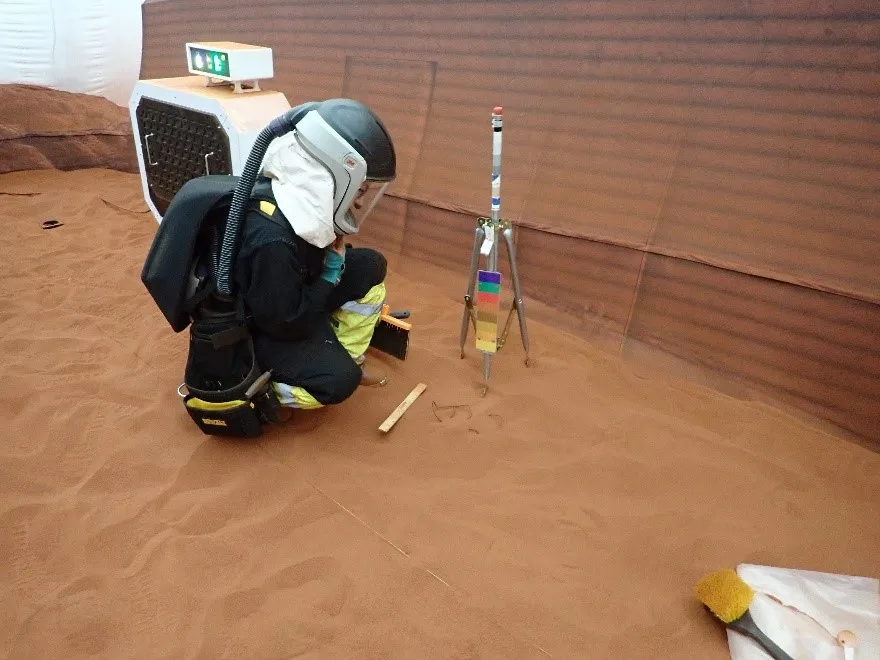
NASA CHAPEA crew member performs a simulated Marswalk inside the 1,200-square-foot sandbox designed to resemble the Martian surface. Photo: NASA/CHAPEA crew, via Texas Standard.
A walk could last for several hours. The crew had to wear a suit that was heavy and uncomfortable, and they had to carry tools and equipment. They also had to communicate with mission control, which was delayed by up to 22 minutes.
Marswalks were not just for fun. They were a serious part of the mission, and they were used to test procedures, equipment, and the crew's ability to work together in a suit.
Through repetition, the crew learned to work efficiently in a suit. They learned how to move, how to use tools, and how to communicate. They also learned how tiring it is to work in a suit for several hours.
6. Food on Mars: What the Crew Ate for 378 Days
Food on a Mars mission is a serious problem. A crew travelling to Mars will need to take enough food for two to three years, or grow some of it themselves. There are no shops on Mars, and no deliveries.
The crew's main supply was shelf-stable food, which is food that can be stored for a long time without refrigeration. It included items such as canned goods, dried foods, and freeze-dried meals. The food was designed to be nutritious, but it was not always tasty.
The food was designed to provide all the nutrients the crew needed, but it was repetitive. The crew ate the same kinds of meals many times, and they had to be creative to make them interesting. They could add spices and sauces, but they could not order a pizza.
Meals were not just about nutrition. They were also about morale. The crew ate together, and meals were a time to talk, relax, and enjoy each other's company. A good meal could make a difficult day better.
The crew also grew some of their own food in a vertical farm inside the habitat. They grew crops such as:
- Cherry tomatoes
- Leafy greens
- Peppers
- Other salad crops
Fresh produce mattered for more than nutrition. It gave the crew something fresh to eat, and it gave them a connection to nature. Growing plants also gave the crew a sense of purpose and a break from the routine.

Fresh crops grown inside the CHAPEA habitat helped supplement the crew's shelf-stable food supply. Photo: NASA/CHAPEA crew, via Texas Standard.
The crew planned their meals carefully, and they had to manage their food supply. They could not waste food, and they had to make sure they did not run out. They also had to manage their water, which was recycled and reused.
A Mars crew will need to grow more food than the CHAPEA crew did. On a real Mars mission, the crew will need to produce a significant amount of their own food, because it would be too heavy and too expensive to carry all of it from Earth.
NASA also studied how the crew's diet affected their health. The researchers measured the crew's weight, body composition, and blood markers to see how their bodies responded to the food.
When you can plan your meals, grow some of your own food, and eat together, food becomes more than fuel. It becomes a source of comfort, routine, and social connection.
7. Communication: When a Message Takes 22 Minutes
On Mars, a message takes between 3 and 22 minutes to travel to Earth, depending on the distance between the two planets. At the time of the CHAPEA mission, NASA simulated a delay of up to 22 minutes each way.
Because messages take so long, the crew could not have a normal conversation with mission control. They had to send a message and wait for a reply, which could take up to 44 minutes for a round trip. This is very different from the instant communication we are used to on Earth.
The crew had to adapt to the delay. They learned to send clear, complete messages, and to wait patiently for a reply. They also learned to make decisions on their own, without waiting for instructions from Earth.
The crew also learned to make decisions on their own. They had to decide when to act and when to wait, and they had to be confident in their own judgement.
- When to make decisions independently.
- When to request assistance.
The crew must develop procedures for independent decision-making, prioritising messages, and determining when to request help.
Communication delay forced the crew to become more independent. They could not rely on mission control for every decision. They had to learn to solve problems on their own, and to trust each other.
At first, this felt strange. On Earth, we are used to asking for help and getting an immediate answer. On Mars, the crew had to wait, and sometimes they had to act without waiting.
The crew developed routines for communication. They sent regular updates to mission control, and they received instructions and information in return. They also had to learn to prioritise messages: which ones were urgent, and which ones could wait.
The team also practised communicating with each other inside the habitat. They had to learn to be clear and patient, and to listen to each other. They also had to learn to handle disagreements without the help of an outside mediator.
This was not simply a technical problem. It was a human problem. The crew had to learn to work together, to trust each other, and to make decisions as a team.
In short, the crew learned that communication on Mars will be slow, and that the crew will need to be independent, patient, and clear.
8. The Psychology of Isolation: Four People, One Small House
Living in a small space with the same three people for more than a year is a psychological challenge. There is no privacy, no escape, and no way to take a break from each other. The crew had to learn to live together, to handle conflicts, and to support each other.
The crew faced the same challenges that any group of people face when they live together for a long time: boredom, frustration, and disagreements. They also faced the added stress of isolation, confinement, and the knowledge that they could not leave.
NASA monitored the crew's psychological health throughout the mission. The researchers used surveys, interviews, and observations to track how the crew was feeling, and how they were getting along.
The crew developed strategies to cope with isolation. They had regular routines, they exercised, they ate together, and they had time for recreation. They also had access to emails from family and friends, although with a delay.
One of the most important factors was the crew's ability to support each other. They learned to listen, to be patient, and to help each other when someone was having a difficult day.
The crew also had to deal with the stress of being observed. They knew that NASA was watching and recording everything they did. This added pressure, but it also gave them a sense of purpose: they knew their experience would help future Mars crews.
By the end of the mission, the crew had developed a strong bond. They had learned to work together, to trust each other, and to handle the challenges of isolation. They emerged as a team, not just as four individuals.
9. Health, Fitness, and the Human Body in a Closed Habitat
The human body was not designed to live in a small, closed habitat for more than a year. The crew faced a range of health challenges, from muscle loss to sleep problems, and from boredom to stress.
The first concern was weight and muscle loss. In space, the body loses muscle and bone because there is no gravity to work against. In CHAPEA, the crew had normal Earth gravity, but they still had to exercise to stay fit. They exercised for about two hours a day, using a treadmill, a cycle ergometer, and resistance training.
Food and exercise were closely linked. The crew's diet was designed to provide the nutrients they needed, and their exercise routine was designed to keep their muscles and bones strong. The researchers monitored the crew's weight, body composition, and blood markers to see how their bodies were responding.
The medical station in the habitat was equipped with basic supplies, but it was not a hospital. The crew had a medical officer, Nathan Jones, who could treat minor injuries and illnesses. For serious problems, they would have had to rely on remote guidance from Earth, with a delay of up to 22 minutes.
The crew faced illnesses and minor injuries during the mission, as any group of people would over the course of a year. They had colds, headaches, and minor cuts and bruises. They also had to deal with the stress of isolation, which can affect sleep, appetite, and mood.
The crew also monitored their sleep, their activity, and their mood. They wore devices that tracked their movement and sleep, and they completed regular surveys about how they were feeling.
10. Maintenance: Keeping the Habitat Alive
A habitat is a machine, and like any machine, it needs maintenance. The crew had to keep the habitat's systems working, from the air and water recycling to the power supply and the communications equipment.
The crew had to learn to fix things. They had to repair equipment, replace parts, and solve problems when something broke. They could not call a plumber or an electrician; they had to do it themselves, with guidance from mission control (delayed by up to 22 minutes).
Maintenance was a daily task. The crew checked the habitat's systems each morning, and they had a schedule for cleaning, repairs, and inspections. They also had to manage the water supply, which was recycled and reused.
One of the challenges was that the crew had to work with limited supplies. They could not order new parts from Earth; they had to use what they had, or make do with what was available.
The crew also had to maintain the vertical farm, where they grew their crops. They had to water the plants, check the lighting, and harvest the produce. They also had to maintain the robotic workstation, where they tested equipment and procedures.
Maintenance taught the crew to be resourceful. They learned to fix things with limited tools, to improvise, and to work together to solve problems. These are skills that will be essential on Mars, where the crew will be far from help.
11. The Science: What Researchers Measured Every Day
CHAPEA is more than a test of endurance. It is a scientific experiment, designed to collect data that will help NASA plan future Mars missions. The researchers measured almost everything the crew did, from their sleep to their mood, from their diet to their exercise.
Scientists used the mission to study how people adapt to isolation, confinement, and delayed communication. They wanted to know how the crew's health, performance, and well-being changed over time, and what factors helped them cope.
A typical research area was the crew's physical health. The researchers measured the crew's weight, muscle mass, bone density, and cardiovascular fitness. They also measured their sleep, their activity, and their diet.
The team also studied the crew's psychological health. They used surveys and interviews to track the crew's mood, stress, and social interactions. They wanted to know how the crew handled conflicts, how they supported each other, and how their relationships changed over time.
They gathered data in several ways:
- Biological samples
- Surveys
- Activity monitors
- Sleep data
- Observations of behavior
The data did not just help the researchers understand the crew. It also helped the crew understand themselves. They could see how their health and mood changed over time, and they could adjust their routines accordingly.
The first mission's findings were shared with the scientific community, and they will be used to plan future missions. The data will help NASA design better habitats, better food systems, and better procedures for Mars missions.
12. What NASA Has Learned So Far
NASA has learned a great deal from the first CHAPEA mission. The most important lesson is that four people can live together in a small habitat for more than a year, and still stay healthy, productive, and cooperative.
The mission showed that the habitat design works. The 3D-printed structure provided a safe and comfortable home, and the systems for air, water, and power worked well. The vertical farm produced fresh food, and the exercise equipment helped the crew stay fit.
The mission also showed that the crew could handle the psychological challenges of isolation and confinement. They developed routines, supported each other, and stayed focused on their work. They did not experience serious conflicts, and they emerged as a team.
NASA also learned about the practical challenges of a Mars mission: how to plan meals, how to manage water, how to communicate with a delay, and how to maintain a habitat with limited supplies.
The mission provided data on the crew's health, performance, and well-being. The researchers are still analysing the data, but the early results suggest that the crew adapted well to the habitat, and that the countermeasures for muscle loss, bone loss, and stress were effective.
Perhaps the most important lesson is that a Mars mission is possible, but it will require careful planning, good design, and a crew that can work together under pressure.
13. What CHAPEA Means for a Real Mars Mission
A human mission to Mars will involve several major stages: launching from Earth, travelling to Mars, landing on the surface, living and working on Mars, and travelling back to Earth. Each stage introduces new risks and challenges.
CHAPEA focuses on one stage: living and working on Mars. It tests the habitat, the food systems, the exercise routines, and the crew's ability to live together in isolation.
The mission has shown that a small crew can live in a habitat for more than a year, and that the habitat can provide a safe and comfortable home. This is an important step towards a real Mars mission.
CHAPEA also shows that the crew will need to be independent. They will not be able to rely on mission control for every decision, because of the communication delay. They will need to solve problems on their own, and to trust each other.
The mission has also shown that food production will be important. The crew grew some of their own food, and this helped them stay healthy and morale. On a real Mars mission, the crew will need to grow more food, and to manage their supplies carefully.
In short, CHAPEA is a rehearsal for Mars. It is not the real thing, but it is the closest we have come to testing what life on Mars will be like.
14. The Limits: What CHAPEA Cannot Tell Us
It is important not to confuse a simulation with the real thing. CHAPEA can tell us a great deal, but it cannot tell us everything. There are important differences between the simulation and a real Mars mission.
CHAPEA was conducted on Earth, with normal gravity, normal air pressure, and a normal atmosphere. The crew could breathe without a suit inside the habitat, and they could walk without a suit in the sandbox. On Mars, the air is thin, cold, and mostly carbon dioxide, and the crew will need a suit to go outside.
The participants were isolated, but they were not in danger. If something had gone seriously wrong, they could have left the habitat and received medical help within minutes. On Mars, help will be months away.
They did not experience the radiation of deep space, the low gravity of Mars, or the dust storms that can last for weeks. They did not experience the long journey to Mars, which will take about six to nine months each way.
The main differences include:
Gravity: Mars has approximately 38% of Earth's gravity. The crew in CHAPEA experienced normal Earth gravity, so the mission cannot tell us how the human body will respond to Mars gravity over a long period.
Radiation: Deep-space radiation is a major risk for Mars crews. The CHAPEA habitat was inside a building on Earth, so the crew was protected from radiation. The mission cannot tell us how radiation will affect the crew's health.
Atmosphere: Mars has a thin atmosphere, mostly carbon dioxide, with very little oxygen. The crew in CHAPEA breathed normal Earth air, so the mission cannot tell us how the crew will cope with the Martian atmosphere.
Temperature: Mars experiences extreme cold, with temperatures as low as -125 degrees Celsius. The CHAPEA habitat was kept at a comfortable temperature, so the mission cannot tell us how the crew will cope with the cold.
Dust: Martian dust is fine, sharp, and potentially toxic. The CHAPEA crew did not have to deal with real Martian dust, so the mission cannot tell us how dust will affect their health and equipment.
Distance: The participants were in Houston, Texas, not on Mars. They could leave the habitat if they needed to, and they could receive help quickly. On Mars, the crew will be hundreds of millions of kilometres from Earth, with no quick return.
Emergency rescue: NASA staff were nearby during CHAPEA, and the crew could have been evacuated quickly if necessary. On Mars, there will be no rescue.
These limitations do not make CHAPEA useless. They explain what the mission can and cannot tell us, and they help NASA plan the next steps.
They explain why CHAPEA is one part of a larger programme, not a complete rehearsal for Mars. Other experiments, such as the International Space Station and lunar missions, will test other parts of the journey.
A research programme does not need to answer every question at once. It needs to answer the questions it is designed to answer, and to be honest about the questions it cannot answer.
The most useful approach is to treat CHAPEA as one piece of evidence, not the whole story. It tells us about life in a habitat, about teamwork, and about daily routines. It does not tell us about gravity, radiation, or the journey to Mars.
15. CHAPEA Mission 2: The Story Continues
Mission 2 is planned as the second of three CHAPEA missions. It will test the same habitat, the same routines, and the same kinds of research, but with a different crew.
It began on October 19, 2025, when a new crew of four volunteers entered the Mars Dune Alpha habitat. They will spend 378 days inside, following a similar schedule to the first crew.
The Mission 2 crew was selected after a long process of applications, interviews, and medical checks. They have backgrounds in science, engineering, and medicine, and they were chosen for their ability to work as a team.
A second mission lets NASA compare results. If the second crew has similar experiences to the first, NASA can be more confident that the findings are reliable. If they have different experiences, NASA can learn why.
Mission 2 uses the same habitat, the same food systems, and the same research methods as Mission 1. This allows NASA to compare the two missions directly, and to see whether the results are consistent.
If Mission 2 produces similar results to Mission 1, NASA will have stronger evidence that the habitat design, the food systems, and the routines work. If it produces different results, NASA will need to investigate why.
Why the First Mission Matters
The first mission established a foundation. It showed that the habitat works, that the crew can live together for more than a year, and that the research methods produce useful data.
This was more than a test. It was a demonstration that a Mars-like habitat can support a crew for a full year, and that the crew can stay healthy and productive.
That is why the first mission matters. It gave NASA the confidence to run a second mission, and it gave researchers the data they need to plan the next steps.
Sources: NASA's CHAPEA programme and NASA's Mission 2 update.
16. How CHAPEA Fits Into the Larger Journey to Mars
The first crews on Mars will not arrive in a single leap. They will be the result of many steps: the International Space Station, lunar missions, and simulations like CHAPEA. Each step tests a different part of the journey.
NASA is also planning to return to the Moon with the Artemis programme. The Moon is closer than Mars, and it provides a place to test habitats, suits, and procedures in a real space environment, with low gravity and no atmosphere.
Other experiments are under way on the International Space Station, where astronauts live in microgravity for months at a time. They test how the human body responds to weightlessness, and how to stay healthy in space.
CHAPEA also fits into a larger programme of research. It is one of several analog missions that NASA and other agencies run to test different aspects of spaceflight. These include missions in Antarctica, in underwater habitats, and in isolated stations.
- Surface habitat construction
- Life-support systems
- Resource utilisation
- Surface mobility
- Medical procedures
- Power systems
- Communication infrastructure
- Spacesuit operations
After the Moon, the next step is Mars. The lessons from CHAPEA, from the Moon, and from the International Space Station will all be needed to plan a Mars mission.
The same knowledge will be needed for Mars: how to build a habitat, how to grow food, how to stay healthy, and how to work together as a team.
Mars missions will depend on many kinds of research, not just one. CHAPEA is one piece of a larger puzzle, and it is an important piece.
CHAPEA also helps NASA plan for the unexpected. By testing the habitat and the routines in a simulation, NASA can identify problems before they occur on Mars, where they would be much harder to fix.
17. Questions That Remain Unanswered
How long can a crew stay healthy in a habitat? The first mission lasted 378 days. A Mars mission will last two to three years. We do not yet know how the crew will cope with a longer mission.
How will the crew handle a serious medical emergency? The CHAPEA crew had a medical officer and basic supplies, but they did not face a serious emergency. On Mars, a serious illness or injury could be life-threatening.
Can a crew stay cohesive for two to three years? The first crew stayed together for 378 days, but a Mars mission will be longer. We do not yet know how relationships will change over a longer period.
Can a crew stay productive for two to three years? The first crew worked hard for 378 days, but a Mars mission will require sustained effort for much longer. We do not yet know how motivation and performance will change.
Will exercise and diet be enough to keep the crew healthy in low gravity? The CHAPEA crew exercised in normal gravity. On Mars, the gravity is only 38% of Earth's, and we do not know how the body will respond over a long period.
Those are not signs of failure. They are the questions that the next missions, and the next experiments, will try to answer.
| Topic | What CHAPEA Suggests | What Remains Uncertain |
|---|---|---|
| Weight and muscle loss | Countermeasures appear to reduce it | The balance in partial gravity is not yet fully established |
| Time delay in communication | Crew adapted with new routines | A real Mars crew will face longer, unchangeable delays |
| Food variety and supply | Crops and shelf-stable meals sustained the crew | Longer missions will need a much larger and more diverse food supply |
| Conflict and team cohesion | The crew stayed cohesive and supportive | A different crew or a longer mission could produce different results |
| Health in a closed habitat | Careful design and monitoring kept the crew healthy | Low gravity, dust, and radiation are still major unknowns |
Conclusion: What We Know, and What We Don't
When the airlock opened on July 6, 2024, four people stepped out into the Texas heat after 378 days inside a simulated Mars habitat. They were tired, but they were healthy. They had lived together, worked together, and supported each other for more than a year. They had shown that it is possible to live in a small habitat, far from home, and still stay healthy and productive.
What we know is that the habitat works, that the food systems work, that the crew can handle isolation and delayed communication, and that a small team can live together for more than a year. What we do not know is how the crew will cope with Mars gravity, radiation, dust, and the long journey to Mars.
That is the honest summary of CHAPEA: a successful simulation, a valuable source of data, and a reminder that Mars is still a long way away — but closer than it was before.
Frequently Asked Questions
Quick answers to common questions.
- What is CHAPEA? CHAPEA is NASA's Crew Health and Performance Exploration Analog, a series of one-year Mars surface simulations. It tests how crews live and work in a 3D-printed habitat at NASA's Johnson Space Center.
- What was CHAPEA Mission 1? Mission 1 ran for 378 days, from June 25, 2023, to July 6, 2024. Four volunteers lived in the Mars Dune Alpha habitat, with no physical contact with the outside world.
- What did the crew do every day? The crew followed a daily schedule that included science experiments, exercise, maintenance, simulated Marswalks, and shared meals.
- Did the crew really go outside? They went into a 1,200-square-foot sandbox that simulated the Martian surface. They wore spacesuits and conducted simulated Marswalks.
- What did the crew eat? They ate shelf-stable foods and grew some crops in a vertical farm, including tomatoes and leafy greens.
- How did the crew talk to Earth? Communication was delayed by up to 22 minutes each way, so the crew adapted by sending complete messages and making decisions independently.
- Did the crew get along? The crew remained cohesive and supportive. They used routines, shared meals, and regular communication to manage stress and maintain morale.
- Did the crew stay healthy? They maintained their health through structured exercise, diet, and careful monitoring. The first mission found no serious health crises.
- What did NASA learn? NASA learned that a small crew can live in a simulated Mars habitat for over a year, and that the habitat, food systems, and routines worked well.
- Can CHAPEA tell us what Mars will be like? It can tell us a great deal about living in a habitat, but not about Mars gravity, radiation, dust, or the journey to Mars.
- What happens in CHAPEA Mission 2? Mission 2 began on October 19, 2025, with a new crew of four volunteers. It follows a similar schedule and will also last 378 days.
- When will humans go to Mars? NASA has not set a firm date. CHAPEA and other missions are part of a long programme to prepare for a human Mars mission, possibly in the 2030s.
The following sources provide NASA's original mission information, research context, crew accounts, and detailed reporting on CHAPEA.
- NASA — About the CHAPEA Programme
- NASA — CHAPEA Mission 1: Crew and Mission Overview
- NASA — Voyagers of Mars: The First CHAPEA Crew's Yearlong Journey
- NASA — First Mars Crew Completes Yearlong Simulated Red Planet Mission
- NASA — Mars Analog Crew to Test Food Systems and Crop Growth
- NASA — First CHAPEA Crew Begins 378-Day Mission
- NASA — First CHAPEA Crew Reaches the 300-Day Milestone
- NASA — First Mars Analog Crew Passes the Halfway Mark
- NASA — NASA's Simulated Mars Crew Marks One Year Inside Habitat, Mission 2
- NASA — CHAPEA Mission 2
- Texas Standard — Back on Earth: NASA Investigates Impacts of First-Ever Human Mars Simulation
- NASA Technical Memorandum — CHAPEA General Description and Research Design
The conversation
Post a Comment