NASA’s Swift Space Telescope Falls to Earth: The Failed Rescue and the Observatory’s Extraordinary Legacy
THE JORNAL | SPACE SCIENCE | NOVEMBER 5, 2026
At 7:39 a.m. Eastern Time on November 4, 2026, a spacecraft weighing approximately 1,470 kilograms crossed into Earth's atmosphere above North Sumatra, Indonesia. It had spent almost 22 years travelling around our planet, watching some of the most energetic events in the universe and sending information about distant cosmic explosions to scientists on the ground.
This was not an ordinary satellite returning from a completed mission. It was the final chapter of NASA's Neil Gehrels Swift Observatory, a space telescope originally designed to operate for just two years. It had survived more than a decade beyond its planned lifetime, observed thousands of extraordinary astronomical events, and helped transform how scientists respond to sudden explosions in deep space.
Now, its journey had ended.
The United States Space Force confirmed the spacecraft's atmospheric re-entry, while NASA reported that the observatory entered above the North Sumatra region of Indonesia. Travelling at approximately 22 times the speed of sound, according to Reuters, the spacecraft encountered the increasingly dense atmosphere that surrounds Earth. Most of its structure was expected to burn up, although some components could survive the journey.
But Swift's ending was not simply the result of an ageing piece of equipment reaching the end of its useful life. Its orbit had been deteriorating, partly because of increased solar activity. NASA and a private space company had attempted an ambitious rescue operation to lift the observatory into a safer orbit. That mission, involving a robotic spacecraft called LINK, failed to achieve its central objective.
The result is a story that connects three important areas of modern space exploration: the unpredictable influence of the Sun, the growing importance of commercial space technology, and the challenge of maintaining valuable scientific machines once they have been launched.
To understand why Swift's disappearance matters, we first need to understand what it was looking for, how it worked, and why scientists considered it so valuable.

What Was NASA's Swift Space Telescope?
The Neil Gehrels Swift Observatory was launched on November 20, 2004. Originally known as the Swift Gamma-Ray Burst Explorer, it was designed to investigate gamma-ray bursts, extraordinary flashes of high-energy radiation associated with some of the most violent events in the universe.
The mission was developed around a simple but difficult scientific problem: gamma-ray bursts can appear suddenly and fade before conventional observatories have enough time to point their instruments toward them.
Imagine trying to photograph a lightning strike in a distant storm. You know that lightning can appear at any moment, but you do not know exactly where it will strike or how long it will remain visible. A camera that takes several minutes to move into position may miss the most interesting part.
Astronomers faced a similar challenge with gamma-ray bursts. They needed an observatory that could detect an event, calculate where it occurred, and rapidly redirect its instruments toward the same location.
Swift was designed to do precisely that.
Unlike a telescope that spends most of its time staring at a predetermined region of the sky, Swift could respond to unexpected events. Its automated systems allowed it to change direction rapidly and coordinate observations with scientists and observatories around the world.
The observatory was named after Neil Gehrels, the astrophysicist who served as its first principal investigator and helped develop the mission. NASA renamed it in his honour in 2018, following his death.
Its original two-year primary mission became an extraordinary scientific journey lasting almost 22 years.
Three Telescopes Working as One
Swift's strength came from the way three scientific instruments worked together. Each was designed to observe a different part of the electromagnetic spectrum, allowing scientists to study cosmic events from several perspectives.
This arrangement was especially important because the light produced by a powerful astronomical explosion does not remain the same over time.
A gamma-ray flash may appear first, followed by X-rays, ultraviolet radiation, and visible light. These different signals provide clues about the physical processes taking place during and after the explosion.
1. The Burst Alert Telescope: Detecting the Unexpected
The first instrument was the Burst Alert Telescope, commonly known as BAT.
Its primary responsibility was to monitor a large portion of the sky for sudden bursts of gamma radiation.
Gamma rays are extremely energetic electromagnetic waves. Human eyes cannot see them, and Earth's atmosphere absorbs most cosmic gamma rays before they reach the ground. Space-based instruments are therefore essential for observing these events directly.
Swift's BAT used a coded-aperture imaging system. In simple terms, it contained a specially designed mask with thousands of small openings and blocked sections positioned above its detectors.
When gamma rays arrived from a particular direction, they produced a distinctive pattern on the detector. Computers analysed that pattern to estimate the location of the source.
The instrument could observe up to approximately half of the sky at once, making it an effective detector for unpredictable events.
Once BAT identified a gamma-ray burst, it transmitted its estimated position to the ground. NASA's technical description explains that the location could be relayed within approximately 20 seconds.
That speed gave astronomers an opportunity to begin follow-up observations before the event faded.
2. The X-Ray Telescope: Examining the Aftermath
The second instrument was the X-Ray Telescope, or XRT.
Detecting an explosion is only the beginning of scientific investigation. Astronomers also want to know what happened afterward.
The XRT examined the X-ray emission associated with gamma-ray bursts and other astronomical objects. These observations helped researchers understand how the energy released during an explosion evolved over time.
X-rays can reveal extremely energetic environments, including material heated around black holes, the remains of exploding stars, and the aftermath of compact-object collisions.
Swift could bring the XRT into position quickly after detecting a burst, allowing scientists to investigate the event while its afterglow was still visible.
Before Swift, obtaining detailed observations of some gamma-ray burst afterglows could take hours or even days because available telescopes were not able to respond quickly enough.
That difference was scientifically important. A rapidly fading event cannot simply be photographed again several days later under identical conditions.
3. The Ultraviolet/Optical Telescope: Seeing Another Side of the Universe
The third instrument was the Ultraviolet/Optical Telescope, known as UVOT.
It observed ultraviolet and visible light, providing information that complemented the gamma-ray and X-ray measurements.
Ultraviolet observations are particularly useful for studying hot, young stars, energetic explosions, and the changing brightness of distant astronomical objects.
The instrument also produced valuable observations of nearby galaxies.
For example, Swift created a detailed ultraviolet view of the Andromeda Galaxy by combining 330 separate observations. The resulting image revealed approximately 20,000 ultraviolet sources, including regions containing young, hot stars.
This is a good example of why Swift became more than a telescope dedicated to one type of cosmic explosion. Its instruments could investigate a wide range of astronomical questions.
Together, BAT, XRT, and UVOT turned Swift into a flexible observatory capable of detecting an event, locating it, and studying its development across several wavelengths.
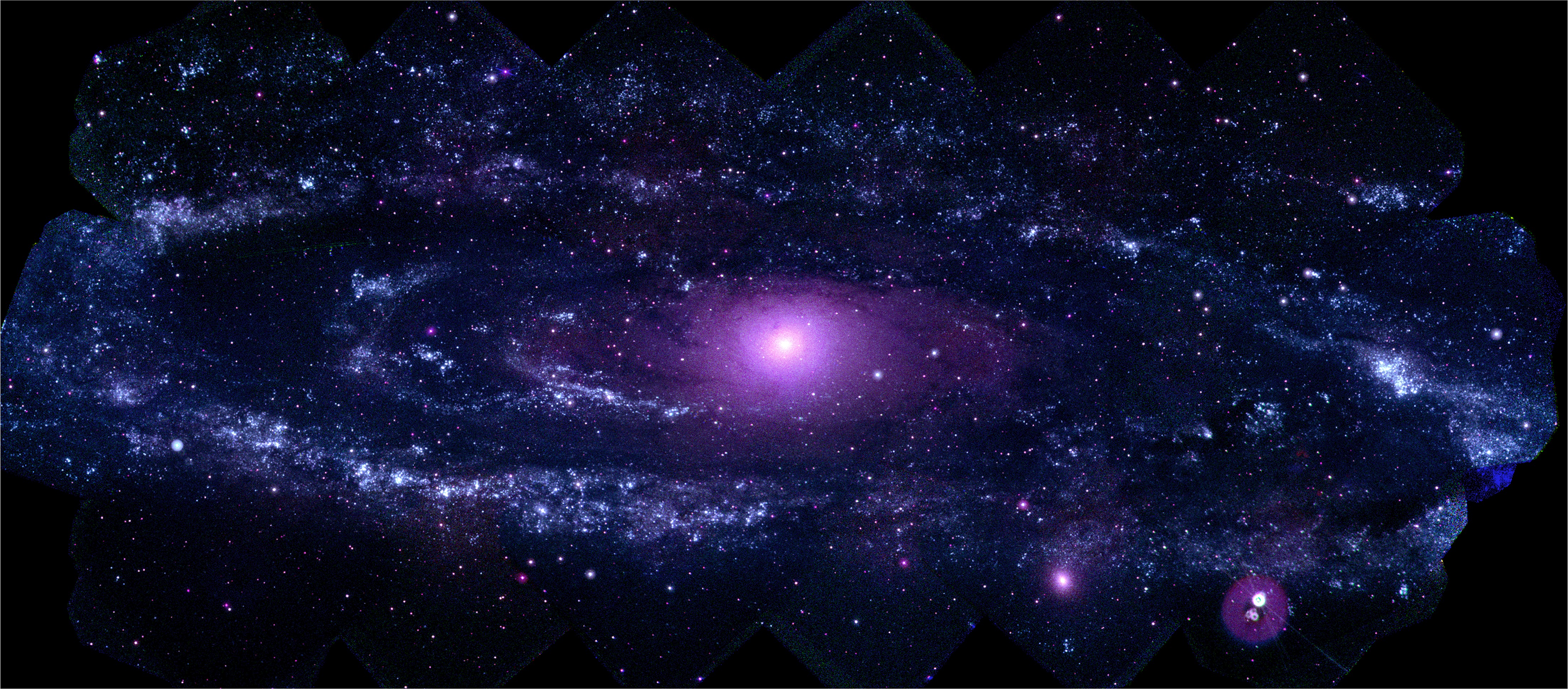
Why Gamma-Ray Bursts Are So Important
To appreciate Swift's scientific contribution, it helps to understand the extraordinary events it was designed to observe.
Gamma-ray bursts, or GRBs, are brief flashes of gamma radiation originating from distant cosmic events. They are among the most energetic phenomena known in astronomy.
Some are associated with the deaths of massive stars, when their cores collapse and can form black holes. Others are associated with mergers involving neutron stars or other compact stellar remnants.
A neutron star is an extremely dense object left behind after certain stars explode. It can contain more mass than the Sun compressed into a sphere roughly the size of a city.
When two neutron stars orbit one another, they gradually lose orbital energy and move closer together. Eventually, they may collide, producing a powerful event that releases radiation and can create gravitational waves.
These mergers are especially interesting because they connect several branches of astronomy.
Scientists can study the light from the explosion, investigate the gravitational waves produced by the collision, and examine the chemical elements created in the aftermath.
However, not every gamma-ray burst has the same duration, brightness, or physical origin. Some last only fractions of a second, while others remain detectable for considerably longer.
The distinction between short and long bursts is important because it provides clues about the processes that created them.
Swift helped astronomers identify and investigate these events by providing rapid observations and accurate positions.
One important milestone occurred in May 2005, when the observatory detected the afterglow of a short gamma-ray burst known as GRB 050509B. The original burst lasted approximately 0.03 seconds.
Swift redirected its instruments quickly enough to detect X-ray photons associated with the event.
Those observations supported the idea that short gamma-ray bursts can originate from neutron-star mergers.
The discovery was significant because it demonstrated that even an event lasting a tiny fraction of a second could provide valuable evidence about the most extreme objects in the universe.
The Observatory That Changed How Astronomers Respond
Swift's greatest contribution was not simply the number of objects it observed. It helped establish a more responsive approach to modern astronomy.
Traditional astronomical observing often involves planning observations in advance. Researchers request time on a telescope, select targets, and prepare an observing schedule.
That approach remains essential, but the universe does not always follow a schedule.
A star can suddenly brighten. A black hole can disrupt a passing star. A gamma-ray burst can appear and disappear before researchers have time to arrange a conventional observation.
Swift helped solve this problem by combining automated detection, rapid spacecraft movement, and communication with ground-based scientific networks.
When the observatory detected an important event, its alert system could distribute information to other astronomers.
Ground-based telescopes and other space observatories could then examine the same region of the sky.
Think of Swift as an emergency notification system for astronomy. It did not need to conduct every investigation itself. Its role was often to recognise that something unusual had happened and give the wider scientific community the information needed to respond.
This approach became increasingly valuable as astronomy moved toward studying events that change over seconds, minutes, days, or weeks.
Swift also developed into a general-purpose observatory. It studied supernovae, active galaxies, stellar flares, comets, asteroids, and stars being torn apart by black holes.
NASA's October 2026 mission summary reported that Swift had observed more than 2,000 gamma-ray bursts and more than 1,400 supernova explosions. Its observations contributed to approximately 7,000 published scientific papers.
Why Was Swift Falling Back to Earth?
The reason behind Swift's final journey was a combination of orbital mechanics and changes in the Sun's activity.
The first important fact is that satellites in low Earth orbit are not completely outside Earth's atmosphere.
Even hundreds of kilometres above the surface, the atmosphere does not disappear entirely. It becomes extremely thin, but small quantities of gas remain.
As a satellite moves through this environment, it experiences a weak force called atmospheric drag.
On Earth, we experience drag whenever we move through air. A cyclist travelling quickly encounters resistance. A parachute experiences much greater resistance because its large surface area interacts with the surrounding atmosphere.
Satellites experience a similar effect, although the atmosphere at their altitude is incredibly thin.
Over time, drag removes a small amount of orbital energy.
For a spacecraft in low Earth orbit, this can gradually lower its altitude. As it moves into denser atmospheric layers, drag can increase, accelerating its orbital decay.
This process is known as orbital decay.
Swift was particularly vulnerable because it did not have an onboard propulsion system capable of raising its orbit and maintaining a safer altitude.
Its original design had not anticipated a rescue operation of this kind being necessary more than two decades after launch.
The observatory had performed far beyond its planned lifetime, but its orbit was becoming increasingly difficult to sustain.
The Sun Played an Unexpected Role
One of the most interesting parts of Swift's story is that the Sun contributed to the spacecraft's decline.
Solar activity changes over time. The Sun produces solar flares, coronal mass ejections, and variations in the amount of energy reaching Earth.
These changes can affect the upper atmosphere.
During periods of increased solar activity, the upper atmosphere absorbs more energy and expands. This means that atmospheric gases can extend farther upward than they would during quieter solar conditions.
For a satellite travelling at a relatively low altitude, that expansion matters.
Imagine swimming through a swimming pool. Moving through the water creates resistance because the water is dense enough to slow you down.
Now imagine that the water becomes thinner. You would encounter less resistance.
Satellites experience a comparable difference when the density of the upper atmosphere changes.
When solar activity increases atmospheric density at a spacecraft's altitude, the satellite can experience more drag than expected.
This additional resistance can accelerate orbital decay.
NASA specifically identified a period of increased solar activity as an important factor in Swift's declining orbit.
The observatory was therefore affected by something that originated approximately 150 million kilometres away: changes in the activity of the Sun.
There is an important distinction here. Solar activity did not directly pull Swift out of space like a magnet. Its influence was indirect, through changes in the density and behaviour of Earth's upper atmosphere.
That difference matters because it shows how events occurring in one part of the space environment can affect spacecraft operating in another.
It also demonstrates why satellite operators must consider space weather when estimating the lifetime of objects in low Earth orbit.
The Final Warning: Swift Was Getting Too Low
By October 2026, Swift had reached an altitude where atmospheric drag was interfering with its ability to conduct reliable observations.
NASA reported that the spacecraft was orbiting below approximately 171 miles, or 275 kilometres, above Earth's surface.
At that altitude, the greater drag made it increasingly difficult for the observatory to maintain steady pointing toward astronomical targets.
The team conducted its final scientific observation on October 20, 2026.
That date marked the end of Swift's scientific operations, although the spacecraft had not yet entered the atmosphere.
The distinction is important.
A satellite can stop performing useful scientific observations before it physically disappears. Its instruments may still exist, and its structure may remain largely intact, but the conditions required for reliable operation may no longer be available.
Swift had reached that stage.
Its remaining time in orbit became a race against atmospheric drag. The rescue effort had already failed, and the spacecraft was now approaching its unavoidable return to Earth.
NASA expected re-entry within weeks. The final event occurred on November 4.
The $30 Million Rescue Mission: A Private Company Attempts the Impossible
Before accepting Swift's fate, NASA explored whether a commercial spacecraft could save the observatory.
The agency contracted Katalyst Space Technologies, an Arizona-based space company, to develop a robotic servicing vehicle capable of approaching Swift, capturing it, and raising its orbit.
The planned spacecraft was called LINK.
The objective was ambitious.
Instead of launching a new telescope to replace Swift, engineers would send a robotic spacecraft to an existing observatory already travelling around Earth.
LINK would approach Swift, use its robotic equipment to establish a secure connection, and provide the force necessary to move the observatory into a higher orbit.
The intended result was an extension of Swift's operational life.
This type of mission represents an important idea in the future of space exploration: spacecraft should not necessarily be treated as disposable machines.
If a satellite can be repaired, refuelled, upgraded, or moved into a safer orbit, its scientific or commercial value could continue for longer.
NASA's contract with Katalyst was part of an effort to explore that possibility.
However, the project faced an unusual challenge. Swift had not been designed specifically for robotic servicing, and the rescue team had to develop a spacecraft capable of performing complex operations within a very limited period.
NASA described the project as a high-risk, high-reward effort.
LINK launched in July 2026 aboard a Northrop Grumman Pegasus XL rocket.
Why Did the Rescue Attempt Fail?
The central problem emerged after LINK reached space.
The robotic spacecraft experienced communication difficulties and problems with its attitude-control system.
In spacecraft engineering, attitude refers to the orientation of a vehicle in space.
A satellite must know which direction it is pointing. Its antennas, solar panels, cameras, and instruments all depend on controlled orientation.
On Earth, a person can turn their head, change direction, and maintain balance without thinking about it.
A spacecraft cannot rely on those natural abilities.
It uses sensors, control computers, and mechanical or propulsion-based systems to maintain its orientation.
Reaction wheels are particularly important for many spacecraft. They allow a satellite to change its orientation by changing the rotation of internal wheels.
If the attitude-control system fails or becomes unreliable, a spacecraft can begin rotating in an uncontrolled way.
This is a serious problem for a vehicle that must approach another satellite and perform a delicate capture operation.
Reuters reported that LINK began spinning uncontrollably after launch. NASA and Katalyst worked to recover the spacecraft, including software changes intended to improve its control. However, the problems remained significant enough that the planned capture and orbit-boost operation could not proceed.
On August 19, Katalyst publicly confirmed that the capture and boost objective would be removed from the mission.
The company did not simply abandon the spacecraft immediately. Instead, LINK continued with a reduced mission focused on demonstrating technology and gathering operational data.
Its team conducted rendezvous and proximity operations, bringing LINK as close as approximately 12 to 15 kilometres from Swift.
That was an important engineering achievement, but it was not the rescue NASA had originally intended.
On September 25, Katalyst's mission concluded after approximately 85 days in orbit. The spacecraft itself subsequently re-entered Earth's atmosphere.
The failure therefore involved more than a single mechanical problem. It demonstrated how difficult it is to coordinate navigation, communication, orientation, propulsion, and robotic capture in orbit, especially when the target spacecraft was never designed for servicing.
Why Capturing a Satellite Is So Difficult
To understand why the rescue failed, consider two cars moving along a highway.
If one car wants to approach another, the drivers must coordinate their speed, direction, and distance. A mistake can produce a collision.
In orbit, the challenge is considerably more complicated.
Two spacecraft are not simply moving forward. They are travelling along orbital paths governed by gravity, altitude, speed, and direction.
A servicing spacecraft must calculate its own trajectory and the target's trajectory. It must approach carefully, control its relative movement, and establish a stable position close enough to perform the planned operation.
The robotic vehicle also needs enough control authority to manage its movement and orientation during the final approach.
If its attitude-control system is unreliable, even reaching the correct neighbourhood in orbit may not be enough.
The spacecraft could approach the target but remain unable to perform the precise manoeuvres required for capture.
This is why rendezvous, proximity operations, and robotic servicing are considered demanding areas of spacecraft engineering.
A successful demonstration requires more than getting two satellites close together. The servicing spacecraft must remain stable, communicate reliably, understand its position, and perform the operation without damaging the target.
Swift's rescue mission showed how quickly a small engineering problem can become a mission-ending limitation.
It also produced valuable experience that may help future commercial servicing missions become more reliable.
November 4: Swift's Final Atmospheric Re-Entry
The final stage of Swift's journey took place on November 4, 2026.
According to NASA, the United States Space Force confirmed that the spacecraft re-entered Earth's atmosphere at 7:39 a.m. Eastern Time over North Sumatra, Indonesia.
NASA provided the approximate location as 3.4 degrees north latitude and 98.6 degrees east longitude.
Reuters reported that Swift entered the atmosphere at approximately 22 times the speed of sound.
Why does a spacecraft become so hot during re-entry?
The explanation is connected to the enormous speed at which it encounters the atmosphere.
A spacecraft in low Earth orbit travels at roughly 7.8 kilometres per second. When it enters increasingly dense air at such speeds, the surrounding gas is rapidly compressed and heated.
The interaction creates extreme thermal conditions around the vehicle.
It is common to describe this process as friction, but the heating is not simply the same as rubbing two solid surfaces together. Compression and the behaviour of the high-speed gas surrounding the spacecraft play major roles.
Materials that can survive years in the relatively cold environment of space may not survive the temperatures experienced during atmospheric re-entry.
The spacecraft begins to break apart, and much of its structure can vaporise or burn up before reaching the ground.
Swift was not designed to perform a controlled landing.
Its descent was therefore an uncontrolled re-entry rather than a planned recovery.
NASA expected most of the observatory to burn up in the atmosphere, although some components could survive.
The agency's confirmation of re-entry closed the operational chapter of one of its longest-running astrophysics missions.
Could Pieces of the Telescope Have Reached the Ground?
This was one of the most important public safety questions surrounding Swift's return.
Although most spacecraft are destroyed during atmospheric re-entry, not every material behaves in the same way.
Some dense or heat-resistant components may survive longer than lighter structural elements.
A spacecraft can contain metal assemblies, instruments, mirrors, mechanical components, and other materials that respond differently to intense heat.
The survival of a component depends on several factors, including its material, shape, mass, construction, and the conditions experienced during re-entry.
For Swift, NASA expected most of the spacecraft to burn up but acknowledged that some components might survive.
Before re-entry, the United States Space Force had estimated the probability of harm to someone on Earth at approximately one in 2,100, according to Reuters.
That figure described the estimated risk associated with the re-entry event, not a prediction that a particular person would be injured.
The spacecraft's re-entry location was over Indonesia, but that did not mean that its debris necessarily landed in a populated area.
Reuters reported that no damage or injuries on the ground had been reported following the event. The exact quantity and final locations of any surviving components remained uncertain in the immediate aftermath.
It is important not to confuse an uncontrolled re-entry with a major disaster.
Spacecraft regularly return through Earth's atmosphere. The challenge is to predict their behaviour, estimate the potential danger, and design future missions so that their eventual disposal is safer.
Swift's return highlights why these calculations matter.
The Scientific Treasure That Did Not Fall With the Spacecraft
There is one major reason why Swift's end is not a complete scientific loss.
Its most valuable legacy is not the physical telescope itself. It is the enormous collection of scientific observations produced during its lifetime.
NASA reported that Swift's archive contains nearly 22 years of brightness measurements, multiwavelength observations, spectra, and more than 1.5 million images from its Ultraviolet/Optical Telescope.
The complete archive represents approximately 12 terabytes of data.
That is equivalent to hundreds of high-definition movies, but the scientific value is considerably greater than the amount of storage suggests.
Each observation represents information about a particular moment in the life of a cosmic object.
Scientists can examine the data again, compare different events, test new theories, and search for patterns that were not obvious when the observations were first collected.
This is especially important in astronomy because scientific understanding changes as new instruments and analytical techniques become available.
A researcher studying a particular type of stellar explosion today may ask different questions from an astronomer who examined the same event ten years ago.
The original observations can therefore become valuable again.
Swift's archive also contains measurements collected over long periods. This allows researchers to investigate how astronomical objects change, rather than relying on a single image.
NASA has made the data publicly available, meaning its scientific usefulness will continue after the spacecraft's disappearance.
In other words, the telescope is gone, but its observations remain.
What Happens to the Discoveries Swift Made?
Swift's scientific contributions cover several important areas of astrophysics.
Its gamma-ray burst observations helped scientists understand the relationship between short bursts and neutron-star mergers.
Its observations of supernovae provided information about exploding stars and the environments surrounding them.
It also studied tidal disruption events, in which a star passes too close to a black hole and is torn apart by the black hole's immense gravitational forces.
These events are particularly interesting because they allow astronomers to investigate black holes that would otherwise be difficult to observe directly.
A black hole itself does not emit light in the ordinary sense. However, the material surrounding it can become extremely hot and produce radiation detectable by space telescopes.
Swift's ability to monitor X-rays and respond rapidly to changing astronomical sources made it valuable for these investigations.
The observatory also studied active galaxies, stellar flares, comets, and asteroids.
Its importance came from its flexibility.
Instead of answering only one narrow scientific question, it became a tool used by researchers working across several branches of astronomy.
That versatility helps explain why its scientific output was so large.
The approximately 7,000 scientific papers associated with Swift's data demonstrate how a single long-running mission can support a much wider research community.
Could NASA Have Saved Swift if the Rescue Had Been Different?
This is a difficult question because it involves a hypothetical mission rather than an event that can be directly measured.
In principle, a successful orbit-boost mission could have extended Swift's operational life.
If LINK had been able to approach the observatory, capture it, and raise its orbit, the additional altitude would have reduced atmospheric drag.
That could have provided more time for scientific observations.
However, success would have depended on several factors.
- The rescue spacecraft needed to be completed and launched before Swift descended beyond a practical servicing altitude.
- Its navigation and control systems needed to operate reliably.
- The approach and capture had to be completed safely.
- The observatory itself needed to remain capable of performing useful scientific work after being moved into a higher orbit.
It is therefore impossible to say exactly how many additional years a successful rescue would have delivered.
NASA and Katalyst attempted an ambitious operation under significant time pressure. The mission did not achieve its main objective, but it produced experience that could inform future servicing projects.
This is a useful distinction for understanding the result.
A failed mission can still generate engineering knowledge, but that does not mean the original objective was achieved.
Swift was not saved. LINK did not raise its orbit. The scientific mission ended.
The technological experience, however, may influence future spacecraft operations.
What Swift's Ending Means for the Future of Satellite Servicing
For decades, the traditional approach to spacecraft development has been relatively straightforward.
An organisation designs a satellite, builds it, tests it, launches it, operates it, and eventually retires it.
Once the spacecraft reaches the end of its useful life, replacing it can be easier than repairing it.
That approach is becoming increasingly expensive as space infrastructure grows.
Modern satellites can provide telecommunications, navigation, weather information, Earth observation, scientific research, and national security services.
Some are extremely valuable and difficult to replace.
The ability to service spacecraft in orbit could change the economics of these systems.
Instead of replacing an entire satellite because one component fails or its orbit becomes unsuitable, a servicing vehicle could potentially repair, refuel, upgrade, or reposition it.
Several different technologies are involved:
- Robotic arms that can capture or manipulate spacecraft.
- Autonomous navigation systems that can approach another object safely.
- Refuelling systems designed for compatible spacecraft.
- Inspection systems that can examine satellites without requiring astronauts.
- Propulsion vehicles capable of changing a satellite's orbit.
- Software that allows servicing spacecraft to operate safely near other vehicles.
These capabilities could eventually make space infrastructure more sustainable.
However, Swift demonstrates that these operations are not simple.
A spacecraft designed decades ago may not include standard docking connections or convenient servicing points. Its shape, control systems, and operating conditions may create unexpected difficulties.
Future spacecraft could be designed from the beginning with servicing in mind.
This could include dedicated grapple fixtures, standardised refuelling interfaces, accessible components, and systems that allow robotic vehicles to interact with them safely.
The long-term objective is to move from a disposable approach to a more maintainable space environment.
Swift's rescue mission did not achieve that future, but it provided a real-world test of how difficult the transition can be.
Why the Hubble Space Telescope Is Now Part of the Conversation
Swift's return has also drawn attention to another famous NASA observatory: the Hubble Space Telescope.
Hubble has operated since 1990 and has transformed our understanding of galaxies, stars, planets, and the expanding universe.
Unlike Swift, Hubble was designed with a history of human servicing in mind.
Astronauts visited it several times, replacing equipment, repairing systems, and upgrading scientific instruments.
However, Hubble's orbit is also gradually affected by atmospheric drag.
The Associated Press reported on November 5 that NASA is exploring potential commercial options for extending Hubble's life, including raising its orbit, upgrading systems, or arranging a controlled re-entry if continued operation is not practical.
The agency is considering proposals from private companies, with a potential servicing effort needing to happen by 2032 under the current planning discussed in the report.
The comparison with Swift is important, but the two missions should not be treated as identical.
Hubble has a different spacecraft design, a different servicing history, and a different set of technical requirements.
Swift's failed rescue does not mean that a future Hubble mission must fail.
Instead, it demonstrates why planning, testing, servicing interfaces, and reliable robotic control systems are essential.
The next generation of satellite servicing missions will benefit from understanding what happened during LINK's attempt.
What Comes Next for Swift's Scientific Community?
The immediate challenge is to preserve and continue using the information collected by Swift.
Its archive contains a huge amount of material that can support future research.
Scientists will continue examining its observations, comparing them with information from other telescopes, and using them to investigate astronomical events.
NASA has also indicated that it will use its existing fleet of space observatories to help respond to sudden cosmic events in the post-Swift era.
That means the scientific role Swift performed will not necessarily disappear completely.
Other observatories can investigate gamma-ray bursts, X-ray sources, and other transient events, although no single replacement necessarily duplicates all of Swift's capabilities.
The future may involve a more coordinated network of space and ground-based instruments.
Some observatories will detect high-energy events. Others will investigate their optical or infrared counterparts. Ground-based telescopes will add observations from different locations around Earth.
The important lesson is that modern astronomy increasingly depends on cooperation between instruments.
A discovery may begin with one telescope but require several others to understand what actually happened.
Swift helped make that approach routine.
Its physical mission has ended, but its influence on the way astronomers coordinate their observations is likely to continue.
What Is Known and What Remains Uncertain?
The distinction between confirmed information and unanswered questions is especially important in the days following a spacecraft's uncontrolled re-entry.
| Confirmed information | What remains uncertain |
|---|---|
| Swift re-entered on November 4, 2026. | The exact amount of spacecraft material that survived. |
| The re-entry occurred over North Sumatra, Indonesia. | The precise location of any surviving fragments. |
| The Space Force reported the re-entry at 7:39 a.m. EST. | The final condition of every spacecraft component. |
| NASA ended scientific operations on October 20. | How much additional operating time a successful rescue would have provided. |
| LINK failed to perform the planned capture and orbit boost. | How individual technical lessons will influence future commercial servicing systems. |
| Swift's scientific archive remains available. | Which new discoveries researchers will make from its archived observations. |
The most important point is that the observatory's re-entry is confirmed. The survival and location of individual pieces are separate questions.
It would be misleading to suggest that the entire spacecraft reached the ground, or that all of it necessarily burned up.
NASA's published information supports a more careful conclusion: most of the observatory was expected to be destroyed during re-entry, while some components may have survived.
The Final Lesson: Space Exploration Does Not End at Launch
Swift's story began with an ambitious scientific goal: to detect some of the universe's most powerful explosions and allow scientists to study them before their signals disappeared.
For nearly 22 years, it accomplished that mission.
It helped astronomers investigate neutron-star mergers, exploding stars, black holes, and other energetic phenomena. It generated a huge scientific archive and demonstrated the value of rapid-response astronomy.
Its ending also exposed an important weakness in the way humanity operates in space.
We have become increasingly capable of placing sophisticated machines into orbit, but maintaining those machines can be much more difficult.
The failed LINK mission demonstrated that robotic spacecraft servicing is a complex engineering discipline, not simply a matter of sending a machine to grab another machine.
It also showed how environmental changes, including solar activity, can affect the expected lifetime of satellites.
Swift's final journey was therefore both an ending and a warning.
Future spacecraft will need to be designed with their entire operational lives in mind, including maintenance, orbit management, and eventual disposal.
The next generation of space exploration may depend not only on building better telescopes, but also on learning how to keep them working.
The Swift Observatory has now disappeared from orbit, but its scientific contribution remains available to researchers around the world.
The telescope that spent decades watching the universe's most violent events has completed its own final journey.
And the data it left behind may continue revealing the secrets of the cosmos for decades to come.
Key Takeaways
- Swift re-entered Earth on November 4, 2026. The United States Space Force confirmed its re-entry over North Sumatra, Indonesia, at 7:39 a.m. EST.
- The observatory operated for almost 22 years. It was originally designed for a two-year primary mission.
- Solar activity accelerated its orbital decline. Increased atmospheric density caused greater drag on the spacecraft.
- A private rescue attempt failed. Katalyst Space Technologies' LINK spacecraft could not complete the planned capture and boost because of attitude-control problems.
- Swift transformed rapid-response astronomy. Its three instruments helped researchers investigate gamma-ray bursts and other cosmic events.
- Its scientific legacy remains. NASA's archive contains approximately 12 terabytes of observations, including more than 1.5 million ultraviolet and optical images.
- Future satellite servicing could learn from the failure. Swift demonstrated the importance of designing spacecraft for maintenance and robotic interaction.
Frequently Asked Questions (FAQ)
1. Did NASA's Swift space telescope really fall back to Earth?
Yes. NASA confirmed that the Neil Gehrels Swift Observatory re-entered Earth's atmosphere on November 4, 2026, over North Sumatra, Indonesia.
2. Why did the Swift telescope fall out of orbit?
Atmospheric drag gradually reduced its orbital altitude. Increased solar activity expanded Earth's upper atmosphere, increasing the drag experienced by the spacecraft.
3. What happened to the private rescue mission?
NASA partnered with Katalyst Space Technologies to use its LINK robotic spacecraft to capture Swift and raise its orbit. LINK experienced attitude-control problems, preventing the planned capture and boost.
4. Did the entire telescope burn up?
NASA expected most of the spacecraft to burn up during re-entry. However, some dense components may have survived. The exact amount of surviving debris was not immediately known.
5. How long did the Swift Observatory operate?
Swift launched on November 20, 2004, and completed its final scientific observation on October 20, 2026. Its scientific operations therefore lasted almost 22 years.
6. What did NASA's Swift telescope discover?
Swift investigated more than 2,000 gamma-ray bursts, over 1,400 supernova explosions, black-hole activity, stellar flares, comets, asteroids, and many other astronomical phenomena.
7. Can scientists still use Swift's discoveries?
Yes. NASA maintains a large public scientific archive containing nearly 22 years of observations. Researchers can continue analysing the data even though the spacecraft no longer exists as an operating observatory.
8. Will NASA try to rescue the Hubble Space Telescope?
NASA is exploring commercial proposals to extend Hubble's life, potentially through orbit-raising or servicing missions. The options differ from Swift's rescue attempt, and no successful outcome should be assumed in advance.
9. Was the Swift re-entry dangerous to people?
The estimated risk of harm to anyone on Earth was approximately one in 2,100, according to the Space Force estimate reported by Reuters. Most of the spacecraft was expected to burn up, and no ground damage or injuries had been reported in the immediate aftermath.
10. What is the biggest lesson from the failed rescue?
The mission demonstrated that maintaining and repairing satellites in orbit requires highly reliable navigation, attitude control, communications, and robotic capture systems. Future spacecraft may need to be designed from the beginning to make servicing easier.
Sources and Further Reading
- NASA — Swift Observatory to Re-Enter Atmosphere (November 2, 2026).
- NASA — Swift's Mission Ends, Leaves Behind Scientific Bonanza.
- NASA — The Swift Spacecraft and Its Three Instruments.
- NASA — Lessons Learned From the Swift Boost Mission.
- NASA — Swift Boost Mission Media Resources.
- Reuters — NASA's 22-Year-Old Swift Satellite Telescope Falls From Orbit.
- Associated Press — NASA Space Telescope Plunges to Earth After Two Decades Studying Cosmic Explosions.
- NASA Scientific Visualization Studio — Swift's Ultraviolet Portrait of Andromeda.
- Wikimedia Commons — Neil Gehrels in the Swift Cleanroom (NASA GSFC).
Editorial note: This article was prepared using NASA mission information, the spacecraft operator's mission updates, and reporting from Reuters and the Associated Press. It distinguishes confirmed re-entry information from details that remain unverified.
THE JORNAL — New ideas. Wider horizons.
The conversation
Post a Comment