Q-Day: Could Quantum Computers Break the Encryption Protecting Your Bank Account, Messages and Government Secrets?
THE JORNAL | SCIENCE & TECHNOLOGY | NOVEMBER 6, 2026
Imagine checking your bank account on an ordinary Tuesday morning. You open your banking application, enter your password and see your balance. Everything looks normal. Your transactions are protected, your personal information is encrypted, and the connection between your phone and the bank is secured by sophisticated mathematical systems.
Now imagine that, somewhere in the world, a new kind of computer has become powerful enough to defeat some of the mathematics protecting that information.
It does not need to steal your password in the traditional way. It does not need to guess millions of combinations or exploit a weakness in your banking application. Instead, it can use the unusual rules of quantum physics to solve mathematical problems that today's most powerful conventional computers cannot realistically solve.
The consequences could extend far beyond online banking. Private messages, government communications, medical records, corporate secrets, digital identities and parts of the infrastructure supporting the internet could all face a new kind of vulnerability.
This hypothetical turning point has a name: Q-Day.
Q-Day is the moment when a sufficiently powerful quantum computer becomes capable of breaking widely used cryptographic systems that currently protect digital information. It is not an officially scheduled event, and nobody can confidently identify its exact date. However, the possibility is serious enough that governments, technology companies, cybersecurity specialists and standards organizations are already preparing for it.
In 2026, the conversation has become more urgent. New theoretical research has produced strikingly lower estimates of the quantum resources potentially needed to attack certain cryptographic systems. Google has announced an ambitious 2029 target for its own post-quantum cryptography migration, while the US National Institute of Standards and Technology (NIST) has published a finalized roadmap for replacing vulnerable encryption standards.
Yet there is an important distinction: the quantum computer capable of breaking today's widely deployed encryption does not exist today.
The challenge is to replace vulnerable digital locks before such a machine arrives.
And that transition may be one of the largest cybersecurity projects in the history of the internet.
Key Takeaways
- Q-Day describes the hypothetical point when a sufficiently advanced quantum computer can break important public-key cryptographic systems.
- RSA and elliptic-curve cryptography (ECC), which support much of today's digital security, are particularly vulnerable to a future quantum attack using Shor's algorithm.
- Current quantum computers cannot break modern banking encryption or widely deployed RSA-2048 systems.
- Nobody knows exactly when Q-Day will happen. Government assessments point to a possible threat in the 2030s, while estimates vary considerably.
- The harvest-now, decrypt-later threat means stolen encrypted information could be collected today and decrypted in the future.
- NIST has already standardized three major post-quantum cryptographic algorithms: ML-KEM, ML-DSA and SLH-DSA.
- Google has set 2029 as its target for migrating to post-quantum cryptography, illustrating why major technology companies are preparing early.
- Quantum computers will not automatically break every form of encryption. Symmetric encryption such as AES is affected differently and remains in a much stronger position in the quantum era.
- The biggest challenge is not simply inventing new algorithms. It is upgrading the enormous number of devices, applications, networks and systems that depend on existing cryptography.
1. What Exactly Is Q-Day?
Q-Day is a name used by cybersecurity researchers to describe a future technological milestone: the arrival of a cryptographically relevant quantum computer, or CRQC.
This is not simply a quantum computer that can perform impressive scientific calculations. It is a machine powerful and reliable enough to attack the mathematical foundations of widely deployed digital security.
The distinction matters.
Quantum computers already exist. Researchers can operate machines containing quantum processors, manipulate qubits and perform specialized calculations. However, these experimental systems are not yet capable of carrying out the enormous, reliable computations needed to defeat the public-key cryptography protecting modern digital infrastructure.
Q-Day refers to a much more advanced stage.
Think of today's encryption as a sophisticated lock. A conventional computer might spend an impractical amount of time trying to discover the combination. A sufficiently powerful quantum computer could use a different mathematical technique to solve the underlying problem much more efficiently.
The lock has not necessarily become weaker. The attacker has acquired a fundamentally different kind of tool.
Is Q-Day an official date?
No.
There is no internationally agreed calendar date for Q-Day, and no organization can guarantee when it will happen.
The term is also sometimes compared with Y2K, the computer problem associated with the transition from 1999 to 2000. However, there is an important difference: Y2K had a fixed date and a known software problem, whereas Q-Day depends on scientific and engineering progress that has not yet reached its destination.
The US Government Accountability Office published a major assessment on October 6, 2026. It concluded that today's quantum computers cannot break the cryptography used by federal systems, but that a sufficiently advanced machine could threaten it. The report noted that many industry experts believe such a computer could emerge as soon as the 2030s, although estimates vary widely.
The realistic conclusion is not that the internet will suddenly become unsafe on a particular morning. It is that the possibility of a future quantum attack is sufficiently credible to justify preparation now.
2. Why Are Quantum Computers Different From Ordinary Computers?
To understand the threat, it helps to understand what makes quantum computing unusual.
Your laptop, smartphone and the servers running the internet use conventional computing. They process information through bits, which represent either zero or one.
A quantum computer uses quantum bits, commonly called qubits.
Unlike an ordinary bit, a qubit can exist in a quantum state involving a combination of zero and one. This property is known as superposition. Qubits can also become connected through a phenomenon called entanglement, allowing the state of one qubit to be related to the state of another.
These properties enable quantum computers to approach certain mathematical problems in ways that classical machines cannot efficiently reproduce.
However, there is a popular misconception worth correcting.
Quantum computers do not simply try every possible answer simultaneously and then magically select the correct one. Their advantage comes from carefully designed quantum algorithms that use interference, superposition and entanglement to make useful information more likely to emerge from measurement.
Different algorithms provide advantages for different problems. Quantum computers are not universally faster than conventional computers.
Why quantum computers are so difficult to build
There is a reason the quantum revolution has taken decades to develop.
Qubits are extremely delicate. Small environmental disturbances, unwanted electromagnetic interactions, temperature changes and other sources of noise can damage their quantum states.
Imagine trying to balance thousands of tiny spinning tops on a moving table while asking each one to maintain a precise position. Even a small disturbance can disrupt the calculation.
Quantum engineers must control these disturbances while maintaining the relationships between qubits.
This is where quantum error correction becomes essential.
A conventional computer can detect and correct many ordinary hardware errors relatively easily. Quantum systems face a more complicated challenge because quantum information cannot simply be copied and stored in several identical locations.
Researchers therefore use groups of physical qubits to encode more reliable units called logical qubits. Error-correction procedures monitor and correct problems without directly destroying the quantum information being processed.
The distinction between physical and logical qubits is extremely important when reading quantum computing headlines.
A company announcing thousands of physical qubits has not necessarily created thousands of reliable logical qubits.
A machine may contain many physical qubits but still lack the error correction, connectivity, stability and computational depth required for a cryptographic attack.
3. The Digital Locks Protecting Your Everyday Life
Before examining how Q-Day could affect banking and private communications, it is important to understand how digital encryption works.
Cryptography is the mathematical foundation of digital trust.
It helps establish secure connections, protect stored information, verify identities and ensure that messages have not been secretly modified.
Without cryptography, the internet would be a very different place.
Public-key cryptography: two keys instead of one
One of the most important developments in modern digital security was public-key cryptography.
Traditional encryption can involve two parties sharing a secret key. The problem is that they need a secure way to exchange that key in the first place.
Public-key cryptography offers a solution.
A user or computer generates two mathematically connected keys:
- A public key, which can be shared with other people.
- A private key, which must remain secret.
The public key can be used in certain systems to establish a shared secret or verify a digital signature. The private key is used for the corresponding secret operation.
The mathematics makes it practical to distribute public keys without revealing private keys.
This is one of the foundations of secure internet communication.
Where do RSA and ECC come in?
Two important families of public-key cryptography are:
RSA (Rivest–Shamir–Adleman): Its security relies on the difficulty of factoring very large numbers into their prime-number components.
ECC (Elliptic-Curve Cryptography): Its security relies on mathematical problems involving elliptic curves, particularly the difficulty of calculating discrete logarithms in the relevant groups.
ECC is widely used because it can provide strong security with relatively compact keys and efficient operations.
Both RSA and ECC have become important components of the digital infrastructure used by governments, financial institutions, websites and technology companies.
Other related systems, including traditional Diffie–Hellman and elliptic-curve Diffie–Hellman key exchange, are also vulnerable to sufficiently capable quantum attacks.
The weakness is not that these algorithms are poorly designed for ordinary computers. They are based on mathematical problems that classical computers find extremely difficult.
The problem is that quantum computing introduces algorithms that change the difficulty of solving some of those problems.
How your browser uses encryption
When you visit a website using HTTPS, your browser and the website establish a secure connection.
The process involves cryptographic operations that help authenticate the website and establish secret session keys.
Once the connection is established, symmetric encryption is generally used to protect the actual information moving between your browser and the server.
That means a single online transaction can depend on several different cryptographic mechanisms.
Some establish trust and exchange keys. Others protect the information itself.
This distinction is central to understanding Q-Day: a quantum attack against public-key cryptography does not automatically mean that every encrypted file or every password becomes readable.
4. The Algorithm That Makes Q-Day Possible: Shor's Algorithm
The most important mathematical development behind the quantum encryption threat is an algorithm developed by mathematician Peter Shor in 1994.
Known as Shor's algorithm, it demonstrated that a sufficiently powerful quantum computer could efficiently solve certain mathematical problems that underpin widely used public-key cryptographic systems.
Two particularly important problems are:
- Integer factorization, which underpins RSA.
- Discrete logarithms, which underpin elliptic-curve cryptography and traditional Diffie–Hellman systems.
How could Shor's algorithm defeat RSA?
Imagine a large number created by multiplying two enormous prime numbers together.
For ordinary multiplication, finding the answer is straightforward.
For example:
17 × 23 = 391
But reversing the process becomes much more difficult when the numbers are extraordinarily large.
Given 391, it is easy to identify its prime factors. Given a number containing thousands of binary digits, finding its original prime factors can become computationally impractical for conventional computers.
RSA uses this mathematical asymmetry to build its security.
Shor's algorithm changes the equation.
A sufficiently advanced quantum computer could use quantum operations to solve the factorization problem efficiently enough to recover information needed to compromise RSA keys.
The implications are significant because RSA has historically been used in systems that protect communications, digital identities and secure information exchange.
What about elliptic-curve cryptography?
ECC is not automatically safe simply because it uses a different mathematical approach.
Shor's algorithm also applies to the discrete logarithm problem that provides the security foundation of elliptic-curve systems.
This is particularly important because ECC is used throughout modern digital infrastructure.
It also matters to cryptocurrency systems, where elliptic-curve digital signatures are used to authorize transactions.
In March 2026, researchers associated with Google published a study in PRX Quantum examining the resources needed to attack the secp256k1 elliptic-curve system used by Bitcoin and other cryptocurrencies.
Their estimates showed that the attack could theoretically be executed using no more than approximately 1,200 logical qubits and fewer than half a million physical qubits under specified superconducting-computer assumptions.
These are theoretical resource estimates, not evidence that an existing computer can perform the attack. Nevertheless, they demonstrate why the cryptographic community is reassessing earlier assumptions about the engineering resources required.
Why digital signatures are part of the threat
Encryption is only one part of cryptography.
Digital signatures help prove that a message, software update, website certificate or financial instruction genuinely came from the claimed source.
They are essential to the digital trust system.
If an attacker could use a sufficiently powerful quantum computer to derive a private signing key from its public counterpart, the attacker might be able to create convincing forged signatures.
That could have consequences beyond reading confidential information.
Potential attacks could include:
- Forging digital certificates used to authenticate websites.
- Impersonating privileged users.
- Signing malicious software so that it appears legitimate.
- Compromising systems that rely on cryptographic authentication.
- Undermining trust in software updates and digital identities.
The October 2026 GAO report specifically identifies forged digital certificates and software signatures as potential consequences of a cryptographically relevant quantum computer.
The threat is therefore not just about opening locked files. It is also about potentially impersonating the people, machines and organizations that the digital world trusts.
5. Does Q-Day Mean Every Encryption System Will Stop Working?
No. This is one of the most important distinctions in the entire debate.
Quantum computers do not threaten all cryptographic systems in the same way.
The most significant known threat concerns certain public-key systems, especially RSA and ECC.
Symmetric encryption works differently.
Why AES is in a different position
The Advanced Encryption Standard, better known as AES, is widely used to encrypt information after a secure session has been established.
It relies on a secret key shared between the communicating parties.
A quantum computer could theoretically use another algorithm, known as Grover's algorithm, to speed up certain brute-force searches.
However, Grover's algorithm offers a quadratic rather than exponential improvement in the number of search operations.
In simplified terms, a sufficiently powerful quantum computer could make searching for a secret key more efficient, but it would not provide the same dramatic attack against AES that Shor's algorithm provides against RSA and ECC.
Longer symmetric keys can also provide an important security margin.
AES-256 is therefore generally considered much better positioned against known quantum attacks than RSA-2048 or conventional elliptic-curve public-key systems.
The Internet Engineering Task Force's 2026 engineering guidance explains that no quantum algorithm is known to fundamentally break the security properties of modern symmetric-key encryption in the way Shor's algorithm threatens public-key cryptography.
This is why the phrase quantum computers will break all encryption is misleading.
A more accurate description is that quantum computers threaten particular mathematical foundations of widely deployed cryptography, requiring a carefully planned replacement of vulnerable systems.
6. How Close Are We to Q-Day? The 2026 Research That Changed the Conversation
This is where the debate becomes particularly interesting.
For years, estimates of the computing power required to break modern encryption were enormous. Researchers often discussed machines containing millions, or even tens of millions, of physical qubits.
Those estimates were based on assumptions about how quantum computers would operate, how much error correction they would need and how efficiently their components could communicate.
But quantum computing research is moving forward, and new approaches to error correction and processor architecture are changing some of those calculations.

The surprising 10,000-qubit research estimate
One of the most widely discussed developments came in March 2026.
Researchers including Madelyn Cain, Qian Xu, Robbie King, Harry Levine, John Preskill and Dolev Bluvstein published a paper titled Shor's Algorithm Is Possible with as Few as 10,000 Reconfigurable Atomic Qubits.
The research explored how improvements in quantum error correction, logical operations and neutral-atom computing could reduce the resources required to execute Shor's algorithm.
The researchers argued that a suitable architecture could potentially run cryptographically relevant calculations with approximately 10,000 reconfigurable atomic qubits.
Their estimates also suggested that a system with approximately 26,000 physical qubits could solve a discrete logarithm problem involving the P-256 elliptic curve in a matter of days under their proposed assumptions.
Factoring RSA-2048 would take considerably longer in their estimates, potentially one or two orders of magnitude more time.
The study is important because it suggests that the engineering gap could be smaller than some earlier estimates indicated.
However, there are three essential qualifications.
First, this is a theoretical resource estimate, not a demonstration of a machine breaking RSA or ECC.
Second, the architecture depends on advanced error-correction techniques and engineering capabilities that have not yet been demonstrated together at the required cryptographic scale.
Third, the paper was initially published as an arXiv preprint. Its projections should not be confused with a verified operational capability.
The research is nevertheless a serious reason to continue accelerating the transition to quantum-resistant cryptography.
Google's changing assessment
Google has also become increasingly vocal about the need to prepare.
In March 2026, Google announced that it was targeting 2029 for its own migration to post-quantum cryptography.
The company explained that its timeline reflected developments in quantum hardware, error correction and resource estimates for quantum factoring.
Importantly, Google did not announce that a machine capable of breaking today's encryption would definitely exist in 2029.
Its announcement was a migration deadline, not a prediction of a guaranteed Q-Day.
Google also highlighted the difference between two types of quantum risk:
- The risk of decrypting previously collected encrypted information.
- The risk of compromising authentication systems and digital signatures.
The company said it was prioritizing both areas as it upgrades its security infrastructure.
What does the government think?
The October 2026 GAO assessment provides another useful perspective.
It describes a potential cryptographically relevant quantum computer emerging as soon as the 2030s, while emphasizing that estimates differ considerably.
Its conclusions also distinguish between the possibility of a quantum computer being developed within the next decade and the probability of that happening. The report notes that experts consider the probability of development within ten years to be low, even though the consequences could be severe.
That is a more careful assessment than headlines suggesting that encryption will definitely collapse within a few years.
The important message: Q-Day is not scheduled for 2029, 2030 or 2035. These dates represent migration targets, policy milestones and scientific projections, not a confirmed countdown.
7. The Hidden Danger: Harvest Now, Decrypt Later
One of the most concerning aspects of the quantum threat is that attackers do not necessarily need to wait for Q-Day.
They can begin collecting information now.
This strategy is known as Harvest Now, Decrypt Later (HNDL), sometimes called Store Now, Decrypt Later.
The concept is surprisingly straightforward.
An attacker intercepts encrypted information today, stores a copy and waits until a sufficiently advanced quantum computer becomes available.
If the encryption protecting that information relies on quantum-vulnerable public-key systems, the attacker may eventually be able to recover the original information.
Imagine stealing a locked archive containing thousands of confidential documents.
You cannot open the archive today, but you know that a future technology might allow you to unlock it.
Instead of abandoning the theft, you store the archive somewhere safe and wait.
That is the basic logic behind HNDL.
Why collect information that cannot be read yet?
Because some information remains valuable for many years.
Consider the following examples:
- Government diplomatic communications.
- Military planning documents.
- Long-term intelligence information.
- Medical records.
- Corporate research and development.
- Confidential legal agreements.
- Industrial designs and trade secrets.
- Financial and identity records.
A confidential message exchanged today may still be sensitive in 2035 or 2040.
If an attacker can preserve an encrypted copy, the information may retain its value long after the original communication has taken place.
This creates an unusual cybersecurity problem: information can be vulnerable today even when the technology needed to decrypt it does not yet exist.
NIST specifically identifies this threat as one of the reasons organizations should not wait for a powerful quantum computer before migrating their encryption systems.
Are attackers already collecting encrypted information?
There is an important distinction between an established threat technique and proof that every suspected collection operation is happening.
We cannot assume that every intercepted encrypted message is being stored for future quantum decryption.
However, the strategy is technically plausible, and security authorities are treating it seriously.
An October 2026 report by Europol and Universidad Carlos III de Madrid examined the technical feasibility and criminal implications of harvest-now-decrypt-later attacks. It discussed potential motivations, vulnerable information and scenarios that law-enforcement agencies could encounter as quantum capabilities develop.
The US GAO also explains how attackers could exploit network vulnerabilities and other methods to acquire encrypted information for future decryption.
Why the age of information matters
The risk of HNDL depends partly on how long information needs to remain confidential.
A public restaurant booking confirmation has a short confidentiality requirement.
A government intelligence document might need protection for several decades.
A medical record may remain sensitive throughout a person's lifetime.
Cybersecurity specialists therefore consider the expected confidentiality lifetime of data when prioritizing migration.
An organization protecting information that must remain secret for 20 years has a different level of urgency from one protecting information that loses its value within a few days.
This is why the quantum threat is not simply about the future. It is also about the information being transmitted and stored today.
8. What Could Happen to Banks, Private Messages and Government Secrets?
The effects of Q-Day would depend on which cryptographic systems had been upgraded and which remained vulnerable.
It would not necessarily produce a single worldwide banking shutdown.
However, the potential consequences could be serious.
Online banking and financial institutions
Banks depend on cryptography at almost every level of their digital infrastructure.
It helps secure:
- Customer connections to banking websites.
- Mobile banking applications.
- Payment authorization systems.
- Communication between financial institutions.
- Digital certificates and authentication systems.
- Secure exchanges of encryption keys.
- Internal financial databases and services.
If a quantum attacker could compromise vulnerable public-key systems, the consequences could include impersonating servers, forging authentication credentials or recovering previously captured confidential communications.
That does not mean someone could automatically open a bank account and transfer its money.
Banks use multiple security controls, including passwords, multifactor authentication, transaction monitoring, fraud detection and internal authorization systems.
A cryptographic compromise would create new opportunities for attackers, but additional weaknesses would generally be required to turn those opportunities into successful financial theft.
Financial institutions are particularly important targets for early preparation because they operate interconnected systems that may include decades-old technology.
Replacing cryptographic components across such an environment is a substantial engineering undertaking.
Private messages and personal conversations
Think about the number of conversations taking place every day through messaging applications.
People exchange photographs, financial information, personal discussions, business agreements and confidential documents.
End-to-end encryption is designed to ensure that only the intended participants can read a conversation.
However, some of the cryptographic mechanisms used to establish secure communication sessions rely on public-key techniques.
A future quantum attack could threaten vulnerable key-establishment systems, particularly when encrypted traffic has been recorded and stored.
This does not mean every existing messaging application will suddenly expose all its conversations.
Security depends on the protocols used, the implementation, the keys involved and whether the service has migrated to quantum-resistant mechanisms.
Messaging providers will need to upgrade their systems and keep their cryptographic protocols current.
For users, maintaining updated applications will become increasingly important as these upgrades become available.
Government and national security
Government communications may represent one of the most strategically important areas of concern.
Countries routinely exchange sensitive diplomatic, military, intelligence and infrastructure information.
Some of that information could remain valuable for decades.
A successful quantum attack could potentially undermine the confidentiality of old communications, compromise authentication mechanisms and create opportunities for impersonation.
The danger is not restricted to one country.
International relations, defence planning, critical infrastructure and intelligence-sharing arrangements all depend on trusted cryptographic systems.
Cryptocurrency and blockchain networks
Cryptocurrency deserves particular attention because many blockchain systems rely on elliptic-curve digital signatures.
A sufficiently powerful quantum computer could potentially derive a private key from an exposed public key using Shor's algorithm.
That could allow an attacker to impersonate the legitimate owner of a vulnerable wallet.
However, blockchain systems have different exposure levels depending on how addresses and public keys are constructed, whether keys have been reused, and how their protocols work.
The 2026 Google research on secp256k1 illustrates that the cryptocurrency community must consider quantum-resistant signature systems and migration strategies rather than assuming existing digital signatures will remain safe indefinitely.
The challenge is especially complicated because decentralized networks cannot always upgrade their security through a single central authority.
They may require software changes, consensus among participants and carefully managed migration procedures.
9. The Solution: Post-Quantum Cryptography
The good news is that researchers are not waiting for Q-Day to arrive.
A major field known as Post-Quantum Cryptography (PQC) is developing new mathematical systems designed to resist attacks from both conventional and quantum computers.
The objective is straightforward:
Replace vulnerable cryptographic systems before a cryptographically relevant quantum computer becomes available.
The important difference is that post-quantum cryptography does not require a quantum computer.
It runs on conventional computers, smartphones, servers and other digital devices.
This makes it possible to prepare the internet for the quantum era without replacing every computer with a quantum processor.
NIST's three major standards
The US National Institute of Standards and Technology has played a central role in selecting and standardizing quantum-resistant cryptographic algorithms.
On August 13, 2024, NIST finalized three important standards.
1. ML-KEM — FIPS 203
Key establishment
Formerly known as CRYSTALS-Kyber, ML-KEM is designed to allow two parties to establish a shared secret key over a public communication channel.
It is particularly important for replacing vulnerable key-establishment mechanisms used in secure internet connections.
2. ML-DSA — FIPS 204
Digital signatures
Formerly known as CRYSTALS-Dilithium, ML-DSA provides a quantum-resistant approach to digital signatures.
It can help authenticate users, software, messages and other digital information.
3. SLH-DSA — FIPS 205
Digital signatures
Based on the SPHINCS+ approach, SLH-DSA uses hash-based cryptography to provide another standardized method of quantum-resistant digital signatures.
Its different mathematical foundation offers an additional security approach.
These standards are important because the cybersecurity industry now has concrete algorithms to implement and test, rather than relying only on theoretical proposals.
NIST describes ML-KEM as a key-encapsulation mechanism and ML-DSA and SLH-DSA as digital-signature standards. All three are designed to resist known attacks from future large-scale quantum computers.
Why NIST selected another algorithm in 2025
Cryptographic security benefits from having alternatives.
What happens if researchers eventually discover a weakness in an algorithm that has become widely deployed?
That possibility is one reason NIST selected another algorithm called HQC (Hamming Quasi-Cyclic) in March 2025.
HQC uses a different mathematical foundation based on error-correcting codes rather than the structured-lattice approach used by ML-KEM.
It is intended to serve as a backup for general encryption.
NIST indicated that a draft standard was expected around 2026, with a finalized standard anticipated in 2027.
The important point is that HQC is intended to complement ML-KEM, not replace the main recommended standard immediately.
Will post-quantum encryption be impossible to break?
No encryption system should be described as permanently unbreakable.
Post-quantum algorithms are designed to resist known quantum attacks and are supported by extensive mathematical analysis and standardization.
However, researchers must continue evaluating their security.
New mathematical discoveries, implementation mistakes, weak random-number generation and software vulnerabilities can create problems even when the underlying algorithm is sound.
The goal is not to create a magical lock that nobody can ever open.
It is to build a new generation of cryptographic systems that can withstand the capabilities of both current and future computers.
10. The 2026 Turning Point: Governments Are Establishing Migration Deadlines
The transition to quantum-resistant cryptography is no longer just an academic discussion.
Governments are beginning to establish formal deadlines, technical standards and migration requirements.
One of the most important developments happened on October 27, 2026, when NIST published the finalized version of its report titled Transition to Post-Quantum Cryptography Standards, known as NIST IR 8547.
The report provides a roadmap for replacing cryptographic systems that could be vulnerable to future quantum computers.
It identifies the algorithms that need to be phased out, the new standards that will replace them and the practical challenges organizations must address during migration.
The American government's 2030 and 2031 targets
The United States has accelerated its migration plans.
Earlier government policy established 2035 as the primary target for completing the transition to post-quantum cryptography across federal systems.
However, Executive Order 14412 introduced accelerated requirements for federal high-value assets and high-impact systems:
| Deadline | Requirement |
|---|---|
| December 31, 2030 | Post-quantum key establishment |
| December 31, 2031 | Post-quantum digital signatures |
| 2035 | Earlier broader federal migration target |
These dates apply to the relevant US federal systems, not automatically to every bank, website, smartphone or private company around the world.
Nevertheless, government suppliers, technology contractors and organizations operating within the wider digital infrastructure will need to pay attention to these changes.
The NSA's CNSA 2.0 programme
The National Security Agency has also introduced the Commercial National Security Algorithm Suite 2.0, commonly called CNSA 2.0.
It provides quantum-resistant cryptographic requirements for national security systems and associated commercial products.
The programme includes a phased implementation schedule extending through 2031.
For example, its published timeline includes the introduction of compatible components during 2027, expanded requirements in 2028 and post-quantum protections across registered solutions by 2030.
The NSA's approach demonstrates that quantum readiness is becoming a practical procurement and infrastructure requirement rather than simply a future research objective.
Google is preparing before governments finish
Google's 2029 migration target is particularly interesting because it is more ambitious than some government deadlines.
The company has been working on post-quantum cryptography for years and has begun integrating quantum-resistant protections into its products.
Its March 2026 announcement also highlighted the importance of authentication and digital signatures, not simply encryption.
For example, Google said Android 17 was integrating post-quantum digital-signature protection using ML-DSA, building on its earlier work bringing post-quantum cryptographic support to Chrome.
The broader message is clear: major technology companies are treating the transition as an active engineering project.
11. Why Replacing Today's Encryption Is Such a Difficult Job
If quantum-resistant algorithms already exist, why not simply replace RSA and ECC everywhere?
Because modern digital infrastructure is extraordinarily complicated.
Cryptography is not contained in one application or one server. It is embedded throughout the technology we use every day.
Consider a large bank.
It may operate:
- Thousands of servers.
- Mobile applications.
- Payment networks.
- Authentication systems.
- Customer databases.
- Cloud infrastructure.
- Hardware security modules.
- Third-party software.
- International communication systems.
- Legacy applications developed decades ago.
Each component may depend on different cryptographic algorithms and implementation methods.
Changing one system can affect several others.
The cryptographic inventory problem
Organizations first need to discover where vulnerable cryptography exists.
This is called cryptographic discovery or cryptographic inventory.
A company may know that its website uses encryption but have little visibility into the algorithms used by internal applications, network equipment, software libraries and external suppliers.
Without a complete inventory, security teams cannot confidently identify every vulnerable component.
The October 2026 GAO report highlighted precisely this problem.
It assessed 24 major US federal agencies and found that none had fully addressed all the preparatory practices required for the transition.
The weaknesses included incomplete cryptographic inventories, insufficient planning for migration funding and a lack of comprehensive testing plans.
Legacy technology creates another problem
Some systems are extremely difficult to upgrade.
An older industrial machine might operate using software that cannot easily be modified.
A medical device may have limited processing power and memory.
A satellite or communications system may be expected to operate for many years without physical maintenance.
An organization might discover that a particular piece of equipment cannot support the larger keys, different protocols or additional processing requirements associated with new cryptographic algorithms.
In such cases, replacing the cryptography could require replacing the hardware itself.
That can make the migration expensive and time-consuming.
Performance and compatibility
Post-quantum algorithms can have different performance characteristics from conventional cryptography.
Some use larger public keys, signatures or ciphertexts.
These differences can affect network bandwidth, storage, processing requirements and the design of existing protocols.
Engineers must test new systems to make sure they work reliably across different devices, browsers, servers and communication networks.
A technically secure algorithm is not enough if its implementation creates operational problems.
Cryptographic agility
One of the most important ideas emerging from the transition is cryptographic agility.
This means designing systems so that cryptographic algorithms can be replaced without rebuilding the entire application.
Imagine buying a smartphone that allows its operating system to receive security updates.
You do not need to purchase a completely new phone every time a security vulnerability is discovered.
Cryptographic agility applies a similar principle to encryption.
Organizations should be able to update algorithms, keys and protocols when security requirements change.
It is an investment not just in protection against Q-Day but in the ability to respond to future cryptographic discoveries.
12. What Can Ordinary Internet Users Do Before Q-Day?
For most people, the transition will happen largely behind the scenes.
Banks, messaging companies, browser developers, cloud providers and device manufacturers will need to update their systems.
However, individuals can still take sensible steps.
1. Keep your devices and applications updated
Security updates are important because software providers may introduce post-quantum protections through operating-system updates, browser upgrades and application releases.
Ignoring updates can leave devices exposed to ordinary security vulnerabilities as well as delaying access to newer cryptographic protections.
2. Pay attention to your bank's security updates
Financial institutions will need to assess their cryptographic infrastructure and work with technology providers to introduce new standards.
Customers should pay attention to official communications about security upgrades.
There is no need to close accounts, withdraw savings or change banks simply because Q-Day is being discussed.
3. Choose reputable communication services
Messaging services should be transparent about their encryption protocols and how they respond to emerging cryptographic threats.
Look for services that publish technical security information and maintain a clear process for updating their protocols.
A product advertised as quantum-proof is not automatically trustworthy.
4. Continue using multifactor authentication
Multifactor authentication remains valuable.
It can help protect accounts against password theft, phishing and many conventional attacks.
It does not independently solve the quantum cryptography problem, but it remains an important part of general account security.
5. Be cautious about quantum-security marketing
As public awareness grows, commercial products will inevitably begin advertising themselves as quantum-safe.
Some products may genuinely implement standardized post-quantum algorithms.
Others may use vague marketing language without providing meaningful technical evidence.
Look for references to recognized standards such as NIST FIPS 203, FIPS 204 and FIPS 205, and check whether claims are supported by credible technical documentation.
The phrase quantum-proof should never be accepted as a substitute for proper security evaluation.
13. What Is Known, and What Is Still Uncertain?
The Q-Day discussion involves a mixture of established mathematics, genuine engineering progress and predictions about future technology.
Keeping these categories separate is essential.
| What is known | What remains uncertain |
|---|---|
| Shor's algorithm can theoretically break RSA and ECC at sufficient scale. | Exactly when a cryptographically relevant quantum computer will exist. |
| Today's quantum computers cannot break widely deployed RSA and ECC systems. | Which quantum architecture will ultimately reach the required scale. |
| Qubits are vulnerable to errors and environmental disturbances. | How quickly error correction and hardware scaling will improve. |
| NIST has finalized three major post-quantum standards. | How quickly the global internet will complete its migration. |
| Encrypted information can be collected today for possible future decryption. | How much valuable information is currently being harvested specifically for this purpose. |
| Governments and technology companies have begun migration programmes. | Whether future cryptanalysis will reveal weaknesses in any selected post-quantum algorithm. |
Could Q-Day arrive earlier than expected?
It is possible that advances in quantum error correction, processor architecture and manufacturing could reduce the time needed to build a cryptographically relevant machine.
The March 2026 research estimates demonstrate why scientists continue revising their calculations.
However, theoretical improvements do not automatically translate into a functioning machine.
A practical cryptographic attack requires a complete system capable of running extremely complex calculations reliably.
That involves far more than increasing the number of qubits.
It requires reliable logical operations, error correction, sufficient connectivity, suitable control systems and the ability to maintain computation for long periods.
Could Q-Day be delayed for decades?
Yes.
Quantum computing is a difficult engineering challenge, and some researchers remain skeptical about how quickly large-scale fault-tolerant systems can be developed.
There may be unexpected obstacles in scaling hardware, controlling errors or maintaining quantum information.
A technology that works beautifully in a laboratory demonstration may be much harder to scale into a machine capable of executing a cryptographic attack.
The important thing is that uncertainty works in both directions.
We cannot guarantee an early Q-Day, but we also cannot safely assume that it will arrive only after the 2030s or 2040s.
That uncertainty is exactly why migration needs to happen before the threat becomes an emergency.
Conclusion: The Quantum Threat Is a Race Against Time
Q-Day is one of the most important emerging challenges in cybersecurity.
The prospect of quantum computers breaking RSA and elliptic-curve cryptography is based on established mathematical principles, not science fiction.
However, today's quantum computers remain far from the reliability and scale required to threaten the encryption protecting the world's digital infrastructure.
That distinction should prevent unnecessary panic, but it should not encourage complacency.
The real challenge is preparing the global digital economy before a cryptographically relevant quantum computer becomes available.
Banks must modernize their infrastructure. Governments must protect sensitive archives. Technology companies must upgrade their products. Software developers must adopt more flexible cryptographic systems. Messaging providers must ensure that their protocols can withstand future attacks.
The good news is that the solution is already being developed.
NIST has standardized new algorithms. Google is working towards its 2029 migration target. Government agencies are establishing deadlines, and researchers are improving the mathematical and engineering foundations of quantum-resistant security.
The next few years will be about turning those standards into real-world protection.
Q-Day may not have a confirmed date, but the race to prepare for it has already begun.
And perhaps the most important lesson is this: the safest time to replace a digital lock is before somebody develops a key capable of opening it.
Frequently Asked Questions (FAQ)
1. What is Q-Day in quantum computing?
Q-Day is the hypothetical point when a sufficiently advanced quantum computer becomes capable of breaking widely used public-key cryptographic systems, particularly RSA and elliptic-curve cryptography. It could threaten digital communications, authentication systems and confidential information.
2. When will Q-Day happen?
Nobody knows the exact date. The October 2026 US GAO assessment identifies the 2030s as a possible period for the emergence of a cryptographically relevant quantum computer, while emphasizing that estimates vary. Some technology companies are migrating earlier to avoid depending on a precise prediction.
3. Can quantum computers break online banking encryption today?
No. Existing quantum computers cannot currently break the modern public-key cryptographic systems protecting mainstream banking infrastructure. Banks are nevertheless preparing for future threats by evaluating post-quantum cryptography and upgrading their systems.
4. Will quantum computers break Bitcoin?
A sufficiently powerful quantum computer could threaten the elliptic-curve digital signatures used by Bitcoin and other cryptocurrencies. An attacker could potentially derive a private key from an exposed public key. However, the attack requires capabilities that current quantum computers do not possess, and blockchain networks can investigate quantum-resistant alternatives.
5. What is Shor's algorithm?
Shor's algorithm is a quantum algorithm developed by mathematician Peter Shor in 1994. It can efficiently solve integer factorization and discrete logarithm problems on a sufficiently powerful quantum computer. These mathematical problems underpin important public-key cryptographic systems such as RSA and ECC.
6. What does harvest now, decrypt later mean?
Harvest now, decrypt later is a strategy in which attackers collect encrypted information today and store it until a future quantum computer might be able to decrypt it. It is particularly concerning for information that must remain confidential for many years.
7. What is post-quantum cryptography?
Post-quantum cryptography refers to cryptographic algorithms designed to resist attacks from both conventional and quantum computers. NIST has standardized ML-KEM, ML-DSA and SLH-DSA as major post-quantum algorithms.
8. Should ordinary people be worried about Q-Day?
People should understand the risk without panicking. There is no need to stop using online banking, abandon messaging applications or change devices because of Q-Day. Keeping software updated and using reputable services will help consumers benefit as companies introduce quantum-resistant security protections.
Sources and Further Reading
The following primary research papers, government publications and technical resources support this article.
- NIST — Quantum Computing Explained. Read the NIST explanation.
- US Government Accountability Office — Quantum Computing: Federal Actions Needed to Prepare for Emerging Cyber Threat, October 2026. Read the GAO report.
- NIST — Transition to Post-Quantum Cryptography Standards, NIST IR 8547, October 2026. Read NIST IR 8547.
- NIST — FIPS 203: ML-KEM, August 2024. Read FIPS 203.
- NIST — FIPS 204: ML-DSA, August 2024. Read FIPS 204.
- NIST — FIPS 205: SLH-DSA, August 2024. Read FIPS 205.
- Google — Google's Timeline for Post-Quantum Cryptography Migration, March 25, 2026. Read Google's announcement.
- Google Research — Securing Elliptic Curve Cryptocurrencies Against Quantum Vulnerabilities, 2026. Read the research.
- Cain et al. — Shor's Algorithm Is Possible with as Few as 10,000 Reconfigurable Atomic Qubits, March 2026. Read the research paper.
- Europol — Harvest Now, Decrypt Later, October 7, 2026. Read the Europol publication.
- NSA — Commercial National Security Algorithm Suite 2.0. Read the NSA guidance.
- IETF — RFC 9958: Post-Quantum Cryptography for Engineers. Read RFC 9958.
Photo Credits
Photo 1 — IBM Quantum System One
Photograph by Onri Jay Benally (OJB Quantum), licensed under CC BY 4.0, via Wikimedia Commons.
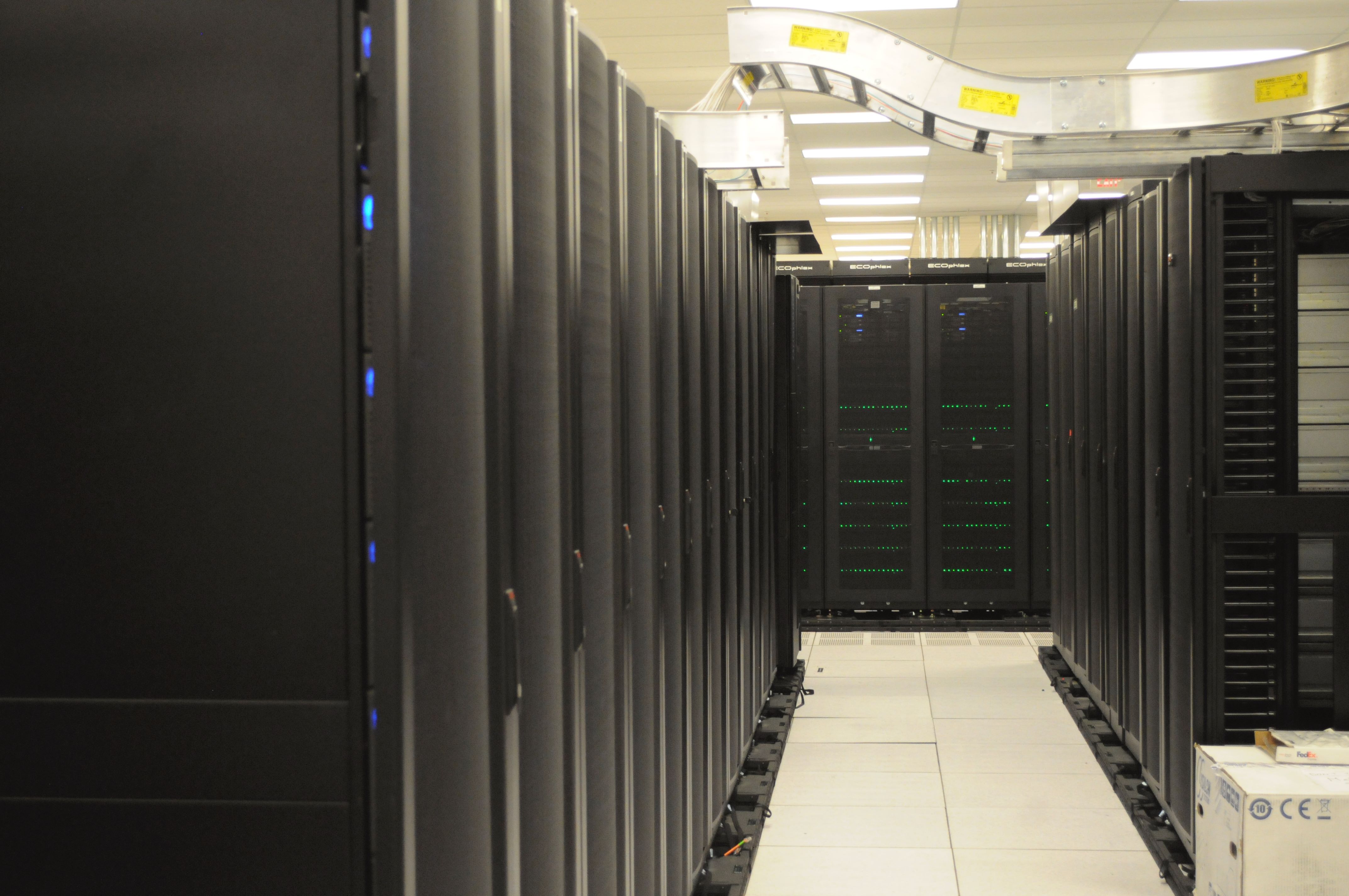
Photo 2 — Server racks at NERSC
Photograph by Derrick Coetzee, released under CC0 1.0, via Wikimedia Commons.
Research and reporting cutoff: November 6, 2026. Quantum-computing resource estimates are theoretical unless explicitly identified as experimental demonstrations. Post-quantum algorithms are designed to resist known quantum attacks, but no cryptographic system should be considered immune to every possible future discovery.
The conversation
Post a Comment