Imagine opening a computer and discovering that its most unusual component is not a processor, a graphics card, or a new type of memory. It is a living network of nerve cells. The cells do not have eyes, hands, or a body. They float in a carefully controlled environment, spread across a chip smaller than the box that contains them. Yet electrical pulses from a digital program can reach them, and their own signals can change what happens on a screen.
This is not a scene from a science-fiction film. It describes an emerging field often called biological computing, or wetware computing. In 2026, researchers and developers at the Australian company Cortical Labs drew attention to the field by connecting cultured human neurons to the classic video game Doom. The results were modest: the system moved, reacted, and failed repeatedly. But the demonstration raised a question more interesting than whether a dish of cells could win a game. Could living neural networks become useful components in computers, or teach us something that ordinary computers cannot?
The answer remains uncertain. Earlier experiments have been published in peer-reviewed journals, while some of the most eye-catching recent demonstrations are still company-led proofs of concept. Researchers have also built related systems using three-dimensional brain-like tissue models. The technology is real, but the stories told about it can run far ahead of the evidence.
To understand why this matters, we need to examine what the cells actually do, how software communicates with them, which applications are plausible, and which claims still belong to the future. The surprising part is not that scientists have built a tiny human brain inside a machine. They have not. It is that computation may not have to be limited to components made entirely from nonliving materials.
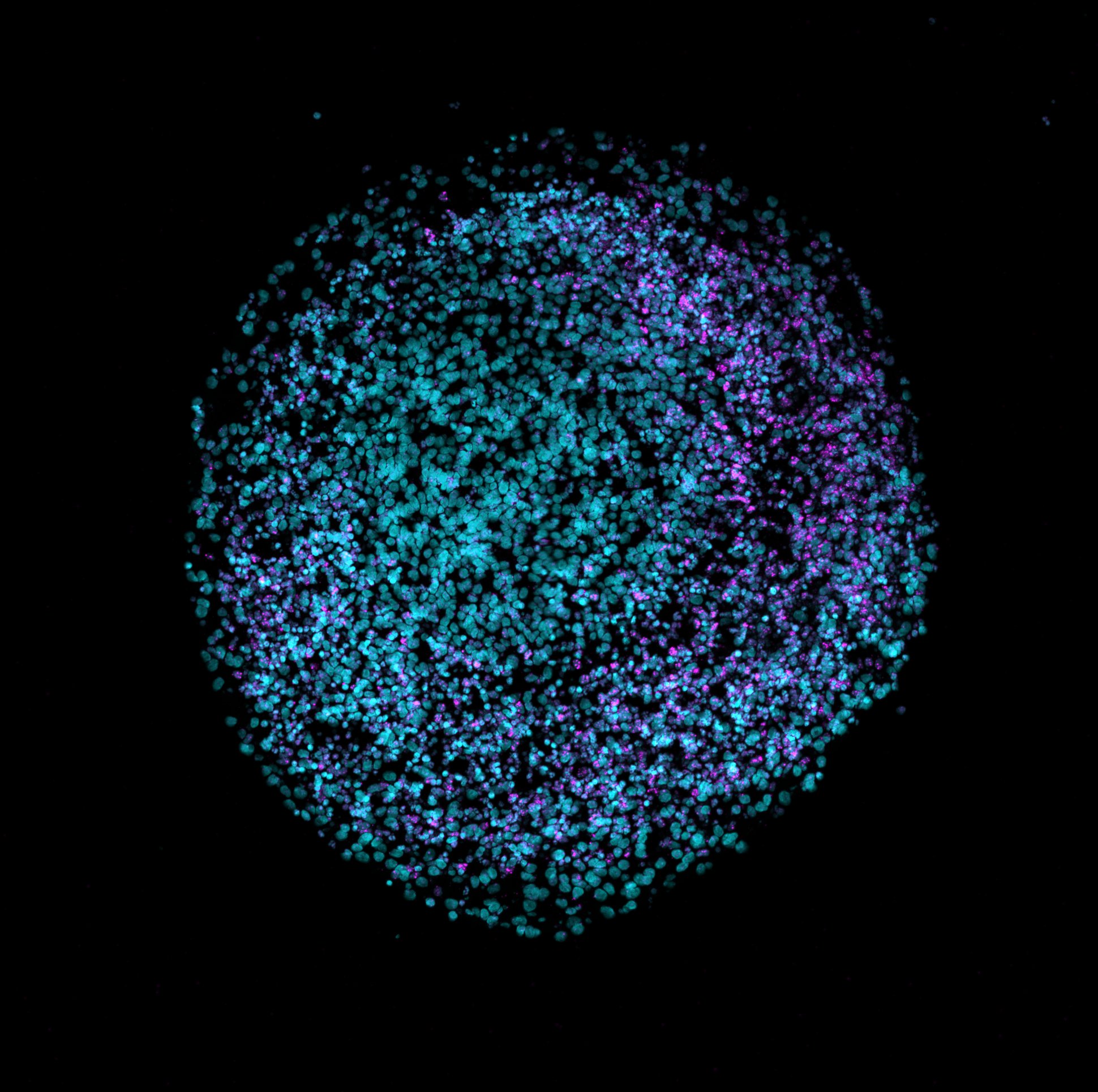
Caption: A human brain organoid — a small, lab-grown cluster of neural tissue that helps researchers study how nerve cells organize and respond. Source: Wikimedia Commons.
A New Kind of Computer, but Not a New Kind of Human
The words biological computer can create the wrong picture. It is tempting to imagine a miniature brain thinking inside a box, perhaps reading instructions or secretly understanding the program it controls. What exists today is far less familiar and far more constrained. Scientists cultivate neurons, keep them alive with nutrients and environmental controls, and connect them to electronics capable of delivering and detecting signals.
A neuron is a specialized cell that communicates through electrical and chemical activity. In the body, enormous networks of neurons help animals sense their surroundings, coordinate movement, learn, remember, and perform countless other functions. Remove a small network from the architecture of a functioning brain, however, and most of those abilities do not simply remain intact. There are no eyes to interpret a scene, no muscles to move a hand, and no complete nervous system organizing behavior.
Instead, researchers give the cells a narrow channel to an artificial environment. A computer decides what information to send. An electrode array delivers stimulation. Other electrodes record the electrical responses of the culture. Software then interprets aspects of those responses as outputs. The result is a hybrid system, because the living cells and the conventional electronics depend on one another.
That distinction is fundamental. These machines are not living replacements for laptops. They are experimental interfaces for studying how biological networks respond and adapt when the world outside the culture changes in response to what the cells do.
The Discovery That Made the Idea Hard to Ignore
The modern excitement did not begin with Doom. An important milestone arrived in 2022, when researchers led by Brett Kagan reported an experiment called DishBrain in the journal Neuron. The team grew networks of human-derived and mouse neurons on high-density electrode arrays and coupled them to a simplified version of Pong, the familiar game of bouncing a ball past a moving paddle.
The experiment was carefully designed around a loop. When the simulated ball changed position, the researchers translated information about that movement into electrical stimulation. Activity recorded from the neurons was interpreted as instructions affecting the paddle. Crucially, the outcome of the action influenced the next signals delivered to the cells. The culture was not merely being played a recording. Its responses mattered to the environment it subsequently encountered.
Across experiments, the researchers observed changes in performance consistent with adaptation during closed-loop interaction. Their study reported that the relevant pattern was not reproduced by control conditions lacking structured feedback. It was evidence that relatively simple cultured networks could participate in a task-dependent process, not proof that they understood the rules of a human game.
This distinction is especially important because the paper's title used the term sentience in a technical theoretical context. In everyday language, sentience usually suggests subjective experience or feeling. The experiment did not establish that cultured neurons had conscious experiences, emotions, or knowledge of being alive. Its central achievement was a measurable relationship between electrical feedback and changing network behavior.
How a Chip Talks to Cells
To picture the hardware, imagine a very small concert stage with hundreds or thousands of tiny microphones and speakers embedded in its floor. Instead of musicians standing on the stage, living nerve cells grow across it. The microphones and speakers are electrodes, and the performance is made of electrical activity too small for human senses to detect unaided.
Neurons maintain electrical differences across their membranes. Under suitable conditions, they produce brief electrical events called action potentials. Groups of cells can influence one another through connections known as synapses. An electrode placed near a neuron may detect some of this activity, while carefully controlled stimulation through an electrode can influence nearby cells. The relationship is complex: one electrode does not necessarily correspond to one cell, and a single observed spike does not carry an obvious sentence-like meaning.
The electrode array serves as a translator between two very different systems. On one side, software works with numerical values, rules, timing, and digital data. On the other, biology works with electrical pulses, changing connections, chemical signaling, noise, and the living condition of the cells themselves.
Researchers can control when and where electrical inputs are delivered. They can also collect measurements of the resulting responses. But recording activity is not the same as reading thoughts. The challenge is to make the signals reliable enough that a particular pattern can serve a practical function, such as steering a simulated object or helping classify a simple input.
Why Feedback Changes Everything
The most significant feature of these experiments may be the closed loop rather than the cells alone. A closed loop exists when an action changes the environment and the changed environment provides new information. Consider learning to balance a bicycle. You move the handlebars, feel the bicycle lean, correct your movement, and continuously repeat the process. Without that feedback, steering becomes guesswork.
A living-neuron system needs some equivalent of consequences. In the Pong setup, researchers used different patterns of electrical stimulation to represent what was happening in the game. They also designed feedback intended to make some outcomes more predictable than others. The reasoning was that neuronal networks might adjust their activity in ways that favor a more structured stream of incoming information.
Scientists have proposed theoretical explanations for such behavior, including frameworks involving prediction and uncertainty. But a proposed explanation is not the same as a fully demonstrated mechanism. There remains debate about exactly which biological changes drive the observed improvement, how long those changes last, and whether different experiments are measuring the same kind of learning.
Still, the principle is powerful. If the biology receives meaningful information and its responses change the next information it receives, researchers can test adaptation under conditions that are closer to interaction than passive cell observation. That creates a new kind of laboratory instrument for neuroscience, regardless of whether it eventually becomes a competitive computer.
From Pong to Doom: What Actually Happened in 2026
A Pong paddle moves along a single axis. Doom is a three-dimensional game involving navigation, enemies, obstacles, and several possible actions. So when Cortical Labs presented a demonstration in 2026 of roughly 200,000 human neurons participating in Doom gameplay, it understandably attracted attention. A living culture was connected to a system that could move through corridors and perform actions in a world far more complicated than Pong.
But the cells did not watch the screen or recognize a monster. Conventional software selected information from the game and converted it into a form suitable for electrical stimulation. Recorded neural activity passed back through software that translated it into game controls. Other conventional computational components helped make that exchange usable. The neurons were one part of a larger engineered system, not a self-contained player.
The performance was limited. Public reports showed imperfect movement, frequent failures, and only basic signs of useful interaction. Describing the event as a dish of human brain cells mastering Doom would be inaccurate. More defensibly, it was a public demonstration that a culture of neurons could be integrated into a real-time, multi-action digital task.
The difference between those descriptions matters. A headline about neurons playing a game is memorable. A careful interpretation asks what signals reached the biology, what the software did independently, whether the neurons changed through experience, and whether the same system would outperform a meaningful control without living cells.
The 2026 Doom demonstration is intriguing, but it should not be treated as equivalent to a complete peer-reviewed scientific validation of every learning claim associated with it.
Does the Biology Really Do the Computing?
This is one of the most important questions facing the field. A hybrid machine has several possible sources of intelligent-looking behavior. The software may extract useful information from a game. A decoding algorithm may gradually improve. The experiment may be designed so that even random electrical activity sometimes leads to successful actions. Or the living network may genuinely contribute adaptable dynamics that the other components cannot easily reproduce.
Distinguishing those possibilities requires controls. Researchers can compare the living-culture system with recordings played back later, shuffled signals, silent inputs, nonliving substitutes, or software-only models. They can ask whether improvement survives a change in task, whether it disappears when feedback is broken, and whether activity patterns evolve in reproducible ways.
A March 2026 analysis by R&D World explored this issue using a software-only version of the Doom pipeline. Removing structured input degraded some outcomes, suggesting the decoding software was not simply ignoring its input. Yet the analysis was explicit about its limitation: simulations without a live culture cannot show that living neurons were responsible for learning. That conclusion requires experiments involving real cells and the appropriate biological controls.
This is not an argument against the demonstration. It is the ordinary scientific path from an exciting possibility to a dependable finding. The useful question is not whether a machine with neurons can sometimes act successfully. It is whether the neurons make a specific, measurable contribution that remains when the novelty wears off and rigorous comparisons begin.
What Do Scientists Mean by Learning?
In everyday conversation, learning means acquiring a skill or understanding an idea. In neuroscience and machine learning, it can mean something narrower: a system changes its behavior in response to experience. A neuron culture might show learning if its activity becomes more effective at producing a selected outcome after repeated feedback, especially when suitable control conditions do not show the same change.
But there are many alternative reasons a measurement could improve. Cells can become more or less active as they mature. They can react to repeated stimulation without storing task-specific information. Electrodes can record different signals as a culture grows or shifts. A decoding algorithm may perform better because it is being trained separately. Random variation can also produce apparent trends when experiments are small.
A convincing result therefore needs repeated trials, appropriate comparisons, clearly defined performance measures, and honest reporting of uncertainty. Researchers should ideally test whether a learned response persists, transfers to a related task, or can be disrupted in a way that identifies the underlying process. Those are harder goals than producing an impressive video.
Even when a culture adapts, the word intelligence needs care. Biological networks can process information without possessing anything like human reasoning. An adaptive thermostat responds to conditions without understanding temperature; a nerve-cell culture is much more complex, but complexity does not automatically establish thought. The interesting science lies in discovering which computational properties emerge, not in awarding the cells a human title.
Not Every Biological Computer Uses the Same Kind of Tissue
The field contains several approaches that should not be mixed together. Some platforms use relatively flat networks of cultured neurons growing across electrodes. Others use three-dimensional structures often called brain organoids. These are made from stem cells and can reproduce selected features of neural tissue development and organization. They are models, not miniature complete brains.
A flat culture can be easier to access with electrodes and observe over time. A three-dimensional organoid may offer different patterns of cell interaction and a more complex tissue environment, but it can also be more difficult to sustain, measure, and standardize. Different organoids may develop differently even when scientists follow similar procedures.
Both approaches depend on conventional laboratory methods, electronics, software, and careful interpretation. And both have limits. Without the full range of sensory organs, body systems, developmental experiences, and structured brain regions, neither can be assumed to behave like a person or an intact animal brain.
The distinction is important when reading claims about organoid intelligence. The term may describe a research ambition or a computing strategy rather than a demonstrated thinking organism. What matters is the precise architecture: what tissue was grown, how it was stimulated, what information it handled, and which test showed that it was useful.
The Brainoware Experiment: A Different Route
One influential example came from a research project called Brainoware, published in Nature Electronics in 2023. Instead of asking a neuronal culture to directly control a game, the researchers explored whether a brain organoid could serve as part of a computing architecture known as reservoir computing.
Reservoir computing uses a complicated system to transform incoming signals into a rich pattern of internal responses. Imagine dropping pebbles into a pond. Different sequences of drops create overlapping ripples. By studying those ripples, an observer may recover information about what happened earlier. A computational reservoir works on a related principle, though its actual mathematics and physical behavior are more sophisticated.
In Brainoware, electrical inputs stimulated a neural organoid, and the resulting patterns were recorded through an electrode array. The researchers combined these biological responses with conventional data-processing methods to investigate tasks including aspects of speech recognition and prediction of a nonlinear mathematical process. The results suggested that the organoid could provide useful dynamic behavior within a hybrid computing system.
This did not mean the organoid understood spoken words, held conversations, or performed all the work independently. It showed that living neural tissue might act as a component that transforms information in ways a readout system can use. The achievement broadened the research question: instead of asking only whether cells can control a game, scientists could ask which kinds of computation living tissue might support best.

Caption: Human cerebral organoids in a laboratory flask. These three-dimensional neural tissue models are used to study brain development and network behavior. Source: Wikimedia Commons / NIAID.
The Rise of Remote Wetware Laboratories
For most of the history of this research, experimenting with living neurons required unusual expertise and equipment. Scientists needed facilities for cell culture, knowledge of electrical recording, sterile handling procedures, and a reliable way to keep biological samples healthy. That limited participation to specialized laboratories.
A change is underway. The Swiss company FinalSpark described a remotely accessible Neuroplatform in a 2024 research paper, with software interfaces that allowed outside researchers to conduct experiments using living neural preparations. Cortical Labs has also promoted remote access to its biological systems through a cloud-style service. In March 2026, it publicized a Melbourne installation containing multiple CL1 units, a step toward making such experiments available at a larger scale.
The appeal is easy to understand. A researcher might write code in one country while a carefully maintained neural culture runs the experiment elsewhere. That resembles cloud computing in its access model, but the physical resource at the other end is very different from a standard server. It must be fed, protected from contamination, monitored for biological health, and eventually replaced.
Remote access does not make the technology mature. It does make independent exploration more practical and may allow groups to compare methods, reproduce results, and develop shared benchmarks. In a young field, those opportunities can matter more than a spectacular individual demonstration.
The Most Immediate Promise May Be Medicine
The strongest near-term argument for connecting neurons to software may have little to do with replacing computers. It may be the ability to study nervous-system function under controlled conditions. Traditional cell cultures can reveal how neurons respond to a chemical or how a disease-related mutation changes basic cellular behavior. But a cell's electrical activity can also depend on the patterns of information it receives and the feedback generated by its environment.
A closed-loop system gives scientists a way to ask functional questions. Does a particular treatment change the network's ability to respond consistently to repeated signals? Does a disease-associated mutation alter adaptation? Do different cell populations respond differently to the same structured task? Such experiments could add information beyond measurements of cell survival or average electrical activity.
Researchers could potentially derive neurons from donated human cells and investigate how certain genetic backgrounds influence network behavior. They might use those preparations to study mechanisms associated with neurological conditions or evaluate candidate compounds at an early research stage. In principle, the same platform could support experiments comparing how similar cultures respond before and after an intervention.
However, a cultured neural network is not a patient. A result in a dish cannot establish that a drug will improve human memory, treat epilepsy, or reverse a psychiatric condition. Actual disorders involve multiple cell types, body systems, lived experiences, and long-term interactions that a simple culture cannot reproduce. Medical benefit would require validation against other models, careful clinical research, and evidence that findings generalize. The exciting opportunity is to improve research tools, not to promise a shortcut around medical testing.
Could Living Chips Save Energy?
Energy efficiency is another reason biological computing attracts attention. Human brains perform remarkable information processing while using power on the scale of a small household light. Modern digital computing, especially at large data-center scale, can require far more electricity. Those observations invite a natural question: might biological networks perform certain tasks with less energy than silicon-based hardware?
It is possible, but direct comparisons are complicated. The electrical activity of the cells may require relatively little power, yet the complete system includes pumps, temperature control, monitoring electronics, data conversion, and often other computing equipment. A conventional server and a living-neuron system may also be solving completely different tasks, making a simple watts-versus-watts comparison misleading.
There is a second problem: a device's energy use matters only in relation to the amount and quality of work it performs. A system that consumes little power but completes a small demonstration poorly is not automatically more efficient than a standard chip that performs millions of accurate operations. Researchers need measures such as energy per validated task, speed, accuracy, reliability, and the resources required to maintain the cells.
The biological approach might eventually offer an advantage for particular kinds of adaptive or low-data processing. It might also prove too fragile or expensive for many practical uses. Claims that living neurons will soon replace energy-intensive AI infrastructure remain speculation until fair, end-to-end comparisons demonstrate a useful advantage.
Biology Does Not Behave Like Factory-Made Silicon
A silicon processor can be manufactured to meet strict specifications and tested before it reaches a customer. Cultured neurons are living materials. They grow, change, respond to their environment, and eventually stop functioning. Two cultures produced using similar methods may not have identical electrical properties. A signal that works well with one preparation may work differently with another.
Keeping the cells alive creates engineering demands that ordinary chips do not face. Nutrients must reach the tissue, waste must be managed, environmental conditions must remain stable, and contamination must be prevented. Electrode connections must work while the biology changes around them. Researchers also need to distinguish useful adaptation from deterioration, stress, or random fluctuations in activity.
Longevity is another difficulty. Cortical Labs describes CL1 life-support conditions intended to keep cultures operating for periods of up to six months, but that is not the same as guaranteeing stable performance for six months on every task. Practical computing hardware needs predictable availability, maintenance procedures, replacement strategies, and consistent behavior after restarting or switching units.
Scaling adds further challenges. More cells do not automatically produce better performance. Larger preparations may be harder to nourish and measure, and the software interface must still convert a complicated pattern of neural activity into dependable outputs. At some point, the machinery needed to support the biology could overwhelm an energy or cost advantage. Solving that problem will demand engineering as much as neuroscience.
The Reproducibility Test
Early scientific breakthroughs often look cleanest in a short demonstration. A video can show the most interesting minute, but researchers need to know what happened during the other hours and days. How many cultures were tested? How many failed before a usable result emerged? Did the same network improve consistently, or did a few unusually successful trials dominate the average?
These are not cynical questions. They are how an emerging field becomes trustworthy. Experiments need transparent descriptions of cell origins, culture age, electrode geometry, stimulation patterns, data-processing choices, and statistical methods. Researchers should specify which parts of a system learn and which are fixed. Ideally, teams that did not build the original platform should reproduce its results using independently collected biological data.
A 2025 framework in Nature for neural organoid and related research emphasized careful experimental design, characterization, reproducibility, and transparent reporting. Those principles apply beyond organoids to the broader effort to turn living tissue into usable scientific devices. They also protect the field from the risk that exciting marketing language will substitute for strong measurements.
The field's progress will be easier to judge when different laboratories can compare the same tasks under similar conditions. A standardized benchmark may be less photogenic than a video game, but it can reveal whether a technique is improving for reasons that survive critical scrutiny.
The Ethical Question Is Real, Even Without a Tiny Mind
Human-derived neural cultures raise questions about donor consent, responsible sourcing, privacy, and the ways living material may be used. Cells can be produced from reprogrammed donor material rather than removed directly from a person's brain. That reduces some concerns but does not eliminate the need for clear permissions, responsible handling, and transparency about commercial applications.
Another question concerns the possibility of subjective experience. Current cultures and organoids do not reproduce the complete organization of a human brain. There is no established evidence that the systems described here are conscious or capable of human-like thought or suffering. Scientists should not describe them as people trapped in machines, nor should they claim that the problem can be dismissed forever simply because today's devices are primitive.
As neural models become more complex, the scientific and ethical questions may change. What kind of evidence would be relevant to assessing awareness or the capacity for experience? Who should evaluate experiments that push biological complexity further? How should researchers respond when the evidence remains uncertain?
In May 2026, the Nuffield Council on Bioethics published a report addressing governance challenges associated with neural organoids and related models. It emphasized the need to consider oversight as the science develops. Responsible innovation here means neither sensational fear nor unlimited enthusiasm. It means giving research participants, regulators, scientists, and the public a clear account of what these systems are, what is unknown, and what standards should guide their use.
What a Useful Breakthrough Would Look Like
Imagine a future study in which independent laboratories receive the same carefully characterized neural preparations and use them for a simple, well-defined task. Each team compares the biological system with conventional software, random-signal controls, and nonadaptive preparations. The researchers track accuracy, speed, power, cost, and biological stability over long periods. Their findings agree, and the living system offers a repeatable advantage on one narrow measure.
That result would be more consequential than an elaborate game demonstration, even if the task were less entertaining. It would establish where biology adds something measurable. Researchers could then ask whether the advantage remains when the system is made larger, whether it helps medicine, and whether the cost of maintaining the cells is justified.
Another valuable outcome could be a better disease model rather than a new type of processor. If a platform reliably reveals how a neural network's functional behavior changes under a specific treatment, it might become an additional tool for selecting which hypotheses deserve further investigation. Its value would come from better evidence, not from claiming that a dish replaces a patient.
The most plausible future may involve specialized hybrid machines. Silicon would continue handling tasks that demand precise arithmetic, long-term storage, and dependable general-purpose computing. Biological networks might contribute unusual adaptive dynamics in controlled settings. The goal would not be to make everything alive. It would be to use the right material for the right problem.
The Open Questions Researchers Still Need to Answer
Several uncertainties remain at the center of biological computing. Scientists need to determine which measurable forms of learning can reliably occur in cultured networks, how those effects relate to changes in synapses or broader network dynamics, and how long useful adaptations can persist. They must identify whether a network trained under one set of conditions can handle a different situation without beginning again.
Engineers need better ways to encode information so that electrical inputs carry useful structure without overloading or damaging the cells. They need decoders that are accurate but do not secretly perform all the learning themselves. They also need improved manufacturing, maintenance, and quality-control methods if experiments are to move beyond small numbers of specially prepared cultures.
Economists and environmental researchers will eventually have to evaluate full-system costs and energy use. Medical scientists will need to determine whether a particular platform predicts anything useful about human disease beyond what existing tools already provide. Ethicists and regulators will have to revisit standards if tissue complexity or experimental applications change substantially.
None of these questions makes the idea less worthwhile. In fact, they define what progress would mean. An emerging technology becomes important not when every question has been answered, but when experiments become good enough to separate what is possible from what is merely attractive to imagine.
Conclusion: The Future May Be Hybrid, Not Human-Shaped
The most striking thing about a neuron connected to a computer is how quickly it challenges a familiar boundary. We are accustomed to thinking of computation as something done by manufactured circuits, while living cells belong to the world of biology. Yet the brain itself is an information-processing system, and researchers are beginning to test whether small pieces of that biological machinery can be connected to software in useful ways.
The experiments so far support cautious interest. DishBrain provided peer-reviewed evidence of adaptation during structured interaction. Brainoware explored the use of neural tissue as a computational reservoir. Newer commercial platforms and public demonstrations have made experimentation more accessible and brought the idea into view in 2026. None of this proves that living chips are conscious, ready to replace ordinary processors, or guaranteed to solve the energy problem of artificial intelligence.
The deeper opportunity is to ask better questions. Can a cultured network help scientists understand how learning emerges? Can it reveal disease-related changes that static measurements miss? Can it contribute a useful computation when paired with the speed and precision of silicon? And can all of this be done reproducibly, economically, and responsibly?
The answer may eventually produce a new class of specialized devices. It may instead produce better methods for studying the nervous system. Either outcome would matter. The computer that is alive is not yet the machine of tomorrow. For now, it is a scientific experiment that forces us to reconsider what a computer can be — and to measure the difference between a remarkable demonstration and a genuine breakthrough.
Sources and Further Reading
Kagan and colleagues' 2022 DishBrain research in Neuron: https://pmc.ncbi.nlm.nih.gov/articles/PMC9747182/
The 2023 Nature Electronics Brainoware study: https://www.nature.com/articles/s41928-023-01069-w
The 2024 Frontiers in Artificial Intelligence study describing FinalSpark's Neuroplatform: https://www.frontiersin.org/journals/artificial-intelligence/articles/10.3389/frai.2024.1376042/full
Scientific American, March 28, 2026, on Cortical Labs' Doom experiment: https://www.scientificamerican.com/article/how-human-neurons-on-a-chip-learned-to-play-doom/
Nuffield Council on Bioethics, May 12, 2026, on neural organoids: https://www.nuffieldbioethics.org/publication/neural-organoids-ethical-and-governance-considerations/
The conversation
Post a Comment