A surprising life on a floating bottle
A piece of plastic drifting across the North Pacific may look like an object outside nature: manufactured, lightweight, and stubbornly resistant to decay. Yet its surface can become a miniature habitat. Microscopic organisms attach to it, exchange nutrients, and form communities that scientists study under the name plastisphere. Among them are fungi, organisms better known to many people from forests, bread, and damp walls. Researchers have asked an ambitious question about this unlikely meeting: can a fungus do more than live on plastic? Can it actually use carbon from the material?
The distinction matters. An organism found on a bottle is not necessarily digesting the bottle, just as a bird standing on a building is not eating the concrete. Plastic can carry a film of organic dirt and seawater nutrients that supports growth independently of the polymer beneath it. To show genuine degradation, researchers need to identify chemical changes or follow the material's carbon into products of metabolism. In 2024, one team reported a particularly intriguing experiment involving a marine fungus collected from ocean plastic. Its result was real but much narrower than headlines about an ocean-cleaning superorganism suggested.
The study offered evidence that Parengyodontium album could convert some carbon from ultraviolet-treated polyethylene into carbon dioxide under laboratory conditions. It did not show that the fungus could rapidly remove untreated garbage from the sea, or that releasing more fungi would be safe or effective. In fact, the experiment highlighted a dependence on sunlight-related weathering before the biological process became detectable. The bigger story is therefore not a miracle cure. It is the hard scientific work of separating a promising chemical pathway from a scalable environmental solution.
What researchers discovered in the North Pacific
The team led by Annika Vaksmaa isolated P. album from floating plastic debris in the North Pacific Subtropical Gyre, a region where ocean circulation can accumulate debris. In a study published in Science of the Total Environment in July 2024, the researchers investigated whether this organism could mineralize polyethylene, commonly called PE. Mineralization means converting carbon from a material into simpler inorganic products such as carbon dioxide. It is a stronger claim than simply seeing cracks or measuring how much of a sample weighs after a culture experiment.
The researchers used polyethylene labeled with a heavier form of carbon, carbon-13, enabling them to trace material derived from the plastic. Their experiment measured carbon dioxide associated with the labeled source and employed additional methods to examine fungal biomass. Over nine days, the reported mineralization rate for ultraviolet-pretreated PE was 0.044 percent of the initially added polymer per day under the study conditions. That small number is essential context. Even without considering the many differences between a laboratory and the sea, it is not evidence that an entire floating bottle will disappear within days.
The contrast between treated and untreated material was especially revealing. The investigators did not detect incorporation of carbon-13 from non-treated polyethylene into fungal cells. For the ultraviolet-treated material, they measured conversion to carbon dioxide while incorporation into fungal biomass remained minor. This pattern supports the idea that prior light-driven chemical changes made some plastic-derived carbon accessible. It also imposes a limit on interpretation: the experiment involved already-weathered polymer in controlled conditions, not untouched shopping bags sinking into dark water or thick fishing equipment resisting years of exposure.


The result is scientifically interesting precisely because polyethylene is difficult to attack. Its molecular backbone consists largely of sturdy carbon-carbon bonds. Unlike some polyesters, it does not offer many easily hydrolyzed links that a common enzyme can snip. Scientists have long looked for microorganisms able to act on persistent plastics, but the evidence often turns on what was measured. Was the sample merely rougher? Did small additives disappear? Did sunlight do most of the chemical work? Tracing labeled carbon is one strategy for resolving those questions, although even such experiments require careful controls and interpretation.
How plastic becomes a possible meal
The word “eat” is convenient but imprecise. A fungus has no teeth and does not swallow a piece of plastic. Fungi grow networks of filaments called hyphae and release chemical substances into their surroundings. In some materials, extracellular enzymes break large molecules into smaller compounds that cells can absorb and metabolize. Whether that happens effectively depends on the polymer's chemistry, its surface, the available nutrients, the organism's machinery, and environmental conditions. A fungus growing across a sample is therefore only the starting observation, not proof that a polymer has been fully recycled.
Sunlight can change that starting point. Ultraviolet radiation and oxygen can help oxidize some plastic surfaces, making chains shorter or introducing chemically reactive groups. Waves and abrasion can break larger objects into smaller pieces, increasing the exposed area, though fragmentation is not the same as biodegradation. The 2024 marine-fungus experiment suggests that prior photodegradation was crucial for the measured transformation of PE-derived carbon. This is both a clue to a potential pathway and a limitation, because deeply submerged or shaded plastic may experience very different conditions from debris near the surface.
Think of a tightly woven rope that can only be handled by a machine after its fibers have loosened. The analogy is imperfect because chemical bonds, not fibers, are the target, but it captures the two-stage idea. Physical and chemical weathering can alter a material; biological activity might then process some of the resulting molecules. An environmental claim must establish what fraction truly becomes carbon dioxide, biomass, or other characterized products. Otherwise, a sample that looks smaller might simply have produced more fragments that remain in the environment.
The chemistry also changes from one plastic to another. PET, used in many beverage bottles and textiles, contains ester bonds that certain enzymes can attack. Some polyurethane formulations contain bonds that biological catalysts may break under suitable conditions. Polyethylene and polypropylene are chemically distinct polyolefins and generally much harder to depolymerize biologically. A research result about one polymer cannot automatically be extended to another. Nor can a successful test on a thin laboratory film establish how a thick, dyed, weathered, multilayer product will behave in seawater.
Why identifying the real reaction is difficult
Scientists have several reasons to be careful about exciting degradation claims. A fungus may feed on plastic additives, residual manufacturing chemicals, or organic matter attached to the surface rather than on the main polymer. A sample can lose mass when it is washed, dried, or handled differently. Ultraviolet light may alter the material without any organism present. In some experiments, microbes grow because another food source is supplied in the culture medium. Such results can still teach researchers something, but they do not all demonstrate the same mechanism.
Measurements therefore need layers of evidence. Researchers may compare treated and untreated controls, examine polymer molecular weight, analyze products with chromatography or spectroscopy, and test what happens to labeled carbon. The strongest conclusions link chemical transformation to a demonstrated biological pathway while accounting for alternative explanations. A 2026 review in Science of the Total Environment argues for standardized levels of evidence in fungal biodegradation research. Without comparable methods, two laboratories may report impressive percentage losses that actually measure different things.
One important caution comes from a 2026 Nature Communications discussion of plastics and responsible innovation. Its authors emphasized the lack of robust evidence for direct enzymatic depolymerization of common polyolefins such as PE and PP, and warned that apparent effects can arise from prior nonbiological weathering or experimental artifacts. This does not mean every observation of microbes processing PE-derived carbon is meaningless. It means that evidence for metabolism after ultraviolet treatment should not be transformed into a claim that intact polyethylene has become an easy biological food source. The precise step supported by the data matters.
This kind of scientific disagreement is productive when the terms remain clear. One paper can demonstrate carbon dioxide formation from a labeled, pretreated sample, while another questions whether microorganisms truly cleave the original, highly resistant polymer backbone. Those are related but not identical claims. The next generation of studies needs to show the full sequence from an initially characterized plastic to verified breakdown products under reproducible conditions. Scientific humility here is not a lack of imagination. It is the difference between a useful discovery and a promise that the ocean cannot yet collect.
What a fungal colony really looks like
In the laboratory, fungi are often studied as spreading colonies on nutrient media. Their appearance can be dramatic: branching growth, patterned edges, and patches of pigment. It is tempting to use a photograph of any such colony as evidence of plastic digestion. That would be misleading. Species identification matters, and a culture photograph does not reveal which carbon source supported the organism. The accompanying image shows an Aspergillus culture as a visual example of filamentous fungal growth, not the marine species used in the 2024 experiment and not an experiment on plastic.
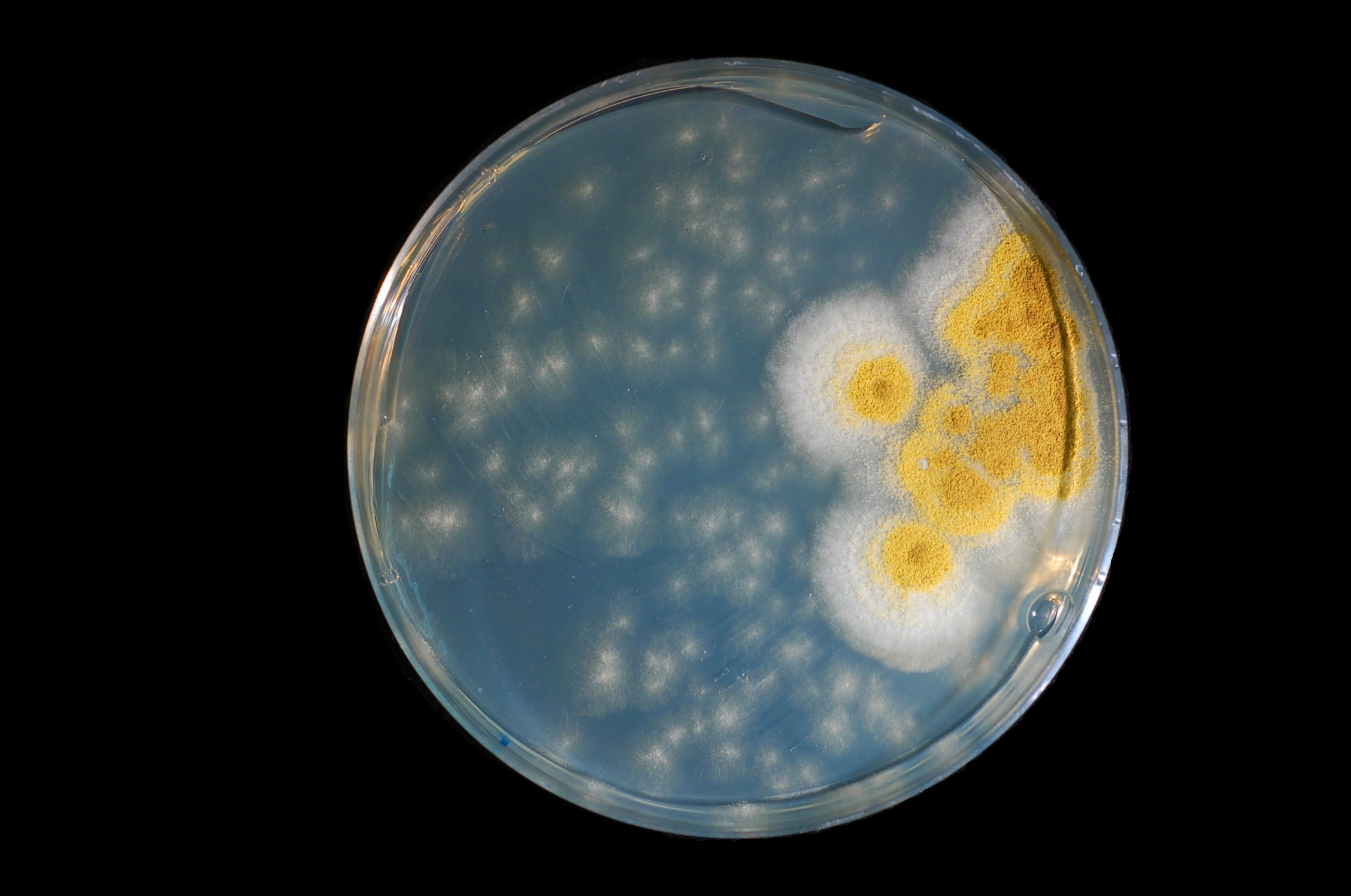

The distinction between species becomes important when discussing applications. Fungi can behave differently across strains, growth conditions, and environments. Some may produce useful enzymes while others can create unwanted metabolites or cause health problems in susceptible people. Research on fungal biodegradation belongs in controlled laboratories with suitable environmental assessment. It is not a reason to cultivate unknown mold at home or release organisms into lakes and beaches. Conservation aims to protect ecosystems, and adding living agents without evidence of safety can introduce a new ecological risk.
The best possible laboratory outcome would not necessarily involve putting living fungi directly into the ocean. Researchers might isolate and study enzymes, improve controlled pretreatment steps, or develop contained processing systems for particular waste streams. Each direction has costs, risks, and engineering problems of its own. The fact that a natural organism demonstrates an unusual chemical capability is valuable because it reveals a mechanism that can be investigated. But moving from a petri dish to a treatment facility demands much more than showing a culture growing under one set of conditions.
Why the ocean is a difficult factory
The sea does not resemble a carefully controlled vessel. Temperature, sunlight, salinity, oxygen, currents, and food availability vary continuously. Debris has different ages and chemical compositions; some remains at the surface while other pieces sink or become buried. A method that needs consistent ultraviolet pretreatment could work very differently across these locations. Fungi also compete with other microorganisms and may encounter substances that inhibit activity. The researcher who measured a rate in a nine-day experiment has not thereby measured the rate of cleanup across an ocean gyre.
Scale adds another obstacle. Plastic pollution includes packaging, synthetic fibers, fishing gear, foams, and many other products. Some objects are large enough to collect; others have fragmented into particles that are difficult to track and remove without also disturbing organisms. A technique suitable for processing a collected batch of film is not automatically suitable for dispersed microplastics. It may be better at treating waste on land, where temperature and chemistry can be controlled and products captured. The location where a process is most scientifically interesting is not always where it is most environmentally useful.
There is also a carbon question. Converting fossil-derived plastic into carbon dioxide is a different endpoint from recovering monomers that can be made into new products. Mineralization can reduce persistent solid material under some circumstances, but it releases carbon to the environment. In a controlled waste-management system, researchers must compare energy use, pretreatment demands, emissions, and possible residues with the alternatives. A process should not be labeled sustainable simply because its catalyst originated in nature. Environmental performance has to be measured across the whole system.
Energy and logistics can overwhelm an attractive biological rate. Imagine collecting waste from remote waters, transporting it to a facility, cleaning it, applying ultraviolet treatment, operating bioreactors, and treating byproducts. Every step has costs. If the process handles only one polymer, material sorting becomes another requirement. A meaningful comparison asks whether the same effort would yield greater benefits through preventing litter, recovering materials before they enter waterways, or improving ordinary collection. Biological innovation may eventually contribute, but it must earn its place against practical options rather than replace them by headline.
The larger field of plastic-degrading organisms
The marine result belongs to a much broader search. Scientists have investigated bacteria and fungi that interact with PET, polyurethane, and other polymers, sometimes focusing on enzymes rather than whole organisms. A major 2025 review in Microbiology and Molecular Biology Reviews described hundreds of functionally verified plastic-active enzymes, while emphasizing how uneven the evidence remains across polymer classes. Enzymes that attack ester-containing plastics have more developed pathways than biological systems for common, highly resistant polyolefins. Grouping all of them together under “plastic eating” hides the chemistry that explains success or failure.
There is another reason to resist simple comparisons. A substance can be biodegradable under a carefully specified industrial condition yet persist in an ordinary backyard or marine environment. Temperature, oxygen, moisture, microbial community, and processing time determine whether a claim applies. The same logic holds for fungi: a measurement in a laboratory should be reported with its environmental assumptions. Honest communication helps consumers and policy makers avoid treating words such as “bio,” “natural,” and “compostable” as guarantees of rapid disappearance wherever a product is discarded.
A useful next experiment might compare a range of realistic plastic samples, including treated and untreated materials, while measuring molecular changes and labeled degradation products over longer periods. Researchers could report the fraction transformed, the energy required, and the identity of any residual particles. Independent replication would be particularly valuable. Promising strains could then be evaluated in contained systems with environmental safety standards. Success would mean a reproducible treatment process for a defined material stream, not the sensational claim that a fungus is ready to consume the world's litter.
What matters more than a laboratory headline
For an ordinary reader, the immediate lesson is not to wait for microbes to solve a waste problem. Avoiding unnecessary disposable plastic, reusing appropriate products, following local collection rules, and supporting practical waste infrastructure remain more direct ways to reduce leakage. Those choices are not equally available to everyone. Packaging design, municipal services, industrial systems, and policy strongly influence how much waste escapes. Responsibility should not be shifted entirely to individuals whose purchasing choices are constrained by cost and local options.
Organizations can do more by measuring where plastic enters waterways and targeting those pathways. A well-designed collection system near a river may stop large objects before weather and waves break them into harder-to-remove fragments. Fishing-gear recovery and improved port facilities can address marine-specific sources. Product redesign can reduce difficult combinations of materials that frustrate conventional recycling. These interventions are not glamorous, and their performance depends on local circumstances, but they operate on the problem before it becomes an enormous, dispersed cleanup challenge.
Fungal research could eventually complement those systems, especially for collected and sorted materials that current processes struggle to handle. However, scientists would need to establish stable operation, material compatibility, safe byproducts, and realistic costs. Public funding and private investment should ask for measurable outcomes rather than a dramatic photograph of a colony growing beside plastic. The world does not need an inspiring nickname as much as it needs reliable evidence. Treating cautious conclusions as a strength gives genuinely useful biotechnology a better chance of developing without exaggerated expectations.
What the next discovery would have to prove
The most convincing future advance would join several pieces that are now often reported separately: a clearly identified organism or enzyme, a well-characterized polymer, a demonstrated chemical breakdown pathway, realistic treatment conditions, and independent verification of what remains. A successful process might recover valuable building blocks, reduce problematic residues safely, or treat a narrow category of discarded material. It would also need an environmental comparison showing that the benefits outweigh the energy and resources used. No single field photograph or laboratory percentage can answer all those questions.
The 2024 experiment with Parengyodontium album is important because it asked a difficult question with more specific measurements than mere surface growth. It also delivered an inconvenient answer: earlier ultraviolet exposure was central to the observed result. That nuance is the story, not a footnote. It tells researchers where to look next and tells the public why laboratory promise should be interpreted carefully. Even when the rate is small, following plastic-derived carbon through an unexpected biological pathway expands knowledge about the fate of human-made materials.
The plastic bottle floating at sea is therefore both a warning and a research question. It warns that a durable material can escape systems built to manage it and remain dispersed in habitats that humans do not easily control. It asks whether life has developed ways to interact with some of the chemicals we introduced. The answer may someday help waste treatment, but the ocean cannot wait for that possibility alone. The most responsible conclusion holds two ideas together: explore the extraordinary chemistry of fungi, and prevent unnecessary plastic from reaching the water in the first place.
That is why the title's promise needs a question mark in our minds. A marine fungus has shown a limited ability to process carbon from weathered plastic in an experiment. It has not been demonstrated to save the oceans. If future scientists turn that ability into safe, scalable technology, the achievement will be the result of careful chemistry and engineering, not a magical organism doing humanity's cleanup for free. For now, the discovery is valuable as a clue about nature's capabilities—and as a reminder of how much responsible innovation still has to prove.
Research and further reading
- Vaksmaa and colleagues (2024), Biodegradation of Polyethylene by the Marine Fungus Parengyodontium album — original carbon-tracing study and its ultraviolet pretreatment requirement.
- PubMed record for the 2024 marine-fungus study — study methods, reported rate, and limits.
- Microbial Plastic Degradation: Enzymes, Pathways, Challenges, and Perspectives (2025) — review of polymer-specific pathways and limitations.
- Advances in Fungal-Mediated Plastic Biodegradation (2026) — scientific evaluation and standardized evidence.
- Nature Communications (2026), Reflections on Bio-Based PET and Plastic Waste Management — important caution on claims about polyolefin breakdown.
- U.S. Environmental Protection Agency, Trash Free Waters — pollution prevention and waste-management context.
The conversation
Post a Comment