Your phone displays the time so casually that it is easy to forget what the numbers represent. A second feels like a natural object: short, familiar, and the same everywhere. Yet making that second reproducible enough for modern science requires extraordinary care. Behind the simple display lies a world of controlled atoms, stable signals, comparisons, and institutions that agree on how time should be measured.
Atomic clocks are often described through spectacular comparisons with the age of the universe. Those comparisons communicate precision, but they can obscure the practical questions. What is actually ticking? How can anyone decide that one clock is better than another? And why keep improving something already far more accurate than a person's daily schedule requires?
The answers begin with a modest idea: a clock needs a repeating process and a way to count it. The history of timekeeping is partly the history of finding processes that repeat more predictably, then learning how the environment can disturb them.
What a clock actually counts
A pendulum swings. A quartz oscillator produces an electrical rhythm. A clock counts cycles of a repeating process and relates that count to a unit of duration. The challenge is that physical systems respond to their surroundings. Temperature, motion, aging, and other influences can change their behavior.
A clock can therefore be wrong in more than one way. It might start at the wrong displayed time. It might run consistently fast. Its rate might wander unpredictably. Correcting the display solves only the first problem. A useful timekeeping system must also understand the rate and its changes.
Imagine two runners completing laps. One runs every lap in almost exactly the same time but uses the wrong length of track. Another uses the correct track but changes pace from lap to lap. Both create problems for someone trying to measure distance from the number of laps. Time measurement faces an analogous distinction between a steady rhythm and a correctly referenced one.
This is why a beautifully regular tick is not the whole story. Researchers need a reference, a measurement process, and an account of uncertainty. They also need to know whether the clock continues working reliably long enough for the intended task.
Why atoms provide a powerful reference
Atoms have characteristic energy transitions. Electromagnetic radiation with a suitable frequency can interact with those transitions. Atomic timekeeping uses this behavior as a reference for controlling an oscillator. Rather than trusting an engineered component alone, scientists compare its signal with a reproducible property of atoms.
The familiar picture of a tiny mechanical pendulum inside an atom is misleading. The relevant physics involves quantum energy states and their interaction with radiation. A clock apparatus prepares atoms, probes their response, and uses the result to adjust a signal. The full machine includes much more than the atoms themselves.
The benefit is reproducibility. Laboratories can investigate the same kind of atomic transition rather than depend on one unique physical object. But reproducibility does not eliminate practical difficulty. The apparatus can disturb the atoms, and nearby fields or environmental conditions can shift what the instrument measures.
A useful analogy is a musical reference note. Knowing the intended note does not automatically make an instrument perfectly tuned. The tuning process, the listener or detector, and the surrounding conditions still matter. Atomic clocks provide a highly reliable reference, while researchers work to make the act of reading it equally trustworthy.
Accuracy and stability answer different questions
Accuracy concerns agreement with the quantity being measured, taking account of the relevant uncertainty. Stability concerns how consistently a clock's rate behaves over a period. A stable clock can still have a systematic offset, while a clock with a well understood average frequency can be less steady over short intervals.
These properties matter differently in different applications. A service that must operate continuously needs dependable output. A research comparison may prioritize exceptionally low uncertainty over a limited measurement period. No single headline number describes every aspect of a clock's usefulness.
Consider a kitchen scale that always reads slightly high. Repeatedly weighing the same object might produce nearly identical answers. That repeatability is helpful, but it does not make the result correct. Calibration and knowledge of systematic effects are still necessary. The example illustrates why impressive consistency should not be confused with complete accuracy.
Scientists also distinguish uncertainty from an error known after the fact. An uncertainty statement describes the limits of the measurement based on available evidence. It is not an admission that the experiment was careless. Indeed, carefully identifying small influences is often what makes a leading clock scientifically valuable.
Why optical clocks offer a finer rhythm
NIST explains that optical clocks use atomic transitions associated with much higher frequencies than those used by traditional microwave atomic clocks. A faster reference rhythm can provide finer resolution, although realizing that advantage requires the rest of the measurement system to perform accordingly.
The ruler analogy is useful. A ruler with finer divisions can support more detailed measurements, but only if its marks are reliable and the user can read them correctly. Simply drawing additional lines on a poor ruler does not make it accurate. Similarly, higher frequency alone does not guarantee a superior clock.
Optical timekeeping requires extraordinarily controlled light and methods for relating optical frequencies to signals that electronics can use. Frequency comb technology is part of that connection. Researchers also need ways of holding and preparing atoms so that they can be probed without excessive disturbance.
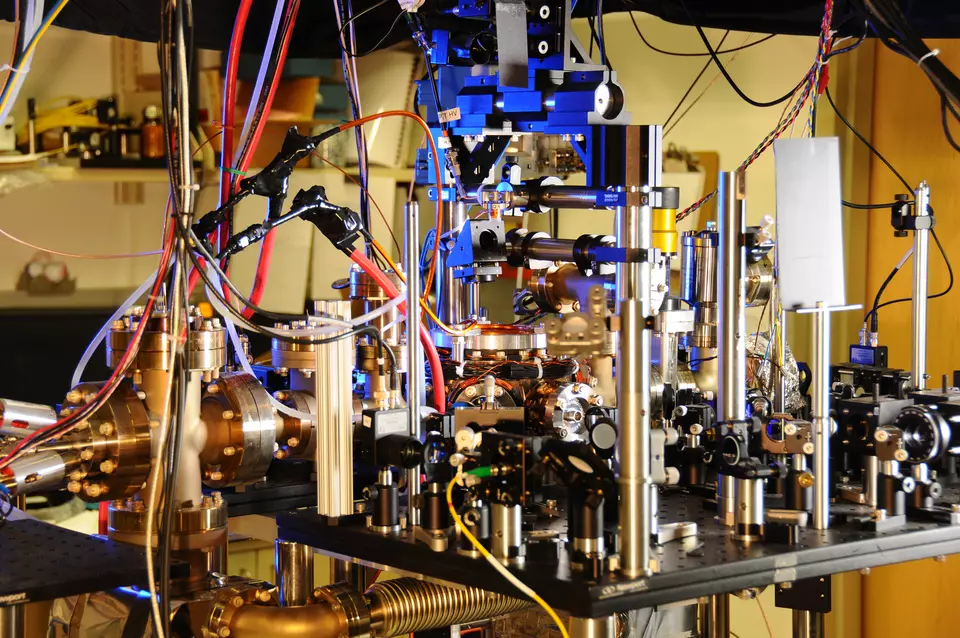
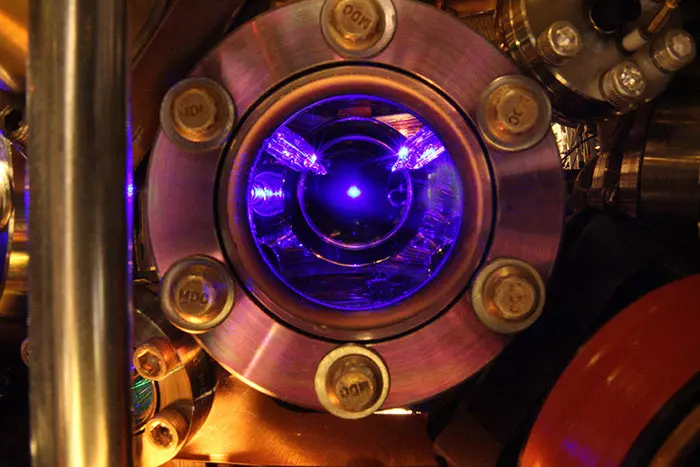
Different clock designs make different choices. Some investigate trapped ions; others use many neutral atoms held in an optical lattice. These are distinct approaches to creating a controlled atomic reference. Their strengths and difficulties depend on the details of the apparatus and the measurement being attempted.
The environment is part of the experiment
The more precise a measurement becomes, the more influences become relevant. Something negligible for a wall clock may matter enormously in a laboratory comparison. Researchers examine temperature-related effects, electromagnetic fields, motion, and other conditions that can change the measured frequency.
This creates an apparent paradox: atoms are useful because they provide reproducible references, yet the machines built around them are complex. There is no contradiction. The complexity comes from isolating the desired behavior from everything that could shift or obscure it.
Imagine trying to hear a quiet instrument in a busy room. The instrument may play a stable note, but background noise affects your ability to identify it. You can improve the instrument, reduce the noise, improve the detector, or gather data for longer. Precision experiments use similarly layered strategies, though the physical details are far more demanding.
Comparison is essential. Two independent systems can expose effects that would be difficult to identify with one system alone. When results disagree, the disagreement becomes useful evidence about a limitation or an unrecognized influence. Agreement is strongest when the systems do not merely share the same potential source of error.
Why the world's time is not a single clock on a shelf
A laboratory clock and an international time scale are different things. NIST describes coordinated timekeeping as a collaboration involving many clocks and laboratories, with the International Bureau of Weights and Measures helping organize the global comparison. Shared time depends on combining measurements rather than crowning one machine infallible.
That approach offers practical resilience. Different instruments have different strengths, and no physical device should be assumed to run forever without interruption. Comparisons and averaging help produce a dependable reference while high-quality standards provide information about its rate.
There is then a separate problem: distributing time. A reference inside a laboratory does not automatically set every computer correctly. Signals must travel through systems that introduce delays and limitations. A device receiving the time needs a method for interpreting that information and keeping its own clock aligned.
This means that two claims must be kept separate. A laboratory may demonstrate an extraordinarily precise frequency comparison, while an ordinary consumer device still receives time with much larger uncertainty. Improvements at the reference level can support better services, but the entire path determines what the user actually receives.
Why better seconds matter outside the laboratory
Many technologies depend on comparing events that happen in different places. A time stamp is useful only when its relationship to other time stamps is understood. As systems become faster and more interconnected, limitations in synchronization can become operational problems rather than minor inconveniences.
Navigation provides a familiar connection between time and distance. Signals travel at a finite speed, so timing information can help infer position. The details of a navigation system involve much more than a clock, but the relationship explains why timekeeping can matter to something that appears to be a geographical task.
Scientific measurements offer another motivation. A better reference can make a previously invisible effect measurable. Instead of merely improving the time on a display, a clock can become part of an experiment investigating the physical world. The question changes from when something happened to what a measured change in frequency can reveal.
Relativity also enters the picture. Clock rates depend on motion and gravitational conditions in ways described by physical theory. At sufficiently high precision, researchers must account for effects that everyday experience does not make obvious. Better clocks can therefore serve both as measuring tools and as ways to test theoretical predictions.
What a claim about an astonishing clock really tells you
When an article says a clock would lose only a tiny amount of time over an immense interval, it usually expresses a measured fractional performance in an intuitive way. It does not mean that the apparatus has actually run for that interval. The comparison is an extrapolation, and a responsible account should make that clear.
Ask whether the result concerns stability, systematic uncertainty, or another quantity. Ask how long the comparison lasted and what it was compared against. A best-ever result under controlled conditions is different from a device that delivers the same performance continuously in an ordinary environment.
It is also useful to distinguish research progress from changes to a unit's formal definition. A technology can outperform older instruments before an international standards process adopts a new basis for the second. Such decisions involve reproducibility, comparisons, practical continuity, and international agreement.
For most people, a better atomic clock will never make an appointment feel noticeably more punctual. Its significance lies in the infrastructure and measurements it enables. The seconds remain familiar while the ability to compare them becomes more powerful.
A useful way to think about precision
Measurement progress is easiest to understand as a chain. There is the physical reference, the instrument used to compare with it, the method of transmitting the result, and the device or experiment that uses the information. Improving one link can reveal that another link has become the limiting factor. That is progress, because it tells researchers where the next improvement will matter.
The same pattern appears in ordinary work. A very precise measuring tape does not help if a drawing uses the wrong units. An accurate timer cannot rescue an experiment whose starting event is poorly defined. Good timekeeping therefore combines hardware with clear definitions and procedures. The remarkable laboratory machinery is only one visible part of that discipline.
Readers do not need to memorize every clock design to understand the central achievement. Scientists are learning to reproduce and compare a physical rhythm with increasing confidence. Every reduction in uncertainty expands the set of differences they can meaningfully detect, whether those differences concern a technological system or a fundamental scientific question.
Questions and answers
Is an atomic clock powered by nuclear energy?
The term describes the atomic reference used for timekeeping. It does not mean that the clock is a small nuclear power station. The apparatus needs electrical power for its instruments, controls, and other components.
Does a phone contain a laboratory atomic clock?
Ordinary phones receive timing information through their communication and navigation systems and maintain local electronic clocks. A phone displaying accurate time is not the same as a primary laboratory standard that realizes the unit of time.
Can two good clocks disagree?
Yes. Their environments, motion, systematic effects, and measurement uncertainties all matter. A meaningful comparison accounts for these factors. Unexpected disagreement is a reason to investigate rather than automatically declare one instrument worthless.
Will optical clocks change the length of everyday seconds?
The purpose of improving a standard is continuity with better measurement, not making daily time arbitrarily speed up or slow down. Formal definitions and their practical realization require careful international coordination.
The most productive question is therefore rarely whether a clock is perfect. No physical measurement needs that impossible description to be useful. The better question is whether its uncertainty, reliability, and connection to a reference are suitable for the task. A household appliance, a communications network, and a laboratory investigation can legitimately need different levels of performance. Understanding those requirements prevents impressive research results from becoming exaggerated promises about immediate consumer benefits.
The conversation
Post a Comment