There is a quiet revolution taking place in libraries, community centers, neighborhood workshops, and ordinary homes. It does not involve a spectacular invention or an expensive new product. Instead, it begins with something familiar: a broken toaster, a jacket with a torn sleeve, a bicycle that no longer runs smoothly, or a lamp that has stopped working.
For decades, the modern consumer economy has encouraged a simple response to broken belongings: replace them. A damaged household item often seems easier to throw away than to investigate. A missing button becomes an excuse to buy another shirt. A defective appliance is replaced before anyone understands what went wrong.
But a growing international movement is questioning that habit. At community gatherings known as Repair Cafés, people bring broken objects and work alongside volunteers who know how to fix them. Sewing enthusiasts, retired technicians, mechanics, craftspeople, students, and curious beginners gather around shared tables. Some repairs take only minutes. Others require patience, experimentation, and a willingness to accept failure.
The movement has grown far beyond its Dutch origins. A global survey published in July 2026 estimated that Repair Cafés attract approximately 1.5 million visitors annually, with roughly 60,000 events and more than 1.6 million objects brought in for attention each year. These are survey-based estimates rather than a complete count of every repair worldwide, but they reveal the scale of the phenomenon.
Behind those numbers is a larger cultural shift. Repair is increasingly being discussed not simply as an economical activity, but as a form of creativity, environmental responsibility, independence, and community participation. Why are people rediscovering skills that earlier generations considered ordinary? What happens inside a Repair Café? Can fixing everyday belongings genuinely reduce waste and save money? And could a culture built around making things last become an important alternative to constant replacement? The answers reveal something surprising about our relationship with possessions, craftsmanship, and one another.
1. The Idea That Turned Broken Objects Into Community Events
The modern Repair Café movement began in Amsterdam in 2009, when Dutch journalist and sustainability advocate Martine Postma helped introduce a simple concept: create welcoming public spaces where people could repair household belongings together. The idea addressed two problems at once. First, useful objects were being discarded because their owners lacked the tools, confidence, or knowledge necessary to repair them. Second, practical expertise was gradually becoming less visible in everyday community life. A person who could replace a damaged electrical cord, mend a torn garment, or adjust a bicycle brake might live only a few streets away from someone struggling with precisely that problem. Yet the two people often had no opportunity to meet.
The Repair Café offered a solution based on cooperation rather than commercial transactions. Visitors could bring damaged belongings to an informal gathering, meet someone with relevant experience, and participate in the repair process. The atmosphere was intended to be approachable, with conversation and shared learning as important as the repaired object itself. The Repair Café Foundation was formally established in March 2010. It subsequently developed into Repair Café International, supporting a worldwide network of community initiatives.
Unlike a conventional repair business, a Repair Café is not organized around promising a guaranteed technical service. Volunteers generally contribute their knowledge and time, while visitors are encouraged to observe, ask questions, and learn. That distinction matters. A commercial technician's goal is to deliver a functioning product. A community repair gathering may also aim to rebuild confidence, transfer knowledge, and introduce neighbors who otherwise might never speak. An unsuccessful repair can still teach someone how an object is assembled, why a component failed, or how to prevent the same problem next time. In a culture where consumers often interact with products through sealed casings and unfamiliar mechanisms, simply discovering how something works can be transformative.
2. Inside a Repair Café: Where Objects Get a Second Chance
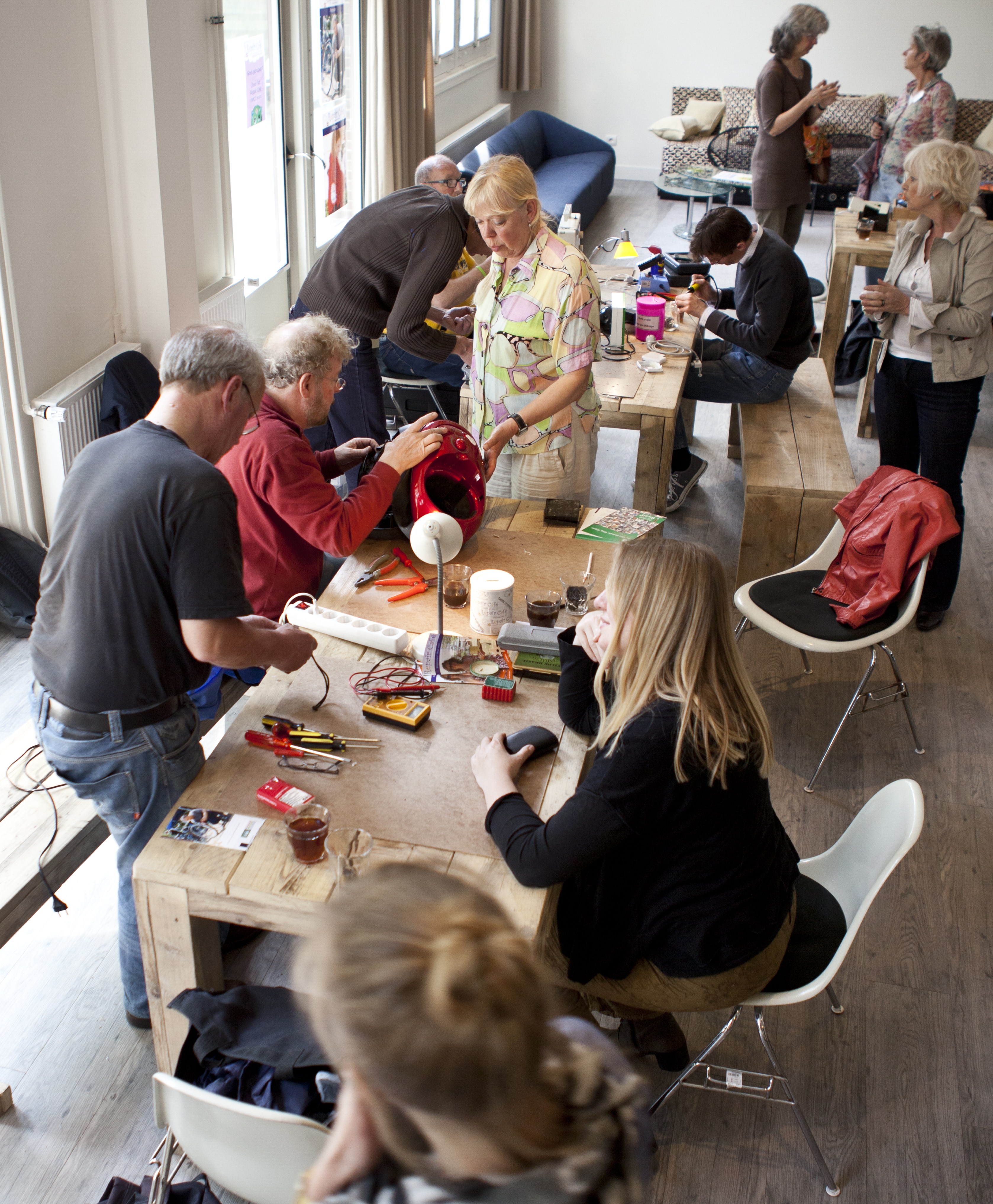
Step inside a typical Repair Café and the first thing you may notice is how ordinary everything looks. There are tables, chairs, electrical outlets, sewing equipment, hand tools, and people discussing everyday problems. The environment resembles a neighborhood gathering more than an industrial workshop. One visitor arrives with a lamp that flickers. Another carries a jacket with a broken zipper. Someone brings an old radio that has remained unused for years.
A volunteer begins by asking questions. When did the problem first appear? Has the object been dropped? Does the defect happen every time it is used? Has anyone already attempted to fix it? These questions help distinguish visible damage from underlying causes. For a garment, the problem might be a loose seam or worn fastening. For a bicycle, the issue could involve adjustment, lubrication, or a damaged component. For an appliance, diagnosis may require technical training and specialized safety precautions. The owner may be invited to participate when appropriate. They might hold a piece of fabric, identify a missing component, or observe an experienced volunteer demonstrating a repair technique.
The gathering also has a social dimension. Someone waiting for help may begin a conversation about a family heirloom. A volunteer may explain how appliances used to be designed. A young participant may discover an interest in sewing or mechanical work. The event transforms a private inconvenience into a shared practical challenge. Not every object can be repaired. Spare parts may be unavailable, damage may be extensive, or the required work may exceed the volunteers' expertise. Electrical devices, especially those involving mains voltage, batteries, heating elements, or high-voltage components, require particular caution. Repairs should be handled by qualified people, and an object should never be assumed safe simply because it appears to work again. A responsible Repair Café recognizes these limitations. Success is not measured exclusively by whether an item leaves in working condition. It can also mean making an informed decision about what should happen next.
3. What the New Numbers Reveal About Repair Culture
The strongest evidence that organized repair is becoming a significant social movement comes from the people participating in it. In 2026, Repair Café International published findings from its fourth global survey, conducted with researchers connected to the University for the Creative Arts in the United Kingdom. The survey received 946 responses from 30 countries, representing a reported response rate of 22.4 percent. Researchers estimated that Repair Cafés collectively organize around 60,000 events each year, drawing approximately 1.5 million visitors. The same research suggested that roughly 89,000 volunteers participate worldwide and that more than 1.6 million objects are brought to these events annually.
These estimates should not be confused with proof that all those objects were successfully repaired. An item being presented for repair is not the same as an item being restored. Nevertheless, the figures illustrate how widely the idea has spread. Another important finding concerned the age of volunteers. More than half were over 60, while only about 5 percent were under 25. At the same time, 86 percent of surveyed Repair Cafés said they wanted to involve more young people. This combination reveals both a strength and a vulnerability. Older volunteers often possess decades of practical experience. They may understand mechanical systems, sewing techniques, woodworking, or appliance construction through professional careers and personal experience. Their knowledge is valuable precisely because many of these skills are no longer regularly taught or practiced.
But a movement dependent on an aging volunteer population needs ways to attract future generations. Youth participation could help preserve expertise while bringing new approaches to community organizing, communication, design, and creative reuse. The survey also identified operational difficulties. Respondents mentioned shortages of suitable volunteers, excessive numbers of repair requests, and difficulty finding people willing to take leadership roles. Growing demand creates pressure. A busy workshop needs scheduling, suitable tools, insurance arrangements, accessible premises, and clear safety procedures. Volunteers also need time to rest and boundaries around what they can reasonably provide. The lesson is that enthusiasm alone cannot sustain a community service indefinitely. For repair culture to flourish, it needs organization as well as generosity.
4. Why We Became So Comfortable Throwing Things Away
Understanding the return of repair requires examining why replacement became so normal. In earlier periods, households often depended on objects for many years because replacements were comparatively expensive or difficult to obtain. Clothing could be altered repeatedly. Furniture might be refinished rather than replaced. Shoes could be repaired. Household equipment was often maintained by local tradespeople. These habits were shaped by economics, available technology, and necessity — not necessarily by environmental awareness.
As mass production expanded, many consumer goods became cheaper and more widely accessible. That development brought genuine benefits. More households gained access to reliable appliances, affordable clothing, convenient tools, and products that substantially improved daily life. But it also changed the practical calculation surrounding repairs. If a replacement kettle costs little more than professional repair labor, many consumers will choose the new kettle. If an inexpensive shirt tears, the time required to mend it may feel disproportionate to its purchase price. Convenience became an increasingly important factor. Modern shopping platforms intensified this tendency by making replacement products available with minimal effort. A consumer can compare prices, select an item, and complete a purchase without leaving home. Repairing the old version, by contrast, may require finding a technician, transporting the object, waiting for a diagnosis, and obtaining a price estimate. The replacement pathway is frequently clearer than the repair pathway.
Product design can make the situation harder. Certain modern devices use adhesives, specialized fasteners, integrated components, or construction methods that complicate disassembly. Even when a technical repair is possible, replacement parts or service information may be difficult to obtain. However, it would be misleading to suggest that everything manufactured in the past was inherently more durable. Older products could be inefficient, unsafe, unreliable, or expensive to maintain. Some modern goods are substantially better designed, and replacement can be justified when it offers meaningful safety or efficiency improvements. The real question is not whether old is always better than new. It is whether disposal should automatically be our first response to a repairable problem.
5. The Environmental Cost of a Disposable Wardrobe
Clothing provides one of the clearest examples of why repair matters. A garment represents more than the fabric visible on a hanger. Its production may involve growing or manufacturing fibers, processing materials, dyeing, cutting, sewing, packaging, transporting, and distributing the finished item. Each stage can require energy, water, chemicals, labor, and infrastructure. When clothing is discarded after limited use, much of the value embedded in those processes is lost. According to the European Environment Agency, apparent consumption of clothing, footwear, and household textiles in the European Union reached an estimated 19 kilograms per person in 2022. The agency also reports that textile consumption and production create substantial environmental pressures involving resource use, emissions, land, and water.
The quantities become more understandable when translated into ordinary household decisions. Imagine a winter coat with a damaged lining. Its outer material remains strong, the fastening works, and the coat still fits. Discarding the entire garment means replacing something that may have required substantial resources to manufacture, even though the defect affects only one component. Repairing the lining may extend its useful life by several seasons. The same principle applies to a backpack with a torn strap, trousers with a damaged seam, or a shirt missing a button. These examples are modest, but their cumulative importance is potentially considerable. The European Commission's sustainable textiles strategy recognizes longer product lifetimes, repairability, and accessible repair services as important parts of a more circular textile economy.
Still, environmental claims must be made carefully. Repairing an item does not automatically produce a specific carbon saving. The benefit depends on whether the repair actually avoids or delays new production, which materials are used, how the item is transported, and how long the restored product remains useful. Repair also cannot solve the entire environmental challenge of overproduction. If consumers continue buying large numbers of unnecessary garments, occasional mending will not cancel out all the resulting resource demands. A more effective approach combines thoughtful purchasing, longer use, care, repair, sharing, and appropriate reuse. Repair is one meaningful part of the solution, rather than a magical answer to every problem.
6. The Unexpected Power of a Needle and Thread
One of the most approachable ways to participate in the repair movement is through clothing. Unlike many electrical or mechanical repairs, basic hand sewing can be learned with a small collection of inexpensive tools. A needle, suitable thread, scissors, and a few spare buttons can solve surprisingly common problems. Consider a shirt with a missing button. The repair begins by finding a replacement that fits the buttonhole. The new button is positioned carefully, then attached through repeated stitches that secure it to the fabric. The technique is not complicated, but the result can restore a garment to everyday use.
Small seam openings are another manageable problem. If the original fabric remains intact, carefully joining the two edges can prevent further damage. For larger tears, reinforcing fabric may be necessary. A patch distributes tension across a wider area and can prevent a weak section from splitting again. Different fabrics require different approaches. Heavy denim tolerates repairs differently from delicate silk. Stretch fabrics need flexible stitching, while thick materials may require stronger needles and thread. Learning to recognize these differences is part of developing practical judgment.
Mending also has an artistic side. Traditionally, many repairs were intended to be nearly invisible. The ideal result concealed evidence that anything had gone wrong. Today, some makers deliberately emphasize the repaired area. A contrasting patch, decorative embroidery, or brightly colored stitching can turn damage into a distinctive design feature. This approach is commonly known as visible mending. Rather than hiding an object's history, the repair celebrates it. A worn pair of jeans can become more personal after carefully placed patches. A sweater may acquire embroidered flowers around a repaired hole. The repaired garment becomes something that cannot be duplicated exactly in a store. However, visible mending is not suitable for every situation. Professional clothing, delicate garments, and certain functional textiles may require less noticeable or more specialized repairs. The important principle is choice. An owner can decide whether the goal is restoration, reinforcement, personalization, or a combination of all three.
7. When Repair Becomes a Creative Art Form
The relationship between repair and creativity extends far beyond clothing. Across artistic traditions, damaged objects have sometimes been treated as opportunities for transformation rather than reasons for disposal. Japanese kintsugi is among the best-known examples. In this traditional approach, broken ceramic objects are repaired using lacquer techniques that can emphasize their fractures with decorative finishes. The practice is often discussed through contemporary philosophical interpretations about imperfection and transformation. Yet it is also a specialized craft with its own materials, methods, and historical context. It should not be reduced to the idea that any broken bowl becomes better simply by decorating the cracks.
Other traditions offer equally valuable examples. Textile cultures around the world have developed methods of patching, darning, reinforcing, and extending the life of clothing. Japanese sashiko stitching, for instance, is associated with decorative and functional stitching traditions, including forms of textile reinforcement. In many communities, embroidery has historically served both practical and artistic functions. North African craftsmanship also provides a useful perspective. Repairing leather goods, maintaining traditional furniture, restoring metalwork, and caring for handwoven textiles have long involved specialized local knowledge. These practices demonstrate that repair can involve aesthetic judgment as well as technical ability. An experienced craftsperson considers how a replacement piece will affect the balance, appearance, and function of an object. A repair might need to match an existing texture, preserve an original pattern, or strengthen a fragile area without changing its character. Such decisions require creativity. They also encourage closer attention to materials. A person who learns to mend fabric begins noticing weave structures, seams, stress points, and construction quality. Someone who restores wooden furniture may become more attentive to joinery, grain, and finish. This awareness can change how people shop. Instead of asking only whether an object looks attractive, they may begin asking whether it can be maintained and whether its components are accessible. Repair therefore offers a different kind of design education. It teaches people to understand objects not merely as finished products, but as assemblies of materials, decisions, and possibilities.
8. Repairing Together Changes the Experience

There is an important difference between watching a repair tutorial alone and working through a problem with another person. Digital instructions can be extremely useful, especially when they demonstrate a specific technique clearly. But a video cannot always respond to unexpected damage, identify a subtle problem, or explain why an attempted repair failed. An experienced person can adapt their advice immediately. They may notice that the apparent problem is only a symptom, or suggest an easier technique suitable for a beginner. This interaction creates opportunities for informal learning. A visitor might arrive knowing nothing about sewing and leave understanding how to reinforce a loose seam. Another may discover that a bicycle problem involves a simple adjustment rather than a major mechanical failure. Just as importantly, people can ask questions without the pressure of a formal classroom. Learning becomes connected to a real object with immediate personal significance. That personal connection can increase motivation. Someone may have little interest in studying textile construction in the abstract, but become deeply curious when trying to save a favorite jacket.
Repair gatherings can also reduce social isolation. The Repair Café Foundation explicitly identifies social cohesion and neighborhood connections among its objectives. Its purpose is not simply to reduce discarded objects, but to connect people through practical cooperation. A workshop can bring together people of different ages, educational backgrounds, and professions. A retired technician may teach a student. A younger participant may help an older volunteer locate a repair manual. Someone skilled in sewing may learn bicycle maintenance from another visitor. Knowledge travels in multiple directions. Of course, community repair spaces are not automatically accessible to everyone. Opening hours, transport, language barriers, disability access, and volunteer availability can all affect participation. A welcoming repair culture requires deliberate attention to these practical concerns.
9. Why Repairing Something Can Feel So Satisfying
The emotional appeal of repair deserves attention. A broken object creates a particular kind of frustration. Something previously dependable has stopped performing its intended function. The owner may feel inconvenienced, disappointed, or powerless. Repair introduces the possibility of changing that situation through practical action. The process often follows a recognizable sequence. First comes observation. The person identifies the problem and examines the object. Next comes investigation. Possible causes are considered and solutions compared. Then comes action. A component is adjusted, a seam is reinforced, or a damaged part is replaced. Finally comes evaluation. The owner checks whether the problem has been resolved. This sequence provides visible feedback. When a repaired lamp switches on or a restored zipper moves smoothly, the result is immediate and concrete. That can make repair particularly rewarding. Many modern tasks involve abstract outcomes, delayed results, or processes that are difficult to observe. Repair offers a tangible connection between effort and consequence.
It can also strengthen a person's sense of competence. Completing a small repair may encourage someone to attempt another manageable task. Over time, practical confidence can grow through repeated experience. However, repairing objects should not be presented as a guaranteed treatment for anxiety, depression, or other mental health conditions. Enjoyment, satisfaction, and confidence are possible benefits of hands-on activity, but their intensity varies among individuals. For some people, repairs are frustrating, physically difficult, or simply uninteresting. There is no obligation to find personal meaning in every household chore. The value of the repair movement lies partly in expanding opportunities. People who enjoy practical problem-solving can discover accessible ways to pursue it, while others can benefit from community expertise without needing to become enthusiastic hobbyists.
10. Can Repair Really Save Money?
For households, financial savings are among the clearest reasons to consider repairs. But the economic value depends on several variables. The purchase price of a replacement is only one part of the calculation. A repair may require parts, labor, transport, specialized tools, and time. A replacement may involve delivery charges, installation costs, disposal expenses, or additional accessories. To make a sensible decision, it helps to compare realistic alternatives. Imagine a household owns a small appliance that originally cost $120. After several years, one component fails. A local repair technician quotes $30 for parts and labor, while an equivalent replacement now costs $140. If the appliance is otherwise in good condition and the repair is safe and reliable, spending $30 may be financially attractive. But suppose the repair costs $110 and the appliance has several other developing faults. Replacement may then be the more sensible option.
The amount originally paid should not determine the decision by itself. What matters is the expected cost, safety, reliability, and future usefulness of each alternative. For clothing, the calculations can be different. Replacing a missing button might cost almost nothing if materials are already available. Professional alterations can be more expensive, but may still make sense for a well-made coat, formal outfit, or garment with substantial personal value. A simple rule is to ask four questions before paying for a repair: Is the object safe to continue using? What is the complete repair cost? How much additional use is realistic? What would a suitable replacement cost? The answers are more informative than a universal rule that repairing is always cheaper. It is also important to recognize the economic contribution of professional repair workers. Voluntary repair events are valuable, but communities need skilled paid technicians, tailors, mechanics, and other specialists too. A healthy repair economy should provide room for both volunteer learning and sustainable professional livelihoods.
11. The Difference Between Repair, Reuse, and Recycling
Environmental discussions sometimes treat repair, reuse, and recycling as interchangeable ideas. They are related, but they describe different activities. Repair restores an existing object or component so that it can continue functioning. Reuse involves using an item again, either for its original purpose or a different one, without necessarily breaking it down into raw materials. Recycling involves processing discarded materials into inputs that can be used for new products. Each can reduce waste under appropriate circumstances, but the resource implications are different. Consider a wooden chair with a loose joint. Repairing it may require only glue, an appropriate clamp, and careful workmanship. Reusing it might mean passing the chair to another person who can still use it. Recycling might involve separating materials or processing the wood through an available recovery system. When a product remains safe and functional, keeping it in service can preserve more of its existing manufacturing value than dismantling it.
But the hierarchy is not absolute. Certain products cannot be repaired safely. Some materials cannot be separated economically. Other items may have more responsible end-of-life options than continued use. The environmental benefit also depends on whether a repaired or reused item truly replaces a new purchase. If someone repairs an old chair but buys several additional chairs anyway, the overall resource savings may be smaller than expected. This is why circular consumption involves more than the final treatment of waste. It begins with reducing unnecessary purchases and choosing products suited to long-term use. Maintenance follows, helping prevent damage before it occurs. Repair becomes relevant when something goes wrong. Reuse and responsible material recovery provide additional options when the original owner no longer needs the item. Together, these practices challenge the assumption that a product's life necessarily ends when its first owner stops using it.
12. How Repair Is Influencing Fashion and Design
Repair culture is beginning to influence the way some designers and consumers think about new products. In fashion, garments can be designed with the possibility of future maintenance in mind. Strong seams, accessible fastenings, replaceable buttons, adequate seam allowances, and durable fabric choices can make clothing easier to maintain. A jacket with replaceable hardware may remain useful longer than one whose essential components are difficult to access. The same idea applies to bags, footwear, and outdoor equipment. Designers may consider how a product will age, where stress is likely to concentrate, and whether damage can be localized rather than spreading. Visible mending introduces another dimension. Instead of treating signs of use as defects, some creative approaches incorporate them into an evolving aesthetic. A garment may acquire contrasting repairs that become part of its identity.
However, there is a tension between genuine repair culture and commercial fashion trends. A company can market clothing as repair-inspired while still encouraging consumers to buy new collections frequently. Decorative patches on a newly manufactured garment do not necessarily reduce waste. Similarly, buying expensive craft materials solely to imitate a repaired aesthetic may not produce the environmental advantages associated with extending the life of an existing item. The distinction lies in actual behavior. Does the activity help someone use a product longer? Does it avoid unnecessary replacement? Does it provide practical skills that can be used again? These questions are more meaningful than the appearance of sustainability. Authentic repair culture does not require a particular visual style. A carefully concealed seam and an elaborate embroidered patch can both be valuable when they extend the usefulness of a garment. The most sustainable repair is not always the most photogenic. Sometimes it is simply the one that works.
13. Teaching the Next Generation to Make Things Last
The future of community repair depends partly on education. Many schools teach students how to understand natural systems, use digital technology, and solve theoretical problems. Practical maintenance skills can complement these subjects by connecting learning to physical objects. Basic sewing teaches measurement, hand coordination, planning, and material awareness. Bicycle maintenance introduces mechanical principles, observation, and systematic troubleshooting. Furniture restoration can develop patience, design judgment, and an appreciation of craftsmanship. These activities can also support interdisciplinary learning. A mathematics lesson might involve calculating fabric measurements. An art project could explore decorative stitching. A social studies class could examine the history of local trades and changing consumer habits. Students might also investigate how products are manufactured and why some are easier to maintain than others. The goal should not be to turn every student into a professional repair technician. It is to provide enough familiarity with common materials and mechanisms that everyday objects seem less mysterious.
Practical education also needs to be safe and age appropriate. Young learners can practice sewing with suitable equipment or work on simple non-electrical items. Electrical repairs, power tools, and tasks involving hazardous materials require properly qualified supervision and appropriate facilities. A well-organized school repair project might start with damaged pencil cases, simple textile items, or reusable classroom materials. Students could document the original problem, describe the chosen repair, and assess whether the item became functional again. They would learn that a successful outcome sometimes involves recognizing when a repair is unsafe or impractical. This judgment is an important part of responsible problem-solving. The 2026 Repair Café survey's finding that relatively few volunteers are under 25 highlights an opportunity. If younger generations become familiar with repair through education and community activities, practical knowledge may be passed on more effectively. Repair could become an intergenerational skill rather than a specialized interest associated with older adults.
14. The Challenge of Making Repair Convenient
If repair has so many potential benefits, why does replacement remain so common? One answer is convenience. Repairing an object often involves uncertainty. The owner may not know whether the problem is serious, how much a repair will cost, whether parts are available, or how long the process will take. Replacement frequently offers a clearer transaction. A new item comes with a stated price, delivery information, and advertised specifications. To compete with this convenience, repair services need to become easier to discover and use. Clear pricing helps. So do accessible booking systems, accurate repair estimates, transparent turnaround times, and information about spare parts. Community Repair Cafés face related challenges. An event held once a month may be helpful for nonurgent repairs, but it cannot necessarily meet the needs of someone whose essential appliance fails unexpectedly. Volunteers may also be unable to handle specialized equipment.
A broader repair ecosystem therefore requires several complementary options. Neighborhood repair businesses provide professional services. Community gatherings introduce people to practical skills. Manufacturers can supply replacement parts and service guidance. Public institutions can host workshops and connect residents with reliable resources. Policy can also influence the environment. European initiatives addressing sustainable textiles and product repairability reflect growing interest in extending product lifetimes and improving access to repair services. Nevertheless, regulations alone cannot create a repair culture. Availability, affordability, product design, and consumer trust must work together. When people believe that repair is reliable and reasonably priced, they are more likely to consider it. When the process feels confusing, risky, or expensive, replacement remains tempting. The future of repair may therefore depend less on persuading people to feel guilty about waste and more on making repair a practical, trustworthy choice.
15. A Practical Guide to Beginning Your Own Repair Habit
Participating in repair culture does not require advanced technical knowledge or a large workshop. The best starting point is often a familiar object with a small, low-risk problem. A loose button, damaged book cover, torn tote bag, or slightly unstable non-structural household accessory may provide an opportunity to learn. Begin with observation rather than immediately reaching for tools. Examine the object carefully. Identify what has changed and determine whether the problem affects appearance, function, or safety. Then consider whether the item is appropriate for a beginner. Basic textile repairs are often suitable starting projects. By contrast, electrical appliances, lithium-ion batteries, pressure systems, gas equipment, and safety-critical vehicle components should be left to appropriately qualified professionals. If the task appears manageable, look for trustworthy instructions that address the specific material and problem. Avoid applying techniques intended for one product to an entirely different construction.
Next, gather the necessary supplies. For a basic sewing kit, useful materials include needles, several thread colors, small scissors, measuring tape, and spare buttons. There is no need to purchase an expensive collection of equipment before discovering which tasks you actually enjoy. Practice on unwanted fabric before working on valuable clothing. Simple exercises build familiarity with thread tension, stitch spacing, and the way different materials respond. When attempting a repair, work slowly and assess the result. A repair that looks successful may still need reinforcement or adjustment. For garments, test the repaired seam gently before wearing the item extensively. For non-electrical household objects, check that restored parts remain secure during normal use. If something goes wrong, avoid forcing the process. Stop and reconsider the instructions, materials, and tools. Sometimes the appropriate next step is to consult an experienced person rather than continue experimenting. An especially useful habit is keeping a small repair record. Write down what broke, how it was fixed, how much it cost, and whether the repair remained successful. Over time, this record can reveal patterns. You may discover that certain products repeatedly fail in the same way, that inexpensive maintenance prevents larger damage, or that particular brands provide easier access to replacement parts. Such information can improve future purchasing decisions.
16. What If Your Neighborhood Has No Repair Café?
Not every community has a formal repair organization. But the underlying concept can be adapted on a small scale. A library might organize an occasional textile-mending session. A community center could invite experienced volunteers to demonstrate safe household maintenance techniques. A school might host a supervised workshop focused on simple repairs. A neighborhood association could coordinate a gathering where residents share knowledge about clothing alterations, furniture care, or bicycle upkeep. The first event does not need to be ambitious. A small group with clearly defined activities may be more effective than a large gathering that attempts to repair everything. The organizers should establish what kinds of items are accepted and what work is outside their capabilities. They should also consider accessibility, participant registration, supervision, liability, and tool safety.
Volunteers need realistic workloads. A skilled person who agrees to demonstrate sewing should not unexpectedly become responsible for diagnosing every broken appliance brought through the door. Clear expectations help protect both visitors and volunteers. It is also important to respect professional expertise. Community workshops should not pressure volunteers into performing complicated repairs without adequate training or equipment. Nor should visitors assume that every damaged object can be restored free of charge. The most useful gathering is one where participants understand the purpose and limitations. A small event that teaches ten people to sew buttons confidently may generate lasting value. Those participants can use the skill repeatedly, share it with family members, and potentially teach others. The effect can spread beyond the original gathering. This is one of the distinctive strengths of repair culture. Knowledge does not disappear when an event ends. It can continue circulating through ordinary relationships.
17. Repair Is Not Always the Right Answer
Any serious discussion of repair must acknowledge that some objects should not be restored for continued use. Safety comes first. Damaged electrical insulation, swollen batteries, compromised protective equipment, defective gas appliances, and structural failures can present significant hazards. Attempting an improvised repair may create risks far greater than the financial value of the item. Certain products also become obsolete for legitimate reasons. An older appliance may consume substantially more energy than an efficient replacement, although the environmental comparison depends on actual usage, manufacturing impacts, and remaining service life. A device that no longer receives essential security updates may present privacy or security concerns even if its hardware continues functioning. For these reasons, the goal should not be to preserve every object indefinitely. The goal is to avoid unnecessary disposal while making informed decisions.
Emotional attachment can complicate this judgment. A family heirloom may have sentimental value far beyond its market price, making professional restoration worthwhile. Conversely, an inexpensive item with no personal significance may not justify a complicated repair. There is also a time consideration. People caring for children, working long hours, or living with physical limitations may not have the capacity to repair everything themselves. Repair culture should expand choices, not impose another standard of personal perfection. Hiring a professional, asking a knowledgeable friend for help, or responsibly replacing an unsafe product can all be reasonable decisions. The movement is strongest when it respects the realities of different households. Sustainability works better as a practical system of choices than as a source of constant guilt.
18. The Economic Opportunity Hidden in Broken Things
The rise of repair culture also creates questions about work and local economies. A discarded object may appear economically worthless to its owner, even though restoring it requires valuable professional expertise. Tailors, cobblers, bicycle mechanics, furniture restorers, and appliance technicians provide services that can preserve substantial product value. When repair is accessible, money that might otherwise be spent entirely on imported replacement goods can sometimes support local labor. This does not mean repair is always economically superior. Some jobs require expensive parts, specialized diagnostics, or more labor than the finished object is worth. But an economy with limited repair options may lose opportunities that would otherwise be viable.
Training is central to expanding those opportunities. A person who learns basic sewing may eventually develop professional alteration skills. Someone who begins with bicycle maintenance may pursue formal mechanical education. A furniture enthusiast may build experience in restoration, finishing, or woodworking. Repair gatherings can introduce these activities, but professional competence requires more structured learning and appropriate standards. There is also a question of fair compensation. Enthusiastic volunteers are essential to many community events, yet society should not assume that skilled maintenance work ought always to be unpaid. Technical knowledge takes time to acquire. Professional repair businesses need income to cover equipment, premises, insurance, training, and labor. A successful repair economy should recognize both forms of contribution. Voluntary events can provide education and access, while paid services can deliver specialized, consistent, and accountable work. The two can reinforce each other. A visitor may learn that a particular repair is beyond the scope of a community workshop and then seek assistance from a qualified local technician. In that situation, the Repair Café has still provided a valuable service: helping the owner understand the problem and identify an appropriate next step.
19. Could Repair Change the Way We Shop?
Perhaps the deepest effect of repair culture occurs before anything breaks. Once a person understands how products fail, they may begin evaluating purchases differently. A pair of shoes is no longer judged solely by its appearance. The buyer might ask whether the sole can be replaced, whether the stitching is durable, and whether local repair services are available. A backpack may be examined for reinforced stress points and replaceable fasteners. A piece of furniture may be evaluated according to construction quality, accessible joints, and the availability of replacement hardware. This approach shifts attention from immediate attraction to long-term usefulness. It also creates a more realistic understanding of price. A cheap product that fails repeatedly may cost more over time than a durable alternative that can be maintained. But higher prices do not automatically guarantee better construction. A premium brand may still use components that are difficult or uneconomical to repair. Consumers benefit from examining evidence rather than relying on marketing language. Useful information includes warranty terms, availability of spare parts, repair documentation, known failure patterns, and independent product testing. The ability to maintain a product is itself a feature. It can deserve consideration alongside performance, appearance, size, and energy consumption.
This perspective may also encourage people to buy fewer unnecessary objects. When someone invests time in maintaining existing belongings, those belongings may become more familiar and appreciated. The goal is not to reject new products or technological progress. It is to distinguish meaningful improvement from replacement driven primarily by novelty. A new purchase can be entirely justified when needs change, safety improves, or an existing product can no longer perform adequately. But a culture of repair makes that decision more deliberate. It encourages a useful question before purchasing: What problem am I actually trying to solve, and do I already own something that could solve it with a little care?
20. A Different Definition of Progress
For much of the modern consumer era, progress has been represented by newness. New buildings, new devices, new vehicles, new clothing, and new household products have become familiar symbols of improvement. Innovation has unquestionably delivered enormous benefits. But newness alone is not a complete measure of progress. An object that lasts longer, can be maintained locally, and continues serving its owner may represent a different kind of achievement. Repair culture asks us to consider durability alongside novelty. It also challenges assumptions about expertise. In a highly specialized world, consumers often depend on professionals and manufacturers to understand the products they own. That specialization is necessary for complicated technologies, but it need not eliminate everyday practical knowledge. Learning basic maintenance skills can help people become more informed users of products. Community workshops can complement professional services by making mechanical and craft knowledge more visible.
The repair movement also offers a different model of social participation. Rather than organizing people exclusively around consumption, it brings them together around cooperation. The question is no longer simply what someone wants to purchase. It becomes what people can accomplish together. There is no guarantee that Repair Cafés will fundamentally transform the global economy. Their influence remains limited by volunteer capacity, product design, consumer behavior, economic conditions, and the availability of professional services. Yet the movement illustrates an important possibility. Changes in everyday habits do not always begin with national campaigns or large corporations. Sometimes they begin when someone lends a needle, explains a technique, or helps another person understand why an object stopped working. These small exchanges can preserve knowledge that might otherwise disappear. They can also demonstrate that practical environmental action does not always require purchasing something labeled sustainable. Sometimes it begins by using what is already there.
Conclusion: The Future May Be Built With Things We Already Own
The growing interest in repair reflects more than a desire to save money. It reveals a renewed appreciation for practical skills, creative problem-solving, durable design, and community cooperation. Repair Cafés have helped make those values visible by turning ordinary maintenance into public events. Their popularity suggests that many people are interested in alternatives to a consumer culture where replacement often seems easier than investigation. But the real significance of the movement lies beyond attendance figures. Every successful repair challenges the assumption that damage necessarily means the end of an object's usefulness. Every shared technique helps preserve knowledge. Every thoughtful decision to repair, reuse, or replace demonstrates that responsible consumption is a matter of judgment rather than rigid rules.
There will always be products that cannot be repaired safely or economically. New technologies will continue to improve everyday life. Professional expertise will remain essential. The goal is not to create a world where nothing is ever replaced. It is to create one where useful things are not discarded without consideration, where repair skills remain accessible, and where people have realistic alternatives to buying again. A repaired jacket may not change the world. Neither will one restored chair, adjusted bicycle, or functioning lamp. Yet millions of such decisions can influence what communities value, what businesses provide, and what future generations learn. The repair revolution begins with a surprisingly simple idea: before deciding that something is finished, find out whether it still has a future. And sometimes, the most meaningful thing we can make is not something new at all. It is something old, made useful once again.
Sources
1. Repair Café International — Global Repair Café Survey, July 3, 2026. 2. Repair Café International — Foundation and History. 3. European Environment Agency — Circularity of the EU Textiles Value Chain in Numbers. 4. European Environment Agency — Textiles, Circularity Metrics Lab. 5. European Commission — EU Strategy for Sustainable and Circular Textiles. 6. Charter, Martin; Li, Junxiong; Pearce, John (2025) — Repair Cafes: A Case Study in Data Collection and Analysis.
Photo credits
Photo 1: https://upload.wikimedia.org/wikipedia/commons/e/e8/Repair_Cafe_by_Ilvy_Njiokiktjien.jpg — Ilvy Njiokiktjien / Stichting Repair Café, Wikimedia Commons, CC BY-SA 3.0. Photo 2: https://upload.wikimedia.org/wikipedia/commons/1/17/Repair_Caf%C3%A9_Trier_Reparatur.jpg — RaMa2016, Wikimedia Commons, CC BY-SA 4.0.
The conversation
Post a Comment