Imagine a robot working in a kitchen. It reaches for a ripe strawberry, lifts it from a bowl, and places it gently on a plate. The movement looks simple. A person might perform it without thinking, perhaps while carrying on a conversation or looking out the window.
For a robot, however, the strawberry presents a remarkable engineering challenge.
Grip too tightly, and the fruit becomes a sticky mess. Grip too loosely, and it slips onto the floor. Approach from the wrong direction, and the robot might push it away rather than pick it up. Even after making contact, the machine needs to know whether the strawberry is stable between its fingers.
Humans solve these problems using something that robots have historically struggled to reproduce: the sense of touch.
Our fingertips continuously gather information about pressure, texture, movement, temperature, and the forces acting on objects. Much of this information is processed automatically. When a glass begins slipping from our fingers, we often tighten our grip before consciously realizing what is happening.
Now, a series of scientific advances is bringing machines closer to this remarkable capability.
Researchers are developing flexible electronic materials that behave like artificial skin, detecting physical contact and translating it into information that robotic systems can interpret. Some of these technologies can distinguish between pressing and sliding forces. Others can sense temperature, recognize surface textures, or detect approaching objects before contact occurs.
During 2026, research published in Nature Communications, Nature Materials, and other scientific journals demonstrated significant improvements in the sensitivity, flexibility, and complexity of these systems. One particularly interesting development involves artificial skin built from soft, biologically inspired gels. Another uses miniature sensors combining graphene and liquid-metal materials to measure forces in three dimensions.
These developments do not mean robots have acquired human sensations or consciousness. Electronic skin measures physical signals; it does not establish that machines experience touch as people do.
Nevertheless, the distinction between detecting contact and intelligently responding to it is becoming increasingly important.
The next generation of robots may depend as much on their ability to feel the world as on their ability to see it.
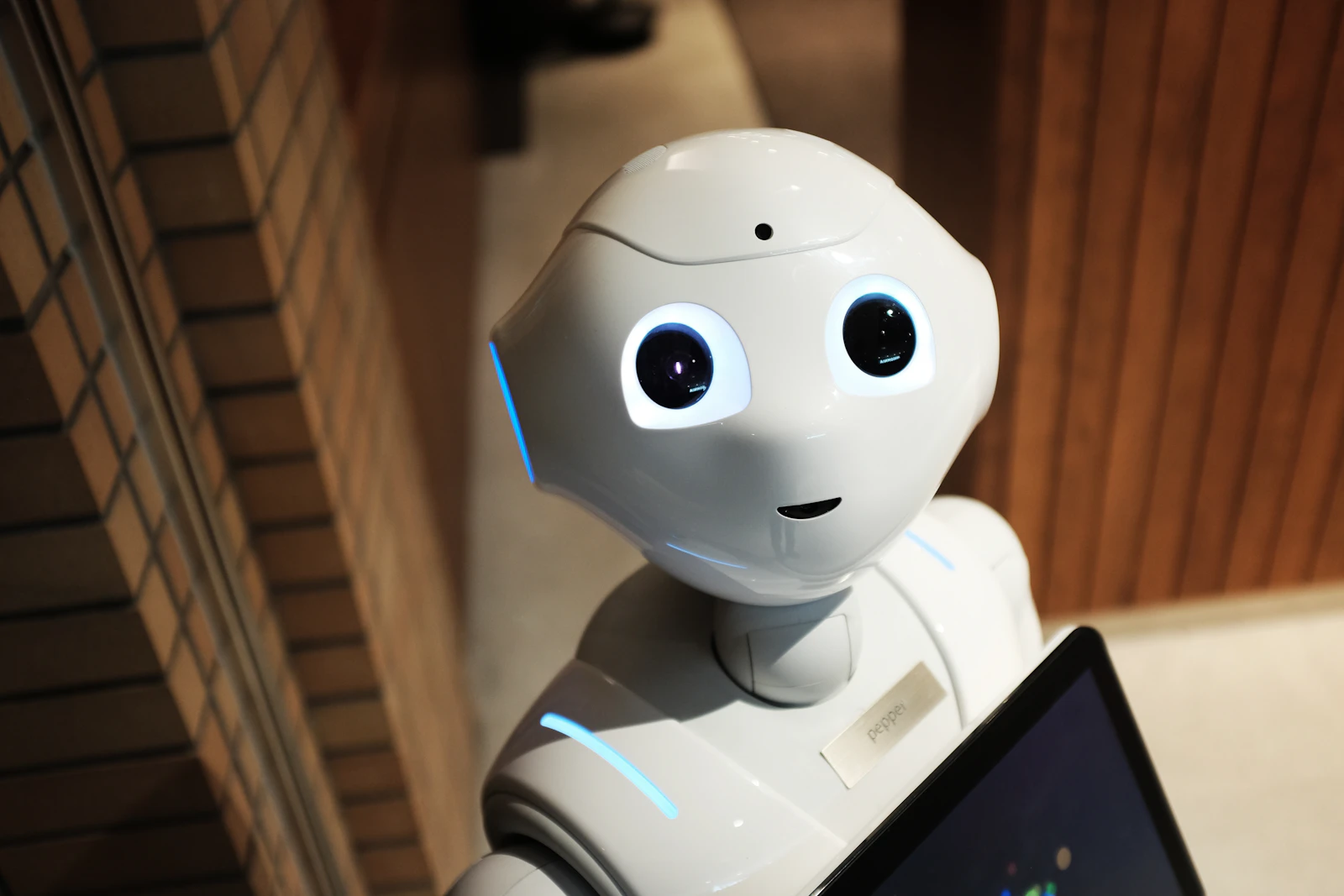
A humanoid robot in a bright room. Artificial skin could help future robots handle everyday objects with greater care and precision. Photo: Unsplash. Illustrative image, not a photograph of the 2026 electronic-skin experiments.
1. The Missing Sense in Modern Robotics
Robotics has made extraordinary progress in movement, vision, and automated decision-making.
Industrial robots can assemble vehicles with remarkable consistency. Warehouse systems can move packages through enormous facilities. Research robots can walk, climb stairs, manipulate tools, and navigate unfamiliar environments.
Yet even an advanced robotic hand may struggle with an everyday task that a young child can perform.
Consider picking up a paper cup filled with water.
The robot must identify the cup, estimate its position, decide where its fingers should touch, and apply enough pressure to lift it. But the cup is flexible. Its shape can change under pressure, and the amount of water inside affects its weight.
If the cup begins slipping, the robot must recognize the problem and respond immediately.
A camera can identify where the cup is located. It can also estimate its shape and track visible movements. But a camera cannot directly measure all the forces between the robot's fingers and the cup.
It may not detect tiny changes in grip stability until the object has already moved.
This limitation illustrates a fundamental challenge in robotics: vision describes what an object looks like, while touch helps reveal how that object behaves during contact.
Human hands combine both senses continuously.
When we pick up an unfamiliar object, our fingertips help estimate its weight, surface friction, shape, and mechanical response. We adjust our grip as new information arrives.
Traditional robotic gripping systems often rely on motor measurements, force sensors at selected locations, and carefully programmed movements.
These approaches work extremely well in controlled situations. However, they become less reliable when objects vary in shape, softness, fragility, or surface conditions.
Electronic skin attempts to close this gap by distributing sensing capabilities across a robotic surface.
Rather than measuring force at only one or two points, a robot could obtain detailed information from many contact locations.
This is particularly valuable for machines intended to operate outside carefully organized industrial environments.
Homes, hospitals, farms, and public spaces contain objects that are irregular, unpredictable, or delicate. Working safely in those settings requires more than accurate mechanical movement.
It requires the ability to recognize what happens when a machine touches the world.
2. What Scientists Have Discovered in 2026
The phrase electronic skin, often shortened to e-skin, refers to flexible sensing systems designed to detect physical interactions.
Unlike ordinary plastic coverings, these materials incorporate electrically responsive components that produce measurable signals when touched, stretched, compressed, or otherwise affected by their surroundings.
The field has existed for years. What makes the latest research interesting is the growing ability to combine multiple kinds of sensing with flexible materials and intelligent signal processing.
One major study, published in Nature Communications on May 26, 2026, described a skin-inspired sensing material developed from a specialized biogel.
The researchers incorporated gelatin, sodium lactate, and montmorillonite nanosheets into a material designed to reproduce selected mechanical and structural features of human skin.
The resulting sensor demonstrated a reported pressure sensitivity of 466.3 per kilopascal, a response time of approximately 47 milliseconds, and a pressure-detection range extending from 20 pascals to 2,000 kilopascals under the study's experimental conditions.
The researchers also developed a thin, flexible, hand-shaped sensor array that could conform to a dexterous robotic hand. Experiments demonstrated pressure mapping and controlled handling of objects, including fruits with different physical characteristics.
Another advance, reported by the University of Cambridge in March 2026, used graphene and liquid-metal composites to create miniature sensors capable of detecting three-dimensional forces.
These sensors were designed to measure not only how strongly an object presses against a surface but also the direction of the force.
They could help detect sliding, friction, and surface roughness, all of which are essential for manipulating objects securely.
The work was reported in Nature Materials and represented progress toward highly localized tactile sensing without requiring bulky optical components.
Meanwhile, researchers have explored unconventional designs inspired by the natural world.
A March 2026 study in npj Flexible Electronics described an artificial skin that draws inspiration from fish scales and origami structures.
By using mechanical folding patterns to transmit deformation across a sensing surface, the researchers demonstrated how relatively sparse sensor arrangements could estimate contact locations with improved spatial detail.
These projects approach the same problem from different directions.
One emphasizes soft materials that resemble biological tissue. Another focuses on highly sensitive force detection. A third uses clever mechanical structures to distribute physical signals.
Together, they illustrate a broader transition in robotics: artificial touch is becoming a system-level technology rather than simply an isolated pressure sensor.
3. How Human Skin Inspired the Technology
To understand electronic skin, it helps to appreciate how extraordinary biological skin really is.
Human skin is not merely a protective covering.
It is a complex sensory organ containing specialized structures that respond to different forms of physical stimulation.
Some receptors are particularly sensitive to steady pressure. Others respond rapidly to changes in contact or movement. Still others contribute information about skin stretching and vibration.
These signals travel through nerves and are processed by the nervous system.
The result is a surprisingly detailed understanding of physical contact.
Imagine closing your eyes and reaching into a bag containing a key, a coin, a rubber ball, and a piece of fabric.
Even without seeing the objects, you can often distinguish them by their shape, texture, stiffness, and the way they move against your fingers.
Your brain combines multiple signals to construct an interpretation of each object.
Engineers would like robots to perform something similar.
However, reproducing the entire biological system is exceptionally difficult.
Human skin can deform in complicated ways. Its receptors are distributed at different depths, and its sensory capabilities are connected to sophisticated neural processing.
Electronic skin must translate selected aspects of these abilities into materials, circuits, and software.
One strategy involves designing sensors that change their electrical properties when mechanical force is applied.
Another involves using soft materials whose internal structure behaves somewhat like layers of biological skin.
The May 2026 biogel research is particularly relevant here.
Human skin contains intricate structures between its outer and deeper layers. These structures influence how pressure and deformation are distributed.
The researchers designed microscopic surface patterns to improve the interaction between their sensing material and applied forces.
The goal was not to create living skin.
Instead, it was to reproduce useful design principles from biology using engineered materials.
This distinction matters because biological inspiration does not require biological replication.
An airplane does not need feathers to fly, and an artificial tactile sensor does not need nerves to detect pressure.
What matters is identifying which natural mechanisms can be translated into reliable engineering solutions.
4. The Secret Lies in Tiny Electrical Changes
How can a soft piece of material recognize that something is touching it?
One answer involves changes in capacitance.
A capacitor is a component that stores electrical charge. Its behavior depends partly on the arrangement of conductive surfaces and the material between them.
When a flexible capacitive sensor is compressed, its geometry changes.
The distance between conductive layers may decrease, or the properties of the material separating them may change.
These changes alter the sensor's capacitance.
Electronic circuits measure that difference and convert it into a signal that can be processed by a computer.
Suppose a robotic fingertip contains several capacitive sensing elements.
When the finger presses against an object, particular regions experience greater compression than others.
The sensor array produces a pattern of electrical measurements corresponding to the distribution of pressure.
Software then interprets this pattern.
A broad contact region may suggest that the finger is pressing against a relatively flat surface. A concentrated contact region might indicate contact with a narrow edge.
As the object moves, the pattern changes.
Repeated measurements can reveal how the contact evolves over time.
Another approach involves resistance.
Some materials become more or less electrically conductive when stretched or compressed.
A resistive tactile sensor detects those changes and uses them to estimate mechanical deformation.
More advanced systems employ iontronic sensing.
In these materials, mobile ions contribute to electrical behavior. When pressure changes the contact between an ion-containing material and an electrode, it can alter the electrical double layer near their interface.
That produces a capacitance change that may be highly sensitive to mechanical pressure.
The 2026 biogel system used this general principle to create a responsive sensing structure.
Its composition and microscopic geometry were designed to influence both the movement of ions and the way mechanical forces affected the sensor.
The important result is that physical contact becomes measurable electrical information.
The robot does not need to see the contact directly.
Instead, it receives signals from the surface touching the object.
In practical applications, however, detecting an electrical change is only the beginning. The system must also interpret it correctly.
A sensor may respond differently depending on temperature, repeated use, material aging, or the direction of the applied force.
Consequently, advanced electronic skin requires careful calibration, signal processing, and testing.
The raw measurements are not equivalent to understanding.
They are the ingredients from which a useful understanding can be constructed.
5. Why Soft Materials Matter
A rigid sensor can be precise, but it may be poorly suited to covering a moving robotic hand.
Human fingers bend, twist, and change shape as they grasp objects.
Robotic fingers often do the same.
A tactile covering must accommodate those movements without breaking or producing misleading measurements.
This is why researchers are investigating flexible polymers, elastomers, gels, and stretchable electronic connections.
A good electronic skin must balance several competing requirements.
It should be soft enough to conform to curved surfaces but strong enough to survive repeated contact.
It should detect gentle pressure without becoming unreliable under larger forces.
It should remain electrically stable as the underlying structure moves.
It should also tolerate the temperature variations, moisture, contamination, and wear encountered in ordinary environments.
Hydrogels are interesting because they contain substantial amounts of water within a polymer network.
Their softness and ability to carry mobile ions can make them useful for certain types of tactile sensing.
However, water-containing materials also present challenges.
They can dry out, change properties over time, and respond to environmental conditions.
Researchers therefore use chemical and structural engineering to improve stability.
In the 2026 gelatin-based study, sodium lactate contributed to the material's hydration-related properties, while nanoscale clay components helped modify its mechanical and electrical behavior.
These ingredients were part of a carefully designed composite rather than a simple layer of ordinary gelatin.
The research highlights a larger lesson: the future of robotic touch may depend as much on materials science as on artificial intelligence.
An advanced computer cannot recover information that a sensor fails to capture.
Similarly, highly sensitive electronics are of limited value if their protective covering tears during ordinary use.
The material, sensor architecture, and control software must operate together.
6. A Robot Must Learn the Difference Between Pressure and Movement
One of the most important problems in robotic manipulation is distinguishing between forces acting in different directions.
Imagine holding a book between your thumb and fingers.
The pressure squeezing the book is primarily directed inward, toward its surfaces. Engineers commonly call this a normal force.
If the book begins sliding downward, another force becomes important: the tangential or shear force acting along the contact surface.
Both kinds of force matter.
A robot might apply sufficient pressure to hold an object under one set of conditions but still lose its grip when friction changes.
For example, a dry glass and a wet glass may require different gripping strategies.
A system that measures only squeezing pressure cannot necessarily recognize every change in sliding behavior.
Three-dimensional tactile sensors seek to address this limitation.
The Cambridge research reported in March 2026 investigated miniature structures that respond to forces along multiple directions.
By combining advanced materials with carefully engineered geometry, the researchers developed a way to analyze complex contact forces within a small sensing area.
The work also explored the detection of surface roughness and sliding behavior.
These capabilities could be especially important for robotic hands that manipulate tools.
Consider a robot tightening a screw with a screwdriver.
It must hold the handle securely while transmitting a twisting force.
If the tool shifts slightly, the robot should detect the change and adjust its grip before the screwdriver slips.
The same principle applies to carrying dishes, opening containers, handling clothing, or operating unfamiliar equipment.
For humans, these adjustments often happen automatically.
For robots, they require a feedback system.
The machine measures contact forces, interprets them, determines whether the grip remains stable, and adjusts its motors.
This repeated cycle is called closed-loop control.
Instead of executing a fixed sequence of movements regardless of what happens, the robot continually updates its actions using information from its sensors.
Electronic skin can make that feedback richer and more geographically detailed.
It transforms a robotic surface from a passive covering into an active participant in movement and control.
7. The Artificial Skin That Borrows an Idea From Fish
Not every promising electronic skin attempts to resemble human tissue.
Some researchers are investigating mechanical structures inspired by fish scales and folded materials.
A study published in npj Flexible Electronics in March 2026 described a large-area capacitive skin using an origami-inspired architecture.
The researchers reported a sensing area of 60,000 square millimeters, equivalent to 600 square centimeters.
Their design used mechanical deformation to distribute information about applied forces across the structure.
Machine-learning methods then helped estimate the location and magnitude of contact.
In the study's single-point testing, the reported average location error was below 3.5 millimeters, while the average force-estimation error was below 0.04 newtons.
The team also investigated sensing shear forces, detecting approaching conductive objects, and identifying certain multi-touch situations.
Why is this interesting?
Ordinarily, achieving finer tactile resolution might seem to require adding more and more individual sensors.
But every additional sensor can introduce wiring, manufacturing complexity, and processing requirements.
The origami approach explores a different possibility.
Instead of measuring contact only at the exact point where pressure occurs, engineers can use the way a structure deforms to infer where the force was applied.
Imagine pressing one corner of a flexible sheet.
The surrounding material may bend or stretch in a pattern related to the location and strength of your touch.
If that pattern can be measured reliably, software may reconstruct the original contact.
It is somewhat like estimating where a stone entered a pond by examining the ripples it produced, although the mechanical and mathematical details are different.
The principle is useful because the physical structure itself helps distribute information.
Researchers describe this type of improvement as super-resolution sensing when the reconstructed contact detail exceeds the native spacing of sensing elements.
However, super-resolution does not magically create unlimited information.
Its accuracy depends on the mechanical design, the training data, the number and arrangement of contacts, and the conditions under which measurements are taken.
A model trained on simple touches may struggle with complicated contact patterns.
Nevertheless, the research suggests that clever mechanical engineering can reduce some of the complexity traditionally associated with large-area tactile sensing.
That could eventually make it easier to cover robotic arms, grippers, and other surfaces with responsive electronic materials.
8. When Artificial Intelligence Interprets Touch
A sensor may generate thousands of measurements, but those numbers do not automatically tell a robot what to do.
This is where artificial intelligence becomes valuable.
Suppose a robotic finger presses against three objects: a sponge, a wooden block, and a rubber eraser.
Each object responds differently.
The sponge compresses considerably under gentle pressure. The wood changes shape much less. The eraser may deform and recover in a characteristic way.
A tactile system can record how pressure changes as the finger moves.
Machine-learning algorithms can then search for patterns associated with these responses.
During training, a model may receive examples of sensor readings paired with known object properties or actions.
Over time, it can learn statistical relationships between the measurements and the physical conditions that produced them.
In a controlled laboratory, such a system might classify textures, identify slipping objects, or estimate material stiffness.
An important 2026 study in Nature Sensors described a multimodal sensor called SuperTac, combining different sensing techniques with a specialized model for interpreting tactile information.
The researchers reported high accuracy in several experimental tasks involving texture, materials, sliding, collisions, and color recognition.
They also introduced DOVE, an 8.5-billion-parameter tactile language model intended to interpret complex tactile stimuli.
This research is noteworthy because it extends tactile sensing beyond straightforward pressure measurement.
A robot could potentially use different types of physical information to build a more complete interpretation of an object.
However, laboratory classification accuracy should not be confused with general human-like understanding.
Performance on a defined dataset does not guarantee equally reliable behavior with unfamiliar materials, damaged sensors, unexpected environmental conditions, or complex real-world interactions.
An artificial intelligence model can also produce incorrect interpretations.
For robots performing safety-critical work, engineers must account for uncertainty rather than treating predictions as unquestionable facts.
The most useful systems will likely combine learned models with physical constraints, conventional control methods, and safety mechanisms.
A robot holding a glass should not continue increasing its grip simply because a model confidently misidentifies the object.
It needs measurable limits, feedback checks, and an appropriate response when information becomes unreliable.
Artificial intelligence can make touch information meaningful, but dependable robotics requires the entire system to work safely.
9. Could a Robot Recognize an Object Without Seeing It?
Imagine placing several objects inside an opaque box.
A robot reaches through an opening and touches one of them.
Its cameras cannot see what is inside.
Could the machine identify the object using touch alone?
In principle, yes.
A sufficiently capable tactile system might examine shape, texture, compliance, and other physical properties.
The robot could move its fingers across the object, apply controlled pressure, and observe how the material responds.
This process resembles the way people explore unfamiliar objects with their hands.
Researchers call this active tactile perception when a machine deliberately changes its contact with an object to gather useful information.
The distinction is important.
A stationary sensor receives information passively. An actively exploring robot can decide where to touch next.
Suppose the first contact reveals a smooth, curved surface.
That observation alone may not distinguish an orange from a rubber ball.
But further measurements might provide clues.
The robot could test how the surface deforms under gentle pressure or move its fingers to estimate the object's overall geometry.
A more advanced system could combine those observations with its previous experience.
Rather than identifying objects from a single measurement, it would build an interpretation over a sequence of interactions.
This approach could be particularly useful when cameras are obstructed.
A robot retrieving an object from a crowded drawer may be unable to see every surface.
A machine working in a dusty environment might experience reduced visual reliability.
A robotic hand operating behind a large object may temporarily lose camera coverage.
Touch can provide information that remains available even when the visual system has an incomplete view.
There are still limitations.
Objects can share similar tactile properties, and some are unsafe to investigate through repeated contact.
A robot should not squeeze an unknown container merely to determine its contents.
Effective active perception requires carefully chosen movements and an understanding of acceptable risks.
Still, combining touch with controlled exploration could significantly expand what autonomous robots can accomplish.
10. What Artificial Skin Could Change in Healthcare
Healthcare is one of the most compelling potential applications of advanced tactile sensing.
Medical environments contain countless situations requiring careful physical interaction.
A caregiver may need to reposition a patient, handle medical supplies, transport delicate equipment, or assist someone with reduced mobility.
These activities demand careful force control.
A robot that can detect distributed pressure across its hands and arms may be better equipped to perform certain assistance tasks.
Consider a robotic device helping someone move from a bed to a chair.
The machine must maintain stable support while avoiding excessive force on sensitive parts of the body.
Sensors embedded in the robot's contact surfaces could provide information about changing pressure and movement.
That information might help its control system adjust support during an assisted transfer.
However, research in robotic skin does not establish that such devices are ready to replace trained caregivers.
Human assistance involves judgment, communication, consent, and awareness of medical circumstances that tactile sensors alone cannot provide.
Any clinical use would require extensive safety testing and appropriate regulatory evaluation.
Electronic skin also has potential relevance to prosthetic limbs.
Modern prosthetic hands can perform increasingly sophisticated movements, but controlling grip forces without natural touch feedback can remain difficult.
Tactile sensors could help an artificial hand estimate whether an object is securely held.
If combined with suitable feedback interfaces, some information might also be communicated to the person using the prosthesis.
Researchers are investigating different ways to provide sensory feedback, including mechanical vibration, electrical stimulation, and connections to the nervous system.
These approaches vary greatly in maturity and clinical applicability.
The key distinction is that a sensor detecting pressure does not automatically restore the user's sensation of touch.
Useful feedback requires another mechanism to translate sensor measurements into information the person can perceive.
Even so, improved tactile measurement could support more precise control.
The ability to recognize slipping, regulate grip, and respond to fragile objects could make assistive devices more practical in daily activities.
11. Safer Robots Around People
As robots move into shared spaces, physical safety becomes increasingly important.
A robot working behind a protective factory barrier operates under different conditions from a robot carrying supplies through a busy hospital corridor.
In a crowded environment, unexpected contact is possible.
A person may accidentally touch a moving robotic arm. Clothing may catch against an exposed surface. An object may shift into the machine's path.
Traditional safety systems can include cameras, proximity sensors, force limits, emergency stops, and restricted operating zones.
Artificial skin could provide an additional layer of information.
Instead of detecting contact only through changes in motor resistance, a robot might recognize precisely where something touches its surface.
This could help the machine decide how to respond.
For example, a robot carrying a box might detect someone brushing against its forearm.
A suitable control system could slow or stop movement, depending on the circumstances.
A 2026 research project described in Nature Sensors investigated a robotic arm equipped with large-area soft tactile sensing, body-position information, and closed-loop control.
The system, called EmArm, demonstrated capabilities involving distributed touch detection and adapting movement during physical interactions.
Other researchers are examining artificial skins capable of producing rapid protective responses.
Some experimental systems aim to recognize unusually strong or potentially damaging contact and trigger a localized reaction.
The principle resembles a protective reflex, although it does not imply that the robot experiences pain.
It is also important to understand that electronic skin does not make every collision safe.
A sensor can fail. A controller may react too slowly. A powerful machine may have significant momentum even after a stop command is issued.
Protective systems must consider mechanical design, maximum forces, operating speed, redundant sensing, and foreseeable misuse.
Artificial touch should therefore complement established safety engineering rather than replace it.
Its greatest contribution may be providing more detailed information about physical interactions that conventional systems struggle to observe.
12. The Unexpected Challenge of Covering an Entire Robot
Creating a sensitive fingertip sensor is difficult.
Covering an entire humanoid robot presents an even greater challenge.
A human-sized robotic body has extensive curved surfaces, moving joints, and many regions where contact might occur.
An engineer could theoretically attach numerous individual sensors across these surfaces.
But each element may need electrical connections, power, calibration, and a way to transmit measurements.
As the number of sensors increases, the system becomes more complex.
Wiring may restrict movement, and damaged connections can be difficult to repair.
Continuous data collection also creates processing demands.
Imagine a robot with thousands of sensing locations, each producing measurements repeatedly throughout every second.
The computer must determine which changes matter.
Most of the surface may experience no meaningful contact, while a small region suddenly requires an urgent response.
Processing everything with equal priority may waste computing resources.
One solution involves organizing tactile information into different levels.
Local electronics can detect simple events near the sensing surface, while higher-level processors interpret more complicated patterns.
This resembles, in a limited engineering sense, the distributed organization of biological sensory systems.
Research published in Nature Machine Intelligence in October 2026 described a large-scale iontronic skin using a neural-hierarchical processing architecture.
The work included demonstrations of fine tactile perception, manipulating delicate objects, detecting potentially harmful stimuli, and initiating protective responses.
These demonstrations are promising because they address not just sensitivity but the broader challenge of organizing tactile information across larger robotic surfaces.
Yet scaling up remains difficult.
A sensor that works beautifully on a laboratory hand may behave differently when stretched around an elbow or attached to a robot that operates continuously.
Manufacturers must consider repairability, contamination, long-term reliability, energy consumption, and cost.
The future of electronic skin will depend partly on solving these less glamorous engineering problems.
A robot does not need the most sensitive surface ever demonstrated in a laboratory if that surface fails after a week of ordinary use.
For widespread adoption, adequate sensitivity must be combined with durability and practical maintenance.
13. The Difference Between Feeling and Being Conscious
The idea of a robot that can feel naturally raises a philosophical question.
If a machine can detect pressure, identify textures, and react to damaging contact, does that mean it experiences sensations?
Not necessarily.
In engineering, the word sensing refers to measuring information about the environment.
A temperature sensor detects changes in temperature, but that alone does not demonstrate that it experiences warmth or cold.
Similarly, artificial skin can detect applied pressure without establishing a subjective sensation of touch.
A robot might be programmed to withdraw its hand when a sensor registers excessive force.
Its reaction could resemble the protective movement of a person touching something sharp.
But an observable reaction does not prove the existence of pain, awareness, or conscious experience.
These are different questions.
Researchers studying consciousness continue to debate what kinds of physical or computational processes might be associated with subjective experience.
There is no established scientific basis for claiming that today's electronic skin systems possess human-like consciousness.
This distinction matters because popular discussions sometimes describe artificial touch in language that suggests more than the experiments actually demonstrate.
A sensor capable of identifying fabric textures has achieved something technologically interesting.
It does not need to be portrayed as having feelings to make that achievement significant.
A careful explanation of robotics should separate measurable abilities from unanswered philosophical questions.
The engineering goal is to give machines useful information about contact and improve their physical interactions.
Whether artificial systems could ever have subjective experiences is a much broader question, not resolved by improvements in tactile sensor performance.
14. The Real-World Obstacles Scientists Still Need to Solve
Despite the excitement surrounding electronic skin, several major barriers remain between laboratory prototypes and widespread commercial use.
The first is durability.
A robotic surface may encounter repeated bending, abrasion, cleaning chemicals, dust, and accidental impacts.
Highly sensitive materials are not always the most resistant to those conditions.
Engineers need sensors that can survive many operating cycles without requiring frequent replacement.
The second challenge is calibration.
A sensor's electrical response may change as its material ages or as environmental conditions vary.
A system trained under controlled laboratory conditions might perform differently in a hot warehouse or humid greenhouse.
Reliable robotics requires ways to detect and correct these changes.
The third challenge is manufacturing.
Producing a small experimental sensor by hand is different from manufacturing thousands of identical units at a competitive price.
Materials must be available, fabrication processes must be repeatable, and quality-control systems must detect defective products.
Research published in npj Flexible Electronics in January 2026 explored a fabrication strategy combining flexible circuits with multiple sensing functions without requiring some of the complex cleanroom processes associated with conventional manufacturing.
The work demonstrated applications involving robotic grippers and interactive systems.
The fourth challenge involves interpretation.
A tactile system may collect detailed measurements but still struggle to identify what those measurements mean.
Pressure changes might result from object movement, robot movement, deformation of the sensor itself, or multiple simultaneous contacts.
Distinguishing among these possibilities can be difficult.
Finally, there is the challenge of integrating electronic skin into useful robotic behavior.
A laboratory demonstration showing accurate pressure detection is valuable, but successful manipulation requires more than accurate measurement.
The robot must understand the task, plan a movement, respond to unexpected events, and determine when to stop.
The complete system must also operate within acceptable limits of reliability, safety, and energy consumption.
Progress in artificial skin will therefore involve advances in materials, electronics, software, control theory, manufacturing, and human-centered design.
No single breakthrough solves all these problems.
15. A Future Where Robots Handle Ordinary Objects
One useful way to imagine the future of electronic skin is to consider a simple household chore: unloading a dishwasher.
A robot performing this task must handle plates, cups, utensils, and containers that vary in weight, shape, and fragility.
Some objects may be wet. Others may be slippery or awkwardly positioned.
A purely visual system can recognize many of these objects, but tactile information could improve the robot's ability to handle them.
As the machine reaches for a cup, it could use visual information to select an initial grip.
Once its fingers make contact, electronic skin could measure pressure distribution.
If the cup begins sliding, the robot could adjust its grip.
If an unexpectedly thin or flexible object deforms, the system could reduce force.
If contact occurs in an unintended location, the robot could reconsider its movement.
This illustrates the value of combining different forms of perception.
Vision is useful for recognizing objects and understanding the surrounding scene.
Touch is useful for understanding physical interactions.
Position sensors provide information about the robot's own movements.
Together, these signals can support more flexible control.
The same principle could eventually apply in agriculture.
A harvesting robot handling delicate produce may benefit from pressure-sensitive fingers that recognize when a fruit is securely held.
In manufacturing, tactile feedback could support assembly tasks involving flexible cables, small components, and parts that require controlled insertion forces.
In recycling facilities, robotic systems might use touch to help manipulate irregular objects that cannot be handled reliably through fixed gripping routines.
These applications are plausible directions for development, not guarantees that current prototypes can perform every task described.
The path from an experimental sensing material to a dependable commercial robot can be long.
But the motivation is clear.
Many of the remaining challenges in robotics involve physical interaction with objects that do not behave exactly as expected.
Electronic skin could provide some of the information needed to manage that uncertainty.
16. Why This Discovery Matters Beyond Robotics
Artificial skin research also tells us something about the relationship between biology and engineering.
For decades, computers have excelled at tasks involving calculation, storage, and digital information processing.
Meanwhile, seemingly simple physical tasks remain surprisingly difficult for machines.
Recognizing the correct amount of pressure to apply to a ripe peach requires a different kind of intelligence from calculating millions of mathematical operations.
The physical world is continuous, variable, and often unpredictable.
Objects bend, slip, stretch, break, vibrate, and change with temperature or moisture.
Successful interaction requires a system to observe these changes and adapt its behavior.
The development of artificial skin reflects a growing recognition that intelligent machines need more than powerful processors.
They need rich connections to the physical world.
This insight has implications for wearable technology, rehabilitation devices, interactive equipment, and future human-machine interfaces.
Soft sensors may eventually support new ways to measure movement, pressure distribution, or interactions with everyday objects.
There may also be applications in industrial equipment that must detect unusual contact or mechanical deformation.
However, each application needs independent validation.
A material suitable for a robotic hand is not automatically suitable for direct contact with human skin, medical diagnosis, or long-term wearable use.
Researchers must evaluate performance, safety, privacy implications, and durability within the context of each proposed application.
The broader importance is not that every future device will be covered in electronic skin.
It is that engineers are learning to make flexible surfaces into information-gathering components.
In earlier generations of electronics, sensing was often concentrated in distinct mechanical devices.
Increasingly, sensing functions can be distributed through materials that also bend, stretch, or protect underlying structures.
That changes how products can be designed.
A robotic hand may no longer need to rely exclusively on separate sensors attached to rigid components.
Its entire contact surface could become part of the sensing system.
This shift could influence future engineering in ways that extend well beyond humanoid robots.
17. What Comes Next?
The coming years will likely bring continued efforts to improve tactile resolution, manufacturing efficiency, sensor durability, and real-time interpretation.
Researchers may develop electronic skins that combine pressure measurement with temperature sensing, vibration detection, and other physical signals.
Some systems may become better at recognizing contact events locally, reducing the need to send every measurement to a central processor.
Others may integrate tactile feedback with more advanced robotic control systems.
An especially important area will be learning from interaction.
Instead of relying entirely on predefined gripping rules, future robots may develop better strategies by observing how objects respond to their actions.
For example, a robot might learn that a particular type of packaging requires less gripping pressure than another.
It could use contact measurements to refine its movements and reduce unsuccessful attempts.
However, learning through trial and error becomes complicated when the objects are valuable, fragile, or potentially dangerous.
Researchers will need methods for building tactile intelligence without exposing people or equipment to unnecessary risks.
Simulation may help, but accurately reproducing the physical behavior of different materials remains challenging.
The interaction between a soft robotic fingertip and a crumpled plastic wrapper is far more complicated than it first appears.
That is why real-world measurements remain important.
The most successful future systems may combine simulated training, carefully collected experimental data, physical models, and ongoing feedback from their sensors.
There is also an economic question.
Will highly sophisticated artificial skin become affordable enough for everyday robots?
The answer will depend on whether manufacturers can produce sensing materials reliably at scale and demonstrate that the added capability justifies its cost.
A specialized industrial robot may need only a few well-positioned tactile sensors.
A household robot expected to perform many different tasks could benefit from much broader coverage.
Different applications will require different solutions.
The future is unlikely to involve one universal artificial skin that works perfectly everywhere.
Instead, it may involve a family of technologies optimized for particular physical environments and tasks.
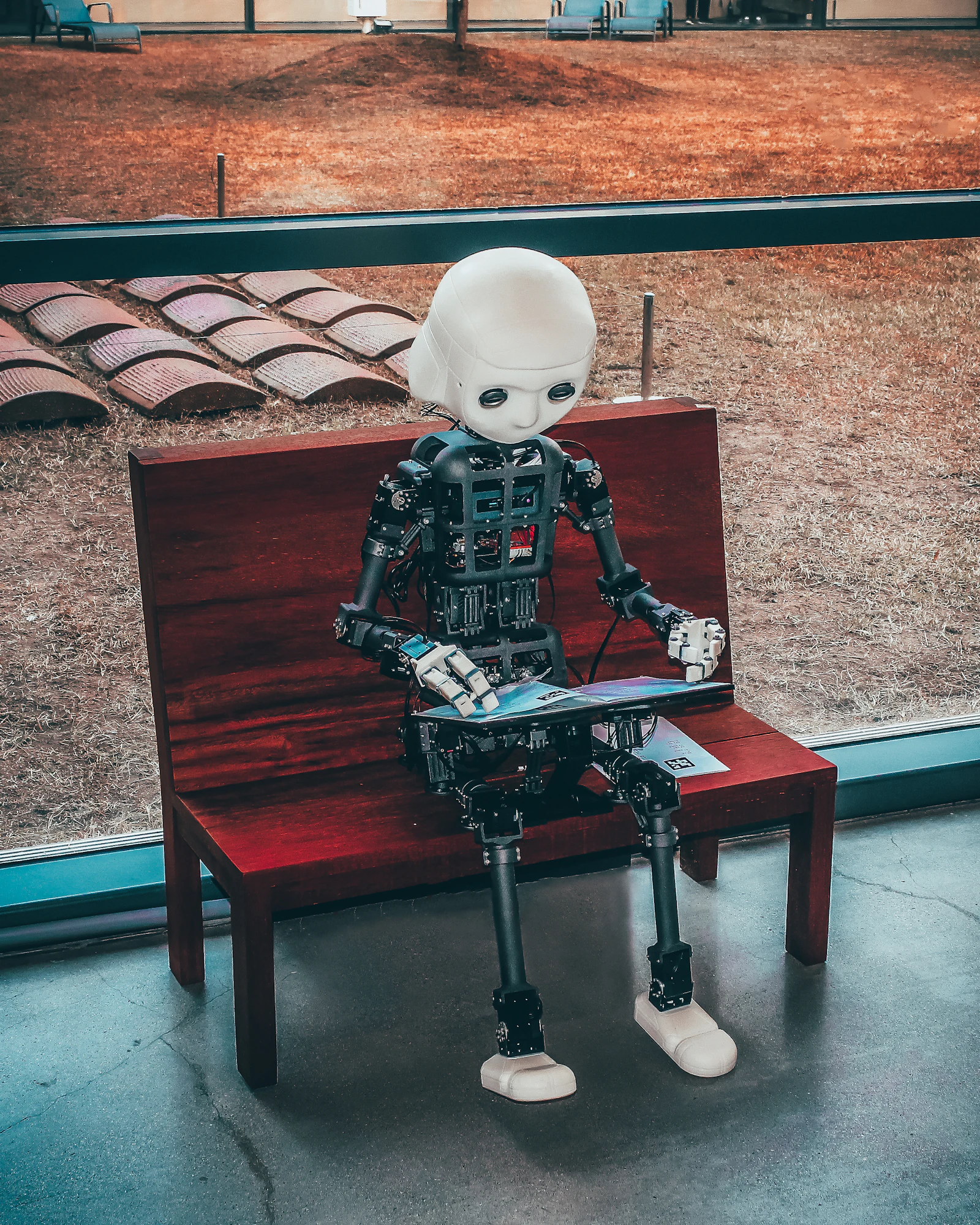
A humanoid robot handling an object with its hands. Combining vision, movement sensing, and touch could help robots work more safely alongside people. Photo: Unsplash. Illustrative image, not a photograph of the 2026 electronic-skin prototypes.
Conclusion: The Next Great Robotic Breakthrough May Be Something We Already Take for Granted
When people imagine the future of robotics, they often focus on spectacular abilities.
They picture humanoid machines running through obstacle courses, autonomous vehicles navigating complex roads, or artificial intelligence systems solving difficult problems.
But one of the most important advances may be quieter.
It may be a robotic hand recognizing that a glass is beginning to slip.
It may be a machine adjusting its grip before damaging a delicate object.
Or it may be a robotic arm detecting unexpected physical contact and responding more appropriately.
These abilities sound ordinary because humans use them constantly.
Yet they depend on sophisticated interactions among materials, sensors, movement, and information processing.
The electronic skin research reported in 2026 demonstrates how engineers are beginning to translate some of these principles into practical sensing technologies.
Soft biogels can detect pressure. Miniature structures can measure forces acting in multiple directions. Origami-inspired designs can help infer the location of contact. Artificial intelligence can interpret complex tactile patterns.
Each achievement solves part of a much larger problem.
None gives robots the complete sensory capabilities of human beings, and none establishes that machines experience touch consciously.
But together, they point toward a future in which robots respond to the physical world with greater sensitivity and adaptability.
The real significance of artificial skin is not that machines will suddenly become human.
It is that they may become better at working in a world designed around human hands.
And sometimes, the difference between a machine that merely moves and one that can genuinely help comes down to something as small as knowing how gently to hold a strawberry.
Sources: Nature Communications, skin-mimicking biogel-based iontronic sensor, May 2026; University of Cambridge, graphene-based artificial skin, March 2026; npj Flexible Electronics, origami-inspired robotic electronic skin, March 2026; Nature Sensors, biomimetic multimodal tactile sensing; Nature Machine Intelligence, large-scale iontronic skins, October 2026; npj Flexible Electronics, scalable fabrication of multimodal electronic skin, January 2026.
The conversation
Post a Comment