For centuries, the remains of a distant star carried a hidden record of its destruction. Now astronomers have found two extraordinary layers of calcium that reveal how one of the universe's most important explosions can happen not once, but twice.
THE JORNAL | Astronomy · Space Science · Astrophysics
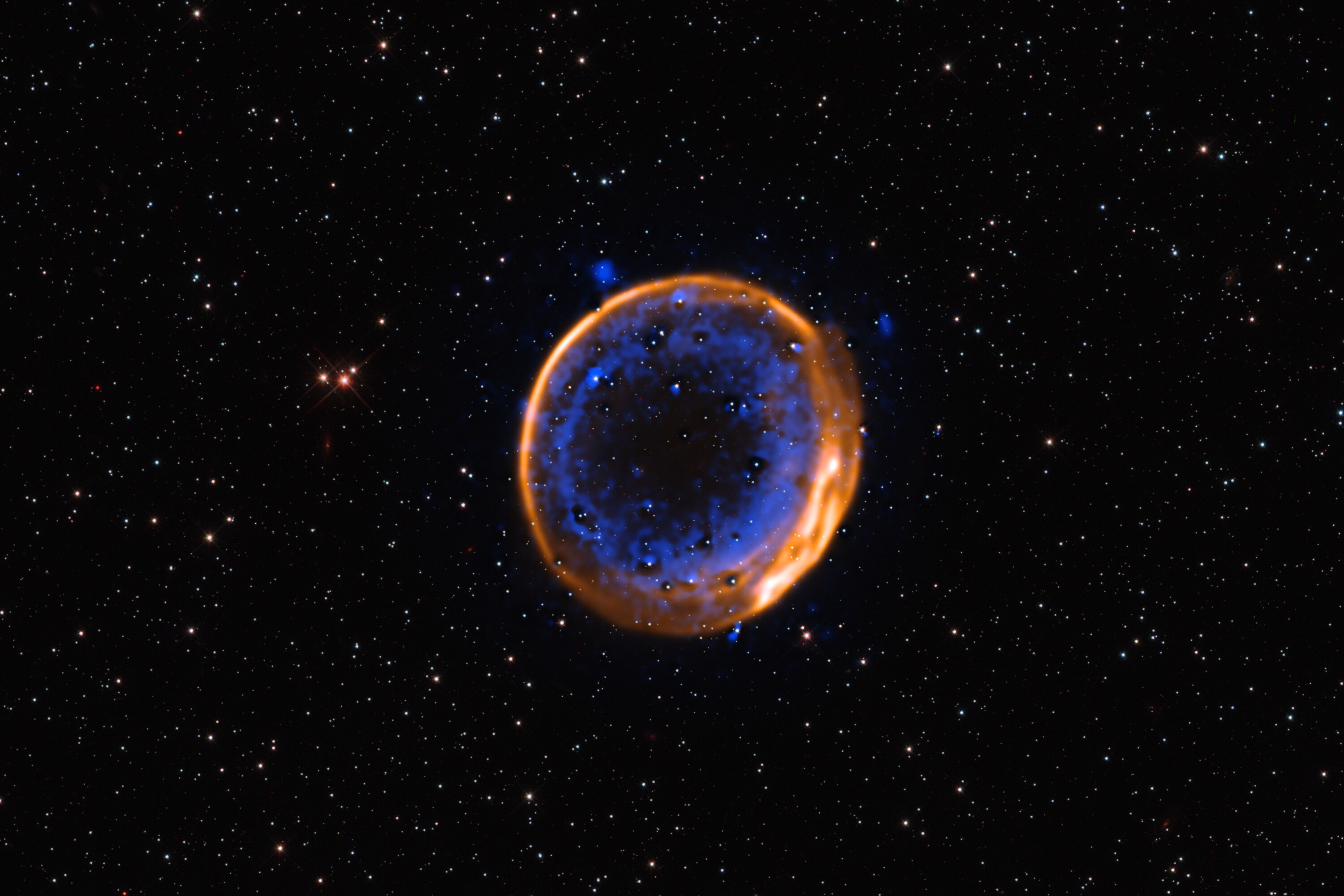
Caption: The supernova remnant SNR 0509-67.5, glowing in blue and orange against a field of stars. Its layered structure is the key clue in a cosmic detective story. Credit: ESO / NASA.
1. The Discovery That Should Not Exist
In a small, satellite galaxy orbiting the Milky Way — the Large Magellanic Cloud, about 160,000 light-years from Earth — astronomers have found something that should not exist. A star that exploded twice.
Not two stars. Not a star that merely flickered. One white dwarf star, long dead in the conventional sense, that first detonated in a partial explosion, survived, and then exploded again — this time completely. The evidence is written in the expanding shell of gas left behind, known as SNR 0509-67.5, where two distinct shells of calcium tell the story of two separate blasts.
The discovery, published in Nature Astronomy and led by researchers at the European Southern Observatory (ESO), challenges a long-held assumption about one of astronomy's most important phenomena: Type Ia supernovae. These explosions are so bright and so consistent that astronomers use them as "standard candles" to measure the expansion of the universe. If some of them happen in two stages, our cosmic yardstick may need recalibration.
"This is a spectacular result," one astronomer not involved in the study remarked in commentary on the finding. "We have long suspected that white dwarfs could detonate in stages, but seeing the forensic evidence — two shells, two explosions, one star — is extraordinary."
2. A Star, a Companion and a Catastrophic Tango
To understand what happened, we need to start with the star itself. A white dwarf is the dense, Earth-sized core left behind when a star like our Sun exhausts its nuclear fuel. It no longer burns; it simply cools, a stellar ember slowly fading over billions of years.
But white dwarfs are rarely alone. Many exist in binary systems, paired with another star. And when the companion is close enough, gravity begins a slow, inexorable theft: material — mostly helium, and sometimes hydrogen — spirals from the companion onto the surface of the white dwarf, piling up like snow on a roof.
Eventually, the weight becomes too much. In the classic picture of a Type Ia supernova, the white dwarf approaches a critical mass limit — about 1.4 times the mass of the Sun, known as the Chandrasekhar limit — and its carbon-oxygen core ignites in a runaway thermonuclear reaction. The entire star is obliterated in seconds, briefly outshining an entire galaxy.
3. The Crime Scene: SNR 0509-67.5
The remnant at the centre of this story, SNR 0509-67.5, is the expanding debris field of a supernova that exploded roughly 300 years ago — at least, that is when its light would have reached telescopes if anyone had been watching. In cosmic terms, it is practically yesterday.
What makes this remnant special is its remarkable symmetry. Most supernova remnants are messy, distorted by uneven surroundings. SNR 0509-67.5 is almost perfectly round, like a soap bubble blown in space. That symmetry suggested the explosion happened in a relatively clean environment, preserving the original structure of the blast.
Using the Very Large Telescope (VLT) in Chile, astronomers led by Priyam Das of the University of New South Wales Canberra mapped the remnant in unprecedented detail. They used an instrument called MUSE — the Multi Unit Spectroscopic Explorer — which does not just take a photograph, but splits the light from every point in the image into its component colours, revealing the chemical fingerprints of the gas.
And there, in the spectrum, was the smoking gun: calcium, arranged in two distinct shells.
Calcium is a key product of thermonuclear explosions. When a white dwarf detonates, nuclear reactions forge heavier elements from lighter ones, and calcium is one of the tell-tale signatures. Finding it in two layers — an inner shell and an outer shell, separated in velocity and space — was like finding two sets of footprints at a crime scene, made at different times.
4. The First Explosion: A Helium Flash That Failed to Kill the Star
The team's explanation reads like a cosmic thriller. First, the white dwarf stole helium from its companion. The helium accumulated on its surface, growing denser and hotter under the star's immense gravity, until it ignited.
This was the first explosion: a helium detonation that raced around the surface of the white dwarf like a fuse burning around a firework. It was powerful — powerful enough to blast a shell of calcium-rich material into space — but it was not powerful enough to destroy the star itself.
For a brief moment, the white dwarf survived its own explosion. Its surface was scorched and disrupted, but its carbon-oxygen core remained intact.
Then came the shockwave. As the helium detonation swept around the star, it sent a converging shockwave inward, compressing and heating the core. Like a hammer striking an anvil from all sides at once, the shock triggered a second, far more violent detonation in the heart of the star.
This second explosion was the real Type Ia supernova: the complete thermonuclear destruction of the white dwarf, forging iron, nickel, silicon, sulphur and calcium, and hurling them outward at tens of thousands of kilometres per second.
The result? Two shells of calcium: one from the initial helium blast, and one from the final, fatal detonation. The first shell, moving slightly differently, now sits as an outer layer in the remnant, a fossil of the explosion that almost — but did not quite — kill the star.
5. The Second Explosion: The Star Finally Dies
So why does this matter? Because Type Ia supernovae are not just spectacular fireworks. They are the tools astronomers used to discover that the expansion of the universe is accelerating — a discovery that earned the 2011 Nobel Prize in Physics and led to the concept of dark energy.
The reasoning is elegant: if all Type Ia supernovae explode in roughly the same way, they should all reach roughly the same peak brightness. By measuring how bright they appear from Earth, astronomers can calculate how far away they are. Compare that distance with how fast the host galaxy is receding, and you can map the history of cosmic expansion.
But if some Type Ia supernovae are actually double detonations — a helium shell explosion followed by a core explosion — they might be systematically slightly brighter, dimmer, or different in colour from the textbook version. That could introduce small errors into distance measurements.
"This does not mean our understanding of dark energy is wrong," astronomers stress. "It means we need to understand the diversity of these explosions better, so we can correct for it. Precision cosmology depends on precision astrophysics."
6. How Astronomers Caught a Star in the Act — Twice
The key to the discovery was not just a sharper telescope, but a smarter one. MUSE is an integral-field spectrograph: it takes a spectrum at every pixel of its image, producing a three-dimensional data cube of position, wavelength and brightness.
That allowed the team to separate the calcium shells not just by where they are on the sky, but by how fast they are moving toward or away from us — revealed by the Doppler shift of their spectral lines.
"It is like listening to an orchestra and being able to pick out each instrument separately," Das explained. "With MUSE, we could see the two calcium layers as distinct voices, moving at different speeds, telling us they were created in two different events."
The team also used computer simulations to test their idea. They modelled a white dwarf with a helium shell, detonated the shell, and watched the shockwave converge on the core. In the simulations, the second detonation followed naturally — and the resulting remnant looked strikingly like SNR 0509-67.5, with two calcium shells in just the right places.
7. The Chemistry of Creation: Why This Matters to You
There is a poetic coda to this story. The calcium in those two shells is the same element that builds your bones and teeth, that helps your muscles contract and your nerves fire. The iron in your blood, forged in supernovae like this one, was once part of a dying star.
Every Type Ia supernova scatters newly forged elements into interstellar space, where they eventually become part of new stars, new planets, and — in our case — new life. A double detonation may forge elements in slightly different proportions, subtly changing the chemical recipe available to future generations of stars.
"We are, quite literally, made of star stuff," as Carl Sagan famously said. Discoveries like this refine our understanding of exactly which stars, exploding in exactly which ways, contributed to the periodic table we carry in our bodies.
8. A Mystery That Refuses to Sit Still
Of course, science rarely delivers a clean, final answer — and this story is no exception. The double-detonation model is now strongly supported for SNR 0509-67.5, but questions remain.
How common is this pathway? Does it account for 10 percent of Type Ia supernovae, or 50 percent, or almost all of them? The answer matters enormously for cosmology. If double detonations are rare curiosities, their effect on distance measurements is small. If they are the norm, textbooks will need rewriting.
What happened to the companion star? In some models, the companion survives the explosion and is flung away at high speed, becoming a "runaway" star. Astronomers are now searching the vicinity of SNR 0509-67.5 for such a survivor, which would provide independent confirmation of the binary origin.
And what about the exact mass of the original white dwarf? Double detonations can occur below the Chandrasekhar limit, which would mean Type Ia supernovae come from a wider range of progenitors than previously thought — further complicating their use as standard candles, but also enriching our understanding of stellar evolution.
9. What the Double Detonation Tells Us About the Future
The implications extend beyond cosmology. Understanding how white dwarfs explode helps astronomers interpret the flood of transient events now being discovered by wide-field surveys such as the Vera C. Rubin Observatory, which will scan the entire southern sky every few nights and discover thousands of supernovae per year.
With so many explosions to classify, astronomers need reliable templates. Knowing that some Type Ia supernovae carry the fingerprint of a double detonation — two calcium shells, a particular light curve, a distinctive spectrum — helps them sort the cosmic zoo more accurately.
It also informs the search for gravitational waves and other multi-messenger signals. While Type Ia supernovae are not expected to be strong gravitational-wave sources like merging neutron stars, understanding their progenitors helps complete the picture of how binary stars evolve and die.
10. The Human Story Behind the Science
Behind the spectra and simulations are people — and a very human story of persistence. The MUSE observations required clear skies over the Atacama Desert, precise pointing, and hours of exposure time. The data analysis required painstakingly separating overlapping spectral lines, testing models, and ruling out alternative explanations.
"We checked and rechecked," the team reported. "The two shells kept appearing, no matter how we analysed the data. At some point, you have to accept what the universe is telling you, even if it surprises you."
That is the essence of science: not the confirmation of what we already believe, but the willingness to be surprised — and to follow the evidence, even when it leads to a star that exploded twice.
11. A Universe Full of Second Chances
There is something deeply appealing about this story. We are used to thinking of explosions as final, irreversible events. A star explodes, and it is gone. But SNR 0509-67.5 shows that even in death, a star can have a second act — a first blast that fails, a pause, and then a second, decisive blast.
It is a reminder that the universe is more creative than our models. Time and again, astronomers have found that nature produces variations we did not predict: stars that pulse, planets that rain glass, black holes that merge and ring like bells. The double detonation joins that list of delightful complications.
12. The Bigger Picture: Why Supernovae Are Cosmic Laboratories
Supernovae are more than distant fireworks. They are laboratories where matter is subjected to temperatures and pressures impossible on Earth. In a few seconds, a white dwarf forges elements, accelerates particles to near light speed, and releases more energy than the Sun will emit in its entire lifetime.
By studying remnants like SNR 0509-67.5, astronomers can test theories of nuclear physics, fluid dynamics and plasma physics under extreme conditions. Each remnant is a fossil experiment, preserving the outcome of an explosion that happened centuries ago, waiting to be read.
"Every supernova remnant is a message in a bottle," as one researcher put it. "Our job is to learn to read the handwriting."
13. Looking Ahead: The Next Cosmic Crime Scene
The discovery of the double detonation in SNR 0509-67.5 is unlikely to be the last. Astronomers are now re-examining other Type Ia remnants, looking for the same double-shell signature. Early results suggest SNR 0509-67.5 may not be unique — it may simply be the clearest example, thanks to its symmetry and clean environment.
Future telescopes, including the Extremely Large Telescope (ELT) now under construction in Chile, will provide even sharper views of supernova remnants, resolving structures that are currently blurred together. Combined with next-generation spectrographs, they may reveal triple shells, asymmetric detonations, or entirely new explosion mechanisms.
The more realistic conclusion is also more interesting: the universe may produce broadly similar thermonuclear explosions through more than one physical route.
Conclusion: Two Blasts, One New Understanding
A star 160,000 light-years away exploded twice. The first explosion was a warning shot — a helium detonation that scarred the star but left it alive. The second was the killing blow — a core detonation that scattered its elements across space, where they would one day help build planets and people.
We know this because astronomers looked closely, patiently, at a glowing bubble of gas in a neighbouring galaxy, and found two layers of calcium where there should have been one. It is forensic astronomy at its finest: reading the ashes to reconstruct the fire.
And it is a humbling reminder. Even our most trusted cosmic tools — the standard candles that revealed dark energy — still hold surprises. The universe, it turns out, is not content with a single explosion when it can have two.
Next time you look up at the night sky, remember: somewhere out there, a star that refused to die quietly has rewritten the textbooks — twice.
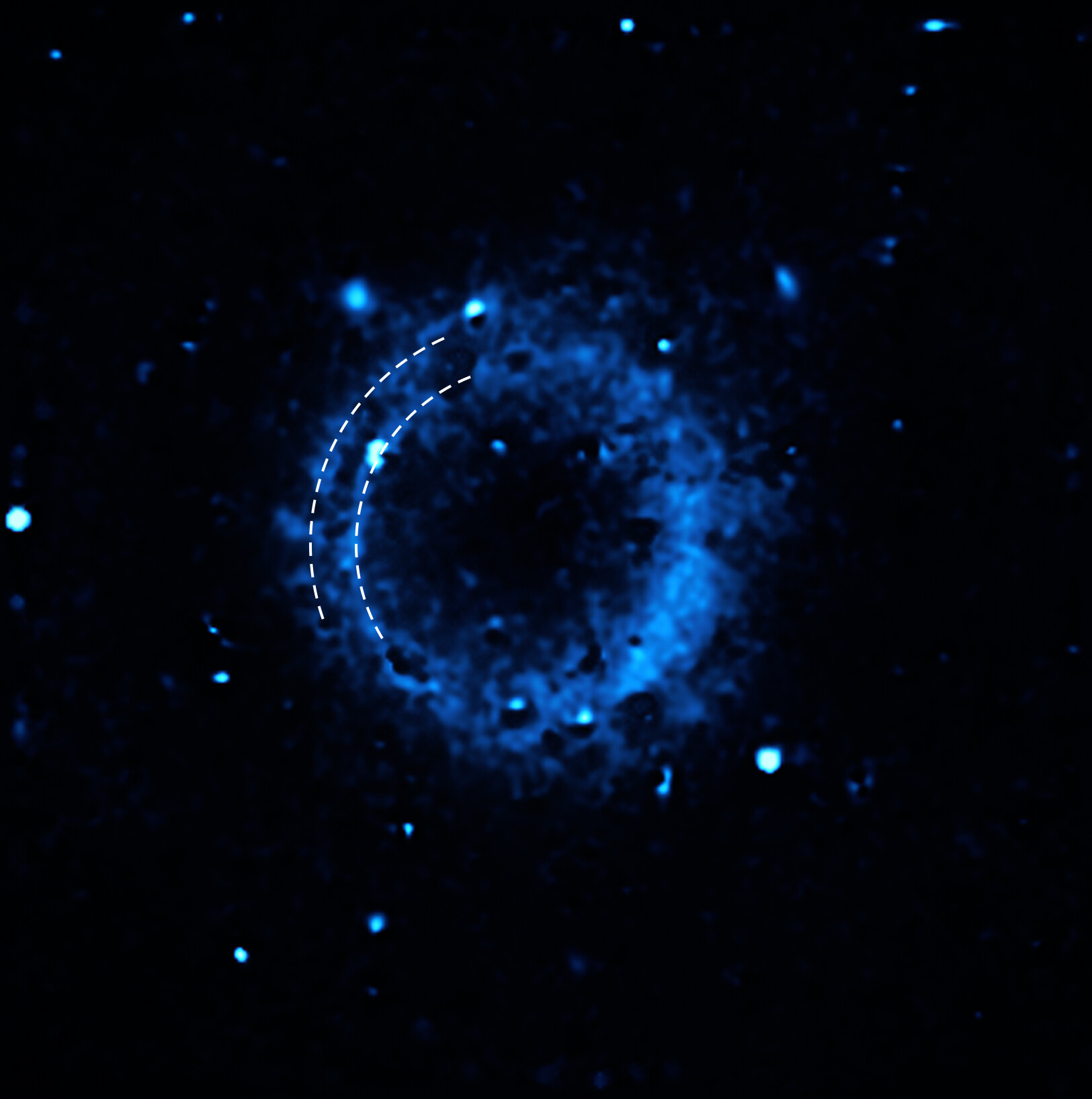
Caption: A detailed view of the layered structure of supernova remnant SNR 0509-67.5, where the two calcium shells reveal the double detonation. Credit: ESO / NASA.
Sources
European Southern Observatory (ESO) — research on SNR 0509-67.5 and the double-detonation model, published in Nature Astronomy. NASA — supernova remnant imaging and background on Type Ia supernovae. University of New South Wales Canberra — research team led by Priyam Das, using the Very Large Telescope and MUSE instrument.
Note: This article explains the published double-detonation findings in accessible language. Distances and timescales are as reported by the research team and ESO.
A Final Note: Reading the Ashes, Layer by Layer
The most compelling part of the SNR 0509-67.5 story is not simply that a star exploded twice, but that astronomers could tell the two explosions apart centuries later. Calcium is not an incidental detail here; it is a clock, a thermometer and a fingerprint all at once. When helium burns under extreme pressure, it produces a distinctive mix of elements, and when carbon and oxygen ignite in a white dwarf core, the mix changes again. By measuring the speed, temperature and distribution of each calcium shell, researchers can work backwards from the debris to the sequence of events that created it, much as a forensic scientist reconstructs a fire from layers of ash.
That reconstruction matters for a second reason: it tests our models in public. A theory that predicts a single, clean explosion must explain why two shells exist. A theory that predicts a double detonation must explain why the shells sit where they do, why they move at the speeds observed, and why the remnant remains so round. The fact that simulations of a helium-shell detonation followed by a core detonation reproduce the observed structure so closely is what elevates this from an intriguing possibility to a strong scientific case.
For readers, the practical lesson is equally clear. Cosmic distance measurements are not based on a single assumption that can be overturned overnight; they rest on thousands of supernovae, cross-checked against other methods, from Cepheid variable stars to the cosmic microwave background. Refining the supernova yardstick — learning which explosions are single detonations, which are double detonations, and how to tell them apart from their light curves and spectra — makes the measurement more precise, not less trustworthy. In other words, discovering that some standard candles have a more complicated history does not dim the light they cast on the universe; it sharpens our understanding of exactly how that light was made.
That is why astronomers will keep returning to remnants like SNR 0509-67.5, and why the next generation of telescopes matters so much. Each new remnant examined with the same care may reveal another variation, another shell, another surprise — and each surprise brings us closer to a complete picture of how stars live, die, and, in rare and remarkable cases, die twice.
The conversation
Post a Comment