THE JORNAL | ASTRONOMY & SPACE SCIENCE | NOVEMBER 2026
For years, astronomers struggled to explain mysterious red points scattered across images of the early universe. Now, discoveries made in 2026 suggest that many of these tiny objects conceal growing black holes wrapped in enormous envelopes of gas. Their existence may change how we understand the birth of galaxies, the origins of cosmic giants, and the universe's first billion years.
1. A Mystery Written in Red
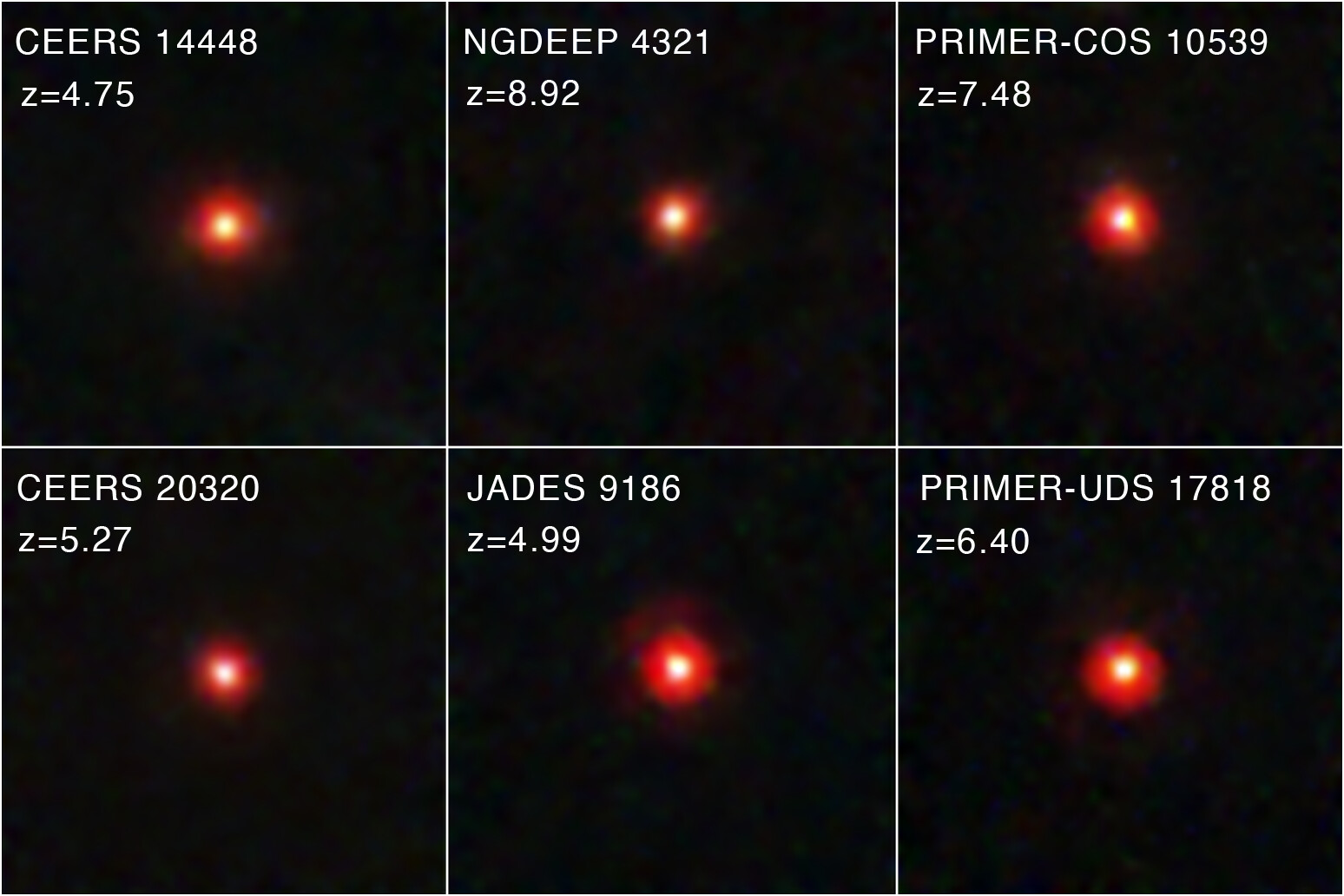
When the James Webb Space Telescope began its science operations, it did something astronomers had long hoped for and quietly feared: it showed them a universe that did not quite match their models. Among its earliest images were objects so small, so red, and so distant that they seemed almost impossible. They were nicknamed little red dots, and the name stuck because it was honest. In Webb's infrared images, these sources really did look like little red dots — compact, unresolved, and strangely bright for objects seen as they were billions of years ago.
At first, many researchers assumed they were simply a new kind of early galaxy: small, dusty, and furiously forming stars. That explanation was comfortable. Galaxies in the early universe were expected to be small, and dust can redden light. But as more little red dots were found, and as their spectra were measured in detail, the comfortable explanation began to fray. Their light did not look quite like starlight. Their colours were too extreme, their sizes too small, and their numbers too large for some of the simplest galaxy models.
Then came a second surprise. Some little red dots showed broad emission lines — the kind of smeared, high-velocity spectral signature produced by gas whirling around a black hole. Others showed signs of dense gas, powerful radiation, and rapid variability. Slowly, a new picture emerged: at least many little red dots are not ordinary galaxies at all. They may be black holes in the act of growing, hidden inside cocoons of gas so thick that they change the light escaping from them.
2. What Are Little Red Dots?
Little red dots are compact sources found in deep James Webb Space Telescope surveys, typically at redshifts of about four to nine. That means we see them as they were when the universe was roughly one to one and a half billion years old, and in some cases even younger. They are unresolved or barely resolved in Webb images, meaning their light comes from a region much smaller than a typical galaxy. In physical terms, many are only a few hundred light-years across, or even smaller.
Their defining feature is colour. They are bright in the red and infrared, but faint or absent in bluer light. Astronomers describe this as a V-shaped spectrum: the light rises toward the blue in the ultraviolet, dips, and then rises steeply toward the red. That shape is unusual. Star-forming galaxies and ordinary quasars do not usually produce it so cleanly. Something is reddening part of the light, absorbing other parts, and letting a surprising amount of energy escape in the infrared.
Their brightness is another clue. Some little red dots shine with a luminosity comparable to a quasar, yet they occupy a volume far smaller than a galaxy. To produce that much light from such a small region, an extraordinarily efficient engine is needed. A supermassive black hole feeding on gas is one of the few engines known that can do it. A dense burst of star formation is another possibility, but it struggles to explain the broad lines, the rapid changes, and the extreme compactness all at once.
3. How Webb Sees Them
Webb sees little red dots because it was built to see the infrared universe. Light from the earliest galaxies is stretched by the expansion of space, shifting ultraviolet and visible light into the infrared by the time it reaches us. Webb's Near Infrared Camera, NIRCam, and its spectrographs can capture that stretched light with extraordinary sensitivity. A source that would be invisible to Hubble can therefore glow clearly in a Webb image.
Surveys such as CEERS, JADES, PRIMER and NGDEEP have scanned small patches of sky to great depth, stacking long exposures to reveal faint, distant objects. Within those fields, little red dots stood out immediately: red, compact, and numerous. Catalogues soon contained hundreds of candidates, far more than early models of black-hole growth had predicted for that era. Their abundance itself became a clue. Whatever they are, they were common in the young universe.
Spectroscopy is what turns a dot into a diagnosis. By spreading its light into a spectrum, astronomers can measure its redshift, and therefore its distance and age, and can look for emission lines from hydrogen and other elements. Broad hydrogen lines, in particular, suggest gas moving at thousands of kilometres per second — speeds expected near a black hole, but difficult to explain with ordinary stars alone. Narrow lines, absorption features and the overall shape of the continuum add further evidence about dust, gas density and temperature.
4. The Black Hole Cocoon Idea
One of the most influential ideas to emerge in 2025 and 2026 is the black hole star, or BH-star, model. In this picture, a black hole is surrounded by an extremely dense envelope of gas, sometimes described as a cocoon. Gas falling toward the black hole releases energy, but instead of escaping freely, much of that energy is trapped, reprocessed and re-emitted by the envelope. The result is a source that looks red, compact and surprisingly bright in the infrared, with spectral features shaped by dense, fast-moving gas.
Think of it as a lamp inside a thick, glowing blanket. The lamp itself — the accretion disc around the black hole — is hot and blue. The blanket — the surrounding gas — absorbs much of that light, heats up, and glows red. Some blue light leaks through gaps or is scattered toward us, producing the blue side of the V-shaped spectrum. The red side comes from the heated envelope and from dust. This simple picture can explain many of the puzzling features at once, including the extreme redness, the compact size, and the unusual line shapes.
Other models invoke a more ordinary active galactic nucleus, a feeding black hole at the centre of a young galaxy, but one whose light is heavily reddened by dust and whose host galaxy is too faint to see clearly. In that case, the little red dot is the bright nucleus, and the galaxy around it is hidden in its glare. The difference between these models matters: a black hole star is a new kind of object, while a reddened active nucleus is a familiar object seen in an extreme setting. The truth may include both, with different little red dots belonging to different categories.
5. Why They Grow So Fast
The central puzzle of the early universe is speed. How did black holes weighing millions or even billions of times the mass of the Sun exist less than a billion years after the Big Bang? If a black hole starts from the collapse of a single massive star, about a hundred solar masses, and grows by steadily swallowing gas at the maximum rate allowed by radiation pressure, it should take longer than the available time to reach a billion solar masses. Something must help it grow faster, start bigger, or both.
Little red dots may be the missing stage in that growth story. If many of them are black holes wrapped in dense gas, then that gas is not just a disguise — it is fuel. A cocoon can feed a black hole efficiently, shielding the infalling gas from the radiation that would otherwise blow it away. In some models, the black hole can even exceed the usual Eddington limit for a time, growing in a super-Eddington burst while the envelope traps and redistributes the energy.
Another possibility is that some little red dots began as heavy seeds: black holes formed directly from the collapse of a massive gas cloud, starting life at ten thousand to a hundred thousand solar masses, rather than from a single star. A heavy seed needs far less time to become a supermassive black hole. The dense, gas-rich environments implied by little red dots are exactly the kind of places where heavy seeds might form. If so, these tiny red points may be showing us the birthplaces of the giants that later anchor galaxies like our own Milky Way.
6. A Galaxy, a Black Hole, or Both?
One reason little red dots are so difficult to classify is that a black hole and a galaxy can look alike when both are tiny and distant. A galaxy forming stars at a furious rate can produce bright emission lines. A black hole can be hidden by dust. Add the blurring of distance, and the two can be hard to tell apart from a single image. Astronomers therefore use several tests at once: line width, line ratios, variability, X-ray emission, and the shape of the spectrum across a wide range of wavelengths.
Variability is especially powerful. Stars do not usually change their total brightness dramatically over months, but a feeding black hole can flicker as its accretion flow changes. Several little red dots have shown variability, strengthening the black-hole case. X-rays are another test: a hot accretion disc should glow in X-rays, yet many little red dots are surprisingly faint in X-rays. That faintness was at first a problem for the black-hole model, but the cocoon model offers an explanation — the dense envelope can absorb X-rays before they escape.
The most honest answer, for now, is that little red dots are probably a mixed population. Some are almost certainly black holes. Some may be extremely compact, dusty star-forming galaxies. Some may be both at once: a black hole growing inside a young galaxy that is also forming stars. The task for the next few years is not to force every dot into one box, but to measure the fraction in each box, and to understand how those fractions change with time, mass and environment.
7. The 2026 Breakthroughs
What changed in 2026 was not a single discovery, but a convergence of evidence. Larger samples, deeper spectra, and better models arrived together. Studies of the object known as QSO1 in the Abell 2744 cluster, and of other little red dots in deep fields, suggested that the dense-gas explanation fits the data better than a simple dusty galaxy or a simple quasar. The spectra showed features consistent with gas densities far higher than those in typical star-forming regions, and with radiation being trapped and reprocessed.
At the same time, theorists refined the black hole star model, showing in detail how a dense envelope changes the emergent spectrum. Their calculations reproduced the V shape, the broad lines with unusual profiles, and the lack of strong X-rays. When a model can explain several independent puzzles at once, astronomers pay attention — not because the model is proven, but because it becomes the hypothesis to test most urgently.
Other 2026 work focused on numbers. If little red dots are black holes, then black holes were far more common in the early universe than many models had assumed. That has consequences for how we count the total mass locked up in black holes, for how early galaxies were regulated by black-hole feedback, and for the gravitational-wave background produced when black holes merge. A population that was once a curiosity may therefore be a major player in cosmic history.

8. How a Cocoon Changes the Light
To understand a cocoon, it helps to think about light not as a straight line, but as a journey. Photons created near a black hole must travel through gas before they reach us. If that gas is thin, they escape almost unchanged. If it is thick, they are absorbed, scattered and re-emitted many times. Each interaction changes their energy and direction. By the time they emerge, they carry information about the gas as much as about the original source.
In a dense envelope, hydrogen is a key player. Hydrogen atoms can absorb and re-emit light at specific wavelengths, creating strong lines and deep absorption troughs. Electrons scatter light, broadening lines. Dust absorbs blue light more efficiently than red light, reddening the spectrum. Together, these processes can turn a hot, blue accretion disc into a red, compact source with a V-shaped spectrum — exactly what Webb sees.
This also explains why little red dots can be so bright in the infrared while being faint in X-rays and sometimes in the ultraviolet. The envelope acts as a filter and a converter, shifting energy from short wavelengths to longer ones. It does not destroy the energy; it redistributes it. That is why measuring a little red dot at only one wavelength is misleading. Only by combining infrared, optical, ultraviolet and X-ray data can astronomers reconstruct what is really happening inside.
9. What About the Host Galaxies?
If little red dots are black holes, where are their galaxies? In many cases, the host galaxy is surprisingly faint or hard to detect. That is strange, because in the nearby universe, supermassive black holes live in massive galaxies, and the mass of the black hole is usually about a thousandth of the mass of the galaxy's central bulge. In the early universe, some little red dots appear to break that rule, with black holes that are far too massive for their hosts — if the hosts can be found at all.
There are several explanations. The host may be hidden by the glare of the nucleus, like a firefly next to a searchlight. It may be genuinely small, because the black hole grew first and the galaxy caught up later. Or the black hole may be over-massive because it grew from a heavy seed. Each explanation changes the story of galaxy formation. If black holes grew first, then they may have shaped their galaxies from the beginning, rather than growing passively inside them.
New techniques are helping to separate nucleus from host. By modelling the point-like nucleus and subtracting it, astronomers can search for faint, extended starlight around it. By using gravitational lensing, where a massive cluster magnifies a distant source, they can resolve details that would otherwise be invisible. Early results are mixed — some hosts are found, others remain elusive — which is itself informative. It suggests diversity, not a single simple rule.
10. Feedback: How Black Holes Shape Galaxies
Black holes are not just passengers in galaxies; they are engines of feedback. As they feed, they release energy in the form of radiation, winds and jets. That energy can heat gas, push it out of a galaxy, or prevent it from cooling and forming stars. In the nearby universe, this feedback is thought to explain why the most massive galaxies stop forming stars, and why black-hole mass correlates with galaxy mass.
If little red dots are numerous and powerful in the early universe, their feedback may have been important much earlier than previously thought. A cocooned black hole, in particular, may trap energy and release it in a different way from an ordinary quasar, heating its surroundings more locally or driving winds that clear gas from the centre. Over time, that could regulate star formation, shape the growth of the galaxy, and even affect the gas between galaxies.
Understanding feedback from little red dots is therefore not just about black holes. It is about why galaxies look the way they do, why some are red and dead while others keep forming stars, and how the universe moved from a smooth, hot beginning to the structured, diverse cosmos we see today. The tiny red dots may be small in the sky, but their influence could have been large.
11. Could They Be Something Else Entirely?
Good science keeps alternatives alive until the evidence rules them out. Could little red dots be something other than black holes or galaxies? Could they be extremely dense star clusters, with thousands of massive stars packed into a tiny volume? Could they be the result of exotic physics, such as dark matter or primordial black holes? These ideas have been explored, and most struggle to match all the observations at once, but they are valuable because they force the black-hole model to be tested rigorously.
Dense star clusters, for example, can produce bright light and broad lines if many massive stars and their winds are combined, but they struggle to produce the extreme compactness and the high luminosities of the brightest little red dots without also producing other signatures that are not seen. Primordial black holes, formed in the first moments after the Big Bang, could in principle provide heavy seeds, but they remain hypothetical. The strength of the black-hole cocoon model is not that it is the only idea, but that it explains the most data with the fewest extra assumptions.
Future observations will be decisive. If little red dots are black holes, we should find more of them with broader lines, clearer variability, and eventually, gravitational-wave signals when their descendants merge. If they are star clusters, we should find stellar features that cannot be produced by an accretion disc. Either way, the answer will teach us something fundamental about the early universe.
12. The Tools That Will Settle It
The next leap will come from more light, at more wavelengths, over longer times. Webb will continue to collect spectra of fainter and more distant little red dots, and to monitor them for variability. The Extremely Large Telescope and other ground-based giants will add high-resolution spectra from the ground. X-ray observatories will test whether the cocoon really absorbs X-rays, and radio telescopes will search for jets and other signatures of feeding black holes.
Gravitational lensing will remain a powerful magnifier. Clusters like Abell 2744 bend and amplify the light of objects behind them, letting Webb see details that would otherwise be too small and too faint. Future deep surveys will also expand the sample from hundreds to thousands, allowing astronomers to measure how the population changes with redshift, luminosity and environment — the kind of statistical evidence that can distinguish between competing models.
On the theoretical side, simulations are becoming sophisticated enough to follow gas falling into a black hole, forming a cocoon, and producing a spectrum that can be compared directly with observations. When a simulation predicts a specific line shape, a specific colour, or a specific pattern of variability, and Webb then finds it, the model gains credibility. When it predicts something that is not found, the model must be revised. That cycle of prediction and test is how a mystery becomes a science.
13. Why It Matters for Everyone Else
It is easy to ask why a tiny red dot billions of light-years away should matter to anyone on Earth. The answer is that these dots are part of our own origin story. The black holes they may contain are the ancestors of the supermassive black holes at the centres of galaxies today, including the four-million-solar-mass black hole at the centre of the Milky Way. Understanding how they grew is understanding how our galaxy, and the conditions for stars and planets like ours, came to be.
There is also a broader lesson about how science works. Little red dots were not predicted in detail. They surprised astronomers, challenged models, and forced new ideas. That is a reminder that the universe is not obliged to match our textbooks. The most interesting discoveries are often the ones that do not fit, because they reveal where our understanding is incomplete. A red dot that should not exist is more valuable than a thousand objects that behave exactly as expected.
Finally, little red dots show the power of new tools. Webb was designed to see the first galaxies, and it is doing that — but it is also revealing a population that was barely imagined before launch. Every new telescope, from Webb to the next generation of observatories, is likely to do the same: answer old questions and raise new ones that no one had thought to ask.
14. How to Follow the Story
For readers who want to follow this story, the best sources are the deep Webb surveys themselves, and the papers that analyse them. Look for terms such as little red dots, black hole stars, and high-redshift active galactic nuclei. Images from Webb, released by NASA, ESA and CSA, are free to explore, and many little red dots can be seen in public image galleries. When a new result is announced, ask the same questions astronomers ask: How many objects were studied? How was the black hole identified? What alternatives were tested? How confident are the authors, and what would change their minds?
That sceptical, curious approach is the heart of astronomy. It is also the reason this story is so exciting right now. We are not at the end of the little red dot mystery; we are in the middle of it, at the moment when a new idea is being tested, challenged and refined in real time. The next Webb release, the next spectrum, or the next theoretical paper could tip the balance.
For now, the red dots remain red, compact and mysterious — but less mysterious than they were a year ago. We know more about what they could be, what they cannot be, and what observations will decide between the possibilities. That progress, from confusion to testable hypotheses, is itself a kind of discovery.
15. What Comes Next
The most important next step is simply more data, of higher quality. Webb's deep surveys are still growing, and each new field adds little red dots to the catalogue. With larger samples, astronomers can test whether the black-hole cocoon model works for all little red dots, or only for a subset. They can look for trends: do brighter dots have broader lines? Do dots at higher redshift look different from dots at lower redshift? Do dots in dense clusters differ from dots in empty fields? Those trends are the fingerprints of a physical process.
Time-domain astronomy will also help. If a little red dot flickers in a way that matches an accretion disc, that is strong evidence for a black hole. If it stays perfectly steady for years, that pushes back toward stars. Monitoring campaigns, in which the same field is observed repeatedly over months and years, are therefore a priority. They are slow science — they require patience — but they can be decisive.
Finally, the search will widen. If little red dots are an early stage of black-hole growth, there should be related objects at slightly later times: black holes emerging from their cocoons, becoming ordinary quasars, and settling into galaxies. Finding that evolutionary sequence, from cocooned dot to luminous quasar to quiet galactic centre, would complete the story. Astronomers are already searching for intermediate objects, and early candidates are being studied.
16. A New Chapter in Cosmic History
For decades, the story of the first billion years was told mainly in terms of galaxies and stars. Gas collapsed, stars ignited, galaxies assembled, and black holes grew inside them. Little red dots suggest a revision: black holes may have been active participants from much earlier, growing rapidly inside dense cocoons, shaping their surroundings, and perhaps even preceding the galaxies we associate with them.
That revision does not discard everything we knew. Galaxies still formed, stars still shone, and the universe still expanded and cooled as cosmology describes. It adds a new character to the early cast — a cocooned black hole, small in size but powerful in effect — and asks how that character changed the plot. In the best scientific stories, a new character does not just appear; it explains earlier puzzles and predicts new ones.
Whether the black hole star model survives in its current form, or is replaced by a more refined model, the little red dots have already changed astronomy. They have shown that the early universe was richer, stranger and more dynamic than many models assumed. They have given theorists a concrete problem to solve and observers a concrete target to study. And they have given the rest of us a new way to look at the night sky: not just as a collection of stars and galaxies, but as a history book in which even the smallest red speck can rewrite a chapter.
Conclusion: The Giants in the Dots
The universe's red-eyed giants are not giants in size. They are giants in implication. A dot a few hundred light-years across, seen from billions of light-years away, may contain a black hole growing at an extraordinary rate, wrapped in gas that hides it, feeds it and transforms its light. If that picture is right, then the first black holes did not grow slowly and quietly. They grew fast, in cocoons, in large numbers, and they helped shape the galaxies around them.
We do not yet know the full story, and that is precisely why it matters. The little red dots are a reminder that discovery is not finished, that new telescopes can still surprise us, and that the early universe still holds secrets. Watch this space — or rather, watch those tiny red points. They may be the youngest giants we have ever seen, and they are telling us how the universe built its largest structures from the smallest beginnings.
Sources
NASA, ESA, CSA, STScI — James Webb Space Telescope images and releases on little red dots, including the Little Red Dots NIRCam image (2025-101) and Abell 2744-QSO1 (ESA522368), via Wikimedia Commons. NASA Webb — Little Red Dots mission pages and news releases. ESA/Webb — Abell 2744-QSO1 and early-universe black hole research. Research papers and preprints on little red dots, black hole stars, and high-redshift active galactic nuclei, 2024-2026, via NASA ADS and arXiv. CEERS, JADES, PRIMER and NGDEEP survey descriptions from STScI and partner institutions.
Published by THE JORNAL — Astronomy & Space Science, November 2026.
The conversation
Post a Comment