Imagine a building that does something useful with the afternoon sunlight after the sun goes down. Its rooftop panels have stopped producing electricity, the offices are empty, and a few hallway lights remain on. Instead of sending every surplus watt into a separate battery cabinet, part of the building's own structure has been quietly holding electrical charge. The walls still hold up the roof. The floor still carries footsteps. But somewhere inside the mineral framework, electrons and ions have been doing another job.
This is not how an ordinary building works, and it is not yet how a commercial building can be ordered. It is an emerging idea made more credible by a series of laboratory experiments. The latest step comes from researchers who used 3D printing to make cement-based supercapacitors: devices that store electrical energy while retaining meaningful compressive strength. Their findings, published in ACS Nano in August 2026 and highlighted by the American Chemical Society in October, bring two normally separate worlds—construction engineering and energy storage—into the same object.
The attraction is immediate. We already surround ourselves with enormous volumes of concrete. Could some of that material do more than remain still for decades? The harder question is whether an electrically active wall can be strong, durable, affordable, safe, and useful enough to justify installing it. The answer lies not in a spectacular battery breakthrough, but in an unexpectedly important detail: the shape of the path that tiny charged particles must travel.
What Was Discovered: A Wall That Stores Electricity
The 2026 study, conducted by researchers affiliated with Harbin Institute of Technology and the Chinese Academy of Sciences, tackled a stubborn problem. Cement-based supercapacitors had already been made. Some could light small devices, and others had shown that a load-bearing element and an electrical component need not be entirely separate. Yet creating thicker, practical units introduced a familiar engineering penalty: the farther ions must move through the material, the more difficult it becomes to charge and discharge efficiently.
The researchers approached the problem as an exercise in architecture on a very small scale. They prepared a printable mixture containing cement, carbon nanotubes, and carbon black. The carbon ingredients provide pathways through which electrons can travel. Using a direct-ink-writing process, they deposited conductive material in a pattern of interlocking fingers onto a cementitious base, with a cement-based separator occupying the spaces between neighboring electrodes. Rather than stacking distant layers and asking ions to cross the whole thickness, the geometry brings opposing electrodes close together along the plane of the slab.
The resulting prototype was both an electrical storage device and a piece of cement-based material capable of resisting compression. The team reported a compressive strength of 23 megapascals and demonstrated three devices connected together powering an array of light-emitting diodes. They also tested performance under different temperatures and identified an important weakness in deep cold.
Those are laboratory results, not evidence that an apartment block can already power itself. They are still useful because they show which direction an idea is moving, and where its physical limits appear. The most important contribution is not a single measurement, but a demonstration that structural strength and electrical storage can be pursued in the same printed unit, rather than traded in separate components.
How It Works: Turning a Structure into a Capacitor
It is helpful to think of a battery as a large water reservoir and a supercapacitor as a smaller tank with an especially wide pipe. Both can deliver water, but their talents differ. The reservoir can sustain a flow for a long time. The wide pipe can release a large flow rapidly. The analogy is imperfect, because actual performance depends on voltage, resistance, capacity, and system design, but it prevents one common mistake: confusing the ability to deliver electricity quickly with the ability to supply a building all night.
The team reported an areal capacitance of 162.14 millifarads per square centimeter and an areal energy density of 22.52 microwatt-hours per square centimeter across a 1-volt operating window. Those figures describe the tested device under specified conditions, not the capacity of a finished building. Its measured compressive strength of 23 megapascals places its mechanical behavior in the range relevant to some ordinary concrete applications, although a single compression result is not the same thing as full structural certification.
With an optimized organic electrolyte, MIT reported that a cubic meter of its material could store more than 2 kilowatt-hours. The 2025 work described roughly a tenfold improvement in energy density over earlier designs, along with demonstrations including a stacked 12-volt module and a small arch that supported a load while powering a light. Those accomplishments are striking, but they should not be silently combined with the 2026 numbers. The two teams used different materials, configurations, testing methods, and units. Energy per cubic meter in one design is not directly interchangeable with energy per square centimeter in another.
First, Forget the Image of a Giant Household Battery
A smartphone battery stores energy mainly through chemical reactions in specialized electrode materials. A supercapacitor works differently. It stores charge at interfaces, often between a vast electrically conductive surface and an electrolyte containing mobile ions. As a rule, supercapacitors can accept and deliver energy quickly, tolerate repeated cycling well, and produce high bursts of power. Their weakness is that they normally hold less energy per unit of mass or volume than the batteries familiar from electric vehicles and home backup systems.
The word battery often appears in headlines about concrete energy storage because it is familiar. In the 2026 experiment, however, the scientific term matters. The device is a supercapacitor, and claims about what it can power must be judged by both its stored energy and its electrical output. A tiny cluster of LEDs is a meaningful proof of electrical function. It is not a substitute for a refrigerator, an elevator, or an air-conditioning system.
Why use cement at all, then? Because the point is not to beat a lithium-ion cell at being a lithium-ion cell. It is to explore whether material that must already exist as part of a structure can provide an additional service without requiring an entirely separate volume of hardware.
How It Works: An Invisible Meeting of Charges and Surfaces
Ordinary hardened cement is not a practical electrical electrode. Its mineral matrix provides strength, but it does not naturally create the connected electronic pathways required for efficient charge storage. The trick is to introduce conductive carbon into the mix while preserving enough of the characteristics that make cement useful in construction.
Carbon black consists of extremely fine carbon particles; carbon nanotubes are slender structures made of carbon atoms. When dispersed and connected appropriately, they can form a conductive network within the cementitious mixture. Electrons move through that network. Meanwhile, an electrolyte provides ions that can migrate through accessible pores and spaces in the material. Neither side alone makes a working supercapacitor. The device requires two electrically separated electrodes, an ion-conducting route between them, and external connections to charge and discharge the system.
Apply a voltage, and opposite charges accumulate on the facing electrode surfaces. Ions in the electrolyte rearrange near those surfaces, creating extremely thin regions of separated charge known as electrical double layers. Energy is stored in the electric field associated with that separation. When the device is connected to a suitable circuit, some of that stored energy can be released.
Surface area is central to the process. A smooth block has relatively little exposed area for its size; a porous, intricately connected network offers far more internal contact between the conductive carbon and the electrolyte. That is why researchers care about structures too small to see with an ordinary microscope. A material that looks plain gray from the outside may contain a labyrinth of surfaces doing the electrical work.
The Breakthrough Is in the Shape of the Fingers
Picture two hands laid flat on a table with their fingers interleaved, but not touching. Each hand represents an electrode. The spaces between the fingers hold a cementitious separator that allows ions to pass while preventing direct electrical contact. This arrangement brings a large area of one electrode into close proximity with a large area of the other. The distance that ions need to travel across the separator can remain short, even if the overall slab is larger than a simple sandwich arrangement would conveniently allow.
This is more than a visual trick. In traditional layered designs, increasing the thickness of an energy-storage unit often lengthens the pathway ions must travel, which can increase resistance and reduce efficiency. By using a co-planar layout, the 2026 researchers kept the ion pathway largely in the plane of the slab, rather than forcing it through the full thickness. That is a simple idea with an important consequence: it separates device size from the worst effects of thickness.
3D printing makes such patterns possible with a degree of precision that is difficult to achieve by hand. The researchers used a direct-ink-writing process, in which a nozzle deposits a paste-like material in programmed paths. Printing does not automatically make a device better. Its value here is that it lets the designer specify where each conductive line goes, how wide it is, and how closely it approaches its neighbor. The pattern becomes part of the material's electrical design, not a decorative afterthought.
The crucial distinction is that the researchers did not 3D-print a complete house that stores power. They printed comparatively small supercapacitor structures on a cementitious slab. Moving from a patterned prototype to beams, stairs, and walls introduces entirely new questions about reinforcement, connections, manufacturing speed, and inspection. Still, the experiment demonstrates that designers can tune electrical behavior with architectural geometry at the material level.
What the Numbers Show—and What They Do Not
The energy figure is especially useful for keeping expectations grounded. If the reported energy density could be extended unchanged across one full square meter of active device area, the result would be about 0.225 watt-hours before system losses. That is an illustration of scale, not a realistic forecast for a wall: actual modules include separators, packaging, connections, inactive regions, and practical limits. But it makes the point clearly. The new geometry is scientifically promising; it is not yet an all-night home battery.
The researchers linked three devices on the same slab and lit a small LED array. Electricity really did move from the cement-based system into an external circuit. The significance of that modest demonstration is not how bright the lights were. It is that the energy-storing component could be fabricated as part of a load-bearing cementitious form rather than attached afterward as an unrelated electronic module.
The next comparisons must be tougher: how much usable energy remains after thousands of cycles, how much voltage a safe module can deliver, what happens to performance when the material ages, and how much installation and maintenance would cost. A research prototype can answer whether an idea works. Infrastructure must answer whether it keeps working when almost nobody is watching.
Another Route Through Concrete: MIT's Carbon Network
The 2026 result fits into a broader research story rather than appearing from nowhere. At the Massachusetts Institute of Technology, a different team has pursued electron-conducting carbon concrete, sometimes called ec³. The approach mixes cement, water, and extremely fine carbon black to encourage a connected network of conductive material inside the hardened structure. Earlier work showed the basic concept, and a 2025 paper in the Proceedings of the National Academy of Sciences reported substantial improvements.
To understand the conductive network, the MIT researchers examined the material at extremely small scales, repeatedly removing thin slices and imaging the newly exposed surfaces. The resulting reconstruction helped reveal a branching, fractal-like web around pores in the cement matrix. The investigators also explored different electrolytes and simplified the manufacturing process by introducing electrolyte during mixing rather than relying entirely on soaking the cured electrodes afterward.
The MIT research also illustrates an important practical tension. Some of the best experimental electrochemical performance came from specialized organic electrolyte formulations, not simply water and harmless table salt. Materials that behave well in a controlled laboratory need additional scrutiny before they can be permanently enclosed inside homes, bridges, or occupied public spaces.
Together, the studies reveal several possible routes forward: creating better conductive networks, selecting better electrolytes, and changing the geometry through which charged particles move. The likely future is not one magical cement recipe, but a family of engineered materials adapted to different jobs.
Why It Matters: Buildings Need More Than Solar Panels
A rooftop solar panel generates electricity only when sufficient light is available. A building, by contrast, uses electricity according to the behavior of the people and machines inside it. Someone may return home after sunset. A hospital corridor may need illumination through the night. Sensors in a bridge may be expected to operate during a storm. The supply of renewable energy and the timing of demand do not naturally agree.
Storage helps bring them closer together. Today that can mean a conventional battery, a thermal system, a connection to wider grid storage, or some combination of technologies. Structural supercapacitors would add another possibility: storage distributed through elements that the building already needs. Such storage might be most useful for brief bursts, rapidly repeated charging, or small local electrical loads, rather than for replacing a large conventional backup battery.
Consider a stairwell light that needs short emergency operation, or a sensor network that samples structural movement and sends an occasional wireless message. These are not necessarily enormous loads, and in some settings the convenience of storage positioned close to the equipment could be valuable. An energy-storing panel might also help buffer very short changes in demand, provided its output and control electronics were designed for the task.
None of those use cases is established commercially by the current studies. They are examples of where the technology's strengths could matter if its durability and economics prove acceptable. The larger idea is to stop treating buildings as passive boxes filled with devices and start asking what additional functions the materials themselves can responsibly provide.
This also explains the difficulty. More porosity can help ions reach the internal surfaces, but too much porosity can weaken a structural material. More carbon can improve conductivity, but the mixture must still set, bond, resist cracking, and carry loads. The research problem is therefore not merely chemical or electrical. It is an argument between several useful properties, all competing inside the same block.
What Comes Next
For centuries, concrete has been valued because it can be shaped into foundations, bridges, buildings, and barriers, then left to perform its mechanical work. Energy-storing concrete asks a different question. What if the enormous physical presence of infrastructure could be turned into an additional resource, without losing the qualities that make it trustworthy?
The 2026 3D-printed supercapacitor study does not answer that question for a city, or even a house. It offers something narrower and more credible: a demonstration that carefully patterned cement-based electrodes can store charge and carry compression, and that shortening the paths traveled by ions can improve an awkward class of devices. Other research has shown that changing the carbon network and electrolyte can also move performance forward.
There is a long distance between those results and a building with no visible battery room. Durability, electrical safety, economics, environmental impacts, and construction codes remain real barriers. But the experiments enlarge the imagination of what a building material might be. In the future, a wall may still be judged first by whether it can stand. The intriguing new possibility is that, while doing so, it might also have a little energy to give.
Sources and Further Reading
ACS Nano, August 2026 — 3D-printed cement-based supercapacitors for architectural energy storage. MIT News, October 1, 2025 — Concrete battery developed at MIT now packs 10 times the power. University of Washington Clean Energy Institute — Educational explanation of supercapacitors. International Energy Agency, 2025 — Breakthrough Agenda Report: Cement and Concrete.
Strength Is Not a Side Benefit
Concrete is entrusted with unglamorous duties that leave very little room for improvisation. It must carry repeated loads, resist weather, survive predictable movement, and behave reliably around steel reinforcement. A building material that stores electricity but cracks prematurely is not an improvement. The strength test in the 2026 study is encouraging precisely because it recognizes that a structural supercapacitor must remain a structural material.
Yet compressive strength is only one part of that responsibility. Structural engineers also care about bending, tension, fatigue, shrinkage, creep, fire exposure, moisture penetration, and the effects of repeated temperature changes. Printed materials can have interfaces between deposited layers, making the direction and quality of bonding important. An electrical device embedded inside a slab introduces further questions: could a damaged electrode create a short circuit, and could efforts to repair the circuit compromise the structure?
A wall is not a convenient piece of equipment to remove and replace. If a removable home battery loses capacity, technicians can often isolate it, inspect it, and exchange modules. If an active electrode is buried inside a supporting member, access becomes harder. That challenge suggests a possible design compromise: use replaceable cement-based panels or noncritical architectural features before attempting energy-storing primary columns and foundations.

Photo 1: Solar panels generating renewable electricity. Future structural storage systems would complement renewable generation like this; the photographed installation is not a demonstration of energy-storing concrete. Source: Unsplash.
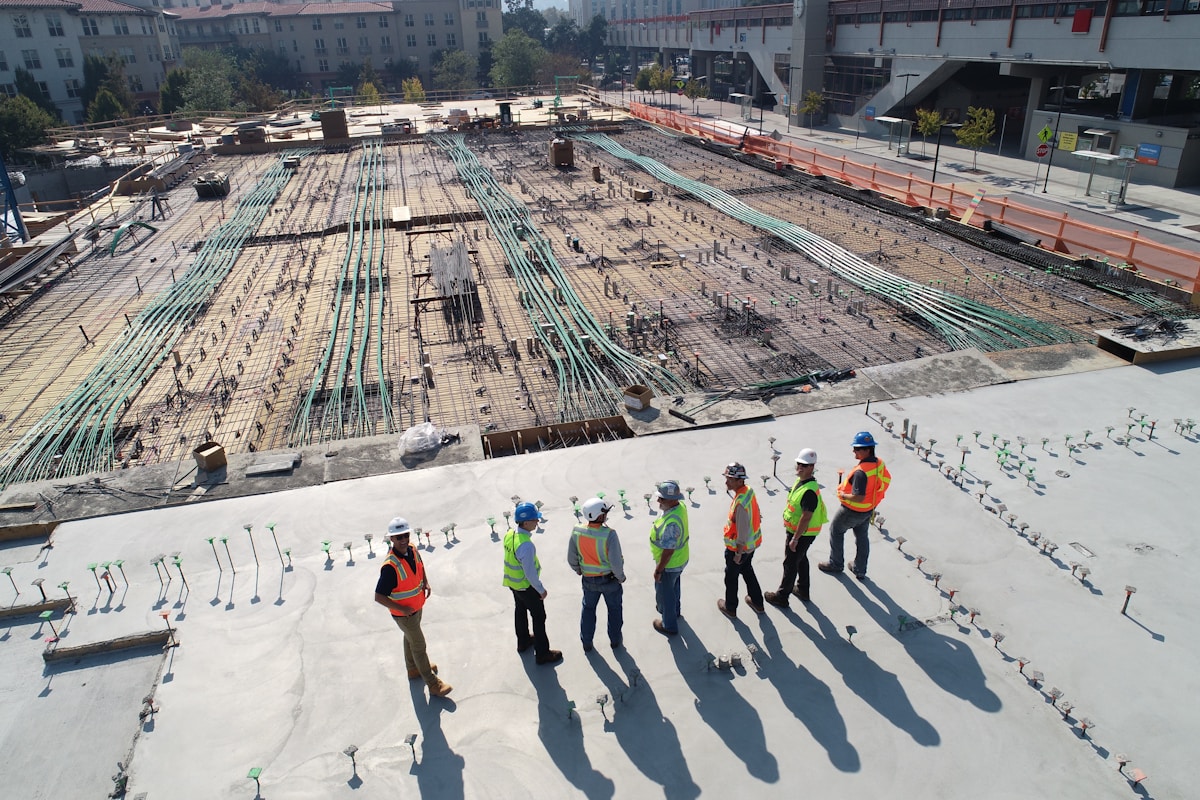
Photo 2: Construction workers on a concrete slab at a building site. Its concrete work illustrates the scale of material already used in buildings; the site is not claimed to contain supercapacitors. Source: Unsplash.
The conversation
Post a Comment