A telescope can gather more light than the human eye could ever collect and still miss a planet sitting beside a bright star. The problem is contrast: the planet's faint signal disappears inside the star's glare. One of astronomy's most ingenious responses is to deliberately remove light before making an image.
The instrument that does this is called a coronagraph. Its job sounds simple: suppress the star while preserving as much light as possible from nearby planets. Achieving that separation requires much more than placing a black circle over a photograph. Light behaves as a wave, telescope optics introduce imperfections, and signals that look like worlds can be leftovers from the instrument itself.
That makes coronagraphy a useful window into how modern discovery works. The striking result may be a tiny dot, but the scientific achievement lies in knowing why that dot deserves to be taken seriously. Here is what astronomers are actually trying to see, why the engineering is difficult, and how to read the next planet-imaging headline without confusing a promising test with a discovery.
The real obstacle is stellar glare
Distance is only part of the challenge. From our viewpoint, a planet and its star occupy a very small patch of sky. The star produces its own enormous supply of light, while a planet may be visible through reflected starlight or the heat it emits. A useful camera must distinguish the weaker source beside the stronger one.
NASA explains that an Earth-like planet around a Sun-like star can be roughly ten billion times fainter than its star. That number describes the scale of the contrast problem; it does not mean every exoplanet observation faces exactly the same ratio. Planet size, temperature, wavelength, orbital position, and the properties of the star all matter. NASA's overview of the big questions in exoplanet science puts the ambition in context.
Imagine trying to identify a dim indicator lamp next to a bright floodlight in a distant building. Enlarging the photograph does not automatically separate the two signals. If glare has already spread across the camera's view, magnification enlarges that contamination too. The analogy is imperfect, but it helps explain why a more powerful telescope also needs more carefully controlled optics.
Why a simple mask is not enough
A coronagraph suppresses the overwhelming contribution from a star using optical components placed along the light's path. The name comes from instruments developed to study the Sun's outer atmosphere, or corona. For exoplanets, the target is the dim environment around a distant star rather than the corona of our own Sun. NASA's coronagraph explainer describes this basic arrangement.
The complication is diffraction. Light passing through a finite opening or around an edge spreads into a pattern rather than landing as a perfectly isolated point. Blocking the bright center therefore does not necessarily remove the surrounding light. Astronomers must control the pattern produced by the entire optical system.
A useful everyday comparison is the difference between covering the center of a spill and cleaning the whole surface. Hiding the most obvious part leaves material elsewhere. In an optical instrument, however, the remaining pattern follows wave physics. Carefully shaped masks and other optical elements help redirect or reject unwanted starlight while allowing some nearby planetary light to reach a detector.
This is why a dark circle added after an ordinary photograph has been taken cannot reproduce what a coronagraph does. The instrument changes which light reaches the camera in the first place. NASA's discussion of optical vortex phase masks explains why controlling diffraction is central to future planet imaging.
Mirrors that correct the light
Even excellent telescope optics are not perfectly unchanging. Small imperfections and changes along the light path can leave bright residual features where astronomers want darkness. The challenge is especially demanding when the object being sought is much fainter than those residuals.
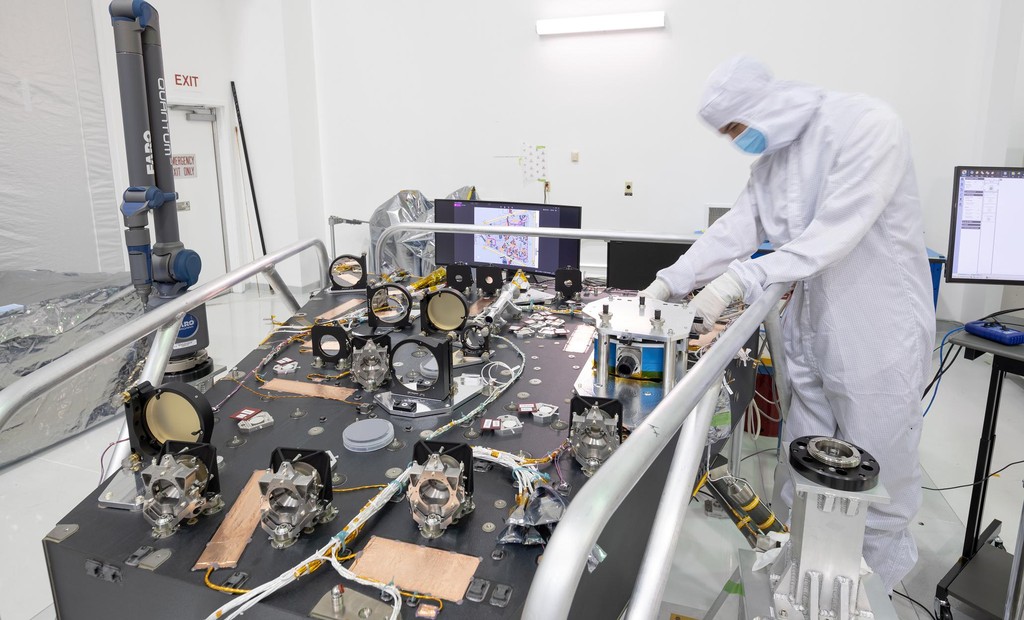
Roman's Coronagraph Instrument combines masks with two deformable mirrors. Their surfaces can be adjusted through many tiny actuators, changing the shape of the reflected light wave. NASA describes this active control as a way to compensate for extremely small optical errors. The mirrors and masks work together; neither is a magic device that removes every unwanted photon. The mission's instrument overview explains the design.
Think of tuning a musical instrument before listening for a quiet harmony. If the instrument itself is drifting, the listener may mistake its own changing sound for something in the performance. Optical correction has a different physical mechanism, but the same practical lesson applies: the measuring system must be understood well enough that its imperfections do not become the discovery.
How ground telescopes fight the atmosphere
Ground observatories face another moving obstacle: Earth's atmosphere. Turbulent air changes the path of incoming light, blurring and distorting the image. Adaptive optics measures these disturbances and adjusts an optical system to reduce their effects. ESO explains how this correction allows telescopes to recover finer details and observe fainter objects. Its adaptive-optics guide provides the underlying picture.
Adaptive optics and a coronagraph solve related but different problems. Correcting atmospheric blur does not automatically remove a nearby star's glare. Blocking that glare does not automatically correct the atmosphere. A successful observing system may need both, along with careful analysis afterward.
ESO's SPHERE instrument on the Very Large Telescope brings together tools for imaging giant planets and disks around stars. Its techniques include atmospheric correction, suppression of the central star, and measurements that exploit differences in light. In particular, scattered light can carry polarization information that helps reveal surrounding material. ESO's SPHERE description shows how several methods can contribute to one result.
Space removes atmospheric turbulence from the observing path, but it does not make the telescope's own optics perfect. The engineering changes rather than disappearing. That distinction helps explain why experience from ground instruments remains valuable even when the next instrument operates far above Earth.
What infrared images already reveal
Direct images of exoplanets already exist. The easier targets have generally been large, young planets on relatively wide orbits. A young giant can still emit substantial heat left over from its formation, making it accessible in infrared light. Wider apparent separation also helps distinguish it from its star. The NASA Exoplanet Archive's direct-imaging resources explain this selection effect.
This means the photographed planets are not a neutral sample of everything that exists. An instrument's abilities shape what it can find. If a fishing net catches only large fish, counting the catch does not tell you how many small fish live in the water. Likewise, a gallery rich in giant planets does not establish that smaller worlds are absent.
Webb also uses coronagraphs in its infrared instruments. NASA's explanation of how Webb's coronagraphs reveal exoplanets describes the optical masks and the additional work needed to separate a planetary signal from residual starlight. These observations are different from the imagined close-up photographs of continents and oceans that often accompany popular stories.

What Roman is testing
The immediate interest in coronagraphy has a concrete milestone. NASA's Jet Propulsion Laboratory reported that Roman's Coronagraph Instrument first observed cosmic light on September 22, 2026. The announcement, published September 30, described an early focused-image test and the start of increasingly complex preparations. It did not announce a newly photographed Earth twin. Read the original JPL update.
Roman's coronagraph is a technology demonstration. Its planet-imaging ambitions concern large worlds and dusty environments around nearby stars, testing techniques that can inform more demanding future observatories. A successful demonstration would be important because an instrument that works impressively in a laboratory still has to prove its behavior in the space environment.
NASA describes Roman as a bridge toward imaging cooler planets through visible light reflected from their stars. That differs from relying mainly on the strong infrared emission of very young, hot giants. Its planned measurements also include ways to investigate dusty disks and atmospheric properties. These are capabilities to demonstrate and use, not a guarantee that every hoped-for target will yield an easy image. NASA's Roman direct-imaging overview explains the intended progression.
How a dot becomes evidence
A faint point beside a star is a candidate explanation, not a complete scientific conclusion. Could it be residual starlight? An unrelated background object? A feature introduced by processing? The point becomes persuasive when observations and analysis test these alternatives rather than merely producing a dramatic picture.
NASA's overview of what we can really see of exoplanets includes the example of HR 8799, whose planets can be followed across repeated observations. Motion adds information that a single image lacks. A time sequence can help turn an isolated-looking point into a member of an orbiting system.
For a reader, the key habit is to ask what was actually measured. A detection, an orbit, a brightness measurement, and an atmospheric interpretation answer different questions. A strong result may combine several, but the headline should not quietly jump from the first to the last.
Consider a hypothetical announcement showing one possible planet in a processed frame. A sensible next question is whether another observation supports the same interpretation. That does not make the first result worthless. It identifies the work that changes an intriguing possibility into stronger evidence.
What light can say about an atmosphere
A planet need not be resolved into a detailed disk to provide useful information. Its light can be divided by wavelength, creating a spectrum. Patterns in that light can help researchers investigate atmospheric molecules and compare observations with physical models. NASA's guide to finding and characterizing planets distinguishes learning that a world exists from studying what it may be like.
The comparison with models matters. Scientists do not simply point at a colored patch and read off a complete atmospheric recipe. Different combinations of clouds, temperature, chemistry, and measurement uncertainty can affect the interpretation. The strength of the conclusion depends on which possibilities the observations can actually distinguish.
Imagine receiving a short, muffled audio recording of an orchestra. You might identify broad features before you could confidently list every instrument. More information can narrow the possibilities, while some ambiguity remains. A spectrum is a physical measurement rather than a sound recording, but the example captures why a partial signal should produce a proportionate claim.
Why a planet image is not proof of life
The long-term ambition includes searching for potentially habitable planets and possible signs of biology. NASA's Habitable Worlds Observatory concept is aimed at studying Earth-like worlds around nearby stars through their reflected light. Its science overview explicitly stresses that possible biosignatures must be interpreted in environmental context. NASA's HWO science page describes that goal.
There are several separate steps here. A world can be detected without having its atmosphere characterized. An atmosphere can be characterized without showing that the surface is habitable. A potentially habitable environment does not demonstrate that organisms occupy it. Treating these stages separately makes the eventual evidence more meaningful.
Even oxygen needs context. Research summarized by NASA describes nonbiological pathways that can produce atmospheric oxygen, including processes involving the breakdown of water and the loss of hydrogen. The relevant question is whether the full set of observations supports biology over credible alternatives. NASA's explanation of false positives illustrates why a single promising molecule is not a verdict.
A practical guide to discovery headlines
When the next planet-imaging story appears, start with five questions. They take little time and prevent several common misunderstandings:
- What kind of result is it? A laboratory test, commissioning milestone, candidate detection, and confirmed planet are different achievements.
- What light was measured? Reflected visible light and emitted infrared radiation provide different observing opportunities.
- What kind of world is involved? A young giant on a wide orbit should not silently become an Earth-like planet in the retelling.
- What does the displayed image represent? Check whether it is observational data, a simulation, an artist's illustration, or a conceptual photograph.
- What uncertainty remains? Look for alternatives still being tested and the next observation needed to distinguish them.
These questions do not drain excitement from a discovery. They locate the exciting part precisely. An instrument proving it can control starlight in space may be a major achievement even before it delivers its most ambitious planet observation.
Coronagraphy also offers a broader lesson about technology: progress sometimes comes from removing an overwhelming signal rather than collecting more of everything. The goal is to make a weak but valuable signal accessible, and then demonstrate that it means what researchers think it means.
Frequently asked questions
Does a coronagraph switch off a star?
No. It suppresses the star's light inside the observing instrument. The star itself continues shining normally.
Have astronomers already photographed exoplanets?
Yes. Direct imaging has revealed planets, especially favorable targets such as large young worlds separated widely from their stars. The harder challenge is extending that ability to smaller, cooler worlds closer to their stars.
Will a direct image show continents?
Do not assume so. An image can separate a planet's light from its star without resolving surface geography. A small point can still provide valuable measurements.
Is Roman's coronagraph a confirmed life detector?
No. It is a technology demonstration intended to advance high-contrast observations. Searching for signs of life on Earth-like planets requires further capabilities and careful interpretation.
Why do some images use artificial colors?
Displayed colors can represent different measured wavelength bands or processing choices. Read the original caption before treating them as the view a human eye would see.
Sources and further reading
This explainer draws on the NASA, JPL, NASA Exoplanet Archive, and ESO resources linked beside the relevant explanations. The dated Roman milestone refers to JPL's September 30, 2026 report. Future observing capabilities are described as goals rather than completed discoveries. Analogies and hypothetical examples are explanatory, not reports of experiments.
Image note: Both images are historical hardware photographs from NASA/JPL-Caltech, shown with their original context. Neither is a newly captured exoplanet image.
The conversation
Post a Comment