A salad in a place without soil
Picture an astronaut opening a small package of leafy greens while the planet rolls beneath the windows of the International Space Station. The leaves look ordinary. Their journey is anything but ordinary. They grew inside a carefully controlled chamber where water behaves strangely, roots cannot rely on gravity to find their way downward and every centimeter of space is valuable. To produce even a modest portion of fresh food, engineers have to solve problems that terrestrial gardeners rarely notice. The station's little gardens are not an attempt to replace the supermarket in orbit; they are experiments in how people might eventually live farther from Earth.
NASA's Vegetable Production System, better known as Veggie, began operating on the station in 2014. The experiment has produced lettuce and other plants, while research facilities such as the Advanced Plant Habitat have offered increasingly controlled environments. A newer generation of investigations asks how seeds, roots, water, microbes and crew care might work together on longer missions. In 2025, NASA described another VEG-03 study in which astronauts could select crops from a small seed library. The results matter because a mission to Mars cannot count on the same regular food deliveries as a crew circling Earth.
The attraction of growing food in space is easy to understand: fresh vegetables, a welcome routine and possibly fewer supplies launched from the ground. The difficult part is proving that a small garden can deliver safe nutrition, year after year, with reasonable demands on water, power, labor and equipment. Today's experiments are not self-sustaining space farms. They are stepping stones, and their modest scale is exactly why their engineering lessons are so important.
What was discovered in the first harvests
Early station crops demonstrated that plants could move through key stages of growth under microgravity with suitable environmental control. In 2014, the VEG-01A experiment grew the red romaine lettuce cultivar Outredgeous. Astronauts harvested the plants after a growth period of roughly a month, and samples were returned for study rather than simply assumed safe to eat. NASA's research record describes irrigation challenges as part of that first test. That might sound like a small obstacle until one considers the cost of losing an entire crop far from Earth.
In August 2015, astronauts aboard the station publicly sampled leaves grown in the Veggie system. The memorable scene was more than a novelty photograph. It was evidence that crews could combine cultivation, handling and food-safety procedures in an operational spacecraft. It did not establish that space-grown produce is always safe or that a greenhouse can feed a crew without resupply. Each plant species and growth method still raises questions about microbial contamination, quality, nutrient content and reliable harvests.
Why plants do not simply grow upward
On Earth, a seedling's roots usually respond to gravity by growing downward while the shoot tends to grow upward. This directional response is called gravitropism. Aboard a spacecraft in orbit, the plants and their containers are in continuous free fall, so the familiar gravity cue becomes extremely weak. They do not become completely directionless organisms. Light, moisture gradients, touch and other environmental signals still affect growth. Spaceflight makes it possible to study those signals without Earth's usual gravitational guidance dominating the experiment.
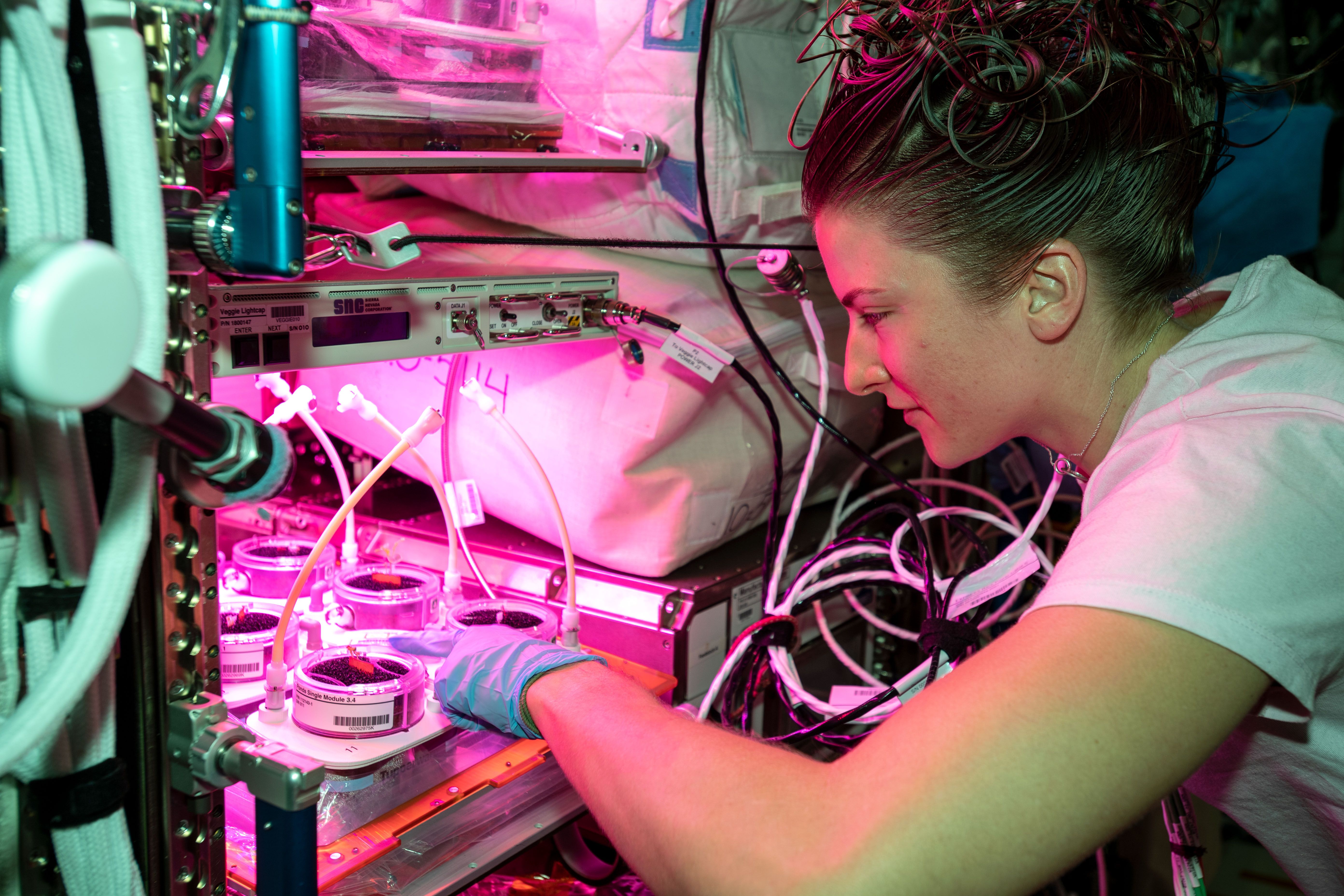
Light is particularly useful. Leaves need photons to power photosynthesis, and plants also detect qualities of light that influence growth and shape. Veggie uses light-emitting diodes, with combinations of red, blue and green illumination selected for plant responses and crew visibility. The pinkish glow visible in many station photographs is not evidence of a strange new kind of lettuce. It is a practical consequence of using particular LED wavelengths to support development inside a compact research system.
Researchers monitor how stems orient, how roots occupy their growing medium and how tissues respond to stress. An apparent difference between space and Earth plants can be caused by more than gravity. Light distribution, airflow, water supply and even how a crew member handles a chamber can matter. This is why ground-control experiments try to reproduce as many conditions as possible. A meaningful comparison requires separating the effect under investigation from all the other ways a space garden differs from a greenhouse.


Water becomes the hardest ingredient
Water does not pour, drain or settle in orbit the way it does in a kitchen sink. Surface tension and capillary action become especially important when the usual effects of gravity are greatly reduced. A puddle may cling to a surface, form a bubble or move through tiny gaps in unexpected ways. Roots need both water and oxygen, so simply soaking their container is not an answer. Too much water can restrict access to air; too little leaves seedlings unable to absorb nutrients.
Veggie addresses some of these problems with plant pillows, small containers holding a growth medium and fertilizer. They help keep seeds, moisture and nutrients in a predictable place. NASA describes the system as compact, roughly the size of carry-on luggage, usually accommodating six plants. Crew members can still be required to add water and inspect the crop. The technology is intentionally practical, but its simplicity does not eliminate the need to monitor root health and prevent stray moisture from entering sensitive equipment.
Other experiments test alternatives such as delivering nutrients directly to exposed roots. NASA's XROOTS demonstration was designed to evaluate hydroponic and aeroponic approaches using the station's Veggie lighting hardware. These techniques may reduce dependence on loose particles and offer better ways to observe roots, but their long-term reliability in space remains an engineering question. Pumps, tubes and sensors introduce their own failure points. The goal is not to find a magical growing method; it is to identify systems that can be maintained safely with limited supplies.
The laboratory behind the lettuce
A space garden is also a biological laboratory. Researchers are interested in gene expression, stress responses, cellular processes and interactions with microbes. The ISS lets scientists compare plants grown in microgravity with carefully chosen ground controls. A difference seen in a leaf may lead to questions about hormones or altered water transport, but an unusual result from one experiment is not enough to establish a universal law about all space crops. Replication and detailed follow-up remain essential.
The Advanced Plant Habitat provides a more automated and enclosed research environment than the relatively open Veggie unit. NASA describes it as the largest automated plant-growth research facility used on the station. It controls factors such as light and environmental conditions, and its design permits studies over extended periods. Automation can improve consistency and reduce some crew tasks, but it requires electricity, maintenance and reliable components. In an isolated habitat, a failed sensor can threaten a scientific study just as seriously as a failed watering line.
Scientists also study the soil substitutes themselves. A porous clay-based medium can hold water and nutrients while letting air reach the roots, but its behavior changes with watering technique and plant stage. Some experiments compare growing media or test new methods of delivering liquid at a controlled rate. These details may seem unglamorous compared with the idea of a farm on Mars, yet they determine whether a seed becomes a healthy plant or a disappointing photograph of wilted leaves.
Why fresh food matters when meals are already packed
Astronauts on today's station receive carefully planned meals through resupply missions. Packaged food provides most of their nutrition, and dietitians must account for energy needs, vitamins, minerals, storage life and food safety. The garden's present contribution is supplemental. It should not be described as replacing the station's food system. Even a successful harvest of leafy vegetables supplies only a small fraction of the calories needed by a crew, and it takes time, growing area and considerable infrastructure to produce.
Fresh crops could nevertheless become important on longer missions. Some nutrients can decline during extended food storage, and menus repeated over many months may become less appealing. A plant's leaves or fruits offer flavors and textures that differ from shelf-stable meals. NASA highlights the nutritional and psychological possibilities of space crops, while acknowledging that crop selection and food-safety challenges remain. A crisp piece of lettuce has a different value when there is no nearby delivery of fresh produce.
It is important not to oversell the health claim. Eating a few space-grown leaves has not been proven to prevent the complex medical risks of long-duration spaceflight. Astronaut health also depends on radiation exposure, exercise, sleep, medical care and many other factors. The contribution of fresh produce has to be studied as part of a complete nutritional system. The promise is credible precisely because it is practical and limited: adding fresh foods may improve variety, support dietary quality and make long missions more livable.
Plants can change the feeling of a habitat
Most people associate gardens with patience, seasons and small acts of care. Space travelers experience unusual schedules, restricted personal space and long periods away from familiar surroundings. Growing a plant could offer an enjoyable routine: checking new leaves, noticing a change in color, or sharing a harvest with crewmates. NASA has described psychological benefits as an important motivation for space gardening, and astronauts have spoken warmly about tending living plants in an otherwise technical environment.
That does not mean a greenhouse is a proven treatment for loneliness or stress in orbit. Crew well-being is influenced by communication with home, team relationships, workload, sleep and the design of the living environment. Garden activities may help some people more than others. Researchers must distinguish appealing stories from measurable outcomes and be careful not to promise that a plant will solve problems requiring broader psychological and organizational support.
Still, the human dimension deserves a place beside the engineering. A mission lasting years would be a place where choices of food, routine and surroundings matter. A healthy plant is more than a nutritional sample if it gives people something familiar to watch grow. The practical task is to provide that benefit without creating extra work that overwhelms a crew already busy with navigation, maintenance and scientific duties.

A small harvest can reveal a big food-safety problem
Fresh food brings an obligation to manage microorganisms. Bacteria and fungi exist in spacecraft environments just as they do in homes and farms. Some are harmless, and plants naturally interact with microbial communities around their roots and leaves. Others may be undesirable in food. A closed habitat makes careful sampling and sanitation particularly important, because contaminated equipment or water could affect repeated crops. Scientists examine harvested samples and cultivation surfaces rather than assuming that food is clean because it grew inside a scientific instrument.
NASA's reports on early Veggie crops describe efforts to assess microbial safety and compare results with accepted food standards. The successful tests were encouraging, but they do not guarantee every future crop will be free of hazards. Different varieties, growing conditions and crew procedures must be evaluated. Washing or handling protocols need to work in an environment where loose droplets are a problem. Any crop intended for regular meals must fit into a food-safety system, not rely on the novelty of being space-grown.
Good engineering can reduce risks through enclosed components, controlled water delivery, cleaning procedures and records of what went wrong. But even automation cannot remove the need for inspections or decisions when a plant looks unhealthy. A mission with limited replacement supplies may need to isolate a crop, clean its chamber or restart from stored seeds. These are ordinary agricultural questions made extraordinary by the distance from help.
Peppers, flowers and the problem of variety
Lettuce is a useful first crop because it can be harvested relatively quickly and eaten without complex cooking. Yet an imagined menu built entirely from lettuce would provide inadequate energy and little variety. Researchers therefore examine crops with different growth habits and nutritional contributions. NASA's Plant Habitat-04 investigation grew chile peppers on the station, creating a chance to study fruit development in microgravity. Zinnia experiments supplied lessons about plant care and flower development while offering something visually welcome.
Every additional crop introduces trade-offs. A pepper plant needs more time and room than a compact leafy green. Some plants require pollination support; others produce substantial stems and leaves that are not part of the meal. Light, humidity and water requirements differ. A good crop for a future mission must be judged by more than whether it grows successfully once. Researchers also need to know its edible yield, nutritional usefulness, crew acceptance, processing needs and reliability over repeated plantings.
There is no single perfect space vegetable. A realistic food strategy might combine compact leafy greens, selected fruiting crops and long-lasting packaged supplies. Future systems might eventually include more productive staples, but growing enough staple calories would be a much larger undertaking than harvesting a salad. Describing the current experiments as a Mars farm hides the most useful question: which crops and systems add the most value for the resources they consume?
What the 2025 seed-library experiment changes
NASA's August 2025 account of the VEG-03 MNO investigation highlighted a practical shift: astronauts could select from a limited library of seeds including mustard greens, kale and lettuce. Choice matters because astronauts may be more willing to care for crops they find appealing, and different plants may prove valuable under different conditions. The experiment's scientific purpose includes learning how crop care and production work in the station environment, not merely showing off an astronaut's preferred salad ingredient.
A seed library also invites questions about storage, germination rates and consistency. A seed must remain viable after launch and storage, and the chosen plant must be able to complete its growth cycle inside available equipment. Scientists can compare crops over time and learn how crew decisions interact with environmental control. That information could improve future schedules for planting and harvest, especially when a habitat needs a relatively steady supply rather than one impressive but occasional crop.
Such experiments are an advance in operational knowledge, not proof of a fully autonomous food supply. Crews still rely on packaged food, ground researchers, maintenance and established infrastructure. The useful development is that cultivation is becoming a repeatable activity with a growing evidence base. Each planting creates another opportunity to discover what fails, what works and which procedures are worth carrying to more remote destinations.
The long road from station to Mars
The ISS receives regular visits and has extensive support from teams on Earth. A mission farther away would face additional constraints: long communication delays, fewer opportunities to replace broken parts and more limited capacity to carry food or water. A crop failure near Earth is inconvenient and scientifically informative. A major food-system failure during a distant expedition could be much more serious. Designers must therefore build redundancy into any future agricultural system and avoid depending on one unproven harvest method.
Growing plants also has an energy cost. Lamps, fans, pumps, environmental controls and water-processing equipment consume power. Crops occupy volume that could otherwise hold supplies. The plant system must be compared with the mass and reliability of transporting prepared food. Recycling water and nutrients may improve the calculation, but closed-loop systems require careful management. A greenhouse does not create food from nothing: it converts energy, water, carbon dioxide and nutrients into edible biomass.
Scientists are exploring larger life-support concepts in which plants contribute to oxygen production, carbon dioxide uptake and water recycling. Those functions are scientifically plausible because they draw on basic biology, but a miniature Veggie harvest should not be mistaken for a self-contained life-support machine. Large-scale bioregenerative systems would need much more growing area and integration with the rest of the spacecraft. The station is a proving ground for individual components, not yet an independent ecosystem.
How to recognize real progress
Space-farming headlines often focus on the first time a particular plant produced leaves, flowers or fruit in orbit. Milestones can be meaningful, but a strong engineering result demands more than a photograph. Researchers need repeatability across plantings, consistent yields, acceptable nutritional quality and microbiological safety. They also need to report water consumption, energy use, crew labor and equipment reliability. A system that grows beautiful vegetables while requiring constant intervention may be scientifically fascinating but operationally difficult.
Future work will likely explore improved root-zone hardware, crop genetics, more capable monitoring and better links between food production and life-support needs. Some approaches may work; others may prove unsuitable. Transparent reporting of failures is essential. NASA's early Veggie accounts mention both under-watering and over-watering because those problems explain where redesign is needed. Hiding disappointing harvests would make future missions less safe, not more inspiring.
For readers, the central question is not whether someone has grown food in space; that achievement has already been demonstrated. The important question is how reliably a small controlled garden can become a dependable part of daily life. The distance between an experimental harvest and a practical food system is substantial, but it can be crossed through careful tests, better hardware and honest accounting of the resources involved.
Why the next space meal matters
A vegetable grown on the station is a small object with a long list of requirements behind it: a viable seed, a stable environment, careful water delivery, adequate illumination, microbial precautions and human patience. Each requirement carries an engineering lesson. Together they show why agriculture may become part of the infrastructure of exploration rather than simply a recreational activity for astronauts.
Today's crews are not living from orbital gardens, and claims of self-sufficient space farming would overstate the evidence. But the experiments reveal something important about future missions: the supplies we can pack are not the only resources worth designing for. The ability to grow even a modest quantity of fresh food could add resilience, choice and a connection to familiar life, provided the technology can be made dependable.
When an astronaut harvests another handful of leaves, the event deserves attention for what it really demonstrates. It is not an instant solution to feeding humans on Mars. It is a series of tested steps toward understanding how living systems and engineered systems can share a tiny habitat far from Earth. The humble salad has become an experiment about the limits of exploration—and about the creativity required to stretch those limits safely.
Research and further reading
- NASA, Growing Plants in Space — Veggie system design, crop examples, and food-safety context.
- NASA Science, VEGGIE — mission history and experiment objectives.
- NASA Science, Advanced Plant Habitat — automated orbital plant research system.
- NASA Science (August 2025), Astronauts Plant Seed Pillows in New Space Agriculture Study — recent VEG-03 crop-choice study.
- NASA Science, XROOTS — root-zone nutrient-delivery research.
- NASA Open Science Data Repository, VEG-01A — first lettuce test and irrigation limitations.
- NASA, Space Gardens (2024) — benefits and further study of growing crops in orbit.
- NASA Science, Space Crops — larger scientific goals for sustainable crop production.
The conversation
Post a Comment